PUBLISHER: Mordor Intelligence | PRODUCT CODE: 2063411

PUBLISHER: Mordor Intelligence | PRODUCT CODE: 2063411
Asia-Pacific Aviation Manufacturing - Market Share Analysis, Industry Trends & Statistics, Growth Forecasts (2026 - 2031)
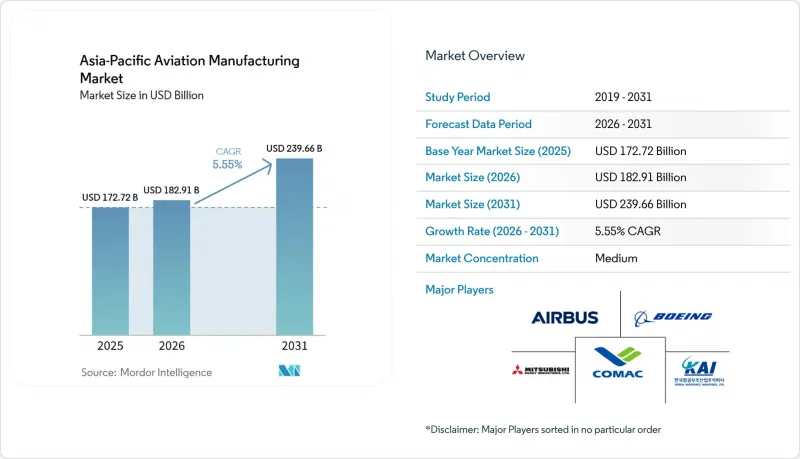
According to Mordor Intelligence, the asia-Pacific aviation manufacturing market size is expected to grow from USD 172.72 billion in 2025 to USD 182.91 billion in 2026 and is forecast to reach USD 239.66 billion by 2031 at a 5.55% CAGR over 2026-2031.
This report is Segmented by Aircraft Type (Commercial Aviation, Military Aviation, and General Aviation), Component (Airframe Structures, Propulsion Systems, Avionics and Flight Control Systems, Cabin and Interior Modules, and More), Material (Aluminum Alloys, Carbon Fiber Composites, and More), and Geography (China, and More). The Market Forecasts are Provided in Terms of Value (USD).
Asia-Pacific Aviation Manufacturing Market Trends and Insights
Commercial Air-Travel Rebound Fuels OEM Backlogs
Asia-Pacific carriers posted a 9.3% year-over-year increase in revenue passenger kilometers in 2025, outpacing other global regions and reinforcing the case for steady single-aisle output. Airbus delivered 793 aircraft in 2025 after 766 in 2024, and a significant portion of the single-aisle flow went to Asia-Pacific operators as airlines restored capacity. Boeing projects sustained large-scale procurement in the region, with growth and replacement both supporting demand. India's carriers continue to expand their order books, which stretch into the next decade, building on headline commitments that locked in delivery slots across the A320neo family. The combination of restored load factors and constrained deliveries keeps backlogs firm and strengthens pricing power for selected configurations.
Surge in Asia-Pacific Low-Cost-Carrier Narrowbody Orders
Low-cost carriers have reshaped traffic within South and Southeast Asia by prioritizing high-frequency point-to-point routes that favor single-aisle economics. The A320neo and B737 MAX families deliver lower fuel burn and per-seat maintenance costs, which align with LCC utilization targets and improve cash-cost positions on dense domestic and regional pairs. Expanded fleets at leading LCCs in India and Southeast Asia also elevate demand for landing gear, brakes, and avionics spares as utilization extends daily block hours. Secondary-city connectivity is becoming more viable as new aircraft reduce trip costs and improve reliability, supporting incremental orders even as airport infrastructure is still maturing. Procurement pacing remains tethered to engine availability and shop-visit capacity, while the structural demand for narrowbody aircraft continues to underpin the Asia-Pacific aviation manufacturing market.
Chronic LEAP and PW-GTF Engine Shortages
Pratt & Whitney's PW1100G inspections related to powder-metal anomalies continue to ground aircraft and constrain fleet availability, with the company signaling extended remediation timelines and material cash costs. Airlines have reported losses linked to aircraft-on-ground events, and OEM support packages reflect the magnitude of compensation and repair expense under current inspection regimes. CFM LEAP families face their own throughput constraints and shop-visit pressures, which keep turnaround times elevated and require more spares coverage to maintain schedules. These headwinds cap near-term delivery profiles for new narrowbodies and delay retirement of older fleets, which redistributes spend toward maintenance and component life extensions. The Asia-Pacific aviation manufacturing market, therefore, grows amid tighter supply conditions that prioritize reliability and aftermarket readiness over short-term volume.
Other drivers and restraints analyzed in the detailed report include:
- Government Offsets/Local-Content Mandates
- Regional Push for SAF-Ready Production Lines
- Skilled-Labor Gaps in Composite Lay-Up and Automation
For complete list of drivers and restraints, kindly check the Table Of Contents.
Segment Analysis
Commercial aviation accounted for 59.76% of the Asia-Pacific aviation manufacturing market size in 2025, reflecting the weight of narrowbody programs in regional build schedules. Military aviation is projected to expand at 7.76% CAGR to 2031 as governments anchor procurement pipelines for combat aircraft, transports, and rotorcraft that align with long-term readiness needs. Within commercial, single-aisle programs remain the backbone due to typical stage lengths and the economics of high-frequency service across domestic and regional routes. The widebody mix remains concentrated in areas where long-haul demand supports dual-aisle utilization, with Northeast Asian carriers and operators in Oceania maintaining steady intake for intercontinental networks.
Defense modernization gives the military segment durable visibility because platform updates and fleet expansions are sequenced over many years. As air forces refresh multi-role fighters and add missionized aircraft for patrol and lift, suppliers across metals, composites, avionics, and actuation benefit from cross-platform commonality. On the civil side, narrowbody dominance holds given predictable block-hour profiles and improved operating economics of new engine options. The Asia-Pacific aviation manufacturing industry continues to balance these cycles by relying on defense stability to smooth commercial variability, while incremental growth in business and general aviation adds diversity to downstream demand.
List of Companies Covered in this Report:
- Airbus SE
- The Boeing Company
- Commercial Aircraft Corporation of China, Ltd. (COMAC)
- Mitsubishi Heavy Industries, Ltd.
- Hindustan Aeronautics Ltd.
- Korea Aerospace Industries, Ltd.
- Kawasaki Heavy Industries, Ltd.
- AVIC SAC Commercial Aircraft Company Ltd. (Aviation Industry Corporation of China)
- Safran SA
- Singapore Technologies Engineering Ltd.
- TATA Advanced Systems Ltd
- Eaton Corporation plc
- GKN Aerospace Services Limited (Melrose Industries plc)
- Honeywell International Inc.
Additional Benefits:
- The market estimate (ME) sheet in Excel format
- 3 months of analyst support
TABLE OF CONTENTS
1 INTRODUCTION
- 1.1 Study Assumptions and Market Definition
- 1.2 Scope of the Study
2 RESEARCH METHODOLOGY
3 EXECUTIVE SUMMARY
4 MARKET LANDSCAPE
- 4.1 Market Overview
- 4.2 Market Drivers
- 4.2.1 Commercial air-travel rebound fuels OEM backlogs
- 4.2.2 Surge in Asia-Pacific low-cost-carrier narrowbody orders
- 4.2.3 Government offsets/local-content mandates
- 4.2.4 Regional push for SAF-ready production lines
- 4.2.5 Additive-manufacturing hubs in China, Japan and Australia
- 4.2.6 ASEAN defense modernization accelerating twin-use plants
- 4.3 Market Restraints
- 4.3.1 Chronic LEAP and PW-GTF engine shortages
- 4.3.2 Skilled-labour gaps in composite lay-up and automation
- 4.3.3 Lengthy bilateral certification for COMAC, KAI, HAL types
- 4.3.4 Cyber-security and ITAR compliance cost spike for suppliers
- 4.4 Value Chain Analysis
- 4.5 Regulatory Landscape
- 4.6 Technological Outlook
- 4.7 Porter's Five Forces Analysis
- 4.7.1 Threat of New Entrants
- 4.7.2 Bargaining Power of Suppliers
- 4.7.3 Bargaining Power of Buyers
- 4.7.4 Threat of Substitutes
- 4.7.5 Intensity of Competitive Rivalry
5 MARKET SIZE AND GROWTH FORECASTS (VALUE)
- 5.1 By Aircraft Type
- 5.1.1 Commercial Aviation
- 5.1.1.1 Narrowbody Aircraft
- 5.1.1.2 Widebody Aircraft
- 5.1.1.3 Regional Jets
- 5.1.2 Military Aviation
- 5.1.2.1 Combat Aircraft
- 5.1.2.2 Non-Combat Aircraft
- 5.1.2.3 Helicopters
- 5.1.3 General Aviation
- 5.1.3.1 Business Jets
- 5.1.3.2 Turboprop Aircraft
- 5.1.3.3 Piston Aircraft
- 5.1.3.4 Helicopters
- 5.1.1 Commercial Aviation
- 5.2 By Component
- 5.2.1 Airframe Structures
- 5.2.2 Propulsion Systems
- 5.2.3 Avionics and Flight Control Systems
- 5.2.4 Cabin and Interior Modules
- 5.2.5 Landing Gear and Actuation
- 5.2.6 Other Components
- 5.3 By Material
- 5.3.1 Aluminum Alloys
- 5.3.2 Carbon Fiber Composites
- 5.3.3 Titanium Alloys
- 5.3.4 High-Strength Steels
- 5.3.5 Other Materials
- 5.4 By Geography
- 5.4.1 China
- 5.4.2 India
- 5.4.3 Japan
- 5.4.4 South Korea
- 5.4.5 Australia
- 5.4.6 Singapore
- 5.4.7 Rest of Asia-Pacific
6 COMPETITIVE LANDSCAPE
- 6.1 Market Concentration
- 6.2 Strategic Moves
- 6.3 Market Share Analysis
- 6.4 Company Profiles (includes Global level Overview, Market level overview, Core Segments, Financials as available, Strategic Information, Market Rank/Share for key companies, Products and Services, and Recent Developments)
- 6.4.1 Airbus SE
- 6.4.2 The Boeing Company
- 6.4.3 Commercial Aircraft Corporation of China, Ltd. (COMAC)
- 6.4.4 Mitsubishi Heavy Industries, Ltd.
- 6.4.5 Hindustan Aeronautics Ltd.
- 6.4.6 Korea Aerospace Industries, Ltd.
- 6.4.7 Kawasaki Heavy Industries, Ltd.
- 6.4.8 AVIC SAC Commercial Aircraft Company Ltd. (Aviation Industry Corporation of China)
- 6.4.9 Safran SA
- 6.4.10 Singapore Technologies Engineering Ltd.
- 6.4.11 TATA Advanced Systems Ltd
- 6.4.12 Eaton Corporation plc
- 6.4.13 GKN Aerospace Services Limited (Melrose Industries plc)
- 6.4.14 Honeywell International Inc.
7 MARKET OPPORTUNITIES AND FUTURE OUTLOOK
- 7.1 White-space and Unmet-Need Assessment

