PUBLISHER: Mordor Intelligence | PRODUCT CODE: 2063417

PUBLISHER: Mordor Intelligence | PRODUCT CODE: 2063417
South America Travel And Tourism - Market Share Analysis, Industry Trends & Statistics, Growth Forecasts (2026 - 2031)
According to Mordor Intelligence, the south america travel and tourism market size is projected to be USD 110.11 billion in 2025, USD 117.05 billion in 2026, and reach USD 158.86 billion by 2031, growing at a CAGR of 6.30% from 2026 to 2031.
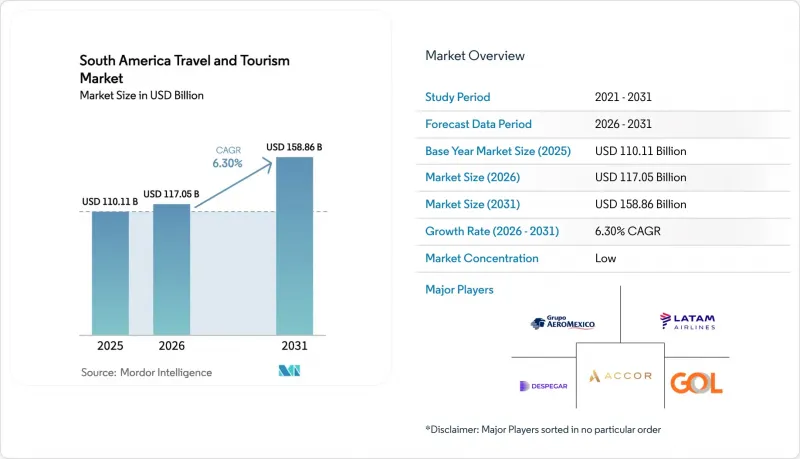
This report is Segmented by Tourist Type (Domestic, Inbound International, Outbound International), Purpose of Travel (Leisure, Business & MICE, Visiting Friends & Relatives, Medical & Wellness), Booking Channel (Online and Offline), and Geography (Mexico, Brazil, Argentina, Chile, Colombia, Peru, Rest of South America). The Market Forecasts are Provided in Terms of Value (USD).
South America Travel And Tourism Market Trends and Insights
Online Booking Penetration Exceeds 50% in 2025 (Mobile-Led)
Mobile-first behavior has pushed digital bookings beyond the halfway mark in South America, and the trend is durable as device penetration and payment rails mature. OTA consolidation signals the value of regional scale, with Prosus acquiring Despegar in 2025 to connect travel with food delivery and events ecosystems that reach over 100 million users, a move designed to convert multi-vertical traffic into travel transactions at lower acquisition cost. Payment's infrastructure is another catalyst, as real-time disbursements, instant refunds, and tokenized credentials reduce abandonment and increase trust in online checkout flows, particularly for air travel. Contactless and digital wallets are now embedded in travel purchase journeys across the region, and they are expected to scale further around event spikes and cross-border traffic associated with 2026 sports mega-events . As airlines enhance direct channels with loyalty-linked offers and post-booking self-service, suppliers continue to steer customers to their apps, which compresses service costs and deepens their customer data advantage over intermediaries. The South America Travel and Tourism market benefits, such as mobile booking, flexible payments, and AI-powered servicing, expand the active traveler base and lift conversion across both short-haul and long-haul itineraries.
Low-Cost Carriers and A321XLR Expand Intra-Regional and Long-Haul Connectivity
Low-cost carriers have increased their share of regional capacity, reshaping price elasticity and stimulating discretionary travel across short- and medium-haul routes. OAG data indicates that low-cost carriers (LCCs) have materially expanded their presence in the region, while new entrants such as JetSMART Colombia have captured share quickly by serving key domestic trunk routes vacated by failed operators. Fleet modernization is amplifying these gains, with South America ordering up to 74 Embraer E195-E2 aircraft to densify regional connectivity and reach underserved city pairs with lower trip costs per seat . The Abra Group, parent to Avianca and GOL, expanded its Airbus order book to support long-haul Americas-Europe growth and more efficient short-haul networks, which should widen itinerary choice for leisure, VFR, and MICE travel. Strategic joint ventures also matter because shared networks and aligned schedules compress connection times and extend reach without duplicative capex, as the Delta-LATAM partnership illustrates with multi-year increases in flows between North and South America. As narrowbodies with extended range deploy over the medium term, thinner long-haul routes can become viable nonstop offerings, which directly supports the South America Travel and Tourism market by reducing travel times and enabling secondary-city links to North America and Europe. A denser web of fares and frequencies then feeds demand into both online and direct channels, reinforcing the structural shift toward digital distribution.
International Tourism Recovery to Pre-Pandemic Levels Boosts Inbound
Inbound travel has returned to growth across multiple destinations, and several countries report higher volumes than in the early recovery years as currency shifts and new routes improve affordability and access. Peru recorded a year-end total of 4.16 million international visitors in 2025, aided by improvements in air gateway efficiency that reduced airport wait times and enhanced transit experiences. Colombia's air traffic and foreign visitor arrivals have been on an upward trajectory as network carriers invest in fleet, lounges, and premium products that appeal to both business and leisure travelers. Joint venture partners increased seat supply between North America and South America, which improved fare competition and added new city-pair options for inbound flows. Event catalysts in 2026 are likely to lift short-term arrivals to Mexico's host cities, and they are expected to leave technology, payment, and mobility upgrades that sustain higher utilization after the event. Airports that embed automated border control, biometric boarding, and touchless passenger journeys also tend to improve repeat-visit intent by compressing queues and improving the perceived quality of arrival and departure experiences.
Other drivers and restraints analyzed in the detailed report include:
- Robust Domestic Travel Base in Brazil and Mexico Stabilizes Demand
- Extreme Weather, Drought, Wildfires, and Sargassum Disrupt Key Destinations
- Visa Policy Shifts (e.g., Brazil E-Visa Reinstatement) Add Inbound Friction
For complete list of drivers and restraints, kindly check the Table Of Contents.
Segment Analysis
Domestic travelers accounted for 59.70% of the South America Travel and Tourism market share in 2025, underscoring how home-market demand underpins resilience and supports capacity additions across Brazil and Mexico. Within the South America Travel and Tourism market, network carriers have added new domestic routes connecting industrial hubs with beach and cultural destinations, improving load factor balance across weekdays and weekends and across cabin classes. The same fundamentals that support domestic volumes, including rising wallet share for travel among younger demographics and the normalization of digital self-service, also lift the value of loyalty ecosystems for suppliers that steer bookings to direct channels. Inbound international volumes are recovering and diversifying by source market as network and low-cost carriers expand connectivity and as border automation reduces friction at major gateways. The South America Travel and Tourism market should continue to see domestic strength coexist with inbound gains as airlines optimize aircraft mix and schedules to match daypart and seasonal patterns across city pairs.
Inbound international is projected to post the fastest 2026-2031 growth at a 4.40% CAGR, supported by new long-haul and mid-haul routes and better transit experiences. Peru's year-end 2025 inbound total and its large-scale deployment of ABC eGates demonstrate how technology improvements and targeted marketing help recapture international flows and smooth airport peaks. Mexico's event calendar and stadium upgrades around the 2026 FIFA World Cup add a multi-city pull for inbound fans and corporate hospitality, which feeds both hotel and short-haul air segments before and after match days. Low-cost carriers are capturing more intra-regional leisure traffic as they expand frequencies and add cross-border city pairs, thereby improving price transparency and stimulating budget-conscious segments that would otherwise defer travel. With domestic share still dominant, airlines can balance their fleets and crews across domestic and international rosters to manage volatility and protect utilization, keeping the South America Travel and Tourism market on a steady growth path.
List of Companies Covered in this Report:
- LATAM Airlines Group S.A.
- Avianca Group International Limited
- GOL Linhas Aereas Inteligentes S.A.
- Azul Linhas Aereas Brasileiras S.A.
- Aeromexico (Grupo Aeromexico)
- Volaris (Controladora Vuela Compania de Aviacion)
- Viva Aerobus (Grupo Viva Aerobus)
- Copa Airlines (Copa Holdings)
- Aerolineas Argentinas
- Despegar.com Corp. (Despegar/Decolar)
- CVC Corp (CVC Viagens, Submarino Viagens)
- PriceTravel Holding
- Accor (South America)
- Grupo Posadas, S.A.B. de C.V.
- Marriott International, Inc.
- Hilton Worldwide Holdings Inc.
- Melia Hotels International
- Iberostar Hotels & Resorts
- Grupo Posadas
- MSC Cruises
- Royal Caribbean Group
- Localiza Rent a Car S.A.
Additional Benefits:
- The market estimate (ME) sheet in Excel format
- 3 months of analyst support
TABLE OF CONTENTS
1 Introduction
- 1.1 Study Assumptions & Market Definition
- 1.2 Scope of the Study
2 Research Methodology
3 Executive Summary
4 Market Landscape
- 4.1 Market Overview
- 4.2 Market Drivers
- 4.2.1 Online booking penetration is greater than 50% in 2025 (mobile-led)
- 4.2.2 Low-cost carriers and A321XLR expand intra-regional and long-haul connectivity
- 4.2.3 Robust domestic travel base in Brazil and Mexico stabilizes demand
- 4.2.4 International tourism recovery to pre-pandemic levels boosts inbound
- 4.2.5 Biometric border/airport automation accelerates throughput and reduces friction
- 4.2.6 Installment/BNPL financing raises conversion and average order value online
- 4.3 Market Restraints
- 4.3.1 Extreme weather, drought, wildfires, and sargassum disrupt key destinations
- 4.3.2 Visa policy shifts (e.g., Brazil e-visa reinstatement) add inbound friction
- 4.3.3 Water scarcity and utility constraints cap capacity in hotspots
- 4.3.4 Payment/FX rules (e.g., Argentina card-installment limits) suppress outbound
- 4.4 Value / Supply Chain Analysis
- 4.5 Regulatory Landscape
- 4.6 Technological Outlook
- 4.7 Porter's Five Forces
- 4.7.1 Threat of New Entrants
- 4.7.2 Bargaining Power of Suppliers
- 4.7.3 Bargaining Power of Buyers
- 4.7.4 Threat of Substitutes
- 4.7.5 Industry Rivalry
5 Market Size & Growth Forecasts (Value)
- 5.1 By Tourist Type
- 5.1.1 Domestic
- 5.1.2 Inbound International
- 5.1.3 Outbound International
- 5.2 By Purpose of Travel
- 5.2.1 Leisure
- 5.2.2 Business & MICE
- 5.2.3 Visiting Friends & Relatives (VFR)
- 5.2.4 Medical & Wellness
- 5.3 By Booking Channel
- 5.3.1 Online (OTAs, supplier-direct)
- 5.3.2 Offline (retail agencies, call centers)
- 5.4 By Geography
- 5.4.1 Mexico
- 5.4.2 Brazil
- 5.4.3 Argentina
- 5.4.4 Chile
- 5.4.5 Colombia
- 5.4.6 Peru
- 5.4.7 Rest of South America
6 Competitive Landscape
- 6.1 Market Concentration
- 6.2 Strategic Moves
- 6.3 Market Share Analysis
- 6.4 Company Profiles {(includes Global level Overview, Market level overview, Core Segments, Financials as available, Strategic Information, Market Rank/Share for key companies, Products & Services, and Recent Developments)}
- 6.4.1 LATAM Airlines Group S.A.
- 6.4.2 Avianca Group International Limited
- 6.4.3 GOL Linhas Aereas Inteligentes S.A.
- 6.4.4 Azul Linhas Aereas Brasileiras S.A.
- 6.4.5 Aeromexico (Grupo Aeromexico)
- 6.4.6 Volaris (Controladora Vuela Compania de Aviacion)
- 6.4.7 Viva Aerobus (Grupo Viva Aerobus)
- 6.4.8 Copa Airlines (Copa Holdings)
- 6.4.9 Aerolineas Argentinas
- 6.4.10 Despegar.com Corp. (Despegar/Decolar)
- 6.4.11 CVC Corp (CVC Viagens, Submarino Viagens)
- 6.4.12 PriceTravel Holding
- 6.4.13 Accor (South America)
- 6.4.14 Grupo Posadas, S.A.B. de C.V.
- 6.4.15 Marriott International, Inc.
- 6.4.16 Hilton Worldwide Holdings Inc.
- 6.4.17 Melia Hotels International
- 6.4.18 Iberostar Hotels & Resorts
- 6.4.19 Grupo Posadas
- 6.4.20 MSC Cruises
- 6.4.21 Royal Caribbean Group
- 6.4.22 Localiza Rent a Car S.A.
7 Market Opportunities & Future Outlook
- 7.1 White-space & unmet-need assessment

