PUBLISHER: Mordor Intelligence | PRODUCT CODE: 2063447

PUBLISHER: Mordor Intelligence | PRODUCT CODE: 2063447
Healthcare Data Collection And Labeling - Market Share Analysis, Industry Trends & Statistics, Growth Forecasts (2026 - 2031)
According to Mordor Intelligence, the healthcare data collection and labeling market size is expected to grow from USD 2.18 billion in 2025 to USD 2.57 billion in 2026 and is forecast to reach USD 5.62 billion by 2031 at 16.94% CAGR over 2026-2031.
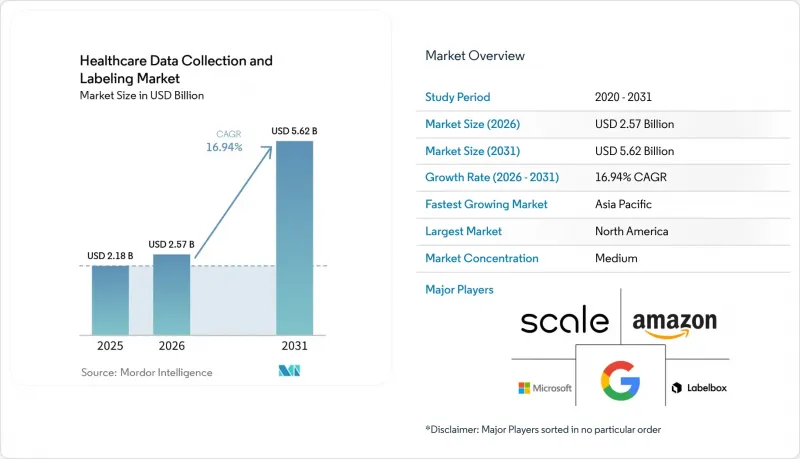
This report is Segmented by Data Type (Image, Text, Video, Audio), Labeling Approach (Manual, Semi-Automated, Fully-Automated), End User (Life-Science & Pharma, Medical-Device Manufacturers, and More), Application Area (Diagnostic Imaging AI, Clinical Decision Support, and More), and Geography (North America, Europe, Asia-Pacific, and More). Market Forecasts are in Value (USD).
Global Healthcare Data Collection And Labeling Market Trends and Insights
Growing Adoption of AI-Driven Medical Imaging Solutions
The FDA cleared 882 AI-enabled medical devices by December 2025, up from 521 in 2023, and each approval requires datasets annotated under 21 CFR Part 11 audit trails . Venture backing mirrors this regulatory velocity; Aidoc secured USD 30 million in late 2024 to train a foundation model on 2.5 million CT scans labeled for 14 pathologies. Whole-slide pathology imaging is following suit, with polygon-level tumor margin annotation times dropping from 45 minutes to 8 minutes per slide when active learning pre-selects ambiguous regions. Continuous-learning pipelines that retrain monthly are replacing one-off projects, giving annotation vendors recurring subscription revenue. Together, these forces amplify demand across radiology, pathology, and emerging 3-dimensional imaging modalities, reinforcing long-term growth in the healthcare data collection and labeling market
Expansion of Multi-Modal Clinical Data (EHR, Sensors, Genomics)
Drug developers now link EHR text, wearable-sensor streams, and genomic variants in unified datasets. Recursion Pharmaceuticals' 2024 partnership with Tempus combined 23 petabytes of histopathology images with longitudinal records for 3 million patients, requiring annotation expertise across ICD-10, SNOMED CT, and genomic nomenclature. Wearable devices magnify scale; a single atrial-fibrillation patient produces 2.5 million ECG datapoints daily, pushing cardiologist review costs to USD 180 per hour. The FDA's 2024 SaMD draft guidance mandates demographically balanced training sets, driving over-sampling of under-represented groups and annotation of social determinants that are often missing from legacy EHRs. Microsoft's 2025 FHIR-native annotation API lets hospitals label clinical notes inside Epic workflows, cutting export latency by 80%. Multi-modal integration broadens addressable revenue pools and cements the role of the healthcare data collection and labeling market in precision medicine
Stringent Privacy Laws Elevate Costs
HIPAA enforcement collected USD 28 million in penalties during 2024, with 40% of violations traced to annotation vendors lacking Business Associate Agreements . GDPR Article 9 restrictions force platforms to deploy granular access controls; an Irish DPC audit suspended 18% of projects lacking lawful transfer bases. Only 47% of U.S. vendors had self-certified under the EU-U.S. Data Privacy Framework by mid-2025, prompting European hospitals to demand on-premises annotation at 30% price premiums. California's CPRA gives patients deletion rights; one genomics company re-annotated 12,000 samples when 8% opted out, incurring USD 1.2 million in extra costs. Together, these mandates add 15-25% overhead to every project in the healthcare data collection and labeling market.
Other drivers and restraints analyzed in the detailed report include:
- Regulatory Shift Toward Real-World Evidence in Approvals
- Outsourced, HIPAA-Compliant Expert Labeling Networks Expand
- Scarcity and High Hourly Rate of Domain Experts
For complete list of drivers and restraints, kindly check the Table Of Contents.
Segment Analysis
Video annotation is projected to grow at a 17.40% CAGR from 2026 to 2031, the highest among data types in the healthcare data collection and labeling market. Intuitive Surgical disclosed that it had annotated 2.3 million robotic-surgery videos at USD 45 million, highlighting the capital intensity. Theator's USD 100 million financing in 2024 targets 4K laparoscopic datasets comprising 127 procedural steps. Image data retained 51.54% healthcare data collection and labeling market share in 2025, thanks to established DICOM pipelines across radiology and pathology, yet the exponential frame count in surgery and endoscopy is shifting revenue toward video. Active-learning tools that pre-track instruments now cut labeling time by 70%, reducing per-project budgets but enabling more simultaneous engagements.
Text and audio remain smaller but strategically significant slices of the healthcare data collection and labeling market size. Large language models auto-code ICD-10 and CPT terms, slashing manual hours, yet FDA guidance still mandates human verification for billing-grade output. Audio annotation is emerging around voice biomarkers; Sonde Health's Mayo Clinic partnership labeled 50,000 samples to detect respiratory distress with 89% sensitivity. Lack of unified ontologies across speech-based disorders keeps the vendor landscape fragmented, but standardization efforts by IEEE promise to unlock scale.
Fully-automated workflows are forecast to expand at a 17.90% CAGR, the fastest among labeling approaches in the healthcare data collection and labeling market. Google's Med-Gemini models tag chest X-rays for 14 pathologies at USD 0.02 per image, matching three-radiologist consensus. Nonetheless, human-supervised annotation maintained 53.10% of the healthcare data collection and labeling market share in 2025, as liability concerns keep experts in the loop for ambiguous cases. Semi-automated platforms dominate oncology and cardiology, where efficiency gains coexist with required clinician oversight.
The FDA's 2024 guidance on predetermined change-control plans eases post-market dataset updates, encouraging vendors to invest in automation that continuously refreshes labels without new submissions. MD.ai's smart-annotation tool reduced cardiologist labeling time by 73% for cardiac MRI, preserving accountability while accelerating throughput. Manual annotation remains necessary for rare diseases and for novel modalities such as photoacoustic imaging, where foundation models lack prior exposure. Over the forecast horizon, hybrid human-plus-AI workstreams will remain the dominant paradigm in the healthcare data collection and labeling market.
Geography Analysis
North America retained 43.20% share in 2025 as 882 FDA-cleared AI devices demanded domestic, audit-ready datasets. Continuous-learning allowances in 2024 guidance make recurrent annotation a fixture, and Cleveland Clinic's sepsis model, trained on 1.2 million encounters, generated USD 18 million in added reimbursement during its first deployment year. Canada's Ontario Health digitized 5 million historical X-rays, awarding an USD 88 million contract that expands regional capacity. Mexico is emerging as a HIPAA-compliant near-shore hub, where technologists earn USD 8-12 per hour, shortening U.S. project turnarounds by 20%.
Asia-Pacific will post the fastest 17.30% CAGR, underpinned by China's USD 15 billion Healthy China 2030 budget and India's standardized EHR drive. Alibaba Cloud's 2024 platform cut annotation timelines from 12 months to three, catalyzing 14 domestic AI startups. India's partnership between Apollo Hospitals and Google Cloud labeled 8 million records, lowering diabetic-retinopathy screening costs by 60%. Japan's requirement for 20% domestic data is driving U.S. vendor alliances with academic hospitals, as seen in Scale AI's 500,000-report project with the University of Tokyo.
Europe contributed significant revenue in 2025. The European Health Data Space enforces consent-tier annotations and cross-border EHR interoperability, consolidating demand among platforms with robust governance. Germany approved 43 AI SaMD products in 2024 and began reimbursing AI-derived codes, reinforcing sustainable demand. The UAE's USD 22 million Arabic-note annotation tender in 2024 and Brazil's nine AI device approvals signal early momentum in the Middle East, Africa, and South America, though limited digitization and macroeconomic volatility temper near-term scale.
- Alegion
- Amazon
- Appen Ltd.
- Centaur Labs
- CloudFactory
- Cognizant
- Datavant
- Deepen AI
- Encord
- HCLTech
- iMerit
- Innodata
- Labelbox
- Lionbridge AI (Telus)
- MD.ai
- Microsoft Azure ML Data Labeling
- Scale AI
- TELUS International
- Wipro
Additional Benefits:
- The market estimate (ME) sheet in Excel format
- 3 months of analyst support
TABLE OF CONTENTS
1 Introduction
- 1.1 Study Assumptions & Market Definition
- 1.2 Scope of the Study
2 Research Methodology
3 Executive Summary
4 Market Landscape
- 4.1 Market Overview
- 4.2 Market Drivers
- 4.2.1 Growing Adoption of AI-Driven Medical Imaging Solutions
- 4.2.2 Expansion of Multi-Modal Clinical Data (EHR, Sensors, Genomics)
- 4.2.3 Regulatory Shift Toward Real-World Evidence In Approvals
- 4.2.4 Outsourced, HIPAA-Compliant Expert Labeling Networks Expand
- 4.2.5 Active-Learning Workflows That Cut Annotation Hours Per Case
- 4.2.6 Generative Synthetic Data Pipelines Reduce Cold-Start Needs
- 4.3 Market Restraints
- 4.3.1 Stringent Privacy Laws (HIPAA, GDPR, CCPA) Elevate Costs
- 4.3.2 Scarcity & High Hourly Rate of Domain Experts (Radiologists, Pathologists)
- 4.3.3 Proprietary Data Silos Limit Cross-Institutional Model Generalizability
- 4.3.4 Carbon-Footprint Scrutiny of Large-Scale Annotation Operations
- 4.4 Value Chain Analysis
- 4.5 Regulatory Landscape
- 4.6 Technological Outlook
- 4.7 Porter's Five Forces
- 4.7.1 Threat of New Entrants
- 4.7.2 Bargaining Power of Suppliers
- 4.7.3 Bargaining Power of Buyers
- 4.7.4 Threat of Substitutes
- 4.7.5 Competitive Rivalry
5 Market Size & Growth Forecasts (Value, USD)
- 5.1 By Data Type
- 5.1.1 Image
- 5.1.2 Text
- 5.1.3 Video
- 5.1.4 Audio
- 5.2 By Labeling Approach
- 5.2.1 Manual
- 5.2.2 Semi-Automated
- 5.2.3 Fully-Automated
- 5.3 By End User
- 5.3.1 Life-Science & Pharma Companies
- 5.3.2 Medical-Device Manufacturers
- 5.3.3 Hospitals & IDNs
- 5.3.4 Health-Tech
- 5.3.5 CROs & Academic Institutes
- 5.4 By Application Area
- 5.4.1 Diagnostic Imaging AI
- 5.4.2 Clinical Decision Support (CDS)
- 5.4.3 Drug Discovery / Biomarker Identification
- 5.4.4 Population Health & Remote Monitoring
- 5.5 By Geography
- 5.5.1 North America
- 5.5.1.1 United States
- 5.5.1.2 Canada
- 5.5.1.3 Mexico
- 5.5.2 Europe
- 5.5.2.1 Germany
- 5.5.2.2 United Kingdom
- 5.5.2.3 France
- 5.5.2.4 Italy
- 5.5.2.5 Spain
- 5.5.2.6 Rest of Europe
- 5.5.3 Asia-Pacific
- 5.5.3.1 China
- 5.5.3.2 India
- 5.5.3.3 Japan
- 5.5.3.4 South Korea
- 5.5.3.5 Australia
- 5.5.3.6 Rest of Asia-Pacific
- 5.5.4 Middle East and Africa
- 5.5.4.1 GCC
- 5.5.4.2 South Africa
- 5.5.4.3 Rest of Middle East and Africa
- 5.5.5 South America
- 5.5.5.1 Brazil
- 5.5.5.2 Argentina
- 5.5.5.3 Rest of South America
- 5.5.1 North America
6 Competitive Landscape
- 6.1 Market Concentration
- 6.2 Market Share Analysis
- 6.3 Company Profiles (includes Global-level Overview, Market-level Overview, Core Segments, Financials as available, Strategic Information, Market Rank/Share, Products & Services, Recent Developments)
- 6.3.1 Alegion
- 6.3.2 Amazon
- 6.3.3 Appen Ltd.
- 6.3.4 Centaur Labs
- 6.3.5 CloudFactory
- 6.3.6 Cognizant Technology Solutions
- 6.3.7 Datavant
- 6.3.8 Deepen AI
- 6.3.9 Encord
- 6.3.10 Google
- 6.3.11 HCLTech
- 6.3.12 iMerit
- 6.3.13 Innodata
- 6.3.14 Labelbox
- 6.3.15 Lionbridge AI (Telus)
- 6.3.16 MD.ai
- 6.3.17 Microsoft Azure ML Data Labeling
- 6.3.18 Scale AI
- 6.3.19 TELUS International
- 6.3.20 Wipro
7 Market Opportunities & Future Outlook
- 7.1 White-space & Unmet-need Assessment

