PUBLISHER: Mordor Intelligence | PRODUCT CODE: 2063452

PUBLISHER: Mordor Intelligence | PRODUCT CODE: 2063452
Microarray Scanners - Market Share Analysis, Industry Trends & Statistics, Growth Forecasts (2026 - 2031)
According to Mordor Intelligence, the microarray scanners market size is expected to grow from USD 1.5 billion in 2025 to USD 1.60 billion in 2026 and is forecast to reach USD 2.30 billion by 2031 at 8.31% CAGR over 2026-2031.
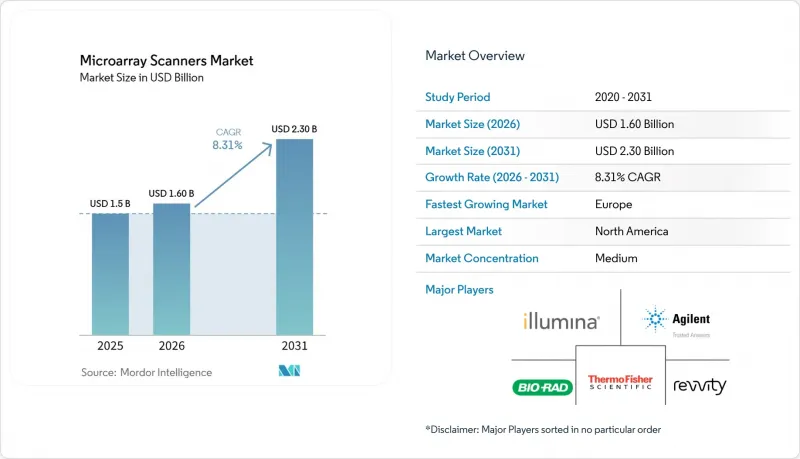
This report is Segmented by Product Type (Fluorescence Scanners, and More), Technology Supported (DNA/CGH/SNP, Methylation, Protein/Antibody/Glycan, MiRNA/Transcriptomics), Application (Research, Diagnostics/Clinical Cytogenetics, Drug Discovery, Agrigenomics), End User (Academic/Research, Pharma/Biotech, Hospitals/Diagnostics, Cros), and Geography. Market Forecasts are Provided in Value (USD).
Global Microarray Scanners Market Trends and Insights
Guideline-Backed Prenatal/Postnatal CMA Sustains Clinical Scanning Volumes
The Society for Maternal-Fetal Medicine reaffirmed CMA as first-tier prenatal testing in January 2025, and the American College of Obstetricians and Gynecologists echoed this position in March 2026, preserving reimbursement under U.S. CPT codes 81228, 81229, and 81349. Canada's professional bodies maintain similar endorsements, ensuring a stable clinical demand floor across North America. These policies shield existing scanner fleets from immediate obsolescence even as exome sequencing gains public coverage. Hospitals therefore, allocate capital toward refreshing legacy hardware rather than embracing disruptive technologies in cytogenetics. The cushion, however, may thin if sequencing's diagnostic yield continues to outperform CMA in head-to-head trials.
Research Arrays Remain Cost-Effective for GWAS/Epigenomics vs Sequencing
Large population studies still prefer array technology when budgets are tight and cohort sizes exceed 10,000 samples. Illumina's Global Screening Array costs USD 40 per genotyping sample, versus USD 80-100 for low-pass sequencing at equivalent scale . MethylationEPIC v2.0 profiles nearly one million CpG sites for USD 200, fourfold cheaper than whole-genome bisulfite sequencing, supporting epidemiology programs in China and Japan. Cost advantages, coupled with mature informatics pipelines, encourage funders to extend array grants through the remainder of the decade. Nevertheless, arrays do forfeit rare-variant and structural-variant insight, limiting their role in precision oncology.
Sequencing Substitute Pressure (ES/GS First-Tier in Pediatrics)
A 2024 Czech cohort study showed exome sequencing achieving 48.9% diagnostic yield versus CMA's historical 15-20%. The American College of Medical Genetics now permits exome sequencing as a first-tier test for developmental delay, eroding the unique clinical justification for arrays. Illumina's NovaSeq X can deliver whole genomes at USD 200, intensifying cost-per-answer competition. Hospitals weigh whether to refresh scanners or divert funds to sequencing platforms that satisfy broader diagnostic menus.
Other drivers and restraints analyzed in the detailed report include:
- Large Installed Base Prolongs Scanner Replacement Cycles
- Growth in Protein/Glycan/Peptide Arrays Expands Use Cases
- High Instrument Cost and Specialized Staffing Needs
For complete list of drivers and restraints, kindly check the Table Of Contents.
Segment Analysis
Fluorescence instruments dominated 46.53% of the Microarray scanners market share in 2025, yet CCD/CMOS biomolecular imagers are expected to clock an 8.57% CAGR through 2031, fueled by triple-modal detection that integrates chemiluminescence and near-infrared channels. The Microarray scanners market size for autoloaders is projected to reach USD 350 million by 2031 as pharmaceutical companies automate slide handling to support 384-array peptide screens. Colorimetric scanners, though niche, remain vital in allergy testing labs that lack laser safety infrastructure. Vendors such as Innopsys and Azure Biosystems co-market cooled sensors with 16-bit dynamic range, delivering 1-micron resolution that enhances low-abundance protein capture. Refurbished fluorescence units sell for under USD 15,000, stretching lifecycles in cost-constrained labs but lowering new-unit bookings.
Capital budgets now favor platforms that aggregate Western blot, nucleic-acid, and antibody imaging to cut bench-space and maintenance costs. Laboratories upgrading from Tecan PowerScanner or Bio-Rad VersaDoc often pick multi-mode replacements to future-proof workflows. Innopsys' InnoScan 1100 AL and Azure's Sapphire show 30% year-over-year booking growth in Europe, where IVDR compliance urges consolidation of imaging assets. Fluorescence-only systems maintain relevance in clinical CMA labs because regulatory validation exists only for legacy dyes, yet emerging facilities skip single-mode options in favor of converged imagers. The product mix shift is pivotal to the Microarray scanners market trajectory through 2031.
DNA/CGH/SNP arrays still generated 51.78% of 2025 revenue, but protein, antibody, and glycan arrays will ascend at an 8.63% CAGR by 2031. Pharmaceutical companies rely on 9,000-feature protein arrays to probe antibody specificity at scale, an activity that cannot be substituted by sequencing. Methylation arrays remain entrenched in epidemiology because they interrogate 935,000 CpG loci for USD 200 per sample, beating bisulfite sequencing on cost and turnaround. MicroRNA and transcriptomics arrays lose share to RNA-seq, but persist in more than1,000-sample discovery screens that prioritize cost over novel isoform resolution.
Protein arrays diversify scanner payloads, sustaining demand outside classical cytogenetics. Glycan chips help virologists decode viral receptor preferences; peptide libraries map kinase inhibitor selectivity faster than LC-MS. Such assays all depend on glass slides and high-sensitivity laser excitation, reaffirming hardware importance. DNA array volume may plateau, yet aggregate throughput across non-nucleic targets keeps utilization high, tempering sequencing headwinds that otherwise threaten the Microarray scanners market.
Geography Analysis
North America delivered 44.16% of 2025 revenue, but Europe will lead growth at an 8.59% CAGR thanks to In Vitro Diagnostic Regulation enforcement that compels labs to upgrade to compliant scanners. The Microarray scanners market in Europe is forecast to grow at 8.59% CAGR by 2031. Asia-Pacific benefits from China's 14th Five-Year Plan genomics spending and Japan's AMED cohorts, but penetration lags in India and Southeast Asia, where scanner cost remains prohibitive. The Middle East grows as Saudi Arabia and the UAE formalize reimbursement, although absolute volumes remain modest. Africa and South America add fewer than 100 new units through 2031 due to infrastructure shortfalls.
IVDR raises the bar on software validation and post-market surveillance, steering buyers toward vendors with deep regulatory resources. U.S. hospitals maintain CMA throughput under stable CPT payment but monitor sequencing guidelines for potential shifts. China emphasizes domestic manufacturing through CapitalBio, insulating its installed base from foreign currency swings. Japan's AMED funds keep SNP arrays central to national biobank strategies, while Singapore's Precision Medicine Initiative adds incremental scanner orders to serve Southeast Asian ancestry projects. Regional heterogeneity therefore shapes the revenue mix but uniformly favors vendors that combine compliance, service depth, and multi-mode imaging technology.
- Agilent Technologies
- Applied Precision
- Arrayit
- Azure Biosystems (Sapphire)
- Bio-Rad Laboratories
- CapitalBio Technology
- Cytiva
- Grace Bio-Labs
- Hamamatsu Photonics
- Illumina
- Innopsys
- LI-COR Biosciences
- Molecular Devices
- Oxford Gene Technology
- RayBiotech
- Revvity, Inc
- SCIENION
- Sensovation
- Tecan Group
- Thermo Fisher Scientific
Additional Benefits:
- The market estimate (ME) sheet in Excel format
- 3 months of analyst support
TABLE OF CONTENTS
1 Introduction
- 1.1 Study Assumptions & Market Definition
- 1.2 Scope of the Study
2 Research Methodology
3 Executive Summary
4 Market Landscape
- 4.1 Market Overview
- 4.2 Market Drivers
- 4.2.1 Guideline-Backed Prenatal/Postnatal CMA Sustains Clinical Scanning Volumes
- 4.2.2 Research Arrays Remain Cost-Effective For GWAS/Epigenomics Vs Sequencing
- 4.2.3 Large Installed Base of Arrays Prolongs Scanner Replacement Cycles
- 4.2.4 Growth In Protein/Glycan/Peptide Arrays Expands Use Cases
- 4.2.5 Multi-Mode Imagers Broaden Access to Slide-Based Microarray Scanning
- 4.2.6 MEA Policy Codification (E.G., Western Asia) Strengthens CMA Utilization
- 4.3 Market Restraints
- 4.3.1 Sequencing Substitute Pressure (ES/GS First Tier In Pediatrics)
- 4.3.2 High Instrument Cost and Specialized Staffing Needs
- 4.3.3 Cross-Platform File/Format Incompatibilities
- 4.3.4 Legacy Product Discontinuations and Parts/Service Risk
- 4.4 Supply-Chain Analysis
- 4.5 Regulatory Landscape
- 4.6 Technological Outlook
- 4.7 Porter's Five Forces
- 4.7.1 Threat of New Entrants
- 4.7.2 Bargaining Power of Suppliers
- 4.7.3 Bargaining Power of Buyers
- 4.7.4 Threat of Substitutes
- 4.7.5 Industry Rivalry
5 Market Size & Growth Forecasts (Value, USD)
- 5.1 By Product Type
- 5.1.1 Fluorescence microarray scanners
- 5.1.2 CCD/CMOS biomolecular imagers used for microarrays
- 5.1.3 Colorimetric microarray scanners
- 5.1.4 Autoloaders & workflow accessories
- 5.2 By Technology Supported
- 5.2.1 DNA/CGH/SNP microarrays
- 5.2.2 Methylation microarrays
- 5.2.3 Protein/antibody/glycan microarrays
- 5.2.4 miRNA/transcriptomics arrays
- 5.3 By Application
- 5.3.1 Research applications
- 5.3.2 Disease diagnostics/clinical cytogenetics (CMA, oncology)
- 5.3.3 Drug discovery and screening
- 5.3.4 Agrigenomics/non-human arrays
- 5.4 By End User
- 5.4.1 Academic & research institutes
- 5.4.2 Pharmaceutical & biotechnology companies
- 5.4.3 Hospitals & diagnostic laboratories
- 5.4.4 Contract research/service labs
- 5.5 By Geography
- 5.5.1 North America
- 5.5.1.1 United States
- 5.5.1.2 Canada
- 5.5.1.3 Mexico
- 5.5.2 Europe
- 5.5.2.1 Germany
- 5.5.2.2 United Kingdom
- 5.5.2.3 France
- 5.5.2.4 Italy
- 5.5.2.5 Spain
- 5.5.2.6 Rest of Europe
- 5.5.3 Asia-Pacific
- 5.5.3.1 China
- 5.5.3.2 India
- 5.5.3.3 Japan
- 5.5.3.4 South Korea
- 5.5.3.5 Australia
- 5.5.3.6 Rest of Asia-Pacific
- 5.5.4 Middle East and Africa
- 5.5.4.1 GCC
- 5.5.4.2 South Africa
- 5.5.4.3 Rest of Middle East and Africa
- 5.5.5 South America
- 5.5.5.1 Brazil
- 5.5.5.2 Argentina
- 5.5.5.3 Rest of South America
- 5.5.1 North America
6 Competitive Landscape
- 6.1 Market Concentration
- 6.2 Market Share Analysis
- 6.3 Company Profiles {(includes Global level Overview, Market level overview, Core Segments, Financials as available, Strategic Information, Market Rank/Share for key companies, Products & Services, and Recent Developments)}
- 6.3.1 Agilent Technologies Inc.
- 6.3.2 Applied Precision
- 6.3.3 Arrayit Corporation
- 6.3.4 Azure Biosystems (Sapphire)
- 6.3.5 Bio-Rad Laboratories
- 6.3.6 CapitalBio Technology
- 6.3.7 Cytiva
- 6.3.8 Grace Bio-Labs
- 6.3.9 Hamamatsu Photonics
- 6.3.10 Illumina Inc.
- 6.3.11 Innopsys
- 6.3.12 LI-COR Biosciences
- 6.3.13 Molecular Devices
- 6.3.14 Oxford Gene Technology
- 6.3.15 RayBiotech
- 6.3.16 Revvity, Inc
- 6.3.17 SCIENION
- 6.3.18 Sensovation
- 6.3.19 Tecan Group
- 6.3.20 Thermo Fisher Scientific
7 Market Opportunities & Future Outlook
- 7.1 White-space & unmet-need assessment

