
PUBLISHER: Mordor Intelligence | PRODUCT CODE: 2063468

PUBLISHER: Mordor Intelligence | PRODUCT CODE: 2063468
Non-Surgical Skin Tightening - Market Share Analysis, Industry Trends & Statistics, Growth Forecasts (2026 - 2031)
According to Mordor Intelligence, the non-Surgical skin tightening market size is projected to expand from USD 2.30 billion in 2025 and USD 2.40 billion in 2026 to USD 3.60 billion by 2031, registering a CAGR of 7.91% between 2026 to 2031.
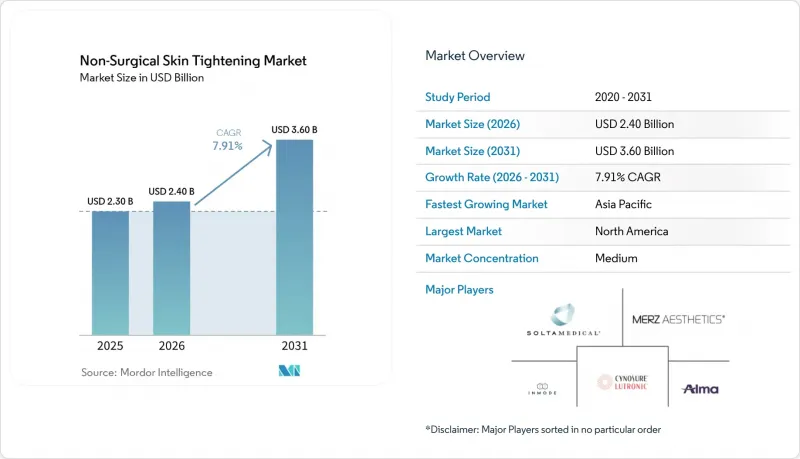
This report is Segmented by Technology (Radiofrequency, RF Microneedling, Ultrasound, and More), End User (Dermatology & Aesthetic Clinics, and More), Application Area (Face & Neck, Periorbital & Perioral, Abdomen & Flanks, Arms & Thighs, Buttocks), and Geography (North America, Europe, Asia-Pacific, Middle East & Africa, South America). The Market Forecasts are Provided in Terms of Value (USD).
Global Non-Surgical Skin Tightening Market Trends and Insights
Shift to Minimally Invasive Treatments With Low Downtime
Patients increasingly insist on procedures that allow a return to social activity within 48 hours, a benchmark that RF and ultrasound platforms satisfy. Consultation data show that 72% of 2025 aesthetic visits in the United States explicitly requested non-surgical options, up from 58% in 2023. FDA clearances in 2024-2025 introduced RF microneedling devices equipped with real-time impedance monitoring, which standardize energy delivery and mitigate operator error . Medspas have capitalized by promoting "lunchtime" treatments that pair RF microneedling with topical serums to enhance collagen stimulation. Cost differentials reinforce the trend: a three-session RF package averages USD 2,500-4,000 versus USD 8,000-12,000 for a surgical facelift, widening the Non-Surgical Skin Tightening market's reach among younger and price-sensitive consumers.
Advances in RF, MFU/HIFU, and Hybrid Platforms Improve Efficacy
Micro-focused ultrasound now targets depths up to 4.5 mm, reaching the SMAS layer previously accessible only through surgery and enabling brow-lift-level tightening without incisions. A 2025 study in Plastic & Reconstructive Surgery confirmed that tiered energy delivery protocols balance efficacy and tolerability, fueling broader adoption . InMode's Morpheus8 demonstrated quarterly revenue above USD 100 million in 2024, underscoring commercial traction for depth-specific RF microneedling. Hybrid workstations such as Alma Lasers' Accent Prime blend RF and ultrasound, letting clinics customize protocols while avoiding multiple capital purchases. The January 2024 Cynosure-Lutronic merger pooled 535+ patents and unlocked global scale to speed next-gen hybrid launches.
High Device Capex/Consumable Cost and Procedure Pricing
Capital expenditure remains a structural barrier: professional RF microneedling units cost USD 30,000-80,000 and each disposable tip adds USD 50-150 per patient. In emerging markets, median incomes cannot sustain procedure packages priced at USD 2,400-3,600, pushing clinics toward leasing models or consumable-free platforms. Competitive pressure from PDO threads, which provide immediate lift at comparable total cost, erodes willingness to pay premiums for gradual collagen formation. Manufacturers now bundle marketing services and extended warranties to shorten payback periods, yet high up-front investment still restricts participation of solo practices and slows Non-Surgical Skin Tightening market penetration in cost-sensitive geographies
Other drivers and restraints analyzed in the detailed report include:
- Expansion of Medspas and Dermatology Clinics Increases Access
- Aging Demographics and Earlier "Prejuvenation" Adoption
- Safety Concerns and Regulatory Scrutiny, Especially Around RF Microneedling
For complete list of drivers and restraints, kindly check the Table Of Contents.
Segment Analysis
RF modalities controlled 38.38% of 2025 revenue, confirming their deep clinical roots, while RF microneedling is forecast to expand at 8.42% CAGR through 2031. The segment's rise reflects precise dermal targeting and synergy with topical cosmeceuticals. Ultrasound systems such as Ultherapy continue to command premium pricing, but patient discomfort and higher per-session fees constrain uptake. Light-based tightening offers modest efficacy and therefore serves more as a maintenance adjunct. Hybrid workstations that merge RF, ultrasound and IPL enable clinics to tailor energy layers from epidermis to SMAS, enhancing outcomes without extra capital. Growing emphasis on AI-governed safety should further differentiate next-generation RF microneedling, underpinning its momentum in the Non-Surgical Skin Tightening market.
Historical product cycles show monopolar RF reigning up to 2020, followed by fractional RF microneedling that blended mechanical and thermal stimuli. Early devices lacked precision but paved the way for platforms like Lutronic's Genius RF, which integrates real-time impedance feedback. The 2024 Cynosure-Lutronic merger accelerated patent consolidation, pointing to rapid platform upgrades. Ultrasound vendors are moderating energy delivery to balance pain and efficacy, while light-based firms position their systems for Fitzpatrick types IV-VI where thermal risks rise. Within this competitive landscape, hybrid modularity and automated safety features appear non-negotiable for future Non-Surgical Skin Tightening market share gains.
Geography Analysis
North America accounted for 46.10% of 2025 value, sustained by dense medspa networks, favorable disposable income and clear FDA pathways that streamline device adoption. The United States alone hosts 7,000+ licensed medspas and continues to expand into secondary cities where competition is lower and rent costs favor clinic economics. Canada and Mexico benefit from cross-border medical tourism, although Mexico's laxer enforcement has allowed unlicensed providers to enter, occasionally denting consumer confidence.
Asia-Pacific is forecast to climb at an 8.37% CAGR through 2031, outpacing the global Non-Surgical Skin Tightening market. China's tier-1 cities reported an 18% annual increase in licensed aesthetic facilities in 2025, and Solta Medical's direct entry via its Wuhan Shibo Zhenmei acquisition is expected to accelerate Thermage FLX volumes . Japan and South Korea demonstrate mature prejuvenation cultures, with consumers favoring non-ablative energy devices over injectables for routine maintenance. India presents a volume opportunity but requires leasing models and consumables-free devices to penetrate beyond top-tier metros.
Europe delivers steady but uneven growth owing to national reimbursement differences and cultural attitudes toward cosmetic procedures. Germany, France and the United Kingdom lead adoption, while Southern and Eastern Europe lag due to economic disparities. CE Mark convergence simplifies approvals, yet stricter post-market reporting enacted in 2024 raises compliance cost. The Middle East, anchored by UAE and Saudi Arabia, positions itself as a luxury hub for medical tourism, although domestic demand outside urban pockets remains modest. South America shows strong cultural acceptance-Brazil ranks among the world's top cosmetic markets-but currency volatility and lower household incomes skew choices toward injectables, tempering Non-Surgical Skin Tightening market expansion.
- Aesthetics Biomedical
- Alma Lasers
- BTL
- Candela Medical
- Cartessa Aesthetics
- Classys
- Cutera
- Cynosure Lutronic
- ENDYMED
- Fotona
- Hironic
- InMode Ltd
- Lumenis
- Lynton Lasers
- Merz Pharma
- Sciton
- Sofwave Medical
- Solta Medical
- Thermi
- Venus Concept
Additional Benefits:
- The market estimate (ME) sheet in Excel format
- 3 months of analyst support
TABLE OF CONTENTS
1 Introduction
- 1.1 Study Assumptions & Market Definition
- 1.2 Scope of the Study
2 Research Methodology
3 Executive Summary
4 Market Landscape
- 4.1 Market Overview
- 4.2 Market Drivers
- 4.2.1 Shift To Minimally Invasive Treatments with Low Downtime
- 4.2.2 Advances In RF, MFU/HIFU, And Hybrid Platforms Improve Efficacy
- 4.2.3 Expansion Of Med spas and Dermatology Clinics Increases Access
- 4.2.4 Aging Demographics and Earlier "Prejuvenation" Adoption
- 4.2.5 GLP-1 Weight-Loss Induced Skin Laxity Boosts Tightening Demand
- 4.2.6 Hybrid Clinic-To-Home Regimens Raise Adherence and Utilization
- 4.3 Market Restraints
- 4.3.1 High Device Capex/Consumable Cost and Procedure Pricing
- 4.3.2 Safety Concerns and Regulatory Scrutiny, Esp. Around RF Microneedling
- 4.3.3 Competition From Injectables/Threads for Immediate Visible Results
- 4.3.4 Misinformation/DIY Device Misuse Causing Adverse Events
- 4.4 Supply-Chain Analysis
- 4.5 Regulatory Landscape
- 4.6 Technological Outlook
- 4.7 Porter's Five Forces
- 4.7.1 Threat of New Entrants
- 4.7.2 Bargaining Power of Suppliers
- 4.7.3 Bargaining Power of Buyers
- 4.7.4 Threat of Substitutes
- 4.7.5 Competitive Rivalry
5 Market Size & Growth Forecasts (Value, USD)
- 5.1 By Technology
- 5.1.1 Radiofrequency
- 5.1.2 RF Microneedling
- 5.1.3 Ultrasound
- 5.1.4 Light-based tightening
- 5.1.5 Hybrid platforms
- 5.2 By End User
- 5.2.1 Dermatology & Aesthetic Clinics
- 5.2.2 Medspas & Beauty Centers
- 5.2.3 Plastic Surgery Centers
- 5.2.4 At-home Consumers
- 5.3 By Application Area
- 5.3.1 Face & Neck
- 5.3.2 Periorbital & Perioral
- 5.3.3 Abdomen & Flanks
- 5.3.4 Arms & Thighs
- 5.3.5 Buttocks
- 5.4 By Geography
- 5.4.1 North America
- 5.4.1.1 United States
- 5.4.1.2 Canada
- 5.4.1.3 Mexico
- 5.4.2 Europe
- 5.4.2.1 Germany
- 5.4.2.2 United Kingdom
- 5.4.2.3 France
- 5.4.2.4 Italy
- 5.4.2.5 Spain
- 5.4.2.6 Rest of Europe
- 5.4.3 Asia-Pacific
- 5.4.3.1 China
- 5.4.3.2 India
- 5.4.3.3 Japan
- 5.4.3.4 South Korea
- 5.4.3.5 Australia
- 5.4.3.6 Rest of Asia-Pacific
- 5.4.4 Middle East and Africa
- 5.4.4.1 GCC
- 5.4.4.2 South Africa
- 5.4.4.3 Rest of Middle East and Africa
- 5.4.5 South America
- 5.4.5.1 Brazil
- 5.4.5.2 Argentina
- 5.4.5.3 Rest of South America
- 5.4.1 North America
6 Competitive Landscape
- 6.1 Market Concentration
- 6.2 Market Share Analysis
- 6.3 Company Profiles {(includes Global level Overview, Market level overview, Core Segments, Financials as available, Strategic Information, Market Rank/Share for key companies, Products & Services, and Recent Developments)}
- 6.3.1 Aesthetics Biomedical
- 6.3.2 Alma Lasers Ltd
- 6.3.3 BTL Aesthetics
- 6.3.4 Candela
- 6.3.5 Cartessa Aesthetics
- 6.3.6 Classys
- 6.3.7 Cutera
- 6.3.8 Cynosure Lutronic
- 6.3.9 ENDYMED
- 6.3.10 Fotona
- 6.3.11 Hironic
- 6.3.12 InMode Ltd
- 6.3.13 Lumenis
- 6.3.14 Lynton Lasers
- 6.3.15 Merz Aesthetics
- 6.3.16 Sciton
- 6.3.17 Sofwave Medical
- 6.3.18 Solta Medical
- 6.3.19 Thermi
- 6.3.20 Venus Concept
7 Market Opportunities & Future Outlook
- 7.1 White-space & unmet-need assessment

