PUBLISHER: Mordor Intelligence | PRODUCT CODE: 2063481

PUBLISHER: Mordor Intelligence | PRODUCT CODE: 2063481
Refurbished Laboratory Equipment - Market Share Analysis, Industry Trends & Statistics, Growth Forecasts (2026 - 2031)
According to Mordor Intelligence, the refurbished laboratory equipment market size is expected to grow from USD 26.38 billion in 2025 to USD 28.18 billion in 2026 and is forecast to reach USD 39.21 billion by 2031 at 6.83% CAGR over 2026-2031.
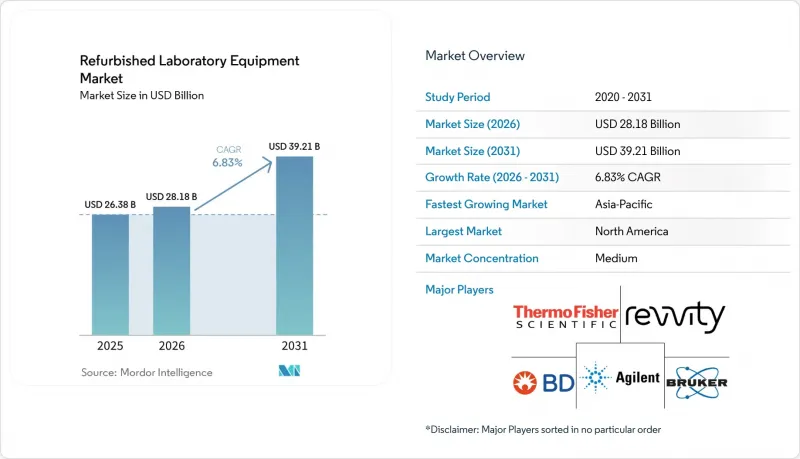
This report is Segmented by Product Type (Analytical Instruments, General Laboratory Equipment, and More), End User (Pharmaceutical & Biotechnology Companies, and More), Sales Channel (OEM Certified Pre-Owned Programs, and More), Refurbishment Grade (OEM Factory-Certified, and More), and Geography (North America, Europe, and More). The Market and Forecasted in Terms of Value (USD).
Global Refurbished Laboratory Equipment Market Trends and Insights
Cost-Effective Procurement for Budget-Constrained Labs and Startups
Budget-sensitive buyers spanning academia, diagnostics, and contract research redirect capital from new purchases to certified refurbished instruments that meet throughput needs at lower acquisition cost, which allows funds to be reallocated to consumables, personnel, and validation. Public buyers and NGOs frame decisions through total cost of ownership lenses that weigh calibration, parts availability, reagent logistics, and service access over multi-year horizons to avoid idle assets and procurement lock-ins. Vendors that publish calibration traceability and pre-shipment validation gain preference as buyers seek predictable uptime and auditable records. On the supply side, certified refurbishment programs with factory inspection and warranty parity narrow the perceived performance gap compared with new systems. Marketplace specialists that provide documented environmental savings and configured startup bundles strengthen appeal to incubators and early-stage labs seeking rapid commissioning. Case-in-point examples include vendor programs that disclose multi-point inspections with genuine parts, full warranty, and on-site installation to support compliant go-live in regulated workflows. Budget-conscious labs also validate supplier claims against calibration certificates traceable to national metrology bodies to maintain audit-ready records.
Expansion of Pharma and Biotech R&D Increasing Instrument Demand
Rising biopharma R&D intensity increases deployments of LC-MS, chromatography systems, and high-content imaging platforms, which later become candidates for trade-in or certified resale during portfolio upgrades. M&A and portfolio shifts add to decommissioning cycles that release high-value instruments into refurbishment pipelines, often bundled with removal and logistics services to reduce buyer friction. Large OEMs continue to invest in end-to-end capabilities and partnerships that reinforce customer relationships and expand access to installed equipment fleets over the asset lifecycle. India's Vigyan Dhara expanded R&D allocations in 2025-26, supporting equipment grants that add to regional installed bases and set up refresh cycles over subsequent funding windows. OEM acquisitions and capacity expansions that align with biopharma demands signal sustained instrument utilization and repower secondary channels as customers modernize fleets. Regulatory convergence around ISO 13485 and FDA QMSR expectations further codifies calibration and documentation, which raises the bar for refurbishers and increases buyer trust in well-documented offerings.
Accuracy, Reliability, and Calibration Concerns from Non-Uniform Refurb Standards
Calibration quality remains a top concern when refurbishment standards vary, especially where labs must meet FDA, ISO, and CLIA requirements that depend on tight measurement control. Federal letters of nonconformance in recent years have frequently referenced calibration gaps, which elevates buyer scrutiny of traceability, uncertainty budgets, and environmental controls embedded in vendor processes. ISO 13485 and ISO/IEC 17025 frameworks expect documented calibration chains to national metrology bodies, defined tolerances, and investigation of out-of-tolerance events to maintain product quality across the lifecycle. FDA quality system requirements also emphasize defined calibration intervals and records that link instrument status to batches or samples tested, which pushes refurbishers to provide auditable documentation from day one. CLIA and related guidance reinforce periodic verification triggers such as reagent-lot changes and maintenance events, which increase the importance of reliable service access for refurbished units placed in clinical workflows. Labs mitigate this restraint by standardizing on vendors that provide calibration certificates traceable to NIST or BIPM, validated software versions, and environmental conditions documented at the time of calibration.
Other drivers and restraints analyzed in the detailed report include:
- Sustainability and Circular Economy Policies Accelerating Reuse
- Growth of Academic and Research Capacity in Emerging Economies
- Limited Warranty/After-Sales Support and Lack of Process Standardization
For complete list of drivers and restraints, kindly check the Table Of Contents.
Segment Analysis
Analytical Instruments captured 42.17% of revenue in 2025 within the refurbished laboratory equipment market, reflecting sustained demand for LC-MS, GC, and spectroscopy systems used across discovery and QC workflows. Procurement teams increasingly channel late-generation instruments into trade-in programs that return certified LC-MS platforms with documented factory inspection, firmware updates, and parity warranties, which strengthens trust in this category for regulated uses. Residual value is reinforced by sellers that provide multi-month warranties, traceable calibration, and installation services, while buyers formalize uptime expectations through service tiers and preventive maintenance plans. Calibration documentation aligned to ISO 13485 and ISO/IEC 17025 remains central to placing refurbished analytical systems in pharma QC and CLIA environments, which influences price premiums for OEM-certified units over non-certified alternatives. Where labs retire legacy operating systems or software versions, sellers that provide validated software states at shipment reduce commissioning friction and speed compliance sign-offs. These factors collectively reinforce category leadership for analytical instruments in the refurbished laboratory equipment market.
General Laboratory Equipment is forecast to be the fastest-growing product category at a 7.43% CAGR through 2031, supported by broad applicability across academic, hospital, and industrial labs. The refurbished laboratory equipment market size tied to this segment benefits from quick-turn availability of centrifuges, incubators, biosafety cabinets, balances, and liquid handling systems that can be certified to lab accreditation requirements. Demand is reinforced by modular automation and sustainability-aligned equipment that reduces energy or consumables usage, which aligns with circular procurement objectives. Sellers differentiate through warranty breadth and ability to ship with documented IQ/OQ/PQ test records for rapid go-live in audited environments. Buyers increasingly bundle refurbished general equipment with startup kits and training to stand up new labs or expand existing facilities on constrained budgets. Documentation quality and consistency remain the primary selection criteria, with calibration traceability and defined service routes improving decision speed and confidence. These dynamics support sustained expansion for general equipment in the refurbished laboratory equipment market.
Pharmaceutical & Biotechnology Companies represented 32.28% of 2025 revenue as R&D investment supported high utilization of LC-MS, chromatography, and high-content imaging platforms across development and QC. Active trade-in and upgrade cycles supply secondary channels with well-maintained assets as new modalities expand instrumentation needs in discovery and analytics. OEM partnerships and capacity additions that align to drug-product manufacturing and services strengthen the equipment lifecycle, from primary sale through eventual certified resale. Bioprocess and analytical workflow investments continue to shape installed bases, which later feed the refurbished laboratory equipment market with quality-documented units. The refurbished laboratory equipment market share tied to pharma buyers remains supported by warranty parity and factory validation that satisfy audit and accreditation requirements. These elements keep refurbished placements viable for non-GxP and selected GxP contexts where documentation, calibration traceability, and service response times are proven.
Academic & Research Institutes are projected to grow the fastest at an 8.56% CAGR through 2031 as public programs expand laboratory capacity and prioritize hands-on infrastructure. India's Vigyan Dhara funding supports instrumentation grants across institutions, which increases near-term demand for certified refurbished systems and sets multi-year refresh cycles for future secondary supply. New national instrumentation centers and university-industry hubs bring metabolomics, molecular, and characterization capabilities online, often with refurbished kits that speed commissioning and training. Procurement teams in academia weigh calibration documentation, installation, and training services to comply with accreditation and grant reporting while maximizing instrument uptime. Suppliers that combine warranty coverage, startup bundles, and service agreements support rapid adoption and long-term utilization in teaching and research labs. These drivers sustain the fast-growing academic cohort in the refurbished laboratory equipment market.
Geography Analysis
North America held 36.74% of 2025 revenue for the refurbished laboratory equipment market, supported by dense pharma and biotech clusters and mature secondary-equipment channels. Federal and accreditation frameworks favor ISO/IEC 17025-aligned calibration providers, which reinforces demand for documented refurbishment and traceability standards. OEMs continue to deepen U.S. manufacturing and services partnerships that strengthen lifecycle support and provide clear pathways to certified resale when fleets refresh. Trade-in programs and factory-certified refurbished offerings remain prominent in this region due to regulatory rigor and buyer preferences for warranty parity. Brokers and dealers complement OEM channels through inventory breadth and flexible warranties, while academic consortia source configured kits for rapid lab setups. These elements underpin regional leadership and steady adoption in the refurbished laboratory equipment market.
Asia-Pacific is projected to grow at an 8.90% CAGR through 2031, the fastest among regions in the refurbished laboratory equipment market. University and national lab expansions are adding capacity in priority fields, and public programs in major countries are directing funds toward research infrastructure and training. India's Vigyan Dhara allocation exemplifies this trend, creating a pipeline for both new and refurbished instruments across universities and institutes. Regional hubs are also building advanced instrumentation centers that will generate installed bases aligned to future secondary supply channels. As cohorts mature and upgrade cycles begin, OEM trade-in and certified refurbished programs are expected to scale further into Asia-Pacific. Buyers in the region focus on documentation readiness, service access, and software validation support to align with accreditation and data-integrity requirements. These developments support sustained regional outperformance in the refurbished laboratory equipment market.
Europe maintains a significant share in the refurbished laboratory equipment market as stringent quality and safety regulations normalize documentation expectations for refurbished units. CE marking requirements for substantial refurbishment of regulated devices raise compliance thresholds but also reduce uncertainty for buyers by standardizing quality across member states. Leading OEMs continue to invest in European manufacturing and service footprints, which supports lifecycle management and certified resale pathways for instruments that exit primary service. Broader sustainability initiatives motivate institutions to extend asset life and adopt circular procurement rules that value refurbishment and take-back options with provable environmental benefits. Collectively, these dynamics support durable demand for documented refurbished systems that fit regulated workflows and ESG policies in Europe.
In the Middle East and Africa and in South America, the refurbished laboratory equipment market advances as governments and universities build out research and testing capacity. Cross-border digital infrastructure that connects thousands of institutions is catalyzing equipment demand for scientific programs, which expands installed bases that later recycle into secondary channels. Public-private programs that strengthen research-granting capacity and promote equipment utilization are improving access to instruments and supporting shared resource models. Buyers in these regions prioritize reliability, calibration traceability, and access to replacement parts to sustain uptime with limited local service options. Brokers and OEMs that provide remote support, documented installation, and clear warranty terms are positioned to accelerate adoption.
- Agilent Technologies
- American Laboratory Trading (ALT)
- Beckton Dickinson
- Bruker
- Cambridge Scientific Products
- Carl Zeiss
- Copia Scientific
- EquipNet, Inc.
- GenTech Scientific LLC
- International Equipment Trading Ltd. (IET)
- IRIS Industries
- Marshall Scientific LLC
- Mettler Toledo
- Revvity, Inc.
- Richmond Scientific (UK)
- Sartorius
- Siemens Healthineers
- Surplus Solutions LLC
- Thermo Fisher Scientific
- Waters Corporation
Additional Benefits:
- The market estimate (ME) sheet in Excel format
- 3 months of analyst support
TABLE OF CONTENTS
1 Introduction
- 1.1 Study Assumptions & Market Definition
- 1.2 Scope of the Study
2 Research Methodology
3 Executive Summary
4 Market Landscape
- 4.1 Market Overview
- 4.2 Market Drivers
- 4.2.1 Cost-Effective Procurement for Budget-Constrained Labs and Startups
- 4.2.2 Expansion of Pharma and Biotech R&D Increasing Instrument Demand
- 4.2.3 Sustainability and Circular Economy Policies Accelerating Reuse
- 4.2.4 Growth of Academic and Research Capacity in Emerging Economies
- 4.2.5 OEM Certified Pre-Owned and Trade-In Programs De-Risk Purchases
- 4.2.6 Lab Closures, M&A, and Decommissioning Fueling High-Quality Secondary Supply
- 4.3 Market Restraints
- 4.3.1 Accuracy, Reliability, and Calibration Concerns from Non-Uniform Refurb Standards
- 4.3.2 Limited Warranty/After-Sales Support and Lack of Process Standardization
- 4.3.3 OEM Software Licensing/EoL Support Restrictions Limiting Redeployment
- 4.3.4 Parts Obsolescence and Validation Costs for Regulated Workflows
- 4.4 Regulatory Landscape
- 4.5 Technological Outlook
- 4.6 Porters Five Forces Analysis
- 4.6.1 Threat of New Entrants
- 4.6.2 Bargaining Power of Buyers
- 4.6.3 Bargaining Power of Suppliers
- 4.6.4 Threat of Substitutes
- 4.6.5 Competitive Rivalry
5 Market Size & Growth Forecasts (Value, USD)
- 5.1 Product Type
- 5.1.1 Analytical Instruments
- 5.1.2 General Laboratory Equipment
- 5.1.3 Life Science Equipment
- 5.1.4 Clinical Diagnostic Equipment
- 5.2 By End User
- 5.2.1 Pharmaceutical & Biotechnology Companies
- 5.2.2 Academic & Research Institutes
- 5.2.3 Clinical & Diagnostic Laboratories
- 5.2.4 Contract Research Organizations (CROs)
- 5.2.5 Hospitals & Healthcare Facilities
- 5.3 By Sales Channel
- 5.3.1 OEM Certified Pre-Owned Programs
- 5.3.2 Independent Refurbishers/Dealers
- 5.3.3 Online Marketplaces & Auctions
- 5.4 By Refurbishment Grade
- 5.4.1 OEM Factory-Certified
- 5.4.2 Third-Party Reconditioned
- 5.4.3 As-Is/Lightly Used with Warranty
- 5.5 By Geography
- 5.5.1 North America
- 5.5.1.1 United States
- 5.5.1.2 Canada
- 5.5.1.3 Mexico
- 5.5.2 Europe
- 5.5.2.1 Germany
- 5.5.2.2 United Kingdom
- 5.5.2.3 France
- 5.5.2.4 Italy
- 5.5.2.5 Spain
- 5.5.2.6 Rest of Europe
- 5.5.3 Asia-Pacific
- 5.5.3.1 China
- 5.5.3.2 India
- 5.5.3.3 Japan
- 5.5.3.4 Australia
- 5.5.3.5 South Korea
- 5.5.3.6 Rest of Asia-Pacific
- 5.5.4 Middle East and Africa
- 5.5.4.1 GCC
- 5.5.4.2 South Africa
- 5.5.4.3 Rest of Middle East and Africa
- 5.5.5 South America
- 5.5.5.1 Brazil
- 5.5.5.2 Argentina
- 5.5.5.3 Rest of South America
- 5.5.1 North America
6 Competitive Landscape
- 6.1 Market Concentration
- 6.2 Market Share Analysis
- 6.3 Company Profiles (includes Global Level Overview, Market Level Overview, Core Segments, Financials as available, Strategic Information, Market Rank/Share for key companies, Products & Services, and Recent Developments)
- 6.3.1 Agilent Technologies, Inc.
- 6.3.2 American Laboratory Trading (ALT)
- 6.3.3 Becton, Dickinson and Company
- 6.3.4 Bruker Corporation
- 6.3.5 Cambridge Scientific Products
- 6.3.6 Carl Zeiss AG
- 6.3.7 Copia Scientific
- 6.3.8 EquipNet, Inc.
- 6.3.9 GenTech Scientific LLC
- 6.3.10 International Equipment Trading Ltd. (IET)
- 6.3.11 IRIS Industries
- 6.3.12 Marshall Scientific LLC
- 6.3.13 Mettler-Toledo International Inc.
- 6.3.14 Revvity, Inc.
- 6.3.15 Richmond Scientific (UK)
- 6.3.16 Sartorius AG
- 6.3.17 Siemens Healthineers AG
- 6.3.18 Surplus Solutions LLC
- 6.3.19 Thermo Fisher Scientific, Inc.
- 6.3.20 Waters Corporation
7 Market Opportunities & Future Outlook
- 7.1 White-space & Unmet-need Assessment

