PUBLISHER: Mordor Intelligence | PRODUCT CODE: 2063493

PUBLISHER: Mordor Intelligence | PRODUCT CODE: 2063493
Inhalable Drugs - Market Share Analysis, Industry Trends & Statistics, Growth Forecasts (2026 - 2031)
According to Mordor Intelligence, the inhalable drugs market size is projected to expand from USD 30.10 billion in 2025 and USD 31.70 billion in 2026 to USD 41.30 billion by 2031, registering a CAGR of 5.41% between 2026 to 2031.
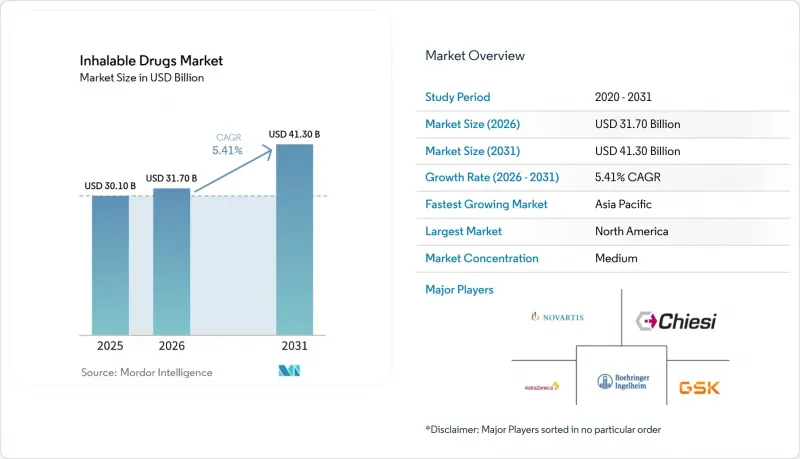
This report is Segmented by Indication (Asthma, COPD, Cystic Fibrosis, PAH, NTM Lung Disease, Diabetes), Dosage Form (Metered-Dose, Dry Powder, Nebulized, Soft Mist), End User (Homecare, Hospitals, Specialty Clinics), Distribution Channel (Retail, Hospital, Online Pharmacies), and Geography (North America, Europe, Asia-Pacific, MEA, South America). Market Forecasts are Provided in Terms of Value (USD).
Global Inhalable Drugs Market Trends and Insights
Growing Global Burden of Asthma and COPD
According to a 2025 article by the National Library of Medicine, by 2050, it is projected that 15.58 billion cumulative COPD-related exacerbations will occur globally, a relative growth of 584% compared with 2025 . Indoor biomass combustion still accounts for 40% of COPD cases in low-income regions, even as LPG subsidies scale. Aging populations in Japan, South Korea, and Southern Europe are increasing multimorbidity, boosting demand for combination inhalers. COPD incidence is climbing 2.1% annually in Asia-Pacific, outpacing available pulmonology capacity. Together, these forces underpin sustained volume growth for maintenance therapies that command premium pricing relative to short-acting agents.
Uptake of Fixed-Dose Dual/Triple Inhalers Improving Outcomes
AstraZeneca's KALOS and LOGOS trials showed 24% fewer COPD-related hospitalizations with a single inhaler combining three active agents compared with dual therapy, prompting payer upgrades in Germany and the UK . Chiesi's triple MDI filing under the 505(b)(2) pathway targets U.S. approval in 2026 and a cohort of 1.2 million patients currently juggling multiple devices. Prescribers increasingly prefer integrated regimens that reduce pharmacy errors and improve six-month persistence, cannibalizing standalone LABA-ICS revenue but reinforcing branded leadership in severe disease.
Intensifying Generic Competition and Price Pressure
Generic share of U.S. MDI scripts jumped significantly from 2022 to 2025 as multiple bioequivalents launched, slashing branded ASPs by one-third. Tender systems in Europe and Latin America now benchmark inhaler prices to generic levels, even in the absence of direct substitutes, while PBMs in the U.S. enforce lowest-acquisition-cost formulas. Shrinking margins shift R&D toward high-barrier biologic-device combinations, leaving incremental small-molecule improvements underfunded.
Other drivers and restraints analyzed in the detailed report include:
- Expansion of Homecare and Digital/Smart Inhalers
- Broadening Access via Generics and Authorized Generics
- Inhaler Technique Errors and Adherence Gaps
For complete list of drivers and restraints, kindly check the Table Of Contents.
Segment Analysis
COPD revenue is expanding at a 5.83% CAGR and is closing the gap with asthma, which retained 38.16% inhalable drugs market share in 2025. Late diagnoses in emerging markets push patients onto higher-priced triple regimens, and smoke exposure keeps incidence climbing. Cystic fibrosis therapies serve roughly 100,000 patients yet enjoy chronic daily dosing, while pulmonary arterial hypertension inhalables captured a modest share of 2025 revenue following treprostinil DPI approval. Non-tuberculous mycobacterial lung disease is advancing annually due to environmental aerosol exposure, widening the niche for liposomal amikacin. Diabetes inhalation therapy remains a sub-0.5% sliver because payers mandate failure on injections first.
COPD's acceleration realigns product strategy toward long-acting bronchodilators with anti-inflammatory co-formulation. United Therapeutics' treprostinil DPI and Insmed's liposomal antibiotic illustrate movement into systemic or orphan realms where robust pricing offsets small populations. As incidence skews older, developers bundle telemonitoring and technique-coaching services to bolster persistence, creating barriers to pure-price generics.
Metered-dose inhalation led with a 43.16% share of the inhalable drugs market in 2025 and will grow at 5.91% through 2031 as HFO-1234ze propellant conversions reset patent life. Dry-powder devices hold a significant share of volume and appeal to eco-conscious prescribers, yet inspiratory-flow demands limit pediatrics and severe COPD use. Nebulizers remain critical in hospital settings where coordination is impossible, and mesh technology reduces treatment time to 5 minutes. Soft-mist platforms achieve 50% lung deposition, supporting once-daily dosing.
Portfolio refresh costs and propellant supply constraints incentivize companies to pivot toward connected MDIs that capture real-world use data. Dry-powder entrants counter with breath-actuated simplicity and zero propellant footprint. Competitive positioning thus hinges on device ergonomics, digital overlays, and carbon-label disclosures rather than chemistry alone.
Geography Analysis
North America held a 46.18% share in 2025, as patent cliffs invite generic erosion and PBMs press for discounts. CMS reimbursement for connected devices accelerates adoption of Hailie and Digihaler platforms, partially offsetting price deflation. Canada's pricing alliance cut branded combination inhaler costs by up to 50%, while Mexico's expanded coverage lifts generic DPI volume.
Asia-Pacific is the fastest-growing region at a 6.10% CAGR. China added 18 inhalers to its 2025 reimbursement list, significantly slashing patients' out-of-pocket expenses. India's Ayushman Bharat covers 500 million people, but rural distribution gaps hamper uptake. Persistent PM2.5 exposure increases COPD incidence by 2.1% annually, expanding the addressable demand. Japan approved liposomal amikacin for NTM lung disease, while Australia struck risk-sharing deals to cap government spending on triple therapies.
Europe commands a significant share, tempered by tenders that pull branded prices within 15% of generics. NHS carbon footprint data motivates prescribers to switch to dry-powder devices. EMA low-GWP guidance spurs rapid MDI reformulations, absorbing capital. Germany reimburses digital inhalers under DiGA rules, paying EUR 250-400 annually when apps document savings. Middle East and Africa grow notabaly driven by Saudi Vision 2030 spending, while South America's rise follows Brazil's inhaler subsidies and Argentina's domestic DPI approval.
- AstraZeneca
- Boehringer Ingelheim
- Chiesi Farmaceutici
- Cipla
- Gilead Sciences
- Glenmark Pharmaceuticals
- GlaxoSmithKline
- Hikma Pharmaceuticals
- Insmed
- Lupin
- MannKind
- Nephron Pharmaceuticals Corporation
- Novartis
- Organon LLC
- Orion
- Pharmaxis Ltd.
- Sandoz Group
- Teva Pharmaceutical Industries
- United Therapeutics
- Viatris
Additional Benefits:
- The market estimate (ME) sheet in Excel format
- 3 months of analyst support
TABLE OF CONTENTS
1 Introduction
- 1.1 Study Assumptions & Market Definition
- 1.2 Scope of the Study
2 Research Methodology
3 Executive Summary
4 Market Landscape
- 4.1 Market Overview
- 4.2 Market Drivers
- 4.2.1 Growing Global Burden of Asthma And COPD
- 4.2.2 Uptake Of Fixed-Dose Dual/Triple Inhalers Improving Outcomes
- 4.2.3 Expansion Of Homecare and Digital/Smart Inhalers
- 4.2.4 Broadening Access Via Generics and Authorized Generics
- 4.2.5 Propellant Transition (low-GWP MDIs) Catalyzing Portfolio Refresh
- 4.2.6 Non-Respiratory Systemic Uses Via Inhalation (E.G., PAH DPI)
- 4.3 Market Restraints
- 4.3.1 Intensifying Generic Competition and Price Pressure
- 4.3.2 Inhaler Technique Errors and Adherence Gaps
- 4.3.3 Complex-Generic/Device Regulatory Hurdles Are Slowing Launches
- 4.3.4 Propellant Supply/Transition Constraints Elevating COGS
- 4.4 Supply-Chain Analysis
- 4.5 Regulatory Landscape
- 4.6 Technological Outlook
- 4.7 Porter's Five Forces
- 4.7.1 Threat of New Entrants
- 4.7.2 Bargaining Power of Suppliers
- 4.7.3 Bargaining Power of Buyers
- 4.7.4 Threat of Substitutes
- 4.7.5 Competitive Rivalry
5 Market Size & Growth Forecasts (Value, USD)
- 5.1 By Indication
- 5.1.1 Asthma
- 5.1.2 Chronic Obstructive Pulmonary Disease (COPD)
- 5.1.3 Cystic Fibrosis
- 5.1.4 Pulmonary Arterial Hypertension / PH-ILD
- 5.1.5 Non-tuberculous Mycobacterial (NTM) Lung Disease
- 5.1.6 Diabetes
- 5.2 By Dosage Form
- 5.2.1 Metered-Dose Inhalation
- 5.2.2 Dry Powder Inhalation
- 5.2.3 Nebulized Solutions
- 5.2.4 Soft Mist Inhalation
- 5.3 By End User
- 5.3.1 Homecare / Self-administration
- 5.3.2 Hospitals & Clinics
- 5.3.3 Specialty Clinics
- 5.4 By Distribution Channel
- 5.4.1 Retail Pharmacies
- 5.4.2 Hospital Pharmacies
- 5.4.3 Online Pharmacies
- 5.5 By Geography
- 5.5.1 North America
- 5.5.1.1 United States
- 5.5.1.2 Canada
- 5.5.1.3 Mexico
- 5.5.2 Europe
- 5.5.2.1 Germany
- 5.5.2.2 United Kingdom
- 5.5.2.3 France
- 5.5.2.4 Italy
- 5.5.2.5 Spain
- 5.5.2.6 Rest of Europe
- 5.5.3 Asia-Pacific
- 5.5.3.1 China
- 5.5.3.2 India
- 5.5.3.3 Japan
- 5.5.3.4 South Korea
- 5.5.3.5 Australia
- 5.5.3.6 Rest of Asia-Pacific
- 5.5.4 Middle East and Africa
- 5.5.4.1 GCC
- 5.5.4.2 South Africa
- 5.5.4.3 Rest of Middle East and Africa
- 5.5.5 South America
- 5.5.5.1 Brazil
- 5.5.5.2 Argentina
- 5.5.5.3 Rest of South America
- 5.5.1 North America
6 Competitive Landscape
- 6.1 Market Concentration
- 6.2 Market Share Analysis
- 6.3 Company Profiles {(includes Global level Overview, Market level overview, Core Segments, Financials as available, Strategic Information, Market Rank/Share for key companies, Products & Services, and Recent Developments)}
- 6.3.1 AstraZeneca plc
- 6.3.2 Boehringer Ingelheim International GmbH
- 6.3.3 Chiesi Farmaceutici S.p.A.
- 6.3.4 Cipla Ltd.
- 6.3.5 Gilead Sciences, Inc.
- 6.3.6 Glenmark Pharmaceuticals Ltd.
- 6.3.7 GSK plc
- 6.3.8 Hikma Pharmaceuticals PLC
- 6.3.9 Insmed Incorporated
- 6.3.10 Lupin Pharmaceuticals, Inc.
- 6.3.11 MannKind Corporation
- 6.3.12 Nephron Pharmaceuticals Corporation
- 6.3.13 Novartis AG
- 6.3.14 Organon LLC
- 6.3.15 Orion Corporation
- 6.3.16 Pharmaxis Ltd.
- 6.3.17 Sandoz
- 6.3.18 Teva Pharmaceutical Industries Ltd.
- 6.3.19 United Therapeutics Corporation
- 6.3.20 Viatris Inc.
7 Market Opportunities & Future Outlook
- 7.1 White-space & unmet-need assessment

