
PUBLISHER: Mordor Intelligence | PRODUCT CODE: 2063495

PUBLISHER: Mordor Intelligence | PRODUCT CODE: 2063495
Medical Device Labeling - Market Share Analysis, Industry Trends & Statistics, Growth Forecasts (2026 - 2031)
According to Mordor Intelligence, the medical device labeling market size was valued at USD 1.33 billion in 2025 and is estimated to grow from USD 1.40 billion in 2026 to reach USD 1.84 billion by 2031, at a CAGR of 5.58% during the forecast period (2026-2031).
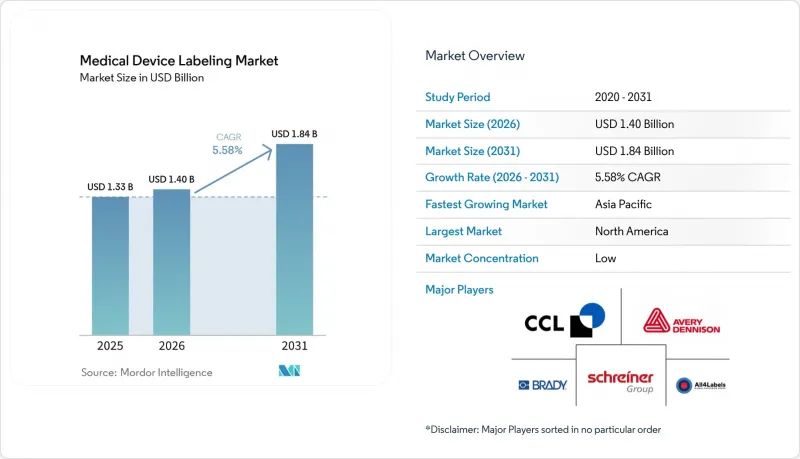
This report is Segmented by Label Type (Pressure-sensitive/Self-adhesive, Glue-applied/Wet-glue, Shrink Sleeves, In-Mold), Application (Disposable Consumables, Monitoring & Diagnostic Equipment, Therapeutic & Surgical Instruments), and Geography (North America, Europe, Asia-Pacific, Middle East and Africa, South America). The Market Forecasts are Provided in Terms of Value (USD).
Global Medical Device Labeling Market Trends and Insights
Global UDI Mandates and Database Submissions Expand Label Data and Dual-Format Barcode Requirements
The U.S. FDA intensified GUDID enforcement in 2025, issuing warning letters when barcode content and database fields diverged, so converters now validate 2D symbols down to 10 mm X 15 mm labels. China finished its phased UDI rollout in 2024, requiring Class I devices to carry machine-readable identifiers, driving exporters to redesign labels for bilingual text and GS1 or HIBC symbologies . Japan, Singapore, Malaysia, and Brazil adopted similar frameworks, meaning one device model may ship with five or more regional label variants. These mandates push device firms toward cloud label-management systems that automate artwork versioning and regulatory change tracking.
MDR/IVDR Multi-Language and Translation Rules Increase Label SKUs and Content Volume
Under EU Regulation 2025/1234, effective July 2025, professional-use devices may replace paper booklets with eIFU, but each language still needs a unique QR link on the label, multiplying SKUs . A single infusion pump can require 24 label designs for the bloc, inflating inventory risk because German-printed stock cannot legally ship to Spain. Translation suppliers report a 30% surge in device-label projects since 2024, and converters that offer in-house language validation win contracts by shortening certification timelines.
Compliance Burden and Frequent Regulatory Updates Raise Cost/Time-to-Market for Labelers
The EU issued 89 guidance documents between 2021 and 2025, each potentially altering label content, while notified-body backlogs stretch to 12 months, forcing multiple artwork revisions that cost USD 5,000-15,000 per iteration. China published 14 UDI circulars in 2024, and inconsistent provincial enforcement adds uncertainty for exporters. Small manufacturers spend up to a notable share of sales on regulatory affairs versus 2% for multinationals, accelerating industry consolidation.
Other drivers and restraints analyzed in the detailed report include:
- Rising Home-Use, Wearable, and POCT Devices Elevate Demand for Durable, Patient-Friendly Labels
- Increased Recall and Track-and-Trace Needs Accelerate 2D-Barcode-Rich UDI Labeling
- Fragmented Label-Converting Landscape Intensifies Pricing Pressure and Margin Squeeze
For complete list of drivers and restraints, kindly check the Table Of Contents.
Segment Analysis
Pressure-sensitive labels held 57.37% of the medical device labeling market in 2025, driven by compatibility with 300-600 labels-per-minute application lines and gamma, ethylene-oxide, and steam sterilization. Acrylic or rubber adhesives maintain bond strength through 50 kGy irradiation without yellowing. Glue-applied or wet-glue labels are forecast to grow at 5.89% through 2031, the fastest rate, as pharmaceutical firms package liquid injectables in glass vials where permanent adhesion outweighs peel-and-reseal convenience. Wet-glue systems create mechanical bonds by penetrating substrates, preventing lift during cold-chain condensation, yet they require 10-15 second dwell times that slow lines to 150-250 units per minute.
Shrink sleeves represented a notable share of volume in 2025, favored for combination products such as pre-filled syringes with integrated safety needles, where 360-degree graphics justify a 30-40% premium. In-mold labels remain niche, applied during blow or injection molding of specimen cups, eliminating post-molding steps. The EU Single-Use Plastics Directive, effective in 2024, exempts medical devices but has prompted evaluation of recyclable face stocks that match container resin. UPM Raflatac launched a linerless construction in 2025 that cuts material waste by 15% and lowers freight costs, appealing to sustainability-focused manufacturers.
Geography Analysis
North America held 45.85% of the medical device labeling market share in 2025, anchored by FDA UDI enforcement and GUDID synchronization requirements. The agency issued 14 warning letters in 2024 for non-compliance, targeting domestic and foreign manufacturers. Canada aligned its Medical Devices Regulations with FDA standards in 2024 and introduced mandatory label-related adverse-event reporting, compelling bilingual French-English labeling for Quebec. Mexico's COFEPRIS adopted UDI in 2025, creating a North American regulatory bloc that simplifies design yet imposes trilingual English-French-Spanish obligations for USMCA distribution.
Europe navigates MDR and IVDR transitions that mandate local-language instructions in Germany, France, Italy, Spain, and Poland, fragmenting label SKUs. The UK's UKCA marking, mandatory in 2024, requires separate labels for Great Britain versus Northern Ireland, which follows EU MDR, forcing parallel inventories. Regulation 2025/1234, effective July 2025, permits eIFU for professional devices but retains QR-code and URL requirements for each language, multiplying designs without reducing print costs.
Asia-Pacific is forecast to grow at 6.08% through 2031, the fastest regional CAGR. China completed UDI rollout in 2024, mandating Class I device identifiers in the NMPA database and driving dual-format barcode adoption. India's Production Linked Incentive scheme channels USD 1.4 billion into domestic manufacturing, favoring local label procurement and attracting multinational converter investment in Pune, Ahmedabad, and Chennai. Japan's PMDA accepted eIFU in 2024, aligning with FDA and EU precedents, yet retained strict on-label Japanese-language and kanji legibility standards. Middle East and Africa, South America, and smaller Asia-Pacific markets collectively represented notable share of revenue in 2025. Brazil's ANVISA published UDI guidelines in 2024, requiring GS1 or HIBC coding for Class III and IV devices by 2026. Australia's TGA harmonized UDI requirements with FDA and EU frameworks in 2024, simplifying Pacific-region design, while South Korea's MFDS mandated Korean-language labeling for imports.
- All4Labels Group
- Avery Dennison
- Beontag
- Brady Corporation
- Brook & Whittle
- CCL Industries
- Cisper Electronics
- CleanMark Labels
- Domino Printing Sciences
- Fortis Solutions Group
- HERMA GmbH
- Inovar Packaging Group
- LINTEC Corporation
- Loftware
- Propper Manufacturing
- Resource Label Group
- RFiD Discovery
- SATO Holdings
- Schreiner Group
- Taylor Corporation
- UPM Raflatac
Additional Benefits:
- The market estimate (ME) sheet in Excel format
- 3 months of analyst support
TABLE OF CONTENTS
1 Introduction
- 1.1 Study Assumptions & Market Definition
- 1.2 Scope of the Study
2 Research Methodology
3 Executive Summary
4 Market Landscape
- 4.1 Market Overview
- 4.2 Market Drivers
- 4.2.1 Global UDI Mandates and Database Submissions Expand Label Data and Dual-Format Barcode Requirements
- 4.2.2 MDR/IVDR Multi-Language and Translation Rules Increase Label SKUs And Content Volume
- 4.2.3 Rising Home-Use/Wearable and POCT Devices Elevate Demand for Durable, Patient-Friendly Labels
- 4.2.4 Increased Recall and Track-And-Trace Needs Accelerate 2D Barcode-Rich UDI Labeling
- 4.2.5 Adoption Of RFID/NFC Smart Labels for Item-Level Traceability in Surgical Kits and Implants
- 4.2.6 Sterile Processing Workflows Boost Usage of Indicator Labels and Documentation (SPD/CSSD)
- 4.3 Market Restraints
- 4.3.1 Compliance Burden and Frequent Regulatory Updates Raise Cost/Time-To-Market for Labelers
- 4.3.2 Fragmented Label Converting Landscape Intensifies Pricing Pressure and Margin Squeeze
- 4.3.3 Direct Part Marking (Permanent UDI) Displaces Some External Labels for Reusable Instruments
- 4.3.4 eIFU Adoption Reduces Paper Booklet/Leaflet Labeling for Professional-Use Devices
- 4.4 Supply-Chain Analysis
- 4.5 Regulatory Landscape
- 4.6 Technological Outlook
- 4.7 Porter's Five Forces Analysis
- 4.7.1 Threat of New Entrants
- 4.7.2 Bargaining Power of Suppliers
- 4.7.3 Bargaining Power of Buyers
- 4.7.4 Threat of Substitutes
- 4.7.5 Competitive Rivalry
5 Market Size & Growth Forecasts (Value USD)
- 5.1 By Label Type
- 5.1.1 Pressure-sensitive
- 5.1.2 Glue-applied
- 5.1.3 Shrink sleeves
- 5.1.4 In-mold labels
- 5.2 By Application
- 5.2.1 Disposable consumables
- 5.2.2 Monitoring & diagnostic equipment
- 5.2.3 Therapeutic & surgical instruments
- 5.3 By Geography
- 5.3.1 North America
- 5.3.1.1 United States
- 5.3.1.2 Canada
- 5.3.1.3 Mexico
- 5.3.2 Europe
- 5.3.2.1 Germany
- 5.3.2.2 United Kingdom
- 5.3.2.3 France
- 5.3.2.4 Italy
- 5.3.2.5 Spain
- 5.3.2.6 Rest of Europe
- 5.3.3 Asia Pacific
- 5.3.3.1 China
- 5.3.3.2 Japan
- 5.3.3.3 India
- 5.3.3.4 Australia
- 5.3.3.5 South Korea
- 5.3.3.6 Rest of Asia Pacific
- 5.3.4 Middle East and Africa
- 5.3.4.1 GCC
- 5.3.4.2 South Africa
- 5.3.4.3 Rest of Middle East and Africa
- 5.3.5 South America
- 5.3.5.1 Brazil
- 5.3.5.2 Argentina
- 5.3.5.3 Rest of South America
- 5.3.1 North America
6 Competitive Landscape
- 6.1 Market Concentration
- 6.2 Market Share Analysis
- 6.3 Company Profiles (includes Global level Overview, Market Level Overview, Core Segments, Financials as Available, Strategic Information, Market Rank/Share for Key Companies, Products & Services, and Recent Developments)
- 6.3.1 All4Labels Group
- 6.3.2 Avery Dennison
- 6.3.3 Beontag
- 6.3.4 Brady Corporation
- 6.3.5 Brook & Whittle
- 6.3.6 CCL Industries
- 6.3.7 Cisper Electronics
- 6.3.8 CleanMark Labels
- 6.3.9 Domino Printing Sciences
- 6.3.10 Fortis Solutions Group
- 6.3.11 HERMA GmbH
- 6.3.12 Inovar Packaging Group
- 6.3.13 LINTEC Corporation
- 6.3.14 Loftware
- 6.3.15 Propper Manufacturing
- 6.3.16 Resource Label Group
- 6.3.17 RFiD Discovery
- 6.3.18 SATO Holdings
- 6.3.19 Schreiner Group
- 6.3.20 Taylor Corporation
- 6.3.21 UPM Raflatac
7 Market Opportunities & Future Outlook
- 7.1 White-space & unmet-need assessment

