
PUBLISHER: Mordor Intelligence | PRODUCT CODE: 2063506

PUBLISHER: Mordor Intelligence | PRODUCT CODE: 2063506
Cardiac Cryoablation Device - Market Share Analysis, Industry Trends & Statistics, Growth Forecasts (2026 - 2031)
According to Mordor Intelligence, the cardiac cryoablation device market size is projected to be USD 1.5 billion in 2025, USD 1.8 billion in 2026, and reach USD 3.9 billion by 2031, growing at a CAGR of 17.30% from 2026 to 2031.
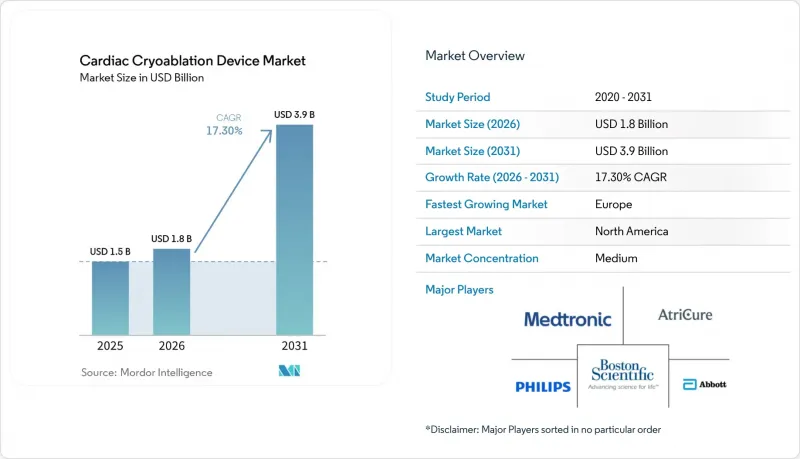
This report is Segmented by Technology (Cryoballoon N2O-Based, Focal Cryo Catheters, Surgical Cryo, and More), Product (Catheters/Balloons, Consoles, Sheaths, and More), Indication (Paroxysmal AF, Persistent AF, SVT, VT), End User (Tertiary Hospitals, Community Hospitals, ASC), and Geography (North America, Europe, Asia-Pacific, MEA, South America). Market Forecasts are Provided in Value (USD).
Global Cardiac Cryoablation Device Market Trends and Insights
ASC Coverage and Outpatient Shift in the United States
The November 2025 CMS final rule moved comprehensive AF ablation code CPT 93656 onto the ASC list with a USD 24,532 facility payment, eclipsing the inpatient tariff and catalyzing an outpatient surge. Cryoballoon procedures average 122 minutes, compared with 160 minutes for radiofrequency (RF), reducing overtime and aligning with ASC throughput models . Early 2026 scheduling data show ASCs booking two additional cryo cases per lab per day, expanding ASC revenue at a projected 17.88% CAGR. Canadian provinces and several Western European payers are piloting similar day-case AF pathways, hinting at an export of a North American playbook.
First-Line Ablation Evidence and Earlier Intervention
FDA first-line clearance for the Arctic Front Advance balloon, together with STOP-AF First and EARLY-AF results showing 75-82% arrhythmia-free survival, shifted ablation from salvage to upfront care . Younger, structurally intact atria yield higher single-procedure durability, trimming costly repeat interventions and pulling forward demand. A 2024 German cost-utility model pegged incremental cost-effectiveness at EUR 1,037 per QALY, well below regional willingness-to-pay thresholds, reinforcing payers' openness to ablation early in the pathway.
PFA Substitution Risk for AF Ablation
The January 2025 NEJM SINGLE SHOT CHAMPION trial reported 37.1% recurrence for PFA versus 50.7% for cryo, propelling hospitals to fast-track PFA console buying even at 23% higher device cost . U.S. physician surveys indicate PFA penetration climbing toward 68% of AF ablations in 2026, tightening the window for cryo vendors to defend share. Europe mirrors the trend as CE-cleared PFA catheters demonstrate zero esophageal injury in 17,000-plus real-world cases, sharpening medico-legal contrast with cryo.
Other drivers and restraints analyzed in the detailed report include:
- New Cryo System Approvals and Installed Base Expansion
- Workflow Efficiency and Reproducibility of Single-Shot Cryo
- Safety Events (Esophageal Injury, Phrenic Nerve Palsy) and IFU Updates
For complete list of drivers and restraints, kindly check the Table Of Contents.
Segment Analysis
In 2025, nitrous oxide cryoballoon systems accounted for 55.30% of the cardiac cryoablation device market share, anchored by Medtronic's decade-old console-based system that enables reproducible single-shot pulmonary vein isolation. The cardiac cryoablation device market for cryoballoon technology is expected to grow steadily as ASCs acquire consoles for paroxysmal AF workflows. Ultra-low-temperature cryo for VT, operating at -196 °C, is projected to log the fastest 17.95% CAGR, opening a new revenue lane for underserved structural heart disease populations.
Console makers are layering incremental software and integrated mapping to hold off PFA cannibalization. Chinese liquid-nitrogen balloons bring sustainability branding that resonates with hospital "green OR" committees. Focal cryo catheters retain niche utility for supraventricular tachycardia, yet their modest volume, coupled with RF's contact-force advances, limits upside. Surgical cryo remains guideline-endorsed but under-penetrated, held back by operating-room workflow inertia and cross-clamp penalties.
Catheters and balloons accounted for 62.18% of 2025 revenue and will continue to outpace consoles at a 17.86% CAGR, as procedure growth directly scales consumable pull-through. Expandable balloons such as POLARx FIT reduce device exchanges, adding economic and ergonomic value. The cardiac cryoablation device market size attached to console sales will rise in tandem with ASC migration, though capital budgets remain sensitive to uncertainty around multi-energy platforms. Ancillary sheaths and mapping catheters are increasingly bundled into single reimbursement codes, compressing stand-alone pricing but cementing vendor lock-in.
Disposable scavenging hoses, pressure lines, and sterile sleeves generate predictable but low-margin revenue; environmental scrutiny of nitrous oxide exhaust may spur additional redesigns of accessories. Integrated platforms that align cryo data feeds with external 3-D mapping systems lower cognitive load for electrophysiologists and are likely to shape future product roadmaps.
Geography Analysis
North America delivered 46.17% of 2025 revenue, buoyed by CMS's outpatient ruling and Medtronic's entrenched console fleet. U.S. labs are fast-tracking ASC conversions, aided by predictable cryo timings that fit half-day blocks. Canadian adoption is constrained by provincial budgetary variances; specialist centers in Ontario and Quebec show momentum, yet cross-country uniformity is absent. Mexico lags due to private-payer dominance and limited EP infrastructure.
Europe is the fastest-growing region at a 17.76% CAGR. Early CE-mark access to POLARx FIT and supportive cost-effectiveness data from Germany and the U.K. have kept cryo competitive even as PFA enters. Germany's workflow modeling demonstrates tangible staffing efficiencies, while the U.K.'s National Health Service weighs higher device cost against lower re-ablation rates. Southern European markets expand on the back of regional cardiac network programs, although reimbursement heterogeneity tempers the pace.
Asia-Pacific presents a mixed landscape. Japan, with PMDA approvals for both paroxysmal and persistent AF indications, serves as a global launch pad for incremental balloon refinements. China's newly approved liquid-nitrogen systems inject price and eco-credential competition, widening access in tier-2 cities. Australia and South Korea display steady tertiary-hospital demand, but ASC infrastructure is nascent. India and much of Southeast Asia remain constrained by cash-pay models, limiting penetration to urban referral centers.
- Abbott Laboratories
- Adagio Medical
- APT Medical
- AtriCure
- Biosense Webster
- Boston Scientific
- Cryofocus Medtech
- Hejeya (Beijing) Medical Device
- Japan Lifeline
- Koninklijke Philips
- Medtronic
- MicroPort EP
- Shanghai Antec Medical Technology
Additional Benefits:
- The market estimate (ME) sheet in Excel format
- 3 months of analyst support
TABLE OF CONTENTS
1 Introduction
- 1.1 Study Assumptions & Market Definition
- 1.2 Scope of the Study
2 Research Methodology
3 Executive Summary
4 Market Landscape
- 4.1 Market Overview
- 4.2 Market Drivers
- 4.2.1 ASC Coverage, Outpatient Shift In The US
- 4.2.2 First-Line Ablation Evidence and Earlier Intervention
- 4.2.3 New Cryo System Approvals and Installed Base Expansion
- 4.2.4 Workflow Efficiency and Reproducibility of Single-Shot Cryo
- 4.2.5 VT Opportunity From Ultra-Low-Temperature Cryo
- 4.2.6 China/Local Entrants Accelerate Access and Price Competition
- 4.3 Market Restraints
- 4.3.1 PFA Substitution Risk for AF Ablation
- 4.3.2 Safety Events (Esophageal Injury, PNP) And IFU Updates
- 4.3.3 FDA Post-Approval Evidence Requirements for New Systems
- 4.3.4 Underutilization Of Surgical Ablation Despite Guidelines
- 4.4 Supply-Chain Analysis
- 4.5 Regulatory Landscape
- 4.6 Technological Outlook
- 4.7 Porter's Five Forces
- 4.7.1 Competitive Rivalry
- 4.7.2 Threat of New Entrants
- 4.7.3 Bargaining Power of Suppliers
- 4.7.4 Bargaining Power of Buyers
- 4.7.5 Threat of Substitutes
5 Market Size & Growth Forecasts (Value, USD)
- 5.1 By Technology
- 5.1.1 Cryoballoon ablation (N2O-based)
- 5.1.2 Focal cryoablation catheters
- 5.1.3 Surgical cryoablation (probes/clamps; N2O/Argon)
- 5.1.4 Ultra-low-temperature cryo for VT (emerging)
- 5.2 By Product
- 5.2.1 Cryoablation catheters/balloons
- 5.2.2 Cryo consoles/generators
- 5.2.3 Steerable sheaths/introducers
- 5.2.4 Inner-lumen circular mapping catheters (cryo workflows)
- 5.2.5 Ancillary disposables
- 5.3 By Indication
- 5.3.1 Paroxysmal atrial fibrillation (PVI)
- 5.3.2 Persistent atrial fibrillation (PVI-centric)
- 5.3.3 SVT/AVNRT (focal cryo)
- 5.3.4 Ventricular tachycardia (ULTC)
- 5.4 By End User
- 5.4.1 Tertiary/academic hospitals & EP labs
- 5.4.2 Community hospitals
- 5.4.3 Ambulatory surgery centers (ASC)
- 5.4.4 Other End Users
- 5.5 By Geography
- 5.5.1 North America
- 5.5.1.1 United States
- 5.5.1.2 Canada
- 5.5.1.3 Mexico
- 5.5.2 Europe
- 5.5.2.1 Germany
- 5.5.2.2 United Kingdom
- 5.5.2.3 France
- 5.5.2.4 Italy
- 5.5.2.5 Spain
- 5.5.2.6 Rest of Europe
- 5.5.3 Asia-Pacific
- 5.5.3.1 China
- 5.5.3.2 India
- 5.5.3.3 Japan
- 5.5.3.4 South Korea
- 5.5.3.5 Australia
- 5.5.3.6 Rest of Asia-Pacific
- 5.5.4 Middle East and Africa
- 5.5.4.1 GCC
- 5.5.4.2 South Africa
- 5.5.4.3 Rest of Middle East and Africa
- 5.5.5 South America
- 5.5.5.1 Brazil
- 5.5.5.2 Argentina
- 5.5.5.3 Rest of South America
- 5.5.1 North America
6 Competitive Landscape
- 6.1 Market Concentration
- 6.2 Market Share Analysis
- 6.3 Company Profiles {(includes Global level Overview, Market level overview, Core Segments, Financials as available, Strategic Information, Market Rank/Share for key companies, Products & Services, and Recent Developments)}
- 6.3.1 Abbott Laboratories
- 6.3.2 Adagio Medical
- 6.3.3 APT Medical
- 6.3.4 AtriCure, Inc.
- 6.3.5 Biosense Webster
- 6.3.6 Boston Scientific Corporation
- 6.3.7 Cryofocus Medtech
- 6.3.8 Hejeya (Beijing) Medical Device
- 6.3.9 Japan Lifeline
- 6.3.10 Koninklijke Philips N.V.
- 6.3.11 Medtronic Plc
- 6.3.12 MicroPort EP
- 6.3.13 Shanghai Antec Medical Technology
7 Market Opportunities & Future Outlook
- 7.1 White-space & unmet-need assessment

