PUBLISHER: Mordor Intelligence | PRODUCT CODE: 2063515

PUBLISHER: Mordor Intelligence | PRODUCT CODE: 2063515
Cleanroom Gloves - Market Share Analysis, Industry Trends & Statistics, Growth Forecasts (2026 - 2031)
According to Mordor Intelligence, the cleanroom gloves market size was valued at USD 1.30 billion in 2025 and is estimated to grow from USD 1.40 billion in 2026 to reach USD 2.20 billion by 2031, at a CAGR of 9.61% during the forecast period (2026-2031).
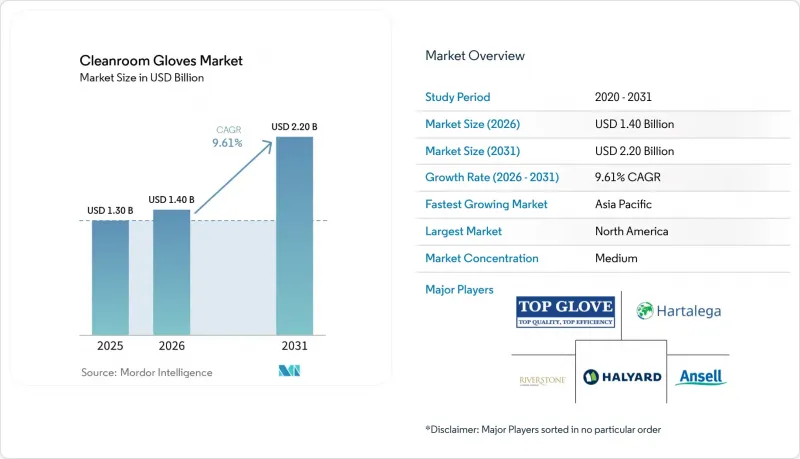
This report is Segmented by Material (Nitrile, and More), End-Use Industry (Semiconductor & Microelectronics, Pharmaceuticals, Biotechnology, Medical Device Manufacturing, Flat Panel Display & Optoelectronics, and More), Sterility (Non-Sterile, Sterile), and Geography (North America, Europe, Asia-Pacific, Middle East & Africa, South America). Market Forecasts are Provided in Terms of Value (USD).
Global Cleanroom Gloves Market Trends and Insights
Semiconductor Fab Expansions And Contamination Control Intensity
Global wafer-fab projects, typified by TSMC's USD 165 billion Phoenix complex, are scaling from 4 nm toward 2 nm geometries that tolerate fewer than 10 particles ≥0.1 µm per cubic meter. ISO Class 1-2 suites require ESD-safe, low-ion nitrile gloves to preserve yield in copper interconnects and high-k dielectrics, pushing annual glove orders into the tens of millions per megafab. SEMI forecasts a significant percentage CAGR in front-end capacity through 2028, while AI-accelerated nodes grow significantly, translating directly into longer operator hours and higher glove turnover. India's Micron ATMP plant, validated in February 2026, highlights the geographic spread of advanced packaging and the demand for additive gloves.
Biopharma Aseptic Manufacturing Tightening
Annex 1's 58-page revision and USP 797's 2023 update require glove-integrity tests at the start and end of each batch, plus quarterly fingertip sampling for high-risk compounding. Validation data showcased at the ISPE 2026 Aseptic Conference indicate a uplift in glove consumption per batch . Modular cleanrooms that commission in two weeks accelerate compliance, intensifying near-term ordering spikes in North America and Western Europe.
NBR/Acrylonitrile-Butadiene Feedstock Price Volatility
NBR spot prices hit USD 3,574/t in Japan during Q4 2025, 40% above U.S. levels, lifting the raw-material cost share to roughly 30% of glove unit economics. Top Glove and Hartalega have responded with captive latex plants and RM 300 million feedstock CAPEX to stabilize margins.
Other drivers and restraints analyzed in the detailed report include:
- Shift From Latex To Nitrile In Cleanrooms
- Growth In Cleanroom-Intensive Medical Device Manufacturing
- Qualification/Validation Lock-In Slows Supplier Switching
For complete list of drivers and restraints, kindly check the Table Of Contents.
Segment Analysis
Nitrile held 63.10% of 2025 volume, translating into the largest cleanroom gloves market size among material classes. The segment is projected to expand at a 9.95% CAGR to 2031, outpacing latex, neoprene, polyisoprene, and vinyl. The cleanroom gloves market share leader offers triple the puncture resistance of natural rubber and full compliance with IEC 61340-5-1 electrostatic thresholds that govern semiconductor and battery plants. Top Glove's halogen-free line, launched in July 2025, exemplifies innovation aimed at eliminating chlorine-based corrosion risks in sub-3 nm wafer nodes, keeping pace with ISO 14644-1 particle ceilings.
Latex continues to retreat on allergy and regulatory grounds, while polyisoprene captures surgical demand by replicating latex feel without protein allergens. Medline's 2025 SensiCare launch illustrated polyisoprene's niche ascent in oncology drug preparation thanks to superior chemotherapy permeation resistance. Neoprene remains a specialty choice for aggressive chemical exposure, while vinyl is preferred for low-risk gowning rooms where puncture strength is secondary. Hybrid synthetics like INTCO's Syntex blend nitrile and vinyl to offer a mid-priced option that meets ISO Class 7 cleanliness for general electronics assembly.
Geography Analysis
North America retained 38.19% of 2025 revenue, powered by USD 52.7 billion in CHIPS Act subsidies that catalyzed wafer-fab and advanced-packaging clusters in Arizona, Ohio, and New York. Modular cleanrooms for 503A and 503B pharmacies proliferated after the 2023 USP 797 revision, accelerating the adoption of sterile gloves among the roughly 7,500 compounding facilities nationwide. Canada leveraged medical-device nearshoring to capture incremental demand, and Mexico saw glove shipments rise as automotive battery plants introduced ISO Class 7 dry rooms.
Asia-Pacific posts the fastest trajectory, with a 10.15% CAGR projected to 2031. India's USD 18.2 billion Semiconductor Mission enabled Micron's Sanand ATMP launch in February 2026, while Malaysia's nitrile-glove majors-Hartalega, Riverstone, and Kossan expanded capacity to serve AI-driven data-center buildouts. China's 25% U.S. tariff exposure and FDA import alerts redirect procurement toward Malaysian and Thai producers, reinforcing regional supply dominance. The cleanroom gloves market in the region is further boosted by Korean and Japanese EV battery gigafactories that specify ESD-rated nitrile gloves.
Europe's growth benefits from the EU Chips Act's EUR 43 billion framework and 2023 Annex 1 enforcement. Germany, France, and the U.K. lead new biologics plants, while Scandinavian PFAS regulations are already prompting PFAS-free glove trials. Hartalega and Sempermed recently secured multi-year supply agreements with German vaccine sites, signaling supplier diversification. Eastern Europe emerges as a secondary hub for disposable-glove contract manufacturing as wage-cost differentials narrow against Southeast Asia.
Middle East & Africa and South America remain nascent in volume terms yet show isolated accelerants. Saudi Arabia's Vision 2030 pharmaceutical push includes sterile insulin-pen production lines that require ISO Class 7 gloves. Brazil's ANVISA pipeline for orthopedic implants is spurring local cleanroom upgrades, albeit from a small base. Riverstone cited RM 250.7 million in 4QFY25 cleanroom segment revenue, with Latin America and GCC deliveries on the rise, underscoring untapped geographic pockets.
- Ansell
- Cardinal Health
- CleanPro/Blue Thunder (distributors)
- CT International
- Thermo Fisher Scientific
- Halyard
- Hartalega
- Honeywell (Isolator/Glovebox)
- Kossan Rubber Industries
- Piercan
- Protective Industrial Products (QRP)
- Riverstone Holdings
- Sempermed
- SHIELD Scientific
- Showa Group
- STAXS
- Supermax
- TechNiGlove
- Top Glove
- Valutek
Additional Benefits:
- The market estimate (ME) sheet in Excel format
- 3 months of analyst support
TABLE OF CONTENTS
1 Introduction
- 1.1 Study Assumptions & Market Definition
- 1.2 Scope of the Study
2 Research Methodology
3 Executive Summary
4 Market Landscape
- 4.1 Market Overview
- 4.2 Market Drivers
- 4.2.1 Semiconductor Fab Expansions and Contamination Control Intensity
- 4.2.2 Biopharma Aseptic Manufacturing Tightening (Annex 1/USP 797)
- 4.2.3 Shift From Latex to Nitrile in Cleanrooms (Allergy, ESD, Extractables)
- 4.2.4 Growth In Cleanroom-Intensive Medical Device Manufacturing
- 4.2.5 EV Battery Dry-Room Buildouts Needing ESD-Safe Gloves
- 4.2.6 PFAS-Free and Low-Ion Formulations Opening Premium Niches
- 4.3 Market Restraints
- 4.3.1 NBR/Acrylonitrile-Butadiene Feedstock Price Volatility
- 4.3.2 Qualification/Validation Lock-In Slows Supplier Switching
- 4.3.3 Particulation/Extractables Limits Raise Costs and Scrap
- 4.3.4 Robotics And Gloveless Isolators Reducing Manual Touchpoints
- 4.4 Supply-Chain Analysis
- 4.5 Regulatory Landscape
- 4.6 Technological Outlook
- 4.7 Porter's Five Forces
- 4.7.1 Threat of New Entrants
- 4.7.2 Bargaining Power of Suppliers
- 4.7.3 Bargaining Power of Buyers
- 4.7.4 Threat of Substitutes
- 4.7.5 Competitive Rivalry
5 Market Size & Growth Forecasts (Value, USD)
- 5.1 By Material
- 5.1.1 Nitrile (NBR)
- 5.1.2 Natural Rubber (Latex)
- 5.1.3 Neoprene (Polychloroprene)
- 5.1.4 Polyisoprene
- 5.1.5 Vinyl (PVC)
- 5.2 By End-use Industry
- 5.2.1 Semiconductor & Microelectronics
- 5.2.2 Pharmaceuticals
- 5.2.3 Biotechnology
- 5.2.4 Medical Device Manufacturing
- 5.2.5 Flat Panel Display & Optoelectronics
- 5.2.6 Others
- 5.3 By Sterility
- 5.3.1 Non-sterile
- 5.3.2 Sterile
- 5.4 By Geography
- 5.4.1 North America
- 5.4.1.1 United States
- 5.4.1.2 Canada
- 5.4.1.3 Mexico
- 5.4.2 Europe
- 5.4.2.1 Germany
- 5.4.2.2 United Kingdom
- 5.4.2.3 France
- 5.4.2.4 Italy
- 5.4.2.5 Spain
- 5.4.2.6 Rest of Europe
- 5.4.3 Asia-Pacific
- 5.4.3.1 China
- 5.4.3.2 India
- 5.4.3.3 Japan
- 5.4.3.4 South Korea
- 5.4.3.5 Australia
- 5.4.3.6 Rest of Asia-Pacific
- 5.4.4 Middle East and Africa
- 5.4.4.1 GCC
- 5.4.4.2 South Africa
- 5.4.4.3 Rest of Middle East and Africa
- 5.4.5 South America
- 5.4.5.1 Brazil
- 5.4.5.2 Argentina
- 5.4.5.3 Rest of South America
- 5.4.1 North America
6 Competitive Landscape
- 6.1 Market Concentration
- 6.2 Market Share Analysis
- 6.3 Company Profiles {(includes Global level Overview, Market level overview, Core Segments, Financials as available, Strategic Information, Market Rank/Share for key companies, Products & Services, and Recent Developments)}
- 6.3.1 Ansell
- 6.3.2 Cardinal Health
- 6.3.3 CleanPro/Blue Thunder (distributors)
- 6.3.4 CT International
- 6.3.5 Thermo Fisher Scientific
- 6.3.6 Halyard
- 6.3.7 Hartalega
- 6.3.8 Honeywell (Isolator/Glovebox)
- 6.3.9 Kossan Rubber Industries
- 6.3.10 Piercan
- 6.3.11 Protective Industrial Products (QRP)
- 6.3.12 Riverstone Holdings
- 6.3.13 Sempermed
- 6.3.14 SHIELD Scientific
- 6.3.15 Showa Group
- 6.3.16 STAXS
- 6.3.17 Supermax
- 6.3.18 TechNiGlove
- 6.3.19 Top Glove Corporation
- 6.3.20 Valutek
7 Market Opportunities & Future Outlook
- 7.1 White-space & unmet-need assessment

