PUBLISHER: Mordor Intelligence | PRODUCT CODE: 2063516

PUBLISHER: Mordor Intelligence | PRODUCT CODE: 2063516
Synthetic Absorbable Sutures - Market Share Analysis, Industry Trends & Statistics, Growth Forecasts (2026 - 2031)
According to Mordor Intelligence, the synthetic absorbable sutures market size is projected to be USD 3.06 billion in 2025, USD 3.33 billion in 2026, and reach USD 5.30 billion by 2031, growing at a CAGR of 9.75% from 2026 to 2031.
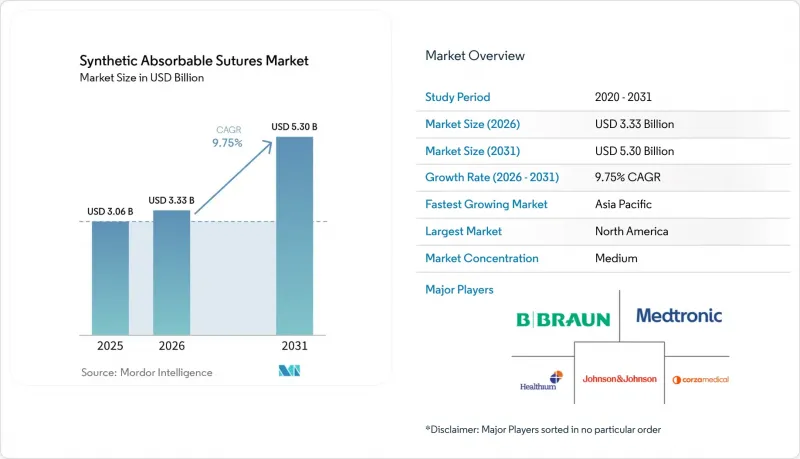
This report is Segmented by Material (Polyglactin 910, Polyglycolic Acid, Poliglecaprone 25, and More), Application (General Surgery, Orthopedic Surgery, Cardiovascular & Thoracic Surgery, Gynecology & Obstetrics, and More), End User (Hospitals, Ambulatory Surgical Centers, Specialty Clinics), and Geography (North America, and More). The Market Forecasts are Provided in Terms of Value (USD).
Global Synthetic Absorbable Sutures Market Trends and Insights
Rising Surgical Procedure Volumes And Aging Populations
Procedure counts climb as populations age and chronic disease prevalence rises. Italy performed 122,777 elective total hip arthroplasties in 2023, up 80% since 2001, and models predict a further 20% rise by 2050. India's healthcare market reached USD 638 billion in 2025, and private systems plan 34,000 new beds by FY2029, supporting more elective surgeries. Growing diabetic and cardiovascular patient pools heighten demand for absorbable closure products with controlled degradation.
Migration To Minimally Invasive And Outpatient Surgeries
Robotic and laparoscopic approaches now require monofilament or barbed sutures, reducing the number of knot-tying steps. A U.S. review of 224,307 robotic cases showed that the use of knotless devices tripled in colorectal surgery and cut operating-room time by up to 19.1 minutes, without increased complications. Ambulatory surgical centers leverage these efficiencies and benefit from reimbursement parity that drives more same-day procedures.
Competition From Staplers, Adhesives, And Energy-Based Closure
Fibrin glues could reach USD 934.68 million by 2029 and cut OR time in hernia repair, eye surgery and vascular work. Staplers speed thoracic procedures, while ultrasonic sealers remove the need for ligatures. Sutures keep their edge where tension distribution or slow absorption is vital, and vendors now bundle sutures with hemostatics to defend share.
Other drivers and restraints analyzed in the detailed report include:
- Adoption Of Antibacterial Absorbable Sutures To Cut SSI Risk
- Rapid Uptake Of Knotless/Barbed Absorbable Sutures In Robotic/MIS Closures
- Tender-Driven Price Pressure And Commoditization
For complete list of drivers and restraints, kindly check the Table Of Contents.
Segment Analysis
Polyglactin 910 accounted for 34.58% of 2025 revenue in the synthetic absorbable sutures market. The material's braided structure assures knot security, but its surface harbors bacteria. Surgeons are now pivoting toward monofilaments such as Poliglecaprone 25, forecast to grow at a 10.54% CAGR. This shift underpins the long-term expansion of the synthetic absorbable sutures market size among minimally invasive closures. Polydioxanone retains a premium niche in orthopedic and cardiovascular work because its 180-day retention profile supports tissue remodeling.
Innovation centers on antimicrobial layering and barbed geometry: Meril's 2024 New Edge Sutures fuse silicon multi-coating with a patented point to lessen tissue drag. Research into chlorhexidine-impregnated glycomer 631 threads signals next-wave differentiation.
Geography Analysis
North America accounted for 46.46% of 2025 revenue, with the United States relying on antibacterial and barbed products to mitigate infection penalties under value-based purchasing . EPA's 90% ethylene oxide cut widens interest in hydrogen peroxide sterilization, yet may raise costs in the near term.
Europe shows mature procedure volumes; centralized tenders squeeze prices, but MDR barriers shelter established brands. B. Braun's Aesculap unit posted EUR 2.16 billion (USD 2.54 billion) in revenue and is pushing barbed Symmcora lines alongside biosurgicals. Asia-Pacific is the fastest-growing region at a 10.01% CAGR. India's med-tech push and Healthium's new plant in Sri City illustrate OEM capacity gains and export ambitions. Chinese tender systems favor domestic labels, while Japan and Australia retain premium barbed uptake. The Middle East & Africa and South America contribute smaller shares, but pockets such as GCC cesarean demand and Brazilian obstetrics sustain volume where currency swings permit.
- Advanced Medical Solutions
- Atramat
- B. Braun Melsungen AG.
- Corza Medical
- DemeTECH
- Dolphin Sutures
- Healthium Medtech
- Johnson & Johnson
- Katsan
- MANI, Inc.
- Medtronic
- Meril Life Sciences
- Peters Surgical
- Riverpoint Medical
- SERAG-WIESSNER
- SMI AG
- Teleflex Medical OEM
- Universal Sutures
Additional Benefits:
- The market estimate (ME) sheet in Excel format
- 3 months of analyst support
TABLE OF CONTENTS
1 Introduction
- 1.1 Study Assumptions & Market Definition
- 1.2 Scope of the Study
2 Research Methodology
3 Executive Summary
4 Market Landscape
- 4.1 Market Overview
- 4.2 Market Drivers
- 4.2.1 Rising Surgical Procedure Volumes and Aging Populations
- 4.2.2 Migration To Minimally Invasive and Outpatient Surgeries
- 4.2.3 Adoption Of Antibacterial Absorbable Sutures to Cut the SSI Risk
- 4.2.4 Orthopedic And Cardiovascular Surgery Burden Expanding, and Closure Demand
- 4.2.5 Rapid Uptake of Knotless/Barbed Absorbable Sutures in Robotic/MIS Closures
- 4.2.6 OEM/Private-Label Capacity in EMS Accelerating Synthetic Absorbable Penetration
- 4.3 Market Restraints
- 4.3.1 Competition From Staplers, Adhesives, And Energy-Based Closure
- 4.3.2 Tender-Driven Price Pressure and Commoditization
- 4.3.3 Regulatory Scrutiny of Triclosan and Divergent Hospital Antimicrobial Policies
- 4.3.4 EtO sterilization rules are raising compliance costs and lead-time risks
- 4.4 Supply-Chain Analysis
- 4.5 Regulatory Landscape
- 4.6 Technological Outlook
- 4.7 Porter's Five Forces Analysis
- 4.7.1 Threat of New Entrants
- 4.7.2 Bargaining Power of Suppliers
- 4.7.3 Bargaining Power of Buyers
- 4.7.4 Threat of Substitutes
- 4.7.5 Competitive Rivalry
5 Market Size & Growth Forecasts (Value, USD)
- 5.1 By Material
- 5.1.1 Polyglactin 910 (PGLA 910)
- 5.1.2 Polyglycolic Acid (PGA)
- 5.1.3 Poliglecaprone 25 (PGCL)
- 5.1.4 Polydioxanone (PDO)
- 5.1.5 Polyglyconate
- 5.1.6 Glycomer 631
- 5.2 By Application
- 5.2.1 General Surgery
- 5.2.2 Orthopedic Surgery
- 5.2.3 Cardiovascular & Thoracic Surgery
- 5.2.4 Gynecology & Obstetrics
- 5.2.5 Gastrointestinal & Colorectal
- 5.2.6 Plastic & Reconstructive
- 5.2.7 Other Applications
- 5.3 By End User
- 5.3.1 Hospitals
- 5.3.2 Ambulatory Surgical Centers (ASCs)
- 5.3.3 Specialty Clinics
- 5.4 By Geography
- 5.4.1 North America
- 5.4.1.1 United States
- 5.4.1.2 Canada
- 5.4.1.3 Mexico
- 5.4.2 Europe
- 5.4.2.1 Germany
- 5.4.2.2 United Kingdom
- 5.4.2.3 France
- 5.4.2.4 Italy
- 5.4.2.5 Spain
- 5.4.2.6 Rest of Europe
- 5.4.3 Asia Pacific
- 5.4.3.1 China
- 5.4.3.2 Japan
- 5.4.3.3 India
- 5.4.3.4 Australia
- 5.4.3.5 South Korea
- 5.4.3.6 Rest of Asia Pacific
- 5.4.4 Middle East and Africa
- 5.4.4.1 GCC
- 5.4.4.2 South Africa
- 5.4.4.3 Rest of Middle East and Africa
- 5.4.5 South America
- 5.4.5.1 Brazil
- 5.4.5.2 Argentina
- 5.4.5.3 Rest of South America
- 5.4.1 North America
6 Competitive Landscape
- 6.1 Market Concentration
- 6.2 Market Share Analysis
- 6.3 Company Profiles (includes Global level Overview, Market Level Overview, Core Segments, Financials as Available, Strategic Information, Market Rank/Share for Key Companies, Products & Services, and Recent Developments)
- 6.3.1 Advanced Medical Solutions
- 6.3.2 Atramat
- 6.3.3 B. Braun Melsungen AG.
- 6.3.4 Corza Medical
- 6.3.5 DemeTECH Corporation
- 6.3.6 Dolphin Sutures
- 6.3.7 Healthium Medtech
- 6.3.8 Johnson & Johnson
- 6.3.9 Katsan
- 6.3.10 MANI, Inc.
- 6.3.11 Medtronic Inc.
- 6.3.12 Meril Life Sciences
- 6.3.13 Peters Surgical
- 6.3.14 Riverpoint Medical
- 6.3.15 SERAG-WIESSNER
- 6.3.16 SMI AG
- 6.3.17 Teleflex Medical OEM
- 6.3.18 Universal Sutures
7 Market Opportunities & Future Outlook
- 7.1 White-space & Unmet-need Assessment

