PUBLISHER: Mordor Intelligence | PRODUCT CODE: 2063548

PUBLISHER: Mordor Intelligence | PRODUCT CODE: 2063548
Medical Fluid Bags - Market Share Analysis, Industry Trends & Statistics, Growth Forecasts (2026 - 2031)
According to Mordor Intelligence, the medical fluid bags market size is projected to expand from USD 4.15 billion in 2025 and USD 4.37 billion in 2026 to USD 5.85 billion by 2031, registering a CAGR of 5.99% between 2026 to 2031.
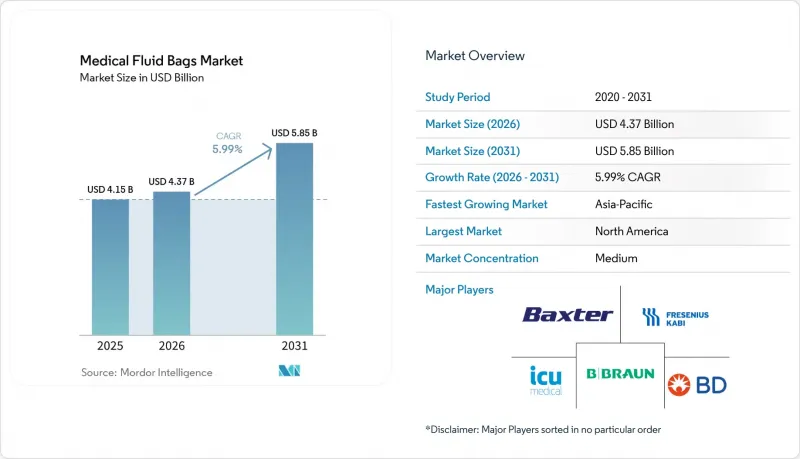
This report is Segmented by Product Type (Intravenous Bags, and More), Material (PVC DEHP-Plasticized and DEHP-Free, and More), Capacity (Up To 250 ML, and More), Chamber Type (Single-Chamber, and More), End User (Hospitals, and More), and Geography (North America, Europe, Asia-Pacific, Middle East and Africa, South America). The Market Forecasts are Provided in Terms of Value (USD).
Global Medical Fluid Bags Market Trends and Insights
Rising Surgical Volumes and Chronic Disease Burden Increasing IV Therapy, Transfusion and Dialysis Utilization
The medical fluid bags market continues to benefit from the persistent rise in chronic conditions that require controlled fluid therapy, dialysis solutions, and blood component transfusions. Hospitals and outpatient centers depend on reliable IV hydration and electrolyte management during and after procedures, which sustains the baseline for daily bag consumption across care settings. Growth in dialysis and infusion therapy in ambulatory and home environments expands the use cases for standardized bag formats and durable connectors that simplify administration. As care shifts earlier in the recovery pathway, formulary committees and clinical teams are standardizing kits and labeling conventions to reduce administration errors and speed bedside workflows. Reimbursement policy remains a strong determinant of use patterns, and when reimbursement rules favor out-of-hospital care, suppliers that align product design to caregiver ease-of-use tend to gain share within the medical fluid bags market.
Expansion of Ambulatory Surgery and Home-Care Shifting Demand to Flexible, Lightweight Bag Formats
Ambulatory surgery growth drives demand for lightweight, portable, prefilled systems that can integrate into short-stay recovery and safe discharge protocols the same day. Home infusion and long-term care growth favor flexible designs with secure ports, color coding, and clear volume markings that non-clinical caregivers can handle without compromising asepsis. These design preferences lift adoption of formats that enhance tamper evidence and reduce backflow while maintaining compatibility with pumps and gravity sets common in home-care inventory. Device makers that improve clarity of labels and implement intuitive connectors reduce training time and errors for rotating staff and family caregivers. This shift continues to influence capacity choices and chamber configurations as the medical fluid bags market adapts to lower-acuity care settings with different handling and storage constraints.
Complex Sterile Manufacturing, Validation and Regulatory Compliance Raising Cost and Time-to-Market
Sterile barrier integrity and process validation expectations add cost and time to new product introductions and line changes, which can delay commercialization. Packaging validations and seal performance qualifications drive repeat testing whenever materials, equipment, or process parameters change, and gaps in documentation or challenge conditions can prompt remediation before release. In parallel, new emission limits for EtO sterilization require capital projects to add controls like permanent total enclosures and continuous monitoring, which diverts budgets from R&D and slows throughput during installation. For multi-site manufacturers, staggered retrofits reduce systemic risk, but local bottlenecks still occur as chambers go offline for upgrades. These realities raise the compliance threshold for smaller firms and favor players with established quality systems and sterilization partnerships in the medical fluid bags market.
Other drivers and restraints analyzed in the detailed report include:
- Material Shift to Non-PVC, DEHP-Free Formats Accelerating Replacement Demand in Mature Markets
- Aging Population Elevating Incidence of Urinary Incontinence and Transfusion Needs
- PVC Disposal and Leachables Scrutiny and Resin Price Volatility Pressuring Margins
For complete list of drivers and restraints, kindly check the Table Of Contents.
Segment Analysis
Intravenous bags commanded 42.90% share in 2025 as the default modality for hydration and electrolyte management across emergency, surgical, and infusion settings in the medical fluid bags market. This foundation keeps line utilization steady while niche categories grow into specialized roles aligned to therapy protocols. Parenteral nutrition bags, supported by standardized multi-chamber formats, are projected to grow at 7.34% CAGR as clinical teams consolidate compounding steps into ready-to-activate designs that cut error risk and preparation time. Hospitals standardize around integrated compartments for lipids, amino acids, and glucose, which also improve distribution efficiency and simplify bedside activation procedures. Blood collection and storage bags remain essential to component processing and inventory management, while dialysis solution and urinary drainage bags align to chronic-care pathways in inpatient and home settings.
The medical fluid bags market reflects procurement preferences that reward validated quality systems and consistent delivery performance, which supports incumbents with global manufacturing and service footprints. Enteral feeding and surgical drainage bags play targeted roles tied to oncology, gastroenterology, and post-surgical care where single-use norms remain non-negotiable. Buyers emphasize labeling clarity, tamper-evident seals, and compatibility with existing pumps and accessories to minimize change-management overhead. Packaging and sterile barrier validations remain a gating factor for product switch-outs, which tempers the speed of change in busy hospital pharmacies. Over the forecast period, the medical fluid bags market will likely see continued adoption of TPN kits that address infection control and cost-to-serve, while legacy IV solutions continue to anchor everyday fluid therapy across care settings.
PVC, both DEHP-plasticized and DEHP-free variants, held 46.23% share in 2025 due to long clinical familiarity and straightforward seal compatibility in the medical fluid bags market. At the same time, polyolefin multilayer co-extrusions are projected to grow at 8.65% CAGR as hospitals and national bodies emphasize low-extractables profiles and alternatives to phthalates in sensitive populations. California's ban of DEHP in specified medical devices beginning 2030 intensifies planning for non-PVC lines, with procurement teams pushing earlier conversions in neonatal and maternal care pathways. Clinical data also show far lower migration into lipid-containing solutions when alternative plasticizers or polyolefin substrates are used, which supports long-horizon decisions that prioritize biocompatibility.
Tooling and process transitions from PVC to multilayer PP or PE demand recalibration of extrusion, sealing, and port welding, which raises upfront costs before scale benefits arrive. EVA retains a role where chemical compatibility and clarity are decisive, while elastomeric blends and copolyesters see use in high-stress applications like blood component processing. EU device rules that restrict CMR substances add to the compliance case for non-phthalate formulations within the remaining PVC cohort. Taken together, safety profiles, regulatory direction, and total cost-of-ownership calculations are moving a larger share of the medical fluid bags market toward polyolefin and non-phthalate platforms across routine and specialty applications.
Geography Analysis
North America held 45.34% share of the medical fluid bags market in 2025, supported by entrenched hospital networks, broad adoption of validated non-PVC lines for sensitive patient groups, and supply-chain initiatives that reduce exposure to single-site risk. States that implement material restrictions and sustainability requirements are nudging hospitals toward phthalate-free options, and California's device-focused DEHP ban is a visible example guiding procurement calendars. The region faces near-term sterilization retrofit activity as commercial sterilizers install emissions controls, and these projects can create temporary allocation environments that increase the value of multi-site capacity and diversified contract sterilization partnerships. Investment decisions are shaped by the need for supply assurance, which has led to new onshore capacity commitments and targeted government support to reduce import dependence for critical fluids. These elements together reinforce the role of quality systems and delivery performance in contract awards across the medical fluid bags market.
In Europe, MDR enforcement and chemical safety reviews reinforce a gradual pivot away from phthalate-containing PVC toward compliant chemistries and polyolefin multilayers. These regulations often require deeper documentation on extractables and leachables, which favors suppliers with robust testing programs and stability data. Procurement teams also weigh lifecycle environmental impacts in tender scoring, stimulating interest in recyclable substrates or designs with reduced additive loadings. With device-makers updating portfolios to meet evolving expectations, buyers place value on backward compatibility with existing hardware to limit training and capital needs. The overall effect is a steady rationalization of product lines to those that meet European compliance norms and sustainability priorities within the medical fluid bags market.
Asia-Pacific is projected to expand at 8.01% CAGR through 2031 as domestic manufacturing capacity matures and governments support local production to strengthen healthcare resilience. Expanded dialysis use and nutrition therapy in fast-urbanizing centers will continue to influence capacity mixes and product formats. Regional producers are scaling non-PVC lines and applying international quality frameworks to qualify for tenders across public and private channels. Distribution models in large countries remain decisive, and players that match product to regional clinician preferences and logistics requirements can gain quicker traction. The medical fluid bags market in Asia-Pacific also benefits from ongoing investment in hospital infrastructure and the spread of home-care programs in higher-income economies within the region.
- Amsino International, Inc.
- B. Braun
- Baxter
- Beckton Dickinson
- Cardinal Health
- Coloplast
- Convatec
- Fresenius
- Grifols
- ICU Medical
- JW Life Science Corp.
- MacoPharma
- Medline Industries
- Nipro
- Otsuka
- Poly Medicure Ltd.
- PolyCine GmbH
- Sippex IV Bag
- Technoflex
- Teleflex
- Terumo
Additional Benefits:
- The market estimate (ME) sheet in Excel format
- 3 months of analyst support
TABLE OF CONTENTS
1 Introduction
- 1.1 Study Assumptions & Market Definition
- 1.2 Scope of the Study
2 Research Methodology
3 Executive Summary
4 Market Landscape
- 4.1 Market Overview
- 4.2 Market Drivers
- 4.2.1 Rising surgical volumes and chronic disease burden increasing IV therapy, transfusion and dialysis utilization
- 4.2.2 Expansion of ambulatory surgery and home-care shifting demand to flexible, lightweight bag formats
- 4.2.3 Material shift to non-PVC, DEHP-free formats accelerating replacement demand in mature markets
- 4.2.4 Aging population elevating incidence of urinary incontinence and transfusion needs
- 4.2.5 EPA 2024 EtO sterilizer standards catalyzing retooling and alternative-sterilant ready bag adoption
- 4.2.6 EU REACH/MDR phthalate (DEHP) authorization timeline driving non-PVC conversion programs
- 4.3 Market Restraints
- 4.3.1 Complex sterile manufacturing, validation and regulatory compliance raising cost and time-to-market
- 4.3.2 PVC disposal/leachables scrutiny and resin price volatility pressuring margins
- 4.3.3 Sterilization capacity constraints during EtO retrofits risk intermittent supply bottlenecks
- 4.3.4 EVA/PP resin supply concentration and tariff exposure elevating input cost risk
- 4.4 Supply-Chain Analysis
- 4.5 Regulatory Landscape
- 4.6 Technological Outlook
- 4.7 Porter's Five Forces
- 4.7.1 Threat of New Entrants
- 4.7.2 Bargaining Power of Suppliers
- 4.7.3 Bargaining Power of Buyers
- 4.7.4 Threat of Substitutes
- 4.7.5 Industry Rivalry
5 Market Size & Growth Forecasts (Value, USD)
- 5.1 By Product Type
- 5.1.1 Intravenous (IV) bags
- 5.1.2 Parenteral nutrition (TPN) bags
- 5.1.3 Enteral feeding bags
- 5.1.4 Blood collection and storage bags
- 5.1.5 Urinary drainage bags (leg, bedside)
- 5.1.6 Dialysis/peritoneal dialysis solution bags
- 5.1.7 Surgical/wound drainage and suction canister liners
- 5.1.8 Enema/irrigation bags
- 5.2 By Material
- 5.2.1 PVC (DEHP-plasticized; DEHP-free)
- 5.2.2 Polyolefin multilayer (PP/PE co-extrusions)
- 5.2.3 EVA (ethylene-vinyl acetate)
- 5.2.4 Copolyester ether (COPE)
- 5.2.5 Thermoplastic elastomers (TPU/TPE)
- 5.3 By Capacity
- 5.3.1 Up to 250 mL
- 5.3.2 250-500 mL
- 5.3.3 500-1,000 mL
- 5.3.4 Above 1,000 mL
- 5.4 By Chamber Type
- 5.4.1 Single-chamber
- 5.4.2 Dual-chamber
- 5.4.3 Triple / Multi-chamber
- 5.5 By End User
- 5.5.1 Hospitals (tertiary/community)
- 5.5.2 Ambulatory surgical centers
- 5.5.3 Blood banks / transfusion centers
- 5.5.4 Home healthcare / long-term care
- 5.5.5 Clinics & physician offices
- 5.6 By Geography
- 5.6.1 North America
- 5.6.1.1 United States
- 5.6.1.2 Canada
- 5.6.1.3 Mexico
- 5.6.2 Europe
- 5.6.2.1 Germany
- 5.6.2.2 United Kingdom
- 5.6.2.3 France
- 5.6.2.4 Italy
- 5.6.2.5 Spain
- 5.6.2.6 Rest of Europe
- 5.6.3 Asia-Pacific
- 5.6.3.1 China
- 5.6.3.2 Japan
- 5.6.3.3 India
- 5.6.3.4 Australia
- 5.6.3.5 South Korea
- 5.6.3.6 Rest of Asia-Pacific
- 5.6.4 Middle East and Africa
- 5.6.4.1 GCC
- 5.6.4.2 South Africa
- 5.6.4.3 Rest of Middle East and Africa
- 5.6.5 South America
- 5.6.5.1 Brazil
- 5.6.5.2 Argentina
- 5.6.5.3 Rest of South America
- 5.6.1 North America
6 Competitive Landscape
- 6.1 Market Concentration
- 6.2 Market Share Analysis
- 6.3 Company Profiles {(includes Global level Overview, Market level overview, Core Segments, Financials as available, Strategic Information, Market Rank/Share for key companies, Products & Services, and Recent Developments)}
- 6.3.1 Amsino International, Inc.
- 6.3.2 B. Braun Melsungen AG
- 6.3.3 Baxter International Inc.
- 6.3.4 Becton, Dickinson and Company (BD)
- 6.3.5 Cardinal Health
- 6.3.6 Coloplast A/S
- 6.3.7 ConvaTec Group PLC
- 6.3.8 Fresenius Kabi AG
- 6.3.9 Grifols S.A.
- 6.3.10 ICU Medical, Inc.
- 6.3.11 JW Life Science Corp.
- 6.3.12 Macopharma
- 6.3.13 Medline Industries, LP
- 6.3.14 Nipro Corporation
- 6.3.15 Otsuka Pharmaceutical Co., Ltd.
- 6.3.16 Poly Medicure Ltd.
- 6.3.17 PolyCine GmbH
- 6.3.18 Sippex IV Bag
- 6.3.19 Technoflex
- 6.3.20 Teleflex Incorporated
- 6.3.21 Terumo Corporation
7 Market Opportunities & Future Outlook
- 7.1 White-space & unmet-need assessment

