PUBLISHER: Mordor Intelligence | PRODUCT CODE: 2063555

PUBLISHER: Mordor Intelligence | PRODUCT CODE: 2063555
Smart Patches - Market Share Analysis, Industry Trends & Statistics, Growth Forecasts (2026 - 2031)
According to Mordor Intelligence, the smart patches market size is expected to grow from USD 10.32 billion in 2025 to USD 10.97 billion in 2026 and is forecast to reach USD 15.15 billion by 2031 at 6.67% CAGR over 2026-2031.
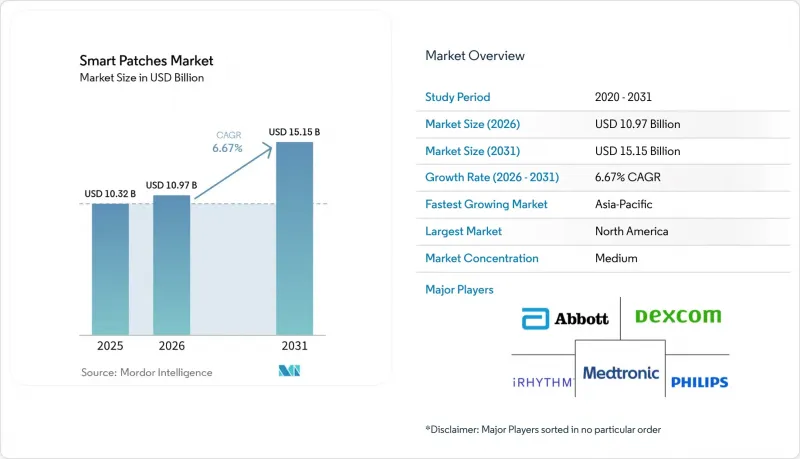
This report is Segmented by Type (Monitoring Patches, and More), Application (Diabetes Management, Cardiac Monitoring, Temperature Surveillance, Multiparameter RPM, and More), End-User (Hospitals & Clinics, Home Care, Ambulatory Centers, Sports & Fitness), and Geography (North America, Europe, Asia-Pacific, Middle East & Africa, South America). Market Forecasts are Provided in Terms of Value (USD).
Global Smart Patches Market Trends and Insights
RPM Reimbursement and Telehealth Expansion Sustain Continuous, At-Home Monitoring Adoption
New U.S. RPM codes (99445, 99470), effective January 2026, let providers bill for patch-transmitted respiratory, activity, and multi-parameter data, broadening billable services beyond glucose and blood pressure. Federal telehealth flexibilities, extended through 2027, allow clinicians to start RPM without in-person visits, fueling hospital-at-home models that rely on continuous patch data. Large health-system pilots such as Penn Medicine's PATH program report reduced readmissions and lower bed-day utilization when patches stream vitals to command centers. Private payers have started mirroring Medicare coverage, turning wearable monitoring into a routine revenue stream for providers. The reimbursement framework repositions patches from wellness gadgets to reimbursable clinical endpoints, removing a primary adoption barrier.
Diabetes and Cardiovascular Disease Burden Shifts Monitoring to Skin Patches and CGMs
Global intensive-insulin populations exceed 11 million, yet automated insulin delivery adoption remains under 15%, leaving large headroom for integrated glucose-sensing pumps. Abbott recorded USD 1.7 billion in CGM revenue in 1Q 2025, and Dexcom forecasted USD 4.6 billion full-year sales, underscoring robust demand. Parallel cardiac-monitoring growth is evident in the 2024 FDA clearance of Medtronic's LINQ II insertable cardiac monitor, enabling long-term arrhythmia detection. Overlapping diabetic and cardiac cohorts benefit from multi-parameter patches, prompting vendors to fuse glucose, electrocardiogram, and accelerometry on one adhesive. Clinical studies linking CGM use to lower HbA1c and reduced hospitalization intensify payer willingness to reimburse skin-worn sensors.
Adhesive-Related Skin Irritation and MARSI Limit Wear Time and Compliance
Medical-adhesive skin injury remains the most cited adverse event in wearable-patch trials, presenting as erythema or epidermal stripping that forces premature removal. Silicone gels mitigate irritation but provide weaker initial tack than acrylics, requiring skin-prep steps that deter consumer use. A 2026 npj Flexible Electronics study showed polyurethane-blended nanomesh electrodes retained adhesion after six hours of water flow, while only one-third of poly(vinyl alcohol) electrodes remained functional. Manufacturers must balance secure adhesion with dermatologic tolerance in the absence of standardized MARSI testing, complicating claims for wear beyond seven days.
Other drivers and restraints analyzed in the detailed report include:
- OTC CGMs Expand TAM Beyond Insulin Users, Catalyzing Consumer and Primary-Care Uptake
- Hospital-at-Home and Early-Discharge Pathways Standardize Patch-Based Vitals Monitoring
- Cybersecurity and Privacy Compliance Increase Cost and Integration Complexity
For complete list of drivers and restraints, kindly check the Table Of Contents.
Segment Analysis
Monitoring patches accounted for 54.21% of 2025 revenue, anchored by CGM flagships such as Abbott Libre and Dexcom G7. The drug-delivery subset of the smart patches market is on track for an 8.23% CAGR as microneedle vaccines, transdermal analgesics, and patch pumps integrate sensing and therapy. Medtronic's MiniMed 780G paired with Abbott's Instinct sensor in early 2026 represents the first open-platform insulin pump-plus-CGM, demonstrating a pathway for cross-vendor therapeutic ecosystems.
The smart patches market size allocated to drug delivery is projected to climb steadily as combination-product exclusivity attracts investment. Electrical-stimulation patches, though still niche, are gaining physician adoption for opioid-sparing pain management. Integrated platforms cut device burden for multi-morbidity patients, unifying consumables and data flows. Combination-product regulation extends timelines but offers competitive moats, encouraging capital allocation toward microneedle manufacturing scale-up. With polymer-semiconductor research now enabling low-power logic on flexible substrates, drug-delivery patches are well positioned to embed closed-loop algorithms that titrate dosing in real time.
Geography Analysis
North America commanded 46.90% of 2025 revenue, aided by Medicare RPM payments, OTC CGM launches, and hospital-at-home adoption. The smart patches market size in Asia-Pacific is expected to log the fastest advance, expanding at 8.23% CAGR through 2031. Regional approvals, such as South Korea MFDS clearance for HLB Lifecare's 15-day Picoling CGM and China NMPA authorization for Sibionics GS3, enable domestic vendors to undercut Western incumbents on form factor and price.
European growth trails as companies grapple with Medical Device Regulation conformity and new battery mandates that prolong redesign cycles. Germany's DiGA pathway reimburses Class IIa patches, yet uptake centers on diabetes and arrhythmia use cases. Emerging markets in South America and the Middle East rely on CE marks for quick entry but lack robust reimbursement, dampening volume. Asia-Pacific's chronic-disease base stands to leapfrog clinic-centric pathways by adopting direct-to-consumer CGMs through e-commerce and primary-care networks. India's 2026 clearance of MicroTech Medical's LinX CGM hints at broader regional momentum, though integration with insulin pumps remains nascent. Vendors attuned to local pricing and smartphone ecosystems are best placed to capture share in the fastest-growing geography of the smart patches market.
- Abbott Laboratories
- Blue Spark Technologies
- Dexcom
- Epicore Biosystems, Inc.
- GE Healthcare
- G-Tech Medical, Inc.
- iRhythm Technologies
- Isansys Lifecare Ltd.
- Koninklijke Philips
- Medtronic
- Nemaura Medical, Inc.
- Sensium Healthcare
- SmartCardia SA
- VitalConnect, Inc.
- VivaLNK, Inc.
Additional Benefits:
- The market estimate (ME) sheet in Excel format
- 3 months of analyst support
TABLE OF CONTENTS
1 Introduction
- 1.1 Study Assumptions & Market Definition
- 1.2 Scope of the Study
2 Research Methodology
3 Executive Summary
4 Market Landscape
- 4.1 Market Overview
- 4.2 Market Drivers
- 4.2.1 RPM Reimbursement and Telehealth Expansion Sustain Continuous, At-Home Monitoring Adoption
- 4.2.2 Diabetes And Cardiovascular Disease Burden Shifts Monitoring to Skin Patches and CGMs
- 4.2.3 OTC CGMs Expand TAM Beyond Insulin Users, Catalyzing Consumer and Primary-Care Uptake
- 4.2.4 Hospital-At-Home and Early-Discharge Pathways Standardize Patch-Based Vitals Monitoring
- 4.2.5 FDA DHT Guidance Normalizes Patch Data in Clinical Trials and Endpoints
- 4.2.6 Miniaturized, Flexible Electronics and Long-Wear Adhesives Unlock Multi-Day Comfort
- 4.3 Market Restraints
- 4.3.1 Adhesive-Related Skin Irritation and MARSI Limit Wear Time and Compliance
- 4.3.2 Cybersecurity and Privacy Compliance Increase Cost and Integration Complexity
- 4.3.3 RF Coexistence and EMC Issues in Hospitals Risk Data Loss or Alarms
- 4.3.4 EU Battery Rules Drive Redesigns (Removability/Labeling), Raising Compliance Burden
- 4.4 Supply-Chain Analysis
- 4.5 Regulatory Landscape
- 4.6 Technological Outlook
- 4.7 Porter's Five Forces
- 4.7.1 Threat of New Entrants
- 4.7.2 Bargaining Power of Suppliers
- 4.7.3 Bargaining Power of Buyers
- 4.7.4 Threat of Substitutes
- 4.7.5 Industry Rivalry
5 Market Size & Growth Forecasts (Value, USD)
- 5.1 By Type
- 5.1.1 Monitoring Patches (vitals, CGM, ECG)
- 5.1.2 Drug Delivery Patches (transdermal, microneedle, patch pumps)
- 5.1.3 Electrical Stimulation Patches (neuromodulation/TENS)
- 5.2 By Application
- 5.2.1 Diabetes Management (CGM)
- 5.2.2 Cardiac Monitoring / Arrhythmia Detection (ECG)
- 5.2.3 Temperature / Fever & Infection Surveillance
- 5.2.4 Multiparameter RPM (home and ambulatory)
- 5.2.5 Wound Monitoring & Post-operative Care
- 5.2.6 Clinical Trials Data Capture (decentralized)
- 5.3 By End-User
- 5.3.1 Hospitals & Clinics
- 5.3.2 Home Care Settings
- 5.3.3 Ambulatory/Diagnostic & Cardiac Centers
- 5.3.4 Sports & Fitness / Workforce Health
- 5.4 By Geography
- 5.4.1 North America
- 5.4.1.1 United States
- 5.4.1.2 Canada
- 5.4.1.3 Mexico
- 5.4.2 Europe
- 5.4.2.1 Germany
- 5.4.2.2 France
- 5.4.2.3 United Kingdom
- 5.4.2.4 Italy
- 5.4.2.5 Spain
- 5.4.2.6 Rest of Europe
- 5.4.3 Asia-Pacific
- 5.4.3.1 China
- 5.4.3.2 India
- 5.4.3.3 Japan
- 5.4.3.4 South Korea
- 5.4.3.5 Australia
- 5.4.3.6 Rest of Asia-Pacific
- 5.4.4 Middle East and Africa
- 5.4.4.1 GCC
- 5.4.4.2 South Africa
- 5.4.4.3 Rest of Middle East and Africa
- 5.4.5 South America
- 5.4.5.1 Brazil
- 5.4.5.2 Argentina
- 5.4.5.3 Rest of South America
- 5.4.1 North America
6 Competitive Landscape
- 6.1 Market Concentration
- 6.2 Market Share Analysis
- 6.3 Company Profiles {(includes Global level Overview, Market level overview, Core Segments, Financials as available, Strategic Information, Market Rank/Share for key companies, Products & Services, and Recent Developments)}
- 6.3.1 Abbott Laboratories
- 6.3.2 Blue Spark Technologies
- 6.3.3 Dexcom, Inc.
- 6.3.4 Epicore Biosystems, Inc.
- 6.3.5 GE HealthCare
- 6.3.6 G-Tech Medical, Inc.
- 6.3.7 iRhythm Technologies, Inc.
- 6.3.8 Isansys Lifecare Ltd.
- 6.3.9 Koninklijke Philips N.V.
- 6.3.10 Medtronic plc
- 6.3.11 Nemaura Medical, Inc.
- 6.3.12 Sensium Healthcare
- 6.3.13 SmartCardia SA
- 6.3.14 VitalConnect, Inc.
- 6.3.15 VivaLNK, Inc.
7 Market Opportunities & Future Outlook
- 7.1 White-space & unmet-need assessment

