PUBLISHER: Mordor Intelligence | PRODUCT CODE: 2063576

PUBLISHER: Mordor Intelligence | PRODUCT CODE: 2063576
Epidermolysis Bullosa Therapeutics - Market Share Analysis, Industry Trends & Statistics, Growth Forecasts (2026 - 2031)
According to Mordor Intelligence, the epidermolysis bullosa therapeutics market size is projected to be USD 1.31 billion in 2025, USD 1.42 billion in 2026, and reach USD 2.13 billion by 2031, growing at a CAGR of 8.53% from 2026 to 2031.
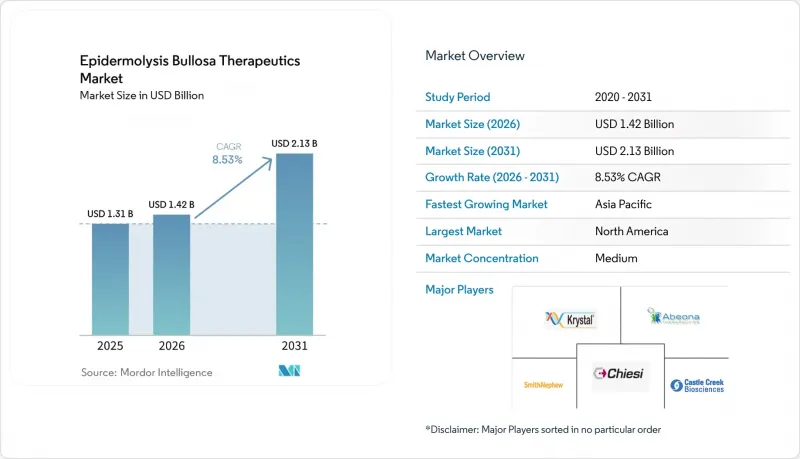
This report is Segmented by Disease Type (Epidermolysis Bullosa Simplex, Dystrophic EB, and More), Therapeutic Modality (Gene Therapy, Cell-Based Therapy, and More), Treatment Setting (Hospital-Based Care, Specialty Outpatient, and More), Age Group (Pediatric, Adult), and Geography (North America, Europe, Asia-Pacific, and More). The Market Forecasts are Provided in Terms of Value (USD).
Global Epidermolysis Bullosa Therapeutics Market Trends and Insights
FDA approval of VYJUVEK gene therapy
Label expansion in September 2025allowed VYJUVEK use from birth and permitted at-home administration by patients or caregivers under healthcare provider oversight, which widened the eligible population and reduced clinic visit frequency for qualified families Caregiver time in severe dystrophic EB is a significant friction point and has historically reached high weekly hour commitments, so enabling at-home application supports the shift toward home-based care and aligns with payer preferences that favor reduced caregiver burden. VYJUVEK demonstrated strong commercial traction in 2025, with reported quarterly revenue of USD 97.8 million and more than 615 U.S. reimbursement approvals by Q3 2025 as international launches progressed in Germany, France, and Japan. France's Haute Autorite de Sante assigned an ASMR III designation in October 2025, which validates the therapy's clinical contribution while channeling access through early-reimbursement programs that balance speed and fiscal discipline. Germany's benefit assessment and pricing process under AMNOG continued into late 2026, emphasizing evidence standards and patient-relevant outcomes that shape final price negotiations. Japan's October 2025 launch followed a cost-effectiveness premium approach under national health insurance, providing a framework that supports access while preserving robust manufacturer margins.
Orphan-drug incentives expanding commercialization runway
U.S. orphan-drug policy and the Rare Pediatric Disease pathway continue to anchor investment flows into ultra-rare dermatology and enable multiple value streams, including transferable Priority Review Vouchers that can be sold to extend operating runways or offset capital needs. Sponsors reported monetization outcomes that funded commercialization readiness and next-wave clinical work, reinforcing the financial logic behind first-mover strategies in indications with very small addressable patient pools . Seven-year market exclusivity limits direct price competition in the initial launch window, which creates predictable revenue curves and encourages evidence investments that support label expansion and line extensions. EMA orphan designation confers fee reductions and scientific advice that may compress development timelines, increasing the appeal of EU engagement for EB programs with clear genetic mechanisms. The UK's Early Access to Medicines Scheme provides managed access for promising therapies before full licensing, which can accelerate real-world data accrual relevant for later pricing rounds and broader rollouts. U.S. tax credits under Internal Revenue Code Section 45C enable sponsors to claim a portion of qualified clinical testing expenses, an incentive that supports late-stage study execution and regulatory preparation for orphan therapies.
High therapy cost & reimbursement hurdles
One-time autologous cell-based gene therapies launched with list prices in the multi-million-dollar range, which concentrates payer scrutiny on durability, re-treatment risk, and outcomes-based safeguards that share financial risk over time. Redosing gene therapies priced per vial with annualized dosing plans shift budget impact from a single upfront payment to recurring annual expense, and sponsors have disclosed per-vial pricing and annual caps designed to fit payer budget models for rare diseases. Patient-assistance and warranty constructs have been communicated to address reimbursement barriers and align manufacturer economics with clinical outcomes, though actuarial models still require maturing real-world evidence for long-horizon projections. Baseline care costs for severe RDEB in national health systems such as the UK have been high, including sustained caregiver time and wound supplies, which informs cost-effectiveness judgments for newly approved therapies. Payer frameworks continue to evolve, and U.S. Medicaid pilot models for cell and gene therapies provide a template for milestone-linked rebates and access agreements, even as disease-specific inclusion varies across programs. The combined effect is that price, real-world durability, and measurable reductions in hospitalizations and caregiver time remain pivotal in reimbursement decisions and therapy selection.
Other drivers and restraints analyzed in the detailed report include:
- Increasing diagnostic rates through genomic testing
- Growing pipeline of gene & cell therapies
- Limited patient pool complicates clinical trials
For complete list of drivers and restraints, kindly check the Table Of Contents.
Segment Analysis
Dystrophic EB accounted for 51.23% of 2025 revenue, reflecting higher clinical need and the availability of approved therapies that target COL7A1-confirmed patients within the Epidermolysis bullosa therapeutics market. Junctional EB began to see expanded clinical attention following U.S. approval of a topical therapy that addresses wounds in JEB, which broadened eligible patient access for subtypes with severe early-life manifestations. Epidermolysis bullosa simplex remains the most common form, yet is less penetrated by genetic-correction modalities, which is why wound care and symptomatic management still represent a noteworthy share of care pathways. Kindler Syndrome is a smaller share in 2025 but registers the fastest growth at an 8.91% CAGR through 2031 as FERMT1 gene panel adoption rises in neonatal screening programs across parts of Europe. Labeling for gene therapies ties use to confirmatory genetic testing, which elevates the role of comprehensive genomic diagnostics in earlier life stages and determines eligibility for disease-modifying care.
The therapeutic footprint within Dystrophic EB now spans topical redosing and one-time autologous graft options, giving clinicians flexibility to match mechanism, site-of-wound, and logistics with patient-specific needs in the Epidermolysis bullosa therapeutics market. Confirmed COL7A1 mutations anchor clinical decision-making for these modalities, and continued evidence development is expected to clarify optimal sequences between redosing regimens and surgical autografts. Ongoing surveillance of squamous cell carcinoma risk and chronic infection burden in severe cases influences therapy selection, dosing windows, and supportive care planning for long-term patient safety. As more real-world data accumulates, payers and providers will refine criteria that weigh durability, retreatment probability, and caregiver time alongside wound-closure outcomes, further shaping the Epidermolysis bullosa therapeutics market.
Small-Molecule and Topical Agents held 40.92% of 2025 revenue, supported by broad label coverage across key subtypes and a strong fit with outpatient and home-based settings in the Epidermolysis bullosa therapeutics market. Longitudinal publications reported sustained reductions in wound burden for approved topical agents with consistent use, and national bodies recognized the clinical benefit in health-economic decisions during 2024 and 2025. Gene Therapy is the fastest-growing modality with a 9.32% CAGR through 2031, underpinned by rising adoption of redosable topical gene delivery and initiation of one-time autologous grafts in qualified treatment centers. Platform expansions to ocular and other site-specific indications could broaden the eligible population further as development and regulatory efficiencies are realized. Program-specific safety monitoring and supply planning will continue to define launch pacing as centers gain operational experience with multi-modality workflows.
Cell-based approaches, including autologous grafts and systemically administered cell therapies, form a complementary tier within the Epidermolysis bullosa therapeutics market, with usage concentrated in high-acuity settings that can support complex handling and post-procedure monitoring. As pivotal data matures, payers will have additional anchors to compare long-term durability against recurring topical gene dosing and to evaluate total cost of care under each approach. Protein replacement concepts remain under evaluation and face adherence and pharmacokinetic hurdles that may narrow the target population relative to gene and cell therapies. Hybrid and site-optimized vectors are emerging to serve sub-populations where systemic exposure is insufficient or where local delivery can better match the disease biology and care setting. These dynamics point to a realignment in modality shares over time as evidence deepens and logistics evolve in the Epidermolysis bullosa therapeutics market.
Geography Analysis
North America maintained 45.18% of global revenue in 2025, supported by early adoption of approved gene and cell therapies and a growing installed base of specialty centers capable of advanced EB care in the Epidermolysis bullosa therapeutics market. The U.S. recorded hundreds of payer approvals within the first two years of gene therapy launch, reflecting the strength of coverage policies that reward demonstrated wound-closure benefits and reduced hospitalization risk. Canadian access moved through province-by-province evaluation and negotiation, which tends to stagger uptake timelines but can still deliver broad access once national and provincial bodies align. Mexico progressed through early planning stages for specialty distribution and site enablement as sponsors expanded networks for 2026, representing a potential medium-term expansion node in North America. In Europe, France's ASMR III appraisal in 2025 enabled inclusion in early reimbursement channels that speed access while price setting continues, balancing the urgency of severe wound care with stewardship imperatives. Germany's AMNOG process maintained rigorous comparative benefit assessments through 2026, which will set precedents for subsequent genetic-dermatology evaluations and influence negotiated price bands. Italy prepared for a 2026 launch window aligned with regional processes, highlighting how decentralized structures can add several months to timing compared to centralized systems. The UK, which issued positive guidance in early 2024 for a topical therapy covering dystrophic and junctional EB, grounded its decision in demonstrable wound-burden reductions and credible budget impact evidence.
Asia Pacific is the fastest-growing region at a 4.67% CAGR through 2031, catalyzed by Japan's October 2025 gene therapy launch and supportive reimbursement frameworks designed for severely debilitating conditions in the Epidermolysis bullosa therapeutics market. Japan's cost-effectiveness premium framework under national insurance enabled timely market entry, with manufacturer communications indicating pricing sufficient to sustain strong margins as site onboarding progressed. China's diagnostics ramp in tier-1 hospitals identified deep intronic mutations through whole-genome sequencing that older panels could not detect, which enlarged the diagnosed prevalence pool and will be important to future access planning. India advanced a national telemedicine infrastructure with integrated genomic referrals that proved scalable for pediatric dermatology, which provides a platform for decentralized follow-up when therapies require periodic monitoring. Australia's regulatory pathways allow for provisional approvals referencing European dossiers, which can shorten timelines for EB therapies that are already authorized in the EU. South Korea's recognition agreements support efficient review of therapies with EU approval histories, reinforcing regional alignment on evidence standards for ultra-rare conditions.
- 3M
- Abeona Therapeutics
- BioMendics
- Castle Creek Biosciences
- Chiesi Group (Amryt Pharma)
- Coloplast
- Convatec
- Eloxx Pharmaceuticals
- Holostem Terapie Avanzate
- InMed Pharmaceuticals
- Integra LifeSciences
- Japan Tissue Engineering
- JCR Pharmaceuticals
- Krystal Biotech
- Phoenix Tissue Repair (BridgeBio)
- ProQR Therapeutics
- RegeneRx Biopharmaceuticals
- RHEACELL
- Shionogi & Co.
- Smiths Group
Additional Benefits:
- The market estimate (ME) sheet in Excel format
- 3 months of analyst support
TABLE OF CONTENTS
1 Introduction
- 1.1 Study Assumptions & Market Definition
- 1.2 Scope of the Study
2 Research Methodology
3 Executive Summary
4 Market Landscape
- 4.1 Market Overview
- 4.2 Market Drivers
- 4.2.1 FDA approval of VYJUVEK gene therapy
- 4.2.2 Orphan-drug incentives expanding commercialization runway
- 4.2.3 Increasing diagnostic rates through genomic testing
- 4.2.4 Growing pipeline of gene & cell therapies
- 4.2.5 Tele-dermatology platforms for remote wound monitoring
- 4.2.6 CRISPR-enabled ex-vivo autografts nearing clinical use
- 4.3 Market Restraints
- 4.3.1 High therapy cost & reimbursement hurdles
- 4.3.2 Limited patient pool complicates clinical trials
- 4.3.3 Regulatory complexity for advanced biologics
- 4.3.4 Viral-vector manufacturing capacity constraints
- 4.4 Value Chain Analysis
- 4.5 Regulatory Landscape
- 4.6 Technological Outlook
- 4.7 Porters Five Forces
5 Market Size & Growth Forecasts
- 5.1 By Disease Type
- 5.1.1 Epidermolysis Bullosa Simplex (EBS)
- 5.1.2 Dystrophic EB (Dominant & Recessive)
- 5.1.3 Junctional EB
- 5.1.4 Kindler Syndrome
- 5.2 By Therapeutic Modality
- 5.2.1 Gene Therapy
- 5.2.2 Cell-based Therapy
- 5.2.3 Protein Replacement
- 5.2.4 Small-Molecule / Topical Agents
- 5.3 By Treatment Setting
- 5.3.1 Hospital-based Care
- 5.3.2 Specialty Out-patient
- 5.3.3 Home-based Care
- 5.4 By Age Group
- 5.4.1 Pediatric (less than17 yrs)
- 5.4.2 Adult (over 18 yrs)
- 5.5 By Geography
- 5.5.1 North America
- 5.5.1.1 United States
- 5.5.1.2 Canada
- 5.5.1.3 Mexico
- 5.5.2 Europe
- 5.5.2.1 Germany
- 5.5.2.2 United Kingdom
- 5.5.2.3 France
- 5.5.2.4 Italy
- 5.5.2.5 Spain
- 5.5.2.6 Rest of Europe
- 5.5.3 Asia-Pacific
- 5.5.3.1 China
- 5.5.3.2 India
- 5.5.3.3 Japan
- 5.5.3.4 South Korea
- 5.5.3.5 Australia
- 5.5.3.6 Rest of Asia-Pacific
- 5.5.4 Middle East & Africa
- 5.5.4.1 GCC
- 5.5.4.2 South Africa
- 5.5.4.3 Rest of Middle East and Africa
- 5.5.5 South America
- 5.5.5.1 Brazil
- 5.5.5.2 Argentina
- 5.5.5.3 Rest of South America
- 5.5.1 North America
6 Competitive Landscape
- 6.1 Market Concentration
- 6.2 Market Share Analysis
- 6.3 Company Profiles
- 6.3.1 3M Company
- 6.3.2 Abeona Therapeutics
- 6.3.3 BioMendics
- 6.3.4 Castle Creek Biosciences
- 6.3.5 Chiesi Group (Amryt Pharma)
- 6.3.6 Coloplast
- 6.3.7 ConvaTec Group
- 6.3.8 Eloxx Pharmaceuticals
- 6.3.9 Holostem Terapie Avanzate
- 6.3.10 InMed Pharmaceuticals
- 6.3.11 Integra LifeSciences
- 6.3.12 Japan Tissue Engineering
- 6.3.13 JCR Pharmaceuticals
- 6.3.14 Krystal Biotech
- 6.3.15 Phoenix Tissue Repair (BridgeBio)
- 6.3.16 ProQR Therapeutics
- 6.3.17 RegeneRx Biopharmaceuticals
- 6.3.18 RHEACELL
- 6.3.19 Shionogi & Co.
- 6.3.20 Smith & Nephew
7 Market Opportunities & Future Outlook
- 7.1 White-space & Unmet-Need Assessment

