
PUBLISHER: Mordor Intelligence | PRODUCT CODE: 2063604

PUBLISHER: Mordor Intelligence | PRODUCT CODE: 2063604
Sphygmomanometer - Market Share Analysis, Industry Trends & Statistics, Growth Forecasts (2026 - 2031)
According to Mordor Intelligence, the sphygmomanometer market size is expected to increase from USD 2.74 billion in 2025 to USD 2.93 billion in 2026 and reach USD 4.26 billion by 2031, growing at a CAGR of 7.76% over 2026-2031.
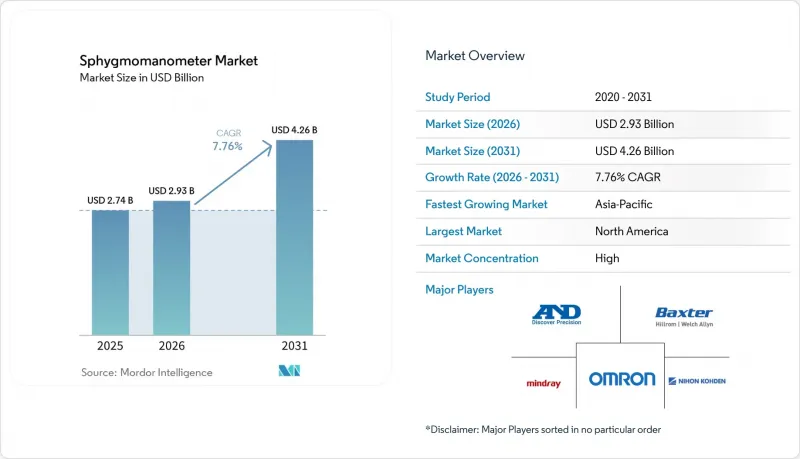
This report is Segmented by Product Type (Mercury Sphygmomanometers, Aneroid Sphygmomanometers, and Digital Sphygmomanometers), by Operation (Manual, Automatic, and Semi-Automatic), by Modality (Portable and Bench-Top), by End User (Hospitals & Clinics, Homecare Settings, and Others), and by Geography (North America, Europe, Asia Pacific, and Others). The Report Offers the Value (USD) for the Above Segments.
Global Sphygmomanometer Market Trends and Insights
Rising Prevalence of Hypertension and Cardiovascular Diseases
The World Health Organization reported that 1.4 billion adults were living with hypertension globally in 2024, while the Centers for Disease Control and Prevention documented that approximately 48% of United States adults meet diagnostic thresholds for elevated blood pressure, a prevalence that translates directly into demand for home monitoring devices as clinical guidelines shift toward frequent measurement for diagnosis confirmation and treatment titration. As per the data reported by American College of Cardiology in February 2026, nearly 80% of United States Adults Have HTN Above BP Goals. This epidemiological trend is structural in nature rather than cyclical, supporting consistent unit demand even as average selling prices decline due to the commoditization of aneroid and entry-level digital devices.
Aging Global Population & Chronic-Disease Burden
The global population aged 65 and older is expanding at 3.1% annually, with Japan, Italy, and Germany exhibiting median ages above 45 years, demographics that correlate with hypertension incidence, which rises from approximately 30% in the 40-49 age cohort to over 70% in those aged 70 and above. This aging cohort also presents higher rates of comorbidities such as diabetes, chronic kidney disease, and atrial fibrillation, conditions that complicate blood pressure management and necessitate frequent monitoring to avoid hypotensive episodes during medication titration. The burden of chronic diseases acts as both a volume driver, bringing more patients into need of monitoring, and a driver of feature complexity, increasing demand within the sphygmomanometer market.
Accuracy Concerns & Lack of Device Validation Standards
Accuracy concerns and lack of standardized validation protocols remain a significant restraint in the sphygmomanometer market. As per the data published in Digital Health in January 2026, a study conducted by the Ethics Committee of the Faculty of Biomedical Engineering of the Czech Technical University in Prague on May 15, 2023, shows that many commercially available devices lack proper clinical validation, with over 500 cuffless devices reported without standardized accuracy verification. As per the article published in Hypertension in October 2024, a literature search of MEDLINE and EMBASE from 1946 and 1947, respectively, through April 2023, stated that discrepancies of 10%-72% in systolic readings have been observed between home monitors and mercury sphygmomanometers, the clinical gold standard. These inconsistencies, coupled with limited adherence to global validation standards, continue to hinder device reliability and market adoption.
Other drivers and restraints analyzed in the detailed report include:
- Rapid Adoption of Home-Based Blood-Pressure Monitoring Devices
- Expansion of Telehealth Reimbursement for Remote BP Monitoring
- Stringent Multi-Region Regulatory Approval Timelines
For complete list of drivers and restraints, kindly check the Table Of Contents.
Segment Analysis
Digital models dominated in 2025, accounting for 58.8% of the sphygmomanometer market share as mercury options receded under environmental bans. Manufacturers such as Omron are expanding digital sphygmomanometer ecosystems by integrating connected BP monitors, mobile applications, and remote patient monitoring services, enabling improved hypertension management and real-time clinician oversight. At the same time, AI-enabled hypertension management is gaining momentum, with devices increasingly incorporating algorithms for AFib detection and cardiovascular risk assessment during routine blood pressure measurements. This shift toward predictive and preventive care is enhancing the clinical value of home BP monitoring devices beyond traditional readings. For instance, in October 2025, Omron Healthcare was recognized by the Digital Health Hub Foundation's 2025 Digital Health Awards as Best in Class in Home Health Diagnostics & Monitoring for its AI-powered AFib-detecting BP monitors.
Automatic units held 53.45% share in 2025, due to automated cuff inflation during measurement cycles that shorten procedure time and reduce discomfort. The sphygmomanometer market size for automatic devices is forecast to expand at 7.96% CAGR to 2031. Beurer's BM 48 checks cuff position before inflation, aborting errors that once generated false alarms. Semi-automatic monitors survive mainly in price-sensitive markets but now claim below 10% unit share, while manual auscultatory kits remain niche for arrhythmia or pediatric use.
Geography Analysis
The increasing prevalence of cardiovascular and lifestyle-related diseases across major regions is emerging as a key public health concern, significantly influencing the demand for diagnostic and monitoring devices such as sphygmomanometers. Heart disease and stroke are affecting a significantly larger population than previously estimated, with about 6 million people living with these conditions in Canada alone, according to Heart & Stroke's latest Heart Month report. This reflects a growing cardiovascular burden across North America, driven by aging populations and lifestyle risk factors such as hypertension and obesity. The rising prevalence is increasing the demand for regular blood pressure monitoring and preventive care.
A recent nationwide survey by the National Statistics Office reported in The India Practitioner in April 2026 in India highlights a sharp increase in lifestyle-related diseases, with nearly half the population now reporting cardiovascular and metabolic conditions such as hypertension, heart disease, and diabetes. Cardiovascular ailments rose from 16.7% in 2017-18 to 25.6% in 2025, while metabolic and endocrine disorders also showed a marked increase. This rapid escalation across the Asia Pacific region underscores a strong need for improved screening and monitoring of blood pressure and related health conditions.
Overall, the rising burden of cardiovascular and metabolic disorders in both North America and Asia Pacific is expected to drive sustained growth in the sphygmomanometer market, as early diagnosis and regular blood pressure monitoring become increasingly critical for disease management and prevention.
- A&D Company, Limited
- Aktiia SA
- Beurer
- Biobeat Technologies Ltd.
- Bosch + Sohn GmbH u. Co. KG
- Citizen Systems Japan Co., Ltd.
- Contec Medical Systems
- GE HealthCare Technologies Inc.
- Hillrom / Welch Allyn
- iHealth Labs, Inc.
- Jiangsu Yuyue Medical (Yuwell)
- Koninklijke Philips
- Microlife
- Mindray Bio-Medical Electronics Co., Ltd.
- Nanowear, Inc.
- Nihon Kohden
- Omron Healthcare Co., Ltd.
- Panasonic Healthcare
- Rossmax
- Rudolf Riester
- SunTech Medical, Inc.
Additional Benefits:
- The market estimate (ME) sheet in Excel format
- 3 months of analyst support
TABLE OF CONTENTS
1 Introduction
- 1.1 Study Assumptions & Market Definition
- 1.2 Scope of the Study
2 Research Methodology
3 Executive Summary
4 Market Landscape
- 4.1 Market Overview
- 4.2 Market Drivers
- 4.2.1 Rising Prevalence of Hypertension and Cardiovascular Diseases
- 4.2.2 Rapid Adoption of Home-based Blood-pressure Monitoring Devices
- 4.2.3 Aging Global Population & Chronic-disease Burden
- 4.2.4 Expansion of Telehealth Reimbursement for Remote BP Monitoring
- 4.2.5 AI-enabled Predictive Analytics in Digital Sphygmomanometers
- 4.2.6 Corporate Wellness & Insurance Programs Mandating BP Tracking
- 4.3 Market Restraints
- 4.3.1 Accuracy Concerns & Lack of Device Validation Standards
- 4.3.2 Stringent Multi-region Regulatory Approval Timelines
- 4.3.3 Data-privacy & Cybersecurity Risks in Connected Devices
- 4.3.4 Supply-chain Disruptions for Critical Electronic Components
- 4.4 Supply-Chain Analysis
- 4.5 Regulatory Landscape
- 4.6 Technological Outlook
- 4.7 Porter's Five Forces Analysis
- 4.7.1 Threat of New Entrants
- 4.7.2 Bargaining Power of Suppliers
- 4.7.3 Bargaining Power of Buyers
- 4.7.4 Threat of Substitutes
- 4.7.5 Competitive Rivalry
5 Market Size & Growth Forecasts
- 5.1 By Product Type
- 5.1.1 Mercury Sphygmomanometers
- 5.1.2 Aneroid Sphygmomanometers
- 5.1.3 Digital Sphygmomanometers
- 5.1.3.1 Standard Upper-Arm Digital
- 5.1.3.2 Wrist Digital
- 5.1.3.3 Wearable / Cuff-less
- 5.2 By Operation
- 5.2.1 Manual
- 5.2.2 Automatic
- 5.2.3 Semi-automatic
- 5.3 By Modality
- 5.3.1 Portable
- 5.3.2 Bench-top
- 5.4 By End User
- 5.4.1 Hospitals & Clinics
- 5.4.2 Homecare Settings
- 5.4.3 Ambulatory Surgical Centers
- 5.4.4 Community Health Centers & Others
- 5.5 By Geography
- 5.5.1 North America
- 5.5.1.1 United States
- 5.5.1.2 Canada
- 5.5.1.3 Mexico
- 5.5.2 Europe
- 5.5.2.1 Germany
- 5.5.2.2 United Kingdom
- 5.5.2.3 France
- 5.5.2.4 Italy
- 5.5.2.5 Spain
- 5.5.2.6 Rest of Europe
- 5.5.3 Asia Pacific
- 5.5.3.1 China
- 5.5.3.2 Japan
- 5.5.3.3 India
- 5.5.3.4 Australia
- 5.5.3.5 South Korea
- 5.5.3.6 Rest of Asia Pacific
- 5.5.4 Middle East and Africa
- 5.5.4.1 GCC
- 5.5.4.2 South Africa
- 5.5.4.3 Rest of Middle East and Africa
- 5.5.5 South America
- 5.5.5.1 Brazil
- 5.5.5.2 Argentina
- 5.5.5.3 Rest of South America
- 5.5.1 North America
6 Competitive Landscape
- 6.1 Market Concentration
- 6.2 Strategic Moves & Developments
- 6.3 Market Share Analysis
- 6.4 Company Profiles (includes Global-Level Overview, Market-Level Overview, Core Segments, Financials, Strategic Information, Market Rank/Share, Products & Services, and Recent Developments)
- 6.4.1 A&D Company, Limited
- 6.4.2 Aktiia SA
- 6.4.3 Beurer GmbH
- 6.4.4 Biobeat Technologies Ltd.
- 6.4.5 Bosch + Sohn GmbH u. Co. KG
- 6.4.6 Citizen Systems Japan Co., Ltd.
- 6.4.7 Contec Medical Systems Co., Ltd.
- 6.4.8 GE HealthCare Technologies Inc.
- 6.4.9 Hillrom / Welch Allyn
- 6.4.10 iHealth Labs, Inc.
- 6.4.11 Jiangsu Yuyue Medical (Yuwell)
- 6.4.12 Koninklijke Philips N.V.
- 6.4.13 Microlife Corporation
- 6.4.14 Mindray Bio-Medical Electronics Co., Ltd.
- 6.4.15 Nanowear, Inc.
- 6.4.16 Nihon Kohden Corporation
- 6.4.17 Omron Healthcare Co., Ltd.
- 6.4.18 Panasonic Healthcare Co., Ltd.
- 6.4.19 Rossmax International Ltd.
- 6.4.20 Rudolf Riester GmbH
- 6.4.21 SunTech Medical, Inc.
7 Market Opportunities & Future Outlook
- 7.1 White-Space & Unmet-Need Assessment

