PUBLISHER: Mordor Intelligence | PRODUCT CODE: 2063606

PUBLISHER: Mordor Intelligence | PRODUCT CODE: 2063606
Plant-Based Meat Nutrition - Market Share Analysis, Industry Trends & Statistics, Growth Forecasts (2026 - 2031)
According to Mordor Intelligence, the plant-Based meat nutrition market size is projected to expand from USD 10.10 billion in 2025 and USD 12.10 billion in 2026 to USD 29.13 billion by 2031, registering a CAGR of 19.29% between 2026 to 2031.
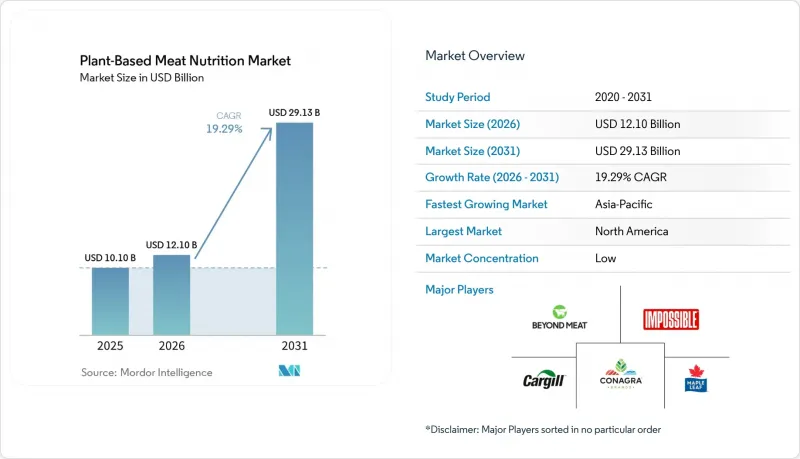
This report is Segmented by Product Category (Burgers, Ground/Minced, and More), Source Protein (Soy, Pea, Wheat/Gluten, Mycoprotein, and More), Distribution Channel (Supermarkets & Hypermarkets, and More), and Geography (North America, Europe, Asia-Pacific, Middle East & Africa, South America). The Market Forecasts are Provided in Terms of Value (USD).
Global Plant-Based Meat Nutrition Market Trends and Insights
Taste-and-Texture Parity Progress (High-Moisture Extrusion, Flavor Systems)
High-moisture extrusion (HME) now aligns plant proteins into anisotropic fibers that replicate the mouthfeel of whole-muscle chicken. Twin-screw systems operating at 60-70% moisture reduce residence time and enable in-line flavor injection, cutting cycle time by 40% at Alpha Foods facilities. Fermentation-derived heme from Impossible Foods and precision-fermented lipids from Nourish Ingredients replicate Maillard browning and enhance umami depth, driving repeat-purchase intent beyond 40% in controlled trials.
Foodservice/QSR Menu Penetration and Co-Branded Launches
Bypassing retail slotting fees, QSRs offer affordable trial formats that position plant proteins as mainstream. McDonald's expanded the McPlant burger to 600 U.S. outlets in 2024 and maintains year-round availability across the United Kingdom. Beyond Meat's agreement with Yum! Brands integrates plant-based proteins into 55,000 outlets, normalizing consumption across breakfast, lunch, and snacking occasions. Heura Foods is extending category reach into airlines and cruise lines, increasing high-frequency exposures that build sensory familiarity.
Sensory Gap Vs. Conventional Meat and Inconsistent Cooking Performance
Home cooks expecting beef-like doneness often experience frustration when plant-based patties, grilled at temperatures above 200°C, char externally while remaining undercooked internally. This issue hampers repeat purchases. Brands pursuing clean-label claims face difficulties as off-notes, described as "beany" or "earthy," are linked to residual saponins in pea and faba isolates. Additionally, year-to-year crop variability can cause water-holding capacity to fluctuate by up to 15%, necessitating mid-cycle reformulations and diminishing brand trust.
Other drivers and restraints analyzed in the detailed report include:
- Retail and Private-Label Expansion, Improved Shelf Placement
- Ingredient Scale-Up (Soy/Pea/Mycoprotein) Reducing Costs
- Price Premium and Input Cost Volatility (Proteins, Oils, Capacity)
For complete list of drivers and restraints, kindly check the Table Of Contents.
Segment Analysis
Sausages and hot dogs are projected to grow at a 21.35% CAGR, surpassing burgers, which are expected to maintain a 38.15% share of the plant-based meat nutrition market in 2025. Quick-service restaurant (QSR) breakfast menus and stadium concessions are increasingly incorporating plant-based options, appealing to casual diners seeking convenient handheld formats. Nugget and wing applications use breading and sauce layers to mask lingering legume off-flavors, resulting in repeat-purchase rates 10-15 percentage points higher than those for uncoated patties. Europe's deli-slice growth highlights a cost-efficient sub-category, as reduced thermal load and shorter extrusion lengths lower capital expenditure and enhance protein functionality.
The premium burger segment is evolving. In late 2025, a rapid update to heme-flavor systems reduced metallic aftertaste scores by 30% in sensory panels, stabilizing market share in North America. Meatball and ready-meal kits are gaining traction among time-pressed households, but their placement in the frozen aisle limits impulse purchases, highlighting the challenge of balancing convenience with visibility. The diversification of product categories is outpacing freezer capacity, forcing retailers to prioritize high-velocity products.
Geography Analysis
In 2025, North America claimed a dominant 32.18% share of the plant-based meat nutrition market, driven by expansions from major players like Walmart and McDonald's, which extended their reach beyond coastal early adopters. Declining costs and advancements in fortification position the market for mid-teens growth, despite ongoing debates over dairy-style naming conventions under FDA jurisdiction. Additionally, Canada's Prairie grain belts, supplying local pea protein, help U.S. brands mitigate foreign-exchange risks.
Europe, influenced by the EU Green Deal and ISO 8700:2025 harmonization, is increasing institutional procurement of plant proteins for school lunch programs. However, a proposal from the European Parliament in October 2025 to ban 29 meat-related descriptors introduces branding uncertainties, potentially delaying new SKU launches until resolutions are reached. While Germany and the U.K. lead in volume, Spain's growth in cold cuts highlights format-specific market opportunities.
Asia-Pacific is set to outpace others with the fastest CAGR at 22.05%. Dominant e-commerce platforms JD.com and Douyin collectively account for over 40% of China's plant-based meat sales, enabling swift market rollouts and real-time consumer insights. Japan and South Korea maintain premium prices exceeding USD 14 per pound, but limited cold-chain infrastructure outside major cities restricts broader market scaling.
- Archer-Daniels-Midland Company
- Beyond Meat, Inc.
- Cargill
- Conagra Brands, Inc.
- Daring Foods Inc.
- DSM-Firmenich
- Future Farm (Fazenda Futuro)
- Givaudan SA
- Gathered Foods Corporation
- Green Rebel Foods
- Heura Foods
- International Flavors & Fragrances Inc.
- Impossible Foods Inc.
- Ingredion Incorporated
- Kellanova (MorningStar Farms)
- Kerry Group plc:
- Konscious Foods
- Kraft Heinz Not Company
- Maple Leaf Foods Inc.
- Nestle
Additional Benefits:
- The market estimate (ME) sheet in Excel format
- 3 months of analyst support
TABLE OF CONTENTS
1 Introduction
- 1.1 Study Assumptions & Market Definition
- 1.2 Scope of the Study
2 Research Methodology
3 Executive Summary
4 Market Landscape
- 4.1 Market Overview
- 4.2 Market Drivers
- 4.2.1 Taste-and-Texture Parity Progress (High-Moisture Extrusion, Flavor Systems)
- 4.2.2 Foodservice/QSR Menu Penetration and Co-Branded Launches
- 4.2.3 Retail and Private-Label Expansion, Improved Shelf Placement
- 4.2.4 Ingredient Scale-Up (Soy/Pea/Mycoprotein) Reducing Costs
- 4.2.5 Fortification (B12, Iron, Zinc, Omega-3) Closing Nutrition Gaps
- 4.2.6 Structured Fats/Oleogels and Fermentation-Derived Lipids Lowering Saturated Fat
- 4.3 Market Restraints
- 4.3.1 Sensory Gap Vs. Conventional Meat and Inconsistent Cooking Performance
- 4.3.2 Price Premium and Input Cost Volatility (Proteins, Oils, Capacity)
- 4.3.3 Labeling Restrictions/Clean-Label Pressures Increasing Compliance Complexity
- 4.3.4 Retail Assortment Rationalization and Slotting Fees Constraining Shelf Space
- 4.4 Value / Supply-Chain Analysis
- 4.5 Regulatory Landscape
- 4.6 Technological Outlook
- 4.7 Porter's Five Forces Analysis
- 4.7.1 Threat of New Entrants
- 4.7.2 Bargaining Power of Suppliers
- 4.7.3 Bargaining Power of Buyers
- 4.7.4 Threat of Substitutes
- 4.7.5 Industry Rivalry
5 Market Size & Growth Forecasts (Value, USD)
- 5.1 By Product Category
- 5.1.1 Burgers
- 5.1.2 Ground/Minced
- 5.1.3 Sausages/Hot Dogs
- 5.1.3.1 Overall Market size numbers
- 5.1.4 Nuggets/Tenders/Wings
- 5.1.5 Deli Slices/Cold Cuts
- 5.1.6 Meatballs
- 5.1.7 Ready Meals/Prepared
- 5.1.7.1 Segmentation market share and growth forecasts
- 5.1.8 Seafood Analogues
- 5.1.9 Jerky/Snacks
- 5.2 By Source Protein
- 5.2.1 Soy
- 5.2.2 Pea
- 5.2.3 Wheat/Gluten
- 5.2.4 Mycoprotein (biomass fermentation)
- 5.2.5 Faba/Chickpea/Lentil
- 5.2.6 Rice/Other Cereals
- 5.2.7 Canola/Rapeseed & Novel Plant Sources
- 5.3 By Distribution Channel
- 5.3.1 Supermarkets & Hypermarkets
- 5.3.2 Convenience Stores
- 5.3.3 Online/E-commerce
- 5.3.4 Specialty Health/Natural Stores
- 5.3.5 Foodservice/HoReCa
- 5.3.6 Direct-to-Consumer (D2C) Brand Sites
- 5.3.7 B2B Ingredients Supply to Manufacturers
- 5.4 By Geography
- 5.4.1 North America
- 5.4.1.1 United States
- 5.4.1.2 Canada
- 5.4.1.3 Mexico
- 5.4.2 Europe
- 5.4.2.1 Germany
- 5.4.2.2 United Kingdom
- 5.4.2.3 France
- 5.4.2.4 Italy
- 5.4.2.5 Spain
- 5.4.2.6 Rest of Europe
- 5.4.3 Asia-Pacific
- 5.4.3.1 China
- 5.4.3.2 India
- 5.4.3.3 Japan
- 5.4.3.4 South Korea
- 5.4.3.5 Australia
- 5.4.3.6 Rest of APAC
- 5.4.4 Middle East & Africa
- 5.4.4.1 GCC
- 5.4.4.2 South Africa
- 5.4.4.3 Rest of MEA
- 5.4.5 South America
- 5.4.5.1 Brazil
- 5.4.5.2 Argentina
- 5.4.5.3 Rest of South America
- 5.4.1 North America
6 Competitive Landscape
- 6.1 Market Concentration
- 6.2 Market Share Analysis
- 6.3 Company Profiles (includes Global level Overview, Market-level Overview, Core Segments, Financials, Strategic Information, Market Rank/Share, Products & Services, Recent Developments)
- 6.3.1 Archer-Daniels-Midland Company
- 6.3.2 Beyond Meat, Inc.
- 6.3.3 Cargill, Incorporated
- 6.3.4 Conagra Brands, Inc.
- 6.3.5 Daring Foods Inc.
- 6.3.6 DSM-Firmenich
- 6.3.7 Future Farm (Fazenda Futuro)
- 6.3.8 Givaudan SA
- 6.3.9 Gathered Foods Corporation
- 6.3.10 Green Rebel Foods
- 6.3.11 Heura Foods
- 6.3.12 International Flavors & Fragrances Inc.
- 6.3.13 Impossible Foods Inc.
- 6.3.14 Ingredion Incorporated
- 6.3.15 Kellanova (MorningStar Farms)
- 6.3.16 Kerry Group plc:
- 6.3.17 Konscious Foods
- 6.3.18 Kraft Heinz Not Company
- 6.3.19 Maple Leaf Foods Inc.
- 6.3.20 Nestle S.A
7 Market Opportunities & Future Outlook
- 7.1 White-space & unmet-need assessment

