PUBLISHER: Mordor Intelligence | PRODUCT CODE: 2063615

PUBLISHER: Mordor Intelligence | PRODUCT CODE: 2063615
North America Art Logistics - Market Share Analysis, Industry Trends & Statistics, Growth Forecasts (2026 - 2031)
According to Mordor Intelligence, the north america art logistics market size is expected to increase from USD 1.36 billion in 2025 to USD 1.40 billion in 2026 and reach USD 1.71 billion by 2031, growing at a CAGR of 4.11% over 2026-2031.
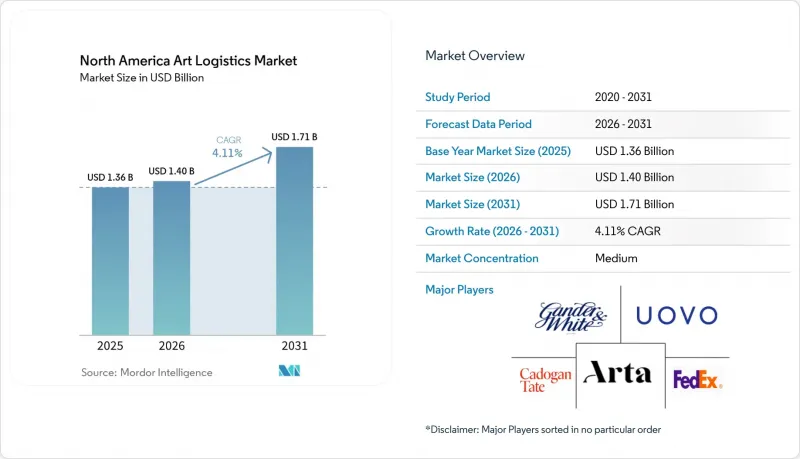
The headline numbers disguise an ongoing structural shift. This report is Segmented by Service Type (Transportation, Warehousing and Distribution, and Value Added Services [Labelling, Kitting, Consulting]), by Application (Art Dealers and Galleries, Auction Houses, Museums, Art Fairs, Private Collectors, and Other Applications), and by Country (United States, Canada, and Mexico). The Market Forecasts are Provided in Terms of Value (USD).
North America Art Logistics Market Trends and Insights
Expanding High-Net-Worth Individual Wealth and Art Allocation in North America
Tech and private-equity fortunes have pushed HNWI collectors to devote a substantially larger share of their wealth portfolios to art, marking a distinct increase year-over-year. This growing allocation drives demand for climate-controlled trucks, real-time tracking, and tailored insurance, which command premium pricing. The western United States already accounts for a major share of domestic art purchases, yet regional hubs like Phoenix and Seattle lack the vault capacity of New York, creating geographic arbitrage opportunities for adventurous providers. Younger HNWIs, who now make up a significant and growing segment of buyers at major auction houses, also insist on blockchain certificates and low-carbon fleets; industry leaders like Crown Fine Art have answered with meaningful emission reductions and electric vans, signaling a green pivot that laggards must match.
Rising Share of Millennial and Gen-Z Buyers
A notable segment of Christie's recent clientele was younger buyers. They prize transparency and sustainability over hush-hush discretion, demanding mobile tracking, NFC-tagged reports, and reusable crates. Gander & White partnered with ROKBOX Loop to supply recyclable cases and rolled out electric vans in New York and Los Angeles, directly courting the eco-minded cohort. Price sensitivity pressures margins per job, yet higher frequency and appetite for subscription services covering transport, storage, and cataloging offer predictable cash flow for firms that adapt early.
Collapse of the High-End Segment (More Than USD 10 Million)
H1 2025 saw marquee failures, forcing auction houses to pull consignments and leaving white-glove fleets idle. H2 bounce, powered by the Leonard A. Lauder estate that fetched USD 527.5 million at Sotheby's, feels episodic rather than structural. With 39 of the year's top 50 lots hammered in New York, geographic concentration magnifies downside risk. Guarantees covered 78% of New York evening-sale value, a level that may not hold if sentiment cools in 2026, threatening shipment pipelines again.
Other drivers and restraints analyzed in the detailed report include:
- Resilient Transaction Volume Despite Lower Values
- Accelerated Shift to Online Bidding and Digital Sales Channels
- Contraction in the Global Art Market Value
For complete list of drivers and restraints, kindly check the Table Of Contents.
Segment Analysis
Transportation accounted for 60.39% of the North America art logistics market share in 2025, underscoring its role in transporting lots from auction to collector. Yet value-added services are on course for a 5.20% CAGR to 2031, the fastest within the North America art logistics market. Younger buyers want blockchain provenance, digital condition reports, and sustainability audits, in addition to crating and trucks. Verisart's tie-up with Arta delivers digital certificates at the hand-off, satisfying both insurance underwriters and tech-savvy collectors. CBP's strict documentation checks and 5- to 30-day CITES waits increase the payout for compliance consulting, lifting margins from the usual 10-15% on transport to more than 30% for bundled advisory packages.
Operational upgrades reinforce this shift. Crozier Fine Arts fitted diesel particulate filters across its 180-vehicle fleet, Gander & White rents ROKBOX Loop's reusable crates, and Crown Fine Art is aggressively decarbonizing its operations through broad Scope 1 and 2 emissions reductions and early fleet electrification. These moves meet Millennial carbon standards while reducing long-term cost per trip. Warehousing remains vital for inventory between sale cycles, but free storage offers from Sotheby's and Christie's squeeze that revenue line, prompting operators to cross-sell climate monitoring, pest control, and digital cataloging. Transportation will remain the revenue heavyweight, yet profitability will hinge on stitching value-added modules into every shipment and quoting premiums where regulatory friction is highest.
List of Companies Covered in this Report:
- Gander & White
- UOVO
- Cadogan Tate
- Crozier Fine Arts
- Sotheby's Art Logistics
- Christie's Fine Art Storage Services
- Crown Fine Art
- Atelier 4
- Artech Fine Art Services
- United States Art Company
- AirSea Packing Group
- Aetna Fine Art Logistics
- PACART
- Dietl International
- Arta Shipping Inc.
- FedEx
- The UPS Store, Inc.
- DHL International GmbH
- Fine Art Shippers
- Acumen International Inc.
Additional Benefits:
- The market estimate (ME) sheet in Excel format
- 3 months of analyst support
TABLE OF CONTENTS
1 Introduction
- 1.1 Study Assumptions and Market Definition
- 1.2 Scope of the Study
2 Research Methodology
3 Executive Summary
4 Market Landscape
- 4.1 Market Overview
- 4.2 Market Drivers
- 4.2.1 Resilient Transaction Volume Despite Lower Values
- 4.2.2 Expanding High-net-worth Individual (HNWI) Wealth and Art Allocation in North America
- 4.2.3 Accelerated Shift to Online Bidding and Digital Sales Channels
- 4.2.4 Rising Share of Millennial and Gen-Z Buyers
- 4.2.5 Strong North American Air-Cargo Capacity and Demand Growth
- 4.2.6 United States Museum and Institutional Recovery to Near Pre-pandemic Levels
- 4.3 Market Restraints
- 4.3.1 Contraction in the Global Art Market Value
- 4.3.2 Collapse of the High-end Segment (More Than USD 10 Million)
- 4.3.3 Severe Slump in Contemporary (Post-2000) Art
- 4.3.4 Persistent Auction Weakness into 2025
- 4.4 Value / Supply-Chain Analysis
- 4.5 Regulatory Landscape
- 4.6 Technological Outlook
- 4.7 Porter's Five Forces
- 4.7.1 Threat of New Entrants
- 4.7.2 Bargaining Power of Suppliers
- 4.7.3 Bargaining Power of Buyers
- 4.7.4 Threat of Substitutes
- 4.7.5 Industry Rivalry
5 Market Size and Growth Forecasts (Value)
- 5.1 By Service Type
- 5.1.1 Transportation
- 5.1.2 Warehousing & Distribution
- 5.1.3 Value-added Services (Labelling, Kitting, Consulting)
- 5.2 By Application
- 5.2.1 Art Dealers and Galleries
- 5.2.2 Auction Houses
- 5.2.3 Museums
- 5.2.4 Art Fairs
- 5.2.5 Private Collectors
- 5.2.6 Other Applications
- 5.3 By Country
- 5.3.1 United States
- 5.3.2 Canada
- 5.3.3 Mexico
6 Competitive Landscape
- 6.1 Market Concentration
- 6.2 Strategic Moves
- 6.3 Market Share Analysis
- 6.4 Company Profiles {(includes Global level Overview, Market level overview, Core Segments, Financials as available, Strategic Information, Market Rank/Share for key companies, Products & Services, and Recent Developments)}
- 6.4.1 Gander & White
- 6.4.2 UOVO
- 6.4.3 Cadogan Tate
- 6.4.4 Crozier Fine Arts
- 6.4.5 Sotheby's Art Logistics
- 6.4.6 Christie's Fine Art Storage Services
- 6.4.7 Crown Fine Art
- 6.4.8 Atelier 4
- 6.4.9 Artech Fine Art Services
- 6.4.10 United States Art Company
- 6.4.11 AirSea Packing Group
- 6.4.12 Aetna Fine Art Logistics
- 6.4.13 PACART
- 6.4.14 Dietl International
- 6.4.15 Arta Shipping Inc.
- 6.4.16 FedEx
- 6.4.17 The UPS Store, Inc.
- 6.4.18 DHL International GmbH
- 6.4.19 Fine Art Shippers
- 6.4.20 Acumen International Inc.
7 Market Opportunities and Future Outlook
- 7.1 White-space and Unmet-need Assessment

