PUBLISHER: Mordor Intelligence | PRODUCT CODE: 2063626

PUBLISHER: Mordor Intelligence | PRODUCT CODE: 2063626
Large Volume Nebulizers - Market Share Analysis, Industry Trends & Statistics, Growth Forecasts (2026 - 2031)
According to Mordor Intelligence, the large volume nebulizers market size is expected to grow from USD 571.80 million in 2025 to USD 611.80 million in 2026 and is forecast to reach USD 862.70 million by 2031 at 7.09% CAGR over 2026-2031.
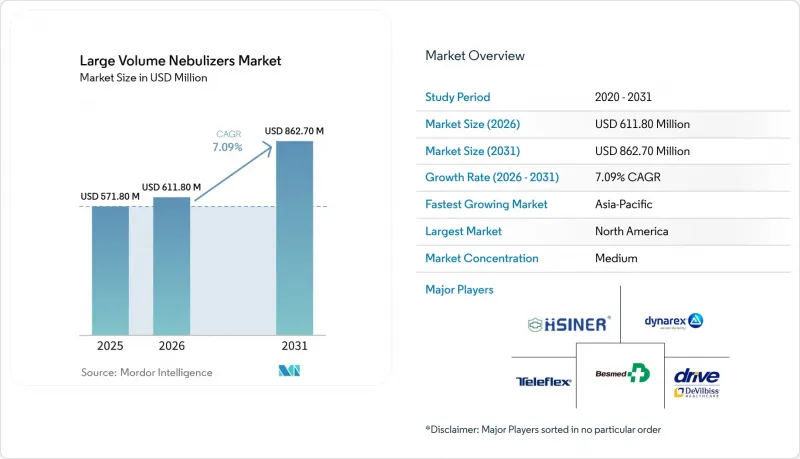
This report is Segmented by Type (Jet/Venturi LVNs, Continuous Medication LVNs, and More), Product Configuration (Prefilled Sterile Reservoir LVNs, Refillable/Empty LVNs), Reservoir Capacity (200-300 ML, and More), Application (Oxygen Therapy Humidification, and More), End User (Hospitals, and More), and Geography (North America, and More). The Market Forecasts are Provided in Terms of Value (USD).
Global Large Volume Nebulizers Market Trends and Insights
Oxygen Humidification Protocols and Continuous Aerosol Therapy in Acute Care Drive Steady LVN Demand
Guidelines from the American Association for Respiratory Care recommend humidifying oxygen flows exceeding 4 L/min. This has linked the adoption of large volume nebulizers (LVNs) to the management of hypoxemic patients in emergency departments and wards. A 2026 trial demonstrated that continuous bronchodilator protocols, administering 10-15 mg/h of albuterol, outperformed intermittent dosing, leading to a 13% reduction in pediatric emergency department stays. While some intensive care units (ICUs) are adopting vibrating-mesh technology, budget constraints in other wards keep them reliant on jet LVNs for primary humidification, especially since the equipment is already in place. Mounting evidence that continuous aerosol therapy reduces admission rates further solidifies the routine stocking of LVNs in adult units.
Oxygen Access Scale-Up in LMICs Expands Installed Base for Humidification/Nebulization
The World Health Organization's 2024 National Oxygen Scale-Up Framework has driven the procurement of pressure-swing adsorption (PSA) plants and their accessories across low- and middle-income countries (LMICs). UNICEF's "Plant in a Box" initiative successfully deployed 57 PSA systems across 21 countries by 2024, with ambitions for 130 by 2025, each capable of servicing up to 100 beds. As hospitals expand their oxygen supply, they concurrently need to humidify these flows to avert mucosal injuries, significantly boosting the demand for large volume nebulizers. A Lancet Commission highlighted that 70% of patients in LMICs still lack access to supplemental oxygen, underscoring the market's potential.Additionally, the Global Oxygen Alliance's funding commitments of USD 4 billion further bolster the sales outlook for LVNs.
Vibrating-Mesh Nebulizers Outperform LVNs in ICU Drug Delivery
Vibrating-mesh systems deliver 1.4 to 3.6 times higher inhaled doses compared to continuous jet LVNs for intubated patients. These systems produce finer particles, leave minimal residual volume, and eliminate compressed-gas flow, ensuring smoother ventilator triggering. Although the unit price of vibrating-mesh systems is three to five times higher than disposable jet LVNs, many tertiary ICUs have the budget flexibility to absorb this cost.
Other drivers and restraints analyzed in the detailed report include:
- Consolidation Among Leading OEMs/Brands Improves Global Distribution and Contracting
- Shift Toward Single-Patient-Use and Prefilled Sterile Reservoirs for Infection Control
- Post-Pandemic Guidelines Limit LVN Usage in Certain Settings
For complete list of drivers and restraints, kindly check the Table Of Contents.
Segment Analysis
Jet or venturi LVNs accounted for 63.18% of 2025 revenue in the large volume nebulizers market. Their straightforward design, low cost, and compatibility with wall-outlet compressed gas ensure their continued inclusion in formularies. Hospitals utilize them for humidification in high-flow oxygen circuits and for intermittent drug delivery through standard oxygen ports. While the market size for ultrasonic devices in large volume nebulizers is currently smaller, it is expanding at an 8.60% CAGR due to the preference of long-term care clinicians for piezoelectric transducers, which provide near-silent operation and finer aerosols.
Ultrasonic models are particularly appealing to staff aiming to minimize sleep disruptions and maintain therapy continuity overnight. Product launches, such as B&B Medical's HOPE platform with an integrated heliox port, highlight differentiation strategies. Consequently, purchasing managers are gradually allocating budgets for these premium devices in step-down units. Jet LVNs are expected to remain prevalent due to their cost-effectiveness in high-volume adult wards, but the adoption of ultrasonic devices will incrementally reduce their market share through 2031.
Refillable bottles represented 72.81% of 2025 sales, reflecting long-standing purchasing habits and the flexibility to use hospital-sourced sterile water. However, outbreaks associated with contaminated rinse bottles have increased scrutiny. The market size for prefilled reservoirs in large volume nebulizers is growing rapidly, with an 8.37% CAGR projected through 2031.
Time-motion studies confirm that nurses save over a minute per setup, which accumulates across numerous patients during each shift. Infection-prevention committees favor sealed packaging for traceability in the event of recalls. Suppliers have responded by introducing tamper-evident caps and laser-etched lot codes, features now included in hospital tender specifications. As a result, forecasts indicate a steady decline in the share of refillables, although budget-conscious hospitals in LMICs are likely to continue using them for the foreseeable future.
Geography Analysis
In 2025, North America commanded a dominant 42.16% share of the large volume nebulizers market, supported by its dense ICU capacities, established medical protocols, and robust healthcare spending. While the region faces challenges due to the widespread adoption of high-flow nasal cannula devices, a recent Class I sterile-water recall has shifted retail preferences toward higher-value prefilled reservoirs, partially offsetting the decline in procedure counts. Both Canada and Mexico are allocating federal funds to upgrade rural hospitals and establish oxygen pipelines, emphasizing the need for humidification accessories. Additionally, a rule from CMS in October 2024 enhances reimbursements for respiratory therapy in skilled-nursing facilities, further encouraging the use of single-patient-use LVNs.
Asia-Pacific is on a rapid growth trajectory, boasting the fastest CAGR of 8.44%. This expansion is largely driven by public investments in oxygen generation, supported by initiatives like China's "Healthy China 2030" and India's "Ayushman Bharat" program. China's ambitious healthcare infrastructure budget of CNY 1.2 trillion (approximately USD 170 billion) for 2024-2026 includes investments in PSA plants, driving co-purchases of LVNs. Meanwhile, India has significantly increased its fiscal 2027 budget for critical-care equipment by 67.66%, paving the way for new tenders on humidification devices. In Southeast Asia, health ministries are leveraging bundled accessory kits, further enhancing the penetration of large volume nebulizers in district hospitals.
Regions like Europe, Japan, South Korea, and Australia, being mature sub-markets, are experiencing upgrades driven by sustainability mandates and infection-control policies, rather than a surge in volume. In Europe, regulations from the European Union concerning fluorinated gases are accelerating the transition from pMDIs to nebulizers, indirectly boosting LVN sales. However, the growth of HFNCs limits potential gains in ICUs. In the Middle East, the recently announced Gulf Cooperation Council's initiative for oxygen self-sufficiency indicates rising demand in this emerging cluster. With domestic PSA plants coming online, they are expected to stimulate downstream device shipments starting in 2026.
- Amsino International, Inc.
- B&B Medical Technologies Inc.
- Besmed Health Business Corp
- Drive DeVilbiss Healthcare GmbH
- Dynarex
- GaleMed Corporation
- Global Healthcare Group
- HSINER Co., Ltd.
- Intersurgical Ltd.
- Protec Somar Industria e Comercio Ltda.
- SunMed Group Holdings, LLC
- Teleflex
- U.P. Medical Salter
- Unitec Hospitalar Ltda.
- VADI Medical Technology Co., Ltd.
- Ventcare Medical
- WestPrime Systems, Inc.
Additional Benefits:
- The market estimate (ME) sheet in Excel format
- 3 months of analyst support
TABLE OF CONTENTS
1 Introduction
- 1.1 Study Assumptions & Market Definition
- 1.2 Scope of the Study
2 Research Methodology
3 Executive Summary
4 Market Landscape
- 4.1 Market Overview
- 4.2 Market Drivers
- 4.2.1 Oxygen Humidification Protocols and Continuous Aerosol Therapy in Acute Care Drive Steady LVN Demand
- 4.2.2 Oxygen Access Scale-Up in LMICs Expands Installed Base for Humidification/Nebulization
- 4.2.3 Consolidation Among Leading OEMs/Brands Improves Global Distribution and Contracting
- 4.2.4 Shift Toward Single-Patient-Use and Prefilled Sterile Reservoirs for Infection Control
- 4.2.5 Workforce Efficiency and Bedside Workflow Simplification Favor Prefilled LVNs
- 4.2.6 Policy Headwinds on Propellants (E.G., F-Gas Quotas) Nudge Hospitals Toward Non-pMDI Delivery
- 4.3 Market Restraints
- 4.3.1 ICU Shift to Vibrating Mesh Nebulizers Reduces LVN Use for Ventilated Drug Delivery
- 4.3.2 Aerosol-Generating Procedure (AGP) Precautions Constrain LVN Use in Some Settings
- 4.3.3 Sterile Water/Saline Supply Disruptions and Recalls Periodically Limit LVN Availability
- 4.3.4 High-Flow Heated Humidification and HFNC Substitute LVN-Based Humidification
- 4.4 Value / Supply-Chain Analysis
- 4.5 Regulatory Landscape
- 4.6 Technological Outlook
- 4.7 Porter's Five Forces Analysis
- 4.7.1 Threat of New Entrants
- 4.7.2 Bargaining Power of Suppliers
- 4.7.3 Bargaining Power of Buyers
- 4.7.4 Threat of Substitutes
- 4.7.5 Industry Rivalry
5 Market Size & Growth Forecasts (Value, USD)
- 5.1 By Type
- 5.1.1 Jet/venturi LVNs
- 5.1.2 Continuous medication LVNs
- 5.1.3 Ultrasonic LVNs
- 5.2 By Product Configuration
- 5.2.1 Prefilled sterile reservoir LVNs
- 5.2.2 Refillable/empty LVNs (with clinician-provided water)
- 5.3 By Reservoir Capacity
- 5.3.1 200-300 mL
- 5.3.2 400-600 mL
- 5.3.3 750-1100 mL
- 5.4 By Application
- 5.4.1 Oxygen therapy humidification (wards/ED/ICU)
- 5.4.2 Continuous bronchodilator therapy
- 5.4.3 Sputum induction/airway hydration
- 5.5 By End User
- 5.5.1 Hospitals (ICU/ED/wards)
- 5.5.2 Long-term care facilities
- 5.5.3 Ambulatory/outpatient clinics
- 5.6 By Geography
- 5.6.1 North America
- 5.6.1.1 United States
- 5.6.1.2 Canada
- 5.6.1.3 Mexico
- 5.6.2 Europe
- 5.6.2.1 Germany
- 5.6.2.2 United Kingdom
- 5.6.2.3 France
- 5.6.2.4 Italy
- 5.6.2.5 Spain
- 5.6.2.6 Rest of Europe
- 5.6.3 Asia-Pacific
- 5.6.3.1 China
- 5.6.3.2 India
- 5.6.3.3 Japan
- 5.6.3.4 South Korea
- 5.6.3.5 Australia
- 5.6.3.6 Rest of Asia-Pacific
- 5.6.4 Middle East and Africa
- 5.6.4.1 GCC
- 5.6.4.2 South Africa
- 5.6.4.3 Rest of Middle East and Africa
- 5.6.5 South America
- 5.6.5.1 Brazil
- 5.6.5.2 Argentina
- 5.6.5.3 Rest of South America
- 5.6.1 North America
6 Competitive Landscape
- 6.1 Market Concentration
- 6.2 Market Share Analysis
- 6.3 Company Profiles (includes Global level Overview, Market-level Overview, Core Segments, Financials, Strategic Information, Market Rank/Share, Products & Services, Recent Developments)
- 6.3.1 Amsino International, Inc.
- 6.3.2 B&B Medical Technologies Inc.
- 6.3.3 Besmed Health Business Corp
- 6.3.4 Drive DeVilbiss Healthcare GmbH
- 6.3.5 Dynarex Corporation
- 6.3.6 GaleMed Corporation
- 6.3.7 Global Healthcare Group
- 6.3.8 HSINER Co., Ltd.
- 6.3.9 Intersurgical Ltd.
- 6.3.10 Protec Somar Industria e Comercio Ltda.
- 6.3.11 SunMed Group Holdings, LLC
- 6.3.12 Teleflex Incorporated
- 6.3.13 U.P. Medical Salter
- 6.3.14 Unitec Hospitalar Ltda.
- 6.3.15 VADI Medical Technology Co., Ltd.
- 6.3.16 Ventcare Medical
- 6.3.17 WestPrime Systems, Inc.
7 Market Opportunities & Future Outlook
- 7.1 White-space & unmet-need assessment

