PUBLISHER: Mordor Intelligence | PRODUCT CODE: 2063633

PUBLISHER: Mordor Intelligence | PRODUCT CODE: 2063633
Sensor Based Smart Catheters - Market Share Analysis, Industry Trends & Statistics, Growth Forecasts (2026 - 2031)
According to Mordor Intelligence, the sensor based smart catheters market size is expected to increase from USD 3.95 billion in 2025 to USD 4.22 billion in 2026 and reach USD 6.13 billion by 2031, growing at a CAGR of 7.74% over 2026-2031.
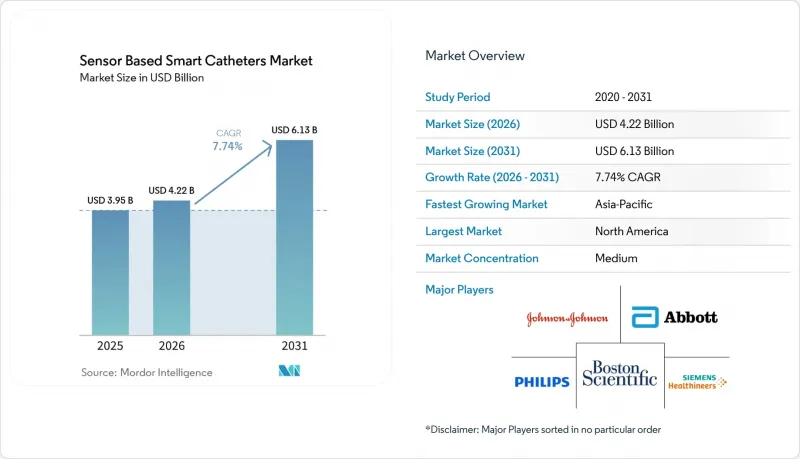
This report is Segmented by Product Type (EP Ablation Catheters, EP Mapping/Diagnostic Catheters, Intravascular Imaging Catheters, and More), Sensor Modality (Contact Force, Local Impedance, and More), Application (Electrophysiology, Interventional Cardiology, and More), End User (Hospitals, Specialty Clinics, and More), and Geography. The Market Forecasts are Provided in Terms of Value (USD).
Global Sensor Based Smart Catheters Market Trends and Insights
EP Ablation Adoption and AF Burden Accelerate Uptake of Force-Sensing and High-Density Mapping Catheters
The rising global prevalence of atrial fibrillation is increasing the demand for new diagnoses, reinforcing the need for scalable interventional strategies that reduce recurrence and downstream healthcare utilization. The 2025 European Heart Rhythm Association consensus standardized AF burden as the proportion of time in atrial fibrillation, which supported a care pathway that prioritizes earlier rhythm control and, when suitable, catheter ablation. Burden-based treatment logic is further supported by data showing that patients who maintain very low residual burden after ablation require fewer follow-up interventions, which improves care continuity and capacity management for high-volume centers. Force-sensing ablation catheters such as TactiFlex illustrate how device design contributes to procedural efficiency by improving stability during lesion delivery and supporting higher-power, shorter-duration workflows for pulmonary vein isolation. In parallel, focal pulsed field ablation with contact-force catheters delivered 80.2% one-year freedom from atrial arrhythmia and a favorable safety profile in the ECLIPSE AF study, which helped validate contact-awareness in energy delivery. Regulatory momentum, including Breakthrough Device designations for dual-energy systems, points to accelerated evidence generation and potential speed-to-approval advantages in priority indications.
IVUS/OCT-Guided PCI Improves Outcomes, Driving Intravascular Imaging Catheter Adoption
In complex bifurcation lesions, IVUS-guided PCI reduced target vessel failure by 60% versus angiography-alone guidance in the DKCRUSH VIII trial, with the effect concentrated among patients who achieved optimal IVUS criteria. In a separate meta-analysis of randomized trials for complex lesions, OCT guidance reduced major adverse cardiovascular events, cardiac death, myocardial infarction, and stent thrombosis compared with angiography-only protocols, reframing the clinical question from whether to image to which modality to use. Guideline bodies in Europe and North America elevated intravascular imaging to top-tier recommendations for complex anatomy, reinforcing a standard-of-care trajectory for IVUS and OCT in higher-risk subsets. Hybrid IVUS-OCT platforms can alleviate modality trade-offs by combining deep penetration with high resolution, with early clinical work showing improved visualization performance for certain stent assessments. Industry consolidation is coalescing around integrated imaging and physiology ecosystems, as seen in acquisitions that combine anatomy, plaque composition, and functional indices within single workflows.
High Device/Procedure Costs and Specialized Training Needs Slow Broader Adoption
Advanced ablation, imaging, and hemodynamic platforms often require significant upfront capital and specialized consumables, which slows uptake in price-sensitive health systems where budget cycles are tight. For many providers, limited reimbursements and competing capital priorities compress the pace of replacement and refresh decisions, which delays the migration to newer sensor-enabled catheters. Multi-modality ecosystems can reduce procedure time and standardize lesion delivery, but they require new training to achieve repeatable performance across case types and staff experience levels. Training curves for complex mapping, PFA, and integrated imaging workflows can be steep, which places pressure on staffing and case scheduling until competency stabilizes. This dynamic is more pronounced at facilities that lack experienced preceptors and formalized proctoring programs. As a result, the sensor based smart catheters market sometimes sees staggered adoption where early uptake concentrates at reference centers before spreading to community settings.
Other drivers and restraints analyzed in the detailed report include:
- MR-Guided Electrophysiology Unlocks Radiation-Free Workflows for Sensor-Enabled Diagnostic and Ablation Catheters
- ICE Guidance Reduces Radiation/Anesthesia, Expanding Sensor-Enabled Catheter Use
- Evidence Gaps and Standardization Needs (e.g., IVUS Sizing, Local Impedance Metrics) Hinder Uniform Uptake
For complete list of drivers and restraints, kindly check the Table Of Contents.
Segment Analysis
EP ablation catheters captured 38.52% sensor based smart catheters market share in 2025 and are poised to expand at 11.52% CAGR over 2026-2031, positioning the category as both current leader and fastest grower. The traction reflects the rising global burden of AF, growing preference for earlier rhythm control and ablation, and the maturation of dual-energy systems that give operators flexibility near sensitive structures while maintaining durable isolation. Abbott's TactiFlex Duo earned a CE Mark in early 2026 with trial evidence showing one-year freedom from rhythm recurrence in paroxysmal AF, which highlights how contact-force awareness and dual-energy delivery can work together in streamlined protocols. Single-shot and all-in-one PFA concepts are also progressing, as exemplified by systems that combine mapping and therapy in a single platform to reduce catheter exchanges and shorten case times. Mapping and diagnostic catheters remain foundational for substrate characterization and for confirming gap closure after ablation, with high-density arrays improving efficiency in large chambers. Intravascular imaging catheters used in interventional cardiology benefit from guideline endorsements in complex coronary anatomies, while peripheral applications gain momentum as clinical data accumulate on stent optimization and patency outcomes.
The sensor based smart catheters market also sees expanding use of ICE catheters, supported by multicenter evidence for 3D imaging that enables high technical success and acceptable image quality compared with transesophageal echocardiography. Hemodynamic and oximetry catheters deliver value in ICU and operating room settings through continuous monitoring, predictive analytics, and decision support that help mitigate hypotension and support fluid management. Temperature-sensing catheters maintain relevance for perioperative care pathways and targeted temperature management protocols, although growth remains more measured than in higher-acuity electrophysiology and coronary imaging lines. Across product types, platform ecosystems that knit together mapping, imaging, and therapy are differentiating on speed, reproducibility, and ease of use in both inpatient and outpatient venues. The net result is a favorable backdrop for systems that compress procedure time and reduce radiation exposure while maintaining or improving safety outcomes in core indications.
Ultrasound modalities, including IVUS and ICE, commanded 40.50% of revenue in 2025, while contact-force sensors are forecast to post the fastest growth at 12.23% CAGR, as electrophysiology teams intensify their focus on real-time lesion-quality feedback and first-pass isolation. The sensor based smart catheters market size increasingly concentrates on modality combinations that allow operators to balance resolution, penetration, and contact assurance within standardized workflows that translate across lab teams. Fiber-optic force sensing has become a leading approach for stable contact and for consistent lesion indices under high-power, short-duration strategies, which favor durable outcomes with fewer energy deliveries. Clinical experience with focal PFA has shown encouraging one-year arrhythmia freedom and high acute isolation rates in contact-aware workflows, which supports faster adoption of force-sensing designs in electrophysiology. Regulatory momentum in China for pressure-sensing PFA catheters affirmed demand for sensor-fusion platforms in large domestic markets that prioritize safety near vulnerable structures. The sensor based smart catheters market continues to see innovation in physiologic sensing as well, with multimodal systems transitioning between noninvasive and invasive monitoring to sustain continuous hemodynamic visibility without additional disposables.
Optical OCT sensing offers very high resolution, which contributes to precise stent expansion and apposition assessments in complex anatomy when contrast and image acquisition conditions are favorable. Spectroscopy combined with IVUS or DeepOCT helps characterize lipid-rich plaques and may inform treatment strategy through plaque composition insights, a direction reinforced by acquisitions that combine imaging and AI-driven physiologic indices. Temperature sensing remains embedded in pulmonary artery catheters and selected urology catheters for perioperative management and targeted temperature control in critical-care pathways. As the sensor based smart catheters industry refines data capture and processing, the value shifts toward integrated measures that correlate with durable lesion creation, optimal stent deployment, and hemodynamic stability, which gives multi-sensor fusion a clear role in next-generation designs. These contrasts between contact, imaging, and physiologic sensing are likely to narrow as platforms interoperate more tightly across mapping, therapy, and monitoring.
Geography Analysis
North America held 41.80% of revenue in 2025, supported by higher healthcare spending, a dense EP and cath lab footprint, and rapid activation of new technologies that pass regulatory review. The region's adoption is further reinforced by Class I recommendations for intravascular imaging in complex coronary anatomy, which codifies higher-standard practice pathways in acute and elective cases. Evidence in coronary bifurcations and complex lesions, including randomized and pooled analyses, continues to validate the clinical value of IVUS and OCT guidance compared with angiography-only protocols. Regulatory designations such as Breakthrough status and clearances for novel systems further accelerate market entry for dual-energy ablation platforms and AI-enabled imaging suites, which benefits technology diffusion in early-adopter centers. Access and capacity vary by locality, so the sensor based smart catheters market grows fastest where training, reimbursement clarity, and equipment readiness align.
Europe is the second-largest region, benefiting from Class IA recommendations for IVUS and OCT in complex lesions and macro-level support for image-guided procedures across leading health systems. Manufacturers continue to bring forward sensor-enabled mapping and ablation systems and to expand integrated imaging platforms despite longer and more complex regulatory processes under EU. A cross-society review indicated that randomized evidence levels remain uneven across high-risk devices at the time of CE-marking, which raises the bar for post-market evidence generation to sustain broad adoption. Training pipeline constraints and procedure backlogs can cap growth in some markets, so consistent mentorship and proctoring programs are helpful to extend access outside tertiary hubs. Select Middle Eastern countries prioritize medical infrastructure build-outs and technology importation for tertiary-care centers, which supports uptake of ICE, ablation, and intravascular imaging in referral networks that serve regional demand. Elsewhere in the wider region, variations in reimbursement readiness and localized expertise shape the speed of adoption without changing the underlying demand curve for precision-guided interventions.
Asia-Pacific is projected to be the fastest-growing region at 10.34% CAGR between 2026 and 2031, driven by rising cardiovascular disease prevalence, urbanization-linked risk factors, and policy emphasis on expanding advanced cardiac care. Regulatory progress is notable, with approval of the first pressure-sensing PFA catheter in China that reflects receptivity to sensor-fusion platforms and localized manufacturing scale-up. Clinical leadership in complex bifurcation PCI, including multi-center randomized work, strengthens the case for intravascular imaging in large Asian health systems. Japan remains a bellwether for coronary imaging practices and training culture, while Australia and South Korea maintain infrastructure and standards comparable to Western Europe. In South America, leading centers adopt contact-force ablation and ICE within private networks, while public-sector pathways evolve with growing AF prevalence that supports interventional capacity investments over time. These dynamics together set a supportive context for the sensor based smart catheters market as regional ecosystems align training, reimbursement, and supply chains.
- Abbott Laboratories
- AngioDynamics.
- Avinger
- BIOTRONIK
- Boston Scientific
- CardioFocus
- Edward Lifesciences
- Gentuity, LLC
- Imricor
- Infraredx, Inc.
- Johnson & Johnson
- Koninklijke Philips
- Lepu Medical Technology (Beijing) Co., Ltd.
- Medtronic
- MicroPort
- Nipro
- Siemens Healthineers
- Stereotaxis
- Terumo
- The Novasight Hybrid System
Additional Benefits:
- The market estimate (ME) sheet in Excel format
- 3 months of analyst support
TABLE OF CONTENTS
1 Introduction
- 1.1 Study Assumptions & Market Definition
- 1.2 Scope of the Study
2 Research Methodology
3 Executive Summary
4 Market Landscape
- 4.1 Market Overview
- 4.2 Market Drivers
- 4.2.1 EP Ablation Adoption and AF Burden Accelerate Uptake of Force-Sensing and High-Density Mapping Catheters
- 4.2.2 IVUS/OCT-Guided PCI Improves Outcomes, Driving Intravascular Imaging Catheter Adoption
- 4.2.3 Hospitals Shift to Minimally Invasive, Image-Guided Procedures Sustains Demand for Sensor-Enabled Catheters
- 4.2.4 MR-Guided Electrophysiology Unlocks Radiation-Free Workflows for Sensor-Enabled Diagnostic and Ablation Catheters
- 4.2.5 Consensus and Reimbursement Momentum for IVUS in Peripheral Interventions Expands Use Beyond Coronaries
- 4.2.6 ICE Guidance Reduces Radiation/Anesthesia, Expanding Sensor-Enabled Catheter Use
- 4.3 Market Restraints
- 4.3.1 High Device/Procedure Costs and Specialized Training Needs Slow Broader Adoption
- 4.3.2 Evidence Gaps and Standardization Needs (E.G., IVUS Sizing, Local Impedance Metrics) Hinder Uniform Uptake
- 4.3.3 Regulatory Timelines and MDR Complexity Elongate Approvals for Novel Sensor Catheters
- 4.3.4 Specialist and Lab Capacity Constraints Limit Procedure Throughput and Adoption
- 4.4 Supply-Chain Analysis
- 4.5 Regulatory Landscape
- 4.6 Technological Outlook
- 4.7 Porter's Five Forces
- 4.7.1 Threat of New Entrants
- 4.7.2 Bargaining Power of Suppliers
- 4.7.3 Bargaining Power of Buyers
- 4.7.4 Threat of Substitutes
- 4.7.5 Industry Rivalry
5 Market Size & Growth Forecasts (Value, USD)
- 5.1 By Product Type
- 5.1.1 EP Ablation Catheters
- 5.1.2 EP Mapping/Diagnostic Catheters
- 5.1.3 Intravascular Imaging Catheters
- 5.1.4 Intracardiac Echocardiography (ICE) Catheters
- 5.1.5 Hemodynamic & Oximetry Catheters
- 5.1.6 Temperature-sensing Urinary & Intravascular Temp-management Catheters
- 5.1.7 Others (Image-guided Atherectomy Catheters, etc)
- 5.2 By Sensor Modality
- 5.2.1 Contact Force
- 5.2.2 Local impedance
- 5.2.3 Pressure/FFR and oximetry (SvO2/ScvO2)
- 5.2.4 Ultrasound (IVUS/ICE)
- 5.2.5 Optical (OCT)
- 5.2.6 Spectroscopy (NIRS/combined IVUS+NIRS)
- 5.2.7 Temperature
- 5.2.8 Others (Electromagnetic (EM), Flow sensors, etc)
- 5.3 By Application
- 5.3.1 Electrophysiology
- 5.3.2 Interventional Cardiology
- 5.3.3 Structural Heart
- 5.3.4 Critical Care Hemodynamics (ICU/OR)
- 5.3.5 Urology
- 5.3.6 Others (Neurovascular and GI manometry niches)
- 5.4 By End User
- 5.4.1 Hospitals
- 5.4.2 Ambulatory Surgical Centers (ASCs)
- 5.4.3 Specialty clinics
- 5.4.4 Cardiac Cath and Electrophysiology (EP) Labs
- 5.5 By Geography
- 5.5.1 North America
- 5.5.1.1 United States
- 5.5.1.2 Canada
- 5.5.1.3 Mexico
- 5.5.2 Europe
- 5.5.2.1 Germany
- 5.5.2.2 United Kingdom
- 5.5.2.3 France
- 5.5.2.4 Italy
- 5.5.2.5 Spain
- 5.5.2.6 Rest of Europe
- 5.5.3 Asia-Pacific
- 5.5.3.1 China
- 5.5.3.2 India
- 5.5.3.3 Japan
- 5.5.3.4 Australia
- 5.5.3.5 South Korea
- 5.5.3.6 Rest of Asia-Pacific
- 5.5.4 Middle East and Africa
- 5.5.4.1 GCC
- 5.5.4.2 South Africa
- 5.5.4.3 Rest of Middle East and Africa
- 5.5.5 South America
- 5.5.5.1 Brazil
- 5.5.5.2 Argentina
- 5.5.5.3 Rest of South America
- 5.5.1 North America
6 Competitive Landscape
- 6.1 Market Concentration
- 6.2 Market Share Analysis
- 6.3 Company Profiles {(includes Global level Overview, Market level overview, Core Segments, Financials as available, Strategic Information, Market Rank/Share for key companies, Products & Services, and Recent Developments)}
- 6.3.1 Abbott
- 6.3.2 AngioDynamics.
- 6.3.3 Avinger
- 6.3.4 Biotronik
- 6.3.5 Boston Scientific Corporation
- 6.3.6 CardioFocus
- 6.3.7 Edwards Lifesciences Corporation
- 6.3.8 Gentuity, LLC
- 6.3.9 Imricor
- 6.3.10 Infraredx, Inc.
- 6.3.11 Johnson & Johnson
- 6.3.12 Koninklijke Philips N.V.
- 6.3.13 Lepu Medical Technology (Beijing) Co., Ltd.
- 6.3.14 Medtronic
- 6.3.15 MicroPort Scientific Corporation
- 6.3.16 NIPRO
- 6.3.17 Siemens Healthineers AG
- 6.3.18 Stereotaxis
- 6.3.19 Terumo Corporation
- 6.3.20 The Novasight Hybrid System
7 Market Opportunities & Future Outlook
- 7.1 White-space & unmet-need assessment

