PUBLISHER: Mordor Intelligence | PRODUCT CODE: 2063637

PUBLISHER: Mordor Intelligence | PRODUCT CODE: 2063637
Veterinary Hospital - Market Share Analysis, Industry Trends & Statistics, Growth Forecasts (2026 - 2031)
According to Mordor Intelligence, the veterinary hospital market size is projected to be USD 67.26 billion in 2025, USD 71.02 billion in 2026, and reach USD 99.22 billion by 2031, growing at a CAGR of 6.91% from 2026 to 2031.
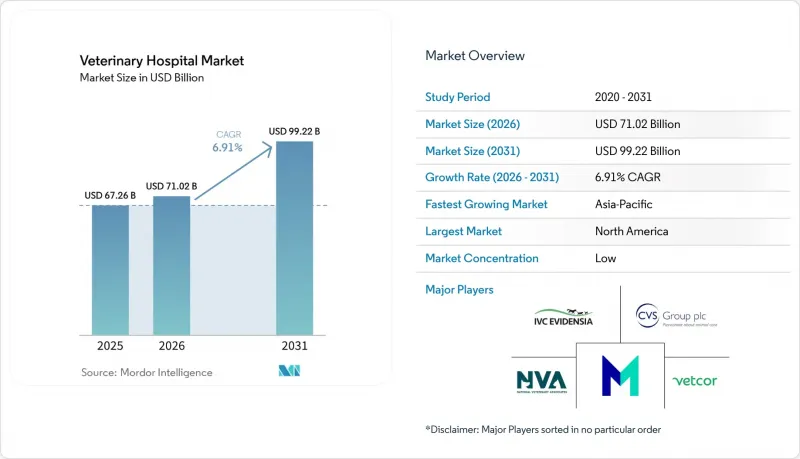
This report is Segmented by Animal Type (Companion Animals and Farm Animals), Service Type (Surgical Services, Medical Services, and Consultation), Sector (Private and Public), and Geography (North America, Europe, Asia-Pacific, Middle East and Africa, and South America). The Market Forecasts are Provided in Terms of Value (USD).
Global Veterinary Hospital Market Trends and Insights
Rising Pet Insurance Adoption Expands Access To High-Acuity Care
Written premium in North American pet health insurance rose to USD 5.2 billion in 2024, up 20.8% from 2023, with 7.03 million insured pets, reflecting accelerating adoption and an expanding financial backstop for advanced treatments. Penetration remains well below Nordic benchmarks, yet the direction of travel is clear as insurers, employers, and digital enrollment reduce friction and raise awareness about coverage options. Clinics serving higher shares of insured clients typically face fewer cost-driven treatment compromises, which supports a fuller diagnostic and surgical workflow. Access to coverage also reduces volatility in case acceptance for oncology and orthopedic procedures whose ticket sizes can challenge out-of-pocket affordability. As insured pet cohorts grow, hospitals can plan capacity and inventory with more confidence, aligning specialty scheduling with predictable reimbursement paths. The net effect is a wider funnel for high-acuity care that sustains the veterinary hospital market even when discretionary visit frequency softens at the margin.
Specialty And Advanced Diagnostics/Surgery Adoption Lifts Revenue Per Visit
Diagnostics outperformed in 2025 on clinics' revenue mix, supported by pricing updates and tighter integration of in-house testing into wellness and sick-visit protocols that raise per-visit yield. Product innovation is expanding point-of-care capability, such as IDEXX's inVue Dx Cellular Analyzer, an AI-enabled, slide-free solution launched in late 2024 that automates differential counts, and IDEXX Cancer Dx, an early detection blood test for canine lymphoma slated for rollout in March 2025. These platforms compress time-to-diagnosis, enabling more general practices to complete workups without referral and to keep downstream procedures in-house. On the surgical side, cranial cruciate ligament repairs account for a dominant share of canine orthopedic cases, and advanced TPLO and TTA techniques favored by specialty hospitals command higher fees and support stronger EBITDA profiles than traditional extracapsular options. The capability to combine advanced imaging with specialty surgery centralizes more value within hospital networks that can staff and equip these services. As more clinics adopt integrated diagnostic-to-procedure workflows, revenue per active client rises and supports reinvestment in further specialty build-outs.
Veterinary Services Inflation Elevates Price Sensitivity And Care Deferrals
Clinics reported that clients became more cost-sensitive through 2025, with visit counts easing and a larger share of cases declining recommended diagnostics as budgets tightened. Practices responded by shifting emphasis toward services less vulnerable to external price competition, while also using payment options and clearer estimates to sustain acceptance. Gross payroll as a percentage of revenue rose in 2025, reflecting tighter labor markets and competitive wages that keep pressure on service fees upward. These input costs and elevated client price sensitivity limit the headroom for further fee increases without risking additional volume erosion. The near-term result is a careful balance between margin protection and case acceptance, with clinics prioritizing diagnostic utilization and procedure bundling to hold revenue per visit steady. Over the forecast horizon, efficiency gains from scheduling, automation, and in-house testing help offset inflationary headwinds, but consumer affordability remains a governor on growth in mature markets.
Other drivers and restraints analyzed in the detailed report include:
- Corporate Consolidation Enables Capex, Specialty Build-Outs, And Standardized Care
- Enterprise Data/AI Tools Improve Scheduling, RCM, And Capacity Utilization
- UK CMA 2026 Remedies Cap Prescription Fees And Mandate Price/Ownership Transparency
For complete list of drivers and restraints, kindly check the Table Of Contents.
Segment Analysis
Companion animals accounted for 64.32% of the veterinary hospital market share in 2025, supported by humanization trends and the propensity to fund diagnostics and specialty procedures for family pets. The veterinary hospital market size for companion animals is projected to expand at an 8.32% CAGR between 2026 and 2031, reflecting greater insurance usage and better access to advanced treatments. Clinics lean on embedded diagnostics and structured wellness plans to capture more of the care continuum for companion animals, anchoring repeat visits and adherence to chronic-disease monitoring. Multi-location operators have created care pathways that extend from primary care to specialty and emergency, which raises lifetime client value for dogs and cats.
Farm animal services remain a smaller share but are essential to biosecurity, food-safety oversight, and zoonotic-disease control, which makes demand steadier across cycles. Public programs and mandatory vaccination efforts underpin activity in livestock hubs, and they add countercyclical stability when discretionary companion-animal visits slow. Over time, digital recordkeeping and traceability requirements can lift the complexity of farm-animal casework, which encourages integrated lab capacity within regional hospital networks.
Geography Analysis
North America accounted for 42.32% of 2025 revenues, reflecting a deep installed base of hospitals, early adoption of specialty and emergency models, and growing insurance coverage that supports acceptance of high-acuity care. In 2024, North American pet insurance covered 7.03 million pets, up 20.9% year over year, which raised the share of clients able to pursue full diagnostic workups and advanced procedures. Clinics used protocol nudges and integrated diagnostics to lift average transaction value even as visit volumes softened, a pattern tied to automation and tighter scheduling discipline. Practices also reported rising client sensitivity to pricing, with decreases in visits and more frequent declines of recommended care when budgets were tight. In response, hospitals emphasized injectable therapies and in-clinic services to mitigate exposure to online pharmacy competition while preserving per-visit yield.
Across Europe, consolidation and insurance penetration underpin access, while the UK's 2026 CMA remedies introduce binding requirements for price publication, ownership disclosure, itemized billing, and capped written prescription fees at USD 26.7 for the first medicine and USD 15.9 for each additional item, with written estimates required for treatment plans expected to exceed USD 635.0 by the compliance date of September, 2026. The direction of reform is clear across mature European markets, with more attention on transparent pricing and clear ownership, especially within large networks. Enterprise groups continue to invest in specialty centers with advanced imaging and ICU capacity, positioning themselves to absorb compliance costs while maintaining integrated care models. The veterinary hospital market in Europe is likely to see a measured moderation in pricing power offset by improved client confidence and stable specialty demand that sustains revenue quality.
Asia-Pacific is projected to post the fastest expansion at an 8.93% CAGR through 2031, driven by urbanization, growing disposable incomes, and rising preventive-care adoption across Tier-1 and Tier-2 cities. Hospitals in leading metros are expanding capacity in diagnostics and imaging to meet demand from a widening pet-owning base. As local operators build referral pathways and add specialty clinics, more complex procedures migrate into regional centers that can staff and equip orthopedic, oncology, and emergency suites. Digital adoption in appointment booking and payments is accelerating, which lowers friction for wellness and recheck visits and helps hospitals optimize utilization. Over the forecast horizon, these structural tailwinds position Asia-Pacific as the primary growth engine for the global veterinary hospital market.
- AniCura
- BluePearl Holdings LLC
- CVS Group plc
- Greencross Vets
- IVC Evidensia
- Linnaeus
- Mars
- Medivet
- MedVet
- Mission Pet Health
- National Veterinary Associates (NVA)
- PetVet Care Centers
- Thrive Pet Healthcare (Pathway)
- VCA Animal Hospitals
- VetCor
- VetPartners
- VetPartners Group
- Vets4Pets
- VetStrategy
Additional Benefits:
- The market estimate (ME) sheet in Excel format
- 3 months of analyst support
TABLE OF CONTENTS
1 Introduction
- 1.1 Study Assumptions & Market Definition
- 1.2 Scope of the Study
2 Research Methodology
3 Executive Summary
4 Market Landscape
- 4.1 Market Overview
- 4.2 Market Drivers
- 4.2.1 Rising Pet Insurance Adoption Expands Access To High-Acuity Care
- 4.2.2 Companion Animal Ownership Intensity Sustains Visit Volumes
- 4.2.3 Specialty and Advanced Diagnostics/Surgery Adoption Lifts Revenue Per Visit
- 4.2.4 Corporate Consolidation Enables Capex, Specialty Build-Outs, and Standardized Care
- 4.2.5 Enterprise Data/AI Tools Improve Scheduling, RCM, and Capacity Utilization
- 4.2.6 APAC Urbanization And Middle-Class Growth Accelerate Demand for Veterinary Care
- 4.3 Market Restraints
- 4.3.1 Veterinarian and Technician Shortages Constrain Capacity and Hours
- 4.3.2 Veterinary Services Inflation Elevates Price Sensitivity and Care Deferrals
- 4.3.3 UK CMA 2026 Remedies Cap Prescription Fees and Mandate Price/Ownership Transparency
- 4.3.4 ER/OOH Access Gaps from Staffing Shortages Reduce Delivered Emergency Volumes
- 4.4 Value-Chain Analysis
- 4.5 Regulatory Landscape
- 4.6 Technological Outlook
- 4.7 Porter's Five Forces
- 4.7.1 Threat of New Entrants
- 4.7.2 Bargaining Power of Suppliers
- 4.7.3 Bargaining Power of Buyers
- 4.7.4 Threat of Substitutes
- 4.7.5 Industry Rivalry
5 Market Size & Growth Forecasts (Value, USD)
- 5.1 By Animal Type
- 5.1.1 Companion Animals
- 5.1.2 Farm Animals
- 5.2 By Service Type
- 5.2.1 Surgical Services
- 5.2.2 Medical Services
- 5.2.3 Consultation
- 5.3 By Sector
- 5.3.1 Private
- 5.3.2 Public
- 5.4 By Geography
- 5.4.1 North America
- 5.4.1.1 United States
- 5.4.1.2 Canada
- 5.4.1.3 Mexico
- 5.4.2 Europe
- 5.4.2.1 Germany
- 5.4.2.2 United Kingdom
- 5.4.2.3 France
- 5.4.2.4 Italy
- 5.4.2.5 Spain
- 5.4.2.6 Rest of Europe
- 5.4.3 Asia-Pacific
- 5.4.3.1 China
- 5.4.3.2 India
- 5.4.3.3 Japan
- 5.4.3.4 Australia
- 5.4.3.5 South Korea
- 5.4.3.6 Rest of Asia-Pacific
- 5.4.4 Middle East and Africa
- 5.4.4.1 GCC
- 5.4.4.2 South Africa
- 5.4.4.3 Rest of Middle East and Africa
- 5.4.5 South America
- 5.4.5.1 Brazil
- 5.4.5.2 Argentina
- 5.4.5.3 Rest of South America
- 5.4.1 North America
6 Competitive Landscape
- 6.1 Market Concentration
- 6.2 Market Share Analysis
- 6.3 Company Profiles {(includes Global level Overview, Market level overview, Core Segments, Financials as available, Strategic Information, Market Rank/Share for key companies, Products & Services, and Recent Developments)}
- 6.3.1 AniCura
- 6.3.2 BluePearl Holdings LLC
- 6.3.3 CVS Group plc
- 6.3.4 Greencross Vets
- 6.3.5 IVC Evidensia
- 6.3.6 Linnaeus
- 6.3.7 Mars, Incorporated
- 6.3.8 Medivet
- 6.3.9 MedVet
- 6.3.10 Mission Pet Health
- 6.3.11 National Veterinary Associates (NVA)
- 6.3.12 PetVet Care Centers
- 6.3.13 Thrive Pet Healthcare (Pathway)
- 6.3.14 VCA Animal Hospitals
- 6.3.15 VetCor
- 6.3.16 VetPartners
- 6.3.17 VetPartners Group
- 6.3.18 Vets4Pets
- 6.3.19 VetStrategy
7 Market Opportunities & Future Outlook
- 7.1 White-space & unmet-need assessment

