PUBLISHER: Mordor Intelligence | PRODUCT CODE: 2063653

PUBLISHER: Mordor Intelligence | PRODUCT CODE: 2063653
Arachnoid Cysts Treatment - Market Share Analysis, Industry Trends & Statistics, Growth Forecasts (2026 - 2031)
According to Mordor Intelligence, the arachnoid cysts treatment market size is projected to expand from USD 1.8 billion in 2025 and USD 1.9 billion in 2026 to USD 2.5 billion by 2031, registering a CAGR of 5.59% between 2026 to 2031.
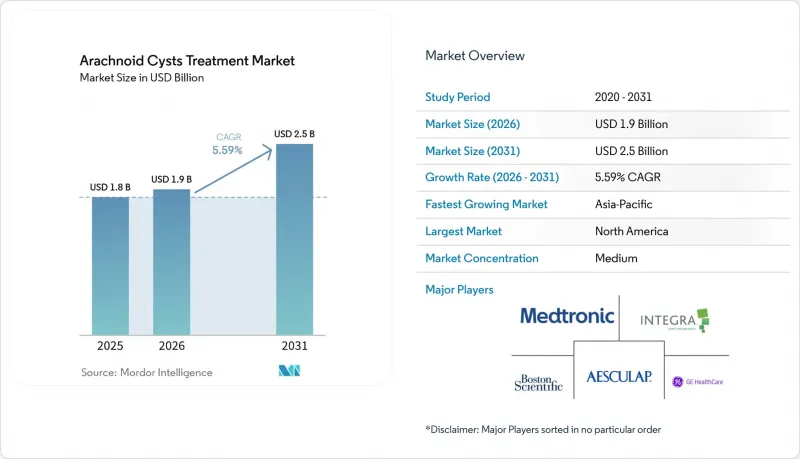
This report is Segmented by Type (Intracranial Arachnoid Cysts, and More), Treatment Type (Endoscopic Cyst Fenestration, Microsurgical Fenestration, Cystoperitoneal Shunting, and More), End-User (Hospitals, Ambulatory Surgical Centers, and More), and Geography (North America, South America, Europe, APAC, Middle East, and Africa). Market Forecasts are Provided in Terms of Value (USD).
Global Arachnoid Cysts Treatment Market Trends and Insights
Advances in Minimally Invasive Neuroendoscopy Drive Procedural Shift
Neuroendoscopic fenestration now anchors first-line therapy, propelled by FDA clearances for systems that pair 4 mm rigid scopes with near-infrared fluorescence to map subsurface vessels and avert venous injury. Integra's single-use AURORA Surgiscope, cleared in April 2025, folds LED lighting and video into a sterile sheath, cutting reprocessing time and infection exposure . A 2024 meta-analysis reported 75% radiographic cyst reduction and 90% headache relief after posterior fossa decompression, reinforcing confidence in endoscopy. Recurrence persists at 10-30%, steering R&D toward biodegradable stents that prop open fenestrations. Shorter average hospitalization of 1.5 days now aligns fenestration economics with ambulatory surgical center models.
Expanding Pediatric Neurosurgery Infrastructure Unlocks Emerging-Market Demand
Government-funded hybrid suites in India, China, and Southeast Asia are broadening operative capacity. Tamil Nadu's integrated theatre, inaugurated in November 2025, merges CT, endoscopy, and ultrasound, enabling 40-50 complex cases per month and eliminating risky mid-procedure transfers. Argentina's neurosurgery society embedded a 720-hour pediatric curriculum that includes arachnoid cyst techniques, signaling talent pipeline expansion. Telemedicine corridors linking Pakistan with Beijing Tiantan Hospital streamline pre-op triage and reserve cross-border referrals for the toughest lesions, trimming travel costs and accelerating care.
High Procedural Costs and Reimbursement Complexity Limit Access
Endoscopic fenestration CPT codes (e.g., 62161) often require prior authorization in the U.S., delaying therapy for most patients and tightening hospital cash flows . In many emerging economies, out-of-pocket bills between USD 3,000 and USD 5,000 keep surgery out of reach. Bundling of navigation and imaging add-on codes further clouds revenue predictability. Pediatric families without insurance frequently defer care until hydrocephalus sets in, crimping the immediately addressable portion of the arachnoid cysts treatment market.
Other drivers and restraints analyzed in the detailed report include:
- Improved High-Resolution MRI Expands Diagnostic Capture of Symptomatic Cases
- Growing Adoption of Programmable Shunt Valves Reduces Overdrainage Complications
- Surgical Complication Risks and Recurrence Rates Constrain Adoption
For complete list of drivers and restraints, kindly check the Table Of Contents.
Segment Analysis
Intracranial cysts commanded 78.19% of the arachnoid cysts treatment market in 2025, mainly because middle cranial fossa and retrocerebellar locations provoke headaches, seizures, or hydrocephalus that necessitate surgery. Galassi type III lesions usually bypass observation and move straight to fenestration or shunting. Spinal arachnoid cysts hold a sliver of current revenue yet are forecast at a robust 7.30% CAGR as safer laminectomy protocols extend operability.
The arachnoid cysts treatment market size attributable to intracranial surgery is projected to widen steadily through 2031, while spinal cases benefit from neuromonitoring that curbs cord-injury risk. Although spinal cysts lack a universal classification scheme, thoracic lesions that compress the dorsal columns are moving toward earlier excision, increasing the demand for low-profile retractors. Combined, these dynamics keep intracranial volume high and spinal growth brisk, sustaining product line diversification for device makers.
Geography Analysis
North America generated 47.17% of 2025 revenue. Widespread insurance coverage and dense neurosurgeon networks buoy procedure volumes, although prior authorization delays continue to blur scheduling. Canada's single-payer model ensures universal access but prolongs elective waitlists. Mexico's private centers draw uninsured U.S. patients with package prices that undercut domestic quotes, nudging tourism inflows and adding a niche layer to the arachnoid cysts treatment market.
Asia-Pacific is projected to climb at 7.45% CAGR through 2031. India's first government-run hybrid neurosurgery suite demonstrates how public capital can pivot regional surgical capacity upward. China's flagship hospitals blend intraoperative CT and neuronavigation, while telemedicine links extend consult reach into Pakistan and Bangladesh. Southeast Asian growth rides pediatric demand spikes and multi-lateral training partnerships. Japan and South Korea hover near saturation, but their aging installed base will demand replacement endoscopes and valves.
Europe remains steady, its universal health systems undergirding consistent procedure counts. Germany and the United Kingdom steer volumes, with the NHS favoring conservative follow-up for asymptomatic cysts. Eastern European states are investing in hybrid theatres to stem outbound medical migration. South America is gradually assembling pediatric neurosurgery muscle, led by Brazil and Argentina, though reimbursement gaps still limit cross-border device adoption, moderating the regional share of the arachnoid cysts treatment market.
- Abbott Laboratories
- Aesculap, Inc
- B. Braun
- Boston Scientific
- Brain Lab
- Conmed
- GE Healthcare
- Integra LifeSciences
- Karl Storz
- Danaher
- Medtronic
- Miethke (Christoph Miethke GmbH)
- Natus Medical
- Nihon Kohden
- Olympus
- Penumbra
- Koninklijke Philips
- Siemens Healthineers
- Sophysa
- Stryker
- Zeiss
Additional Benefits:
- The market estimate (ME) sheet in Excel format
- 3 months of analyst support
TABLE OF CONTENTS
1 Introduction
- 1.1 Study Assumptions & Market Definition
- 1.2 Scope of the Study
2 Research Methodology
3 Executive Summary
4 Market Landscape
- 4.1 Market Overview
- 4.2 Market Drivers
- 4.2.1 Advances in Minimally Invasive Neuroendoscopy and Real-Time Intraoperative Imaging
- 4.2.2 Expanding Pediatric Neurosurgery Infrastructure in Emerging Markets
- 4.2.3 Improved High-Resolution MRI Enabling Early Detection of Symptomatic Cysts
- 4.2.4 Growing Adoption of Programmable Shunt Valves with Anti-Siphon Mechanisms
- 4.2.5 Improved Clinical Outcomes Data and Evidence-Based Guidelines Driving Surgical Intervention
- 4.2.6 Telemedicine-Enabled Triage and Remote MRI Interpretation Expanding Access
- 4.3 Market Restraints
- 4.3.1 High Procedural Costs and Reimbursement Complexity Limiting Access
- 4.3.2 Asymptomatic Presentation In 70-90% Of Cases Limiting Surgical Market
- 4.3.3 Surgical Complication Risks and Recurrence Rates Constraining Adoption
- 4.3.4 Neurosurgeon Workforce Shortages Constraining Capacity in Emerging Markets
- 4.4 Supply-Chain Analysis
- 4.5 Regulatory Landscape
- 4.6 Technological Outlook
- 4.7 Porter's Five Forces Analysis
- 4.7.1 Threat of New Entrants
- 4.7.2 Bargaining Power of Suppliers
- 4.7.3 Bargaining Power of Buyers
- 4.7.4 Threat of Substitutes
- 4.7.5 Competitive Rivalry
5 Market Size & Growth Forecasts (Value, USD)
- 5.1 By Type
- 5.1.1 Intracranial Arachnoid Cysts
- 5.1.2 Spinal Arachnoid Cysts
- 5.2 By Treatment Type
- 5.2.1 Endoscopic Cyst Fenestration
- 5.2.2 Microsurgical Fenestration (Craniotomy)
- 5.2.3 Cystoperitoneal Shunting
- 5.2.4 Observation / Conservative Management
- 5.3 By End-user
- 5.3.1 Hospitals
- 5.3.2 Ambulatory Surgical Centers
- 5.3.3 Specialty Neurosurgery Clinics
- 5.4 By Geography
- 5.4.1 North America
- 5.4.1.1 United States
- 5.4.1.2 Canada
- 5.4.1.3 Mexico
- 5.4.2 Europe
- 5.4.2.1 Germany
- 5.4.2.2 United Kingdom
- 5.4.2.3 France
- 5.4.2.4 Italy
- 5.4.2.5 Spain
- 5.4.2.6 Rest of Europe
- 5.4.3 Asia-Pacific
- 5.4.3.1 China
- 5.4.3.2 India
- 5.4.3.3 Japan
- 5.4.3.4 South Korea
- 5.4.3.5 Australia
- 5.4.3.6 Rest of Asia-Pacific
- 5.4.4 Middle East and Africa
- 5.4.4.1 GCC
- 5.4.4.2 South Africa
- 5.4.4.3 Rest of Middle East and Africa
- 5.4.5 South America
- 5.4.5.1 Brazil
- 5.4.5.2 Argentina
- 5.4.5.3 Rest of South America
- 5.4.1 North America
6 Competitive Landscape
- 6.1 Market Concentration
- 6.2 Market Share Analysis
- 6.3 Company Profiles (includes Global level Overview, Market Level Overview, Core Segments, Financials as Available, Strategic Information, Market Rank/Share for Key Companies, Products & Services, and Recent Developments)
- 6.3.1 Abbott Laboratories
- 6.3.2 Aesculap, Inc
- 6.3.3 B. Braun
- 6.3.4 Boston Scientific Corporation
- 6.3.5 Brainlab
- 6.3.6 ConMed
- 6.3.7 GE Healthcare
- 6.3.8 Integra LifeSciences Corporation
- 6.3.9 Karl Storz
- 6.3.10 Leica Microsystems
- 6.3.11 Medtronic Plc
- 6.3.12 Miethke (Christoph Miethke GmbH)
- 6.3.13 Natus Medical
- 6.3.14 Nihon Kohden
- 6.3.15 Olympus Corporation
- 6.3.16 Penumbra
- 6.3.17 Philips Healthcare
- 6.3.18 Siemens Healthineers
- 6.3.19 Sophysa
- 6.3.20 Stryker Corporation
- 6.3.21 Zeiss
7 Market Opportunities & Future Outlook
- 7.1 White-space & unmet-need assessment

