PUBLISHER: Mordor Intelligence | PRODUCT CODE: 2063656

PUBLISHER: Mordor Intelligence | PRODUCT CODE: 2063656
Bleeding Disorder Testing - Market Share Analysis, Industry Trends & Statistics, Growth Forecasts (2026 - 2031)
According to Mordor Intelligence, the bleeding disorder testing market size is expected to increase from USD 120.90 million in 2025 to USD 128.60 million in 2026 and reach USD 176.30 million by 2031, growing at a CAGR of 6.49% over 2026-2031.
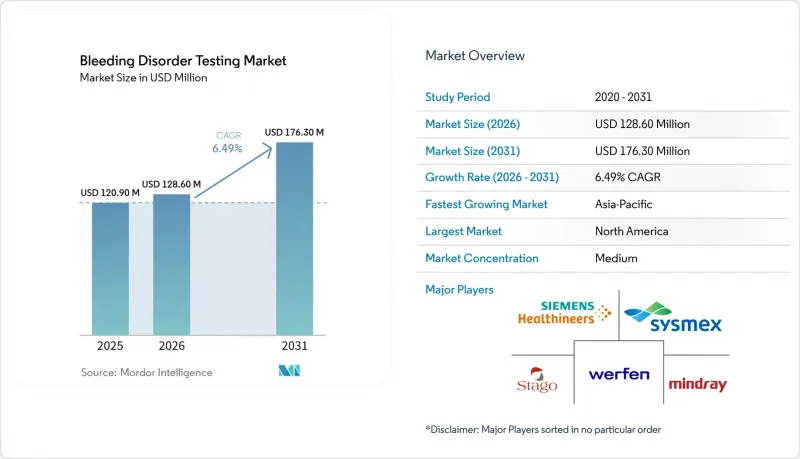
This report is Segmented by Disorder (Hemophilia A, Hemophilia B, Von Willebrand Disease, Others), Technology (Coagulation Assays, Molecular Diagnostics, Point-Of-Care, Others), Product (Reagents, Instruments, Software), End User (Hospitals, Laboratories, Htcs, POC/Home, Research), and Geography (North America, Europe, Asia-Pacific, MEA, South America). Market Forecasts are in Value (USD).
Global Bleeding Disorder Testing Market Trends and Insights
Guideline-Mandated Testing Adoption and Quality Assurance Programs
Global societies updated laboratory manuals in 2025, requiring chromogenic assays for emicizumab-treated patients and standardized inhibitor screening intervals. European laboratories responded to the British Society for Hematology's 2024 Von Willebrand guidance by switching to GPIbM or GPIbR assays, triggering reagent reformulation. Laboratories enrolling in external quality schemes now link compliance directly to reimbursement eligibility, pushing adoption of traceable calibration and ISO 15189 accreditation. Embedded pre-analytical checks lower repeat collection by 40% and shrink medicolegal exposure in gene-therapy monitoring. As harmonized protocols spread, inter-laboratory result portability improves, easing multicenter trial logistics.
Shift to Automation and Integrated Coagulation Platforms
High-volume sites deploy workcells that integrate barcode verification, centrifugation, and data management, cutting manual touchpoints by 70% and enabling overnight lights-out runs. Newly launched analyzers consolidate hemostasis, chemistry, and immunoassay results on one dashboard, trimming emergency-department turnaround times by 30%. RFID reagent tracking eliminates transcription errors and reduces expired inventory. Return on investment arrives within 18 months for labs processing more than 200 hemostasis samples daily, largely through labor savings and decreased waste. Automation also standardizes specimen handling and boosts proficiency-test performance.
Inter-Lab Assay Variability and Lack of Harmonization Across Methods
Proficiency testing in 2024 showed Factor VIII results swinging by ≥30% among labs using identical plasma because of reagent lot drift and differing optical paths. Such noise can force unnecessary dose escalations, adding USD 50,000 per patient annually. Von Willebrand testing is even more discordant; mixed methodologies delay diagnosis an extra 14 months in 18% of Type 2 cases. Central-lab mandates in clinical trials add up to USD 0.5 million in cold-chain logistics, prompting vendors to develop locked-cartridge systems that raise reagent costs by 30% but cap calibration variance.
Other drivers and restraints analyzed in the detailed report include:
- Expansion of Point-of-Care PT/INR Self-Testing and Near-Patient Hemostasis
- Asia-Pacific Diagnostic Capacity Build-Out and Installed-Base Expansion
- Pre-Analytical Errors and Specimen Handling Constraints
For complete list of drivers and restraints, kindly check the Table Of Contents.
Segment Analysis
Hemophilia A generated 48.19% of 2025 revenue as the bleeding disorder testing market transitioned from niche inhibitor monitoring to broad prophylaxis surveillance, swelling the testable population to 40,000 patients worldwide. Von Willebrand Disease represents the fastest-growing disorder, advancing at a 7.98% CAGR as GPIb activity assays expose underdiagnosed Type 2 variants. The bleeding disorder testing market size for Hemophilia B rises with RNA-interference therapy approvals that mandate quarterly Factor IX and antithrombin checks. Molecular panels now identify causal mutations in 74% of rare factor deficiencies, shifting diagnosis from phenotype to genotype.
Gene-therapy adoption alters lifetime testing cadence: monthly Factor VIII/IX levels for three months, then quarterly, replacing episodic inhibitor screens. Intensified monitoring underpins the projected growth of hemophilia treatment centers, which deliver rapid turnaround and clinical oversight that decentralized labs struggle to match. Widening newborn screening further lifts baseline volumes.
Coagulation assays held 42.16% of 2025 revenue, anchored by activated partial thromboplastin time and prothrombin time screens. Yet chromogenic Factor VIII methods are overtaking one-stage tests as emicizumab adoption spreads. Molecular diagnostics is the fastest technology segment, climbing 8.35% annually as next-generation sequencing panels shrink turnaround from eight weeks to three. Point-of-care coagulometers capture a modest share by enabling bedside dose titration, though reimbursement gaps limit U.S. uptake.
Head-to-head trials show comparable precision between premium analyzers, with incremental gains tied to visual defect sensors that flag hemolysis earlier. The bleeding disorder testing market size for molecular platforms is forecast to widen as nationwide genomic initiatives subsidize hereditary-disease panels. Closed-system reagent cartridges reinforce manufacturer lock-in, elevating consumable-to-instrument revenue ratios.
Geography Analysis
Asia-Pacific is the fastest region, projected at an 8.33% CAGR, as the prevalence recognition of hemophilia shifts from 2.57 per 100,000 in 2023 toward 3.12 by 2030, revealing a diagnostic backlog. Government guidelines mandating inhibitor screens, plus affordable domestic analyzers, accelerate market penetration in China and India. Humanitarian factor donations translate into recurring quarterly Factor VIII/IX trough tests, deepening consumable demand.
North America commanded 39.17% revenue in 2025, buoyed by USD 45 Medicare reimbursement per VWF activity assay and a high density of gene-therapy trials that require chromogenic monitoring. Nonetheless, prior authorizations delay testing up to 10 days and elongate dose-adjustment cycles. Europe held a significant share, guided by 2024 VWF recommendations that spurred GPIb reagent adoption, although Brexit extended supply lead times to six weeks and forced 90-day inventory buffers.
Middle East & Africa and South America represented notable shares, with growth clustered in urban HTCs that partner with global training hubs in Japan and Australia. The bleeding disorder testing market share across emerging regions will climb as newborn screening and registry reporting become routine public-health mandates.
- Abbott Laboratories
- BioMedica Diagnostics
- Chrono-Log
- Danaher
- Diagnostica Stago
- Erba Diagnostics Mannheim
- F. Hoffmann-La Roche
- HORIBA Medical
- HYPHEN BioMed
- International Technidyne
- Maccura Biotechnology
- SCLAVO Diagnostics International
- Sekisui Diagnostics
- SHENZHEN MINDRAY BIO-MEDICAL ELECTRONICS CO., LTD.
- Siemens Healthineers
- Sysmex
- Technoclone
- Thermo Fisher Scientific
- Trinity Biotech
- WerfenLife, S.A.
Additional Benefits:
- The market estimate (ME) sheet in Excel format
- 3 months of analyst support
TABLE OF CONTENTS
1 Introduction
- 1.1 Study Assumptions & Market Definition
- 1.2 Scope of the Study
2 Research Methodology
3 Executive Summary
4 Market Landscape
- 4.1 Market Overview
- 4.2 Market Drivers
- 4.2.1 Guideline-Mandated Testing Adoption and Quality Assurance Programs
- 4.2.2 Shift to Automation and Integrated Coagulation Platforms
- 4.2.3 Expansion of Point-Of-Care PT/INR Self-Testing and Near-Patient Hemostasis
- 4.2.4 APAC Diagnostic Capacity Build-Out and Installed-Base Expansion
- 4.2.5 Emicizumab-Driven Shift to Bovine Chromogenic FVIII Assays and Inhibitor Methods
- 4.2.6 Modernization of VWD Activity Testing (GPIB-Based Assays) and Harmonization
- 4.3 Market Restraints
- 4.3.1 Inter-Lab Assay Variability and Lack of Harmonization Across Methods
- 4.3.2 Pre-Analytical Errors and Specimen Handling Constraints
- 4.3.3 Limited FDA Clearance for Preferred VWD Activity Assays in the U.S.
- 4.3.4 High Costs and Reimbursement Friction for Advanced Tests and Gene-Therapy Era Pathways
- 4.4 Supply-Chain Analysis
- 4.5 Regulatory Landscape
- 4.6 Technological Outlook
- 4.7 Porter's Five Forces Analysis
- 4.7.1 Threat of New Entrants
- 4.7.2 Bargaining Power of Suppliers
- 4.7.3 Bargaining Power of Buyers
- 4.7.4 Threat of Substitutes
- 4.7.5 Competitive Rivalry
5 Market Size & Growth Forecasts (Value, USD)
- 5.1 By Disorder (Indication)
- 5.1.1 Hemophilia A
- 5.1.2 Hemophilia B
- 5.1.3 Von Willebrand Disease (Type 1/2A/2B/2M/2N/3)
- 5.1.4 Other Bleeding Disorders
- 5.2 By Technology
- 5.2.1 Coagulation Assays
- 5.2.2 Molecular Diagnostics
- 5.2.3 Point-of-care Coagulometers
- 5.2.4 Others
- 5.3 By Product
- 5.3.1 Reagents & assay kits
- 5.3.2 Instruments
- 5.3.3 Software & connectivity
- 5.4 By End User
- 5.4.1 Hospitals
- 5.4.2 Independent/clinical laboratories
- 5.4.3 Hemophilia treatment centers
- 5.4.4 Point-of-care/home monitoring
- 5.4.5 Research & academia
- 5.5 By Geography
- 5.5.1 North America
- 5.5.1.1 United States
- 5.5.1.2 Canada
- 5.5.1.3 Mexico
- 5.5.2 Europe
- 5.5.2.1 Germany
- 5.5.2.2 United Kingdom
- 5.5.2.3 France
- 5.5.2.4 Italy
- 5.5.2.5 Spain
- 5.5.2.6 Rest of Europe
- 5.5.3 Asia-Pacific
- 5.5.3.1 China
- 5.5.3.2 India
- 5.5.3.3 Japan
- 5.5.3.4 South Korea
- 5.5.3.5 Australia
- 5.5.3.6 Rest of Asia-Pacific
- 5.5.4 Middle East and Africa
- 5.5.4.1 GCC
- 5.5.4.2 South Africa
- 5.5.4.3 Rest of Middle East and Africa
- 5.5.5 South America
- 5.5.5.1 Brazil
- 5.5.5.2 Argentina
- 5.5.5.3 Rest of South America
- 5.5.1 North America
6 Competitive Landscape
- 6.1 Market Concentration
- 6.2 Market Share Analysis
- 6.3 Company Profiles (includes Global level Overview, Market level overview, Core Segments, Financials as available, Strategic Information, Market Rank/Share for key companies, Products & Services, and Recent Developments)
- 6.3.1 Abbott Laboratories
- 6.3.2 BioMedica Diagnostics
- 6.3.3 Chrono-Log
- 6.3.4 Danaher Corporation
- 6.3.5 Diagnostica Stago
- 6.3.6 Erba Diagnostics Mannheim
- 6.3.7 F. Hoffmann-La Roche
- 6.3.8 HORIBA Medical
- 6.3.9 HYPHEN BioMed
- 6.3.10 International Technidyne
- 6.3.11 Maccura Biotechnology
- 6.3.12 Sclavo Diagnostics
- 6.3.13 Sekisui Diagnostics
- 6.3.14 SHENZHEN MINDRAY BIO-MEDICAL ELECTRONICS CO., LTD.
- 6.3.15 Siemens Healthineers
- 6.3.16 Sysmex Corporation
- 6.3.17 Technoclone
- 6.3.18 Thermo Fisher Scientific
- 6.3.19 Trinity Biotech
- 6.3.20 WerfenLife, S.A.
7 Market Opportunities & Future Outlook
- 7.1 White-space & unmet-need assessment

