PUBLISHER: Mordor Intelligence | PRODUCT CODE: 2063665

PUBLISHER: Mordor Intelligence | PRODUCT CODE: 2063665
Platform Engineering And Internal Developer Platform (IDP) - Market Share Analysis, Industry Trends & Statistics, Growth Forecasts (2026 - 2031)
According to Mordor Intelligence, the platform engineering and internal developer platform (IDP) market size is expected to increase from USD 10.44 billion in 2026 to reach USD 31.57 billion by 2031, growing at a CAGR of 24.77% over 2026-2031.
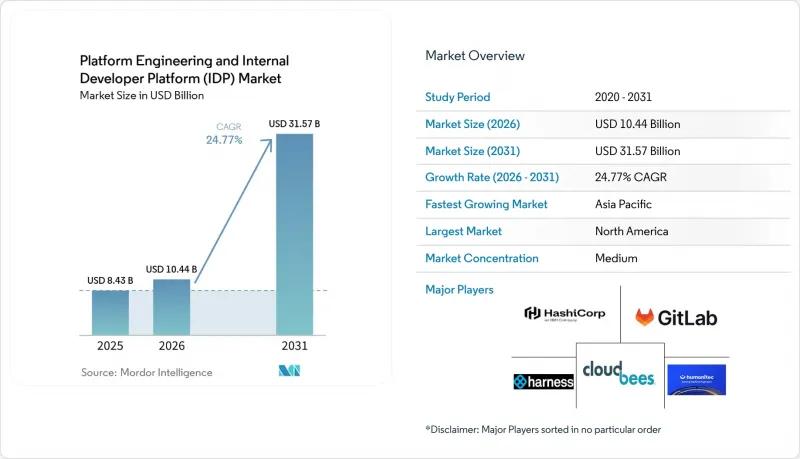
This report is Segmented by Platform Component (Infrastructure Automation Layer, and More), Deployment Mode (On-Premise, Cloud, and Hybrid), Organization Size (Large Enterprises, and Small and Medium Enterprises), End-User Industry (Technology and Software, Financial Services, and More), and Geography. The Market Forecasts are Provided in Terms of Value (USD).
Global Platform Engineering And Internal Developer Platform (IDP) Market Trends and Insights
Accelerating Shift to Cloud-Native Architectures
Cloud-native workloads grew to 82% of production estates in 2025, but the operational burden ballooned as Kubernetes introduced more than 50 core resource types, each carrying dozens of configuration parameters. Internal developer platforms now provision namespaces, ingress, and policy bundles by default, eliminating YAML sprawl and shortening release cycles. Early deployments, such as Nokia's 5G core, saved hundreds of engineering hours per release by removing manual cluster drift. Financial institutions layer Basel III and audit logging policies directly into templates, ensuring regulatory alignment without slowing product delivery. As managed Kubernetes services add edge and multi-networking features, abstraction layers will remain pivotal for keeping the developer experience simple.
Rising Demand for Developer Productivity Gains
Prior to platform adoption, developers devoted roughly 35% of their week to infrastructure tasks, stalling feature velocity. Organizations running mature platforms report near-40% boosts in deployment frequency and around 25% faster mean-time-to-recovery, metrics that translate into sharper competitive positioning. Shopify's migration to a composable admin interface processed 67 million daily page views across 101 teams, an achievement made possible by platform-driven automation. Regulatory frameworks such as GDPR embed privacy-by-design principles into golden paths so developers never manually handle sensitive data. Affordable SaaS subscriptions, priced near USD 1,000 per month, extend these productivity gains to resource-constrained mid-market firms.
High Upfront Investment in Building Internal Platforms
A production-grade platform often needs three to five full-time engineers for up to 18 months, equating to labor costs between USD 150,000 and USD 650,000 before tooling or cloud fees. This capital hurdle sidelines many small and medium-sized enterprises, which accounted for only 38.62% of 2025 spending despite representing the majority of global businesses. Continuous feature evolution, routine security patching, and user-experience refinement compound lifetime costs, prompting some firms to adopt subscription offerings. Software Defined Automation's path to ISO 27001 certification in February 2026, following a USD 10 million seed round, highlights how compliance overhead inflates the total price tag.
Other drivers and restraints analyzed in the detailed report include:
- Increasing Kubernetes Complexity Necessitating Abstraction
- Expansion of Platform Teams in Large Enterprises
- Talent Shortage of Platform Engineers
For complete list of drivers and restraints, kindly check the Table Of Contents.
Segment Analysis
Developer self-service portals captured 34.87% of 2025 revenue, reflecting early enterprise emphasis on workflow automation. This slice of the platform engineering and internal developer platform market size is expected to retain leadership as portals remain the primary touchpoint for developers creating new services. Observability and telemetry pieces, however, are set to grow 25.77% annually, driven by OpenTelemetry adoption that mandates trace-first design across all golden paths. Integrated suites now fold metrics, traces, and logs into the initial scaffolding, so every microservice emits data without extra developer steps, ensuring that performance regressions are caught before they impact users.
A parallel trend favors CI/CD orchestration woven into platform blueprints, with 67% of 2025 respondents citing GitOps as their delivery pattern of choice. Infrastructure automation components, exemplified by Pulumi's OpenAPI release, abstract diverse cloud REST endpoints behind uniform APIs, easing multi-provider workflows. Governance and security layers embed the Open Policy Agent to enforce guardrails at admission controller time. Collectively, these pieces suggest the platform engineering and internal developer platform (IDP) market will shift from discrete modules toward opinionated bundles that minimize configuration debt.
Cloud deployment held 46.32% of the platform engineering and internal developer platform market share in 2025, thanks to mature managed Kubernetes services that lower operational lift. Yet hybrid topologies are projected to compound at 35.37% each year, more than 10 percentage points above the headline CAGR. Driving the swing are regulatory mandates, such as Europe's Digital Operational Resilience Act, that push banks to maintain on-premises disaster-recovery zones even as they leverage public-cloud elasticity for dev environments. Platform abstraction stitches together these disparate estates, presenting developers with a single API regardless of where workloads eventually land.
Vodafone's validated OpenShift patterns exemplify how GitOps keeps edge clusters in sync with centralized control planes. On-prem deployments remain mandatory for air-gapped defense workloads, yet the arrival of sovereign cloud options from Oracle and others is eroding the case for purely local installations. As multi-cloud adoption climbs, platform blueprints must mask provider-specific primitives, a design shift that fuels hybrid growth and cements vendor-agnostic orchestration as table stakes.
Geography Analysis
North America held 41.68% of 2025 revenue due to deep Kubernetes penetration and early formation of platform teams. Enterprises in the United States weave PCI-DSS 4.0 and SOC 2 Type 2 controls directly into golden paths, enabling developers to ship code without wrangling compliance minutiae. The region's salary premium, 27% above DevOps baselines, creates talent gravity but also strains hiring pipelines, prompting firms to automate repetitive platform maintenance tasks. Canada and Mexico follow similar trajectories, modernizing pipelines to manage cross-border data flows governed by GDPR-inspired statutes.
Asia-Pacific is expanding at a 24.89% CAGR, fueled by sovereign-cloud mandates in India and China that make abstraction layers indispensable for multi-region workloads behind unified developer interfaces. The latest Cloud Native Computing Foundation pulse shows that 87% of regional enterprises are either implementing or planning platform programs, an indicator that the platform engineering and internal developer platform markets will post sustained double-digit growth. Japan and South Korea dominate mature adoption, while India's technology-services giants embed internal platforms to standardize global client delivery. Talent shortages remain acute, so AI-guided platforms fill operational gaps.
Europe maintains a mid-tier share but is accelerating where the Digital Operational Resilience Act, the Network and Information Security Directive 2, and GDPR converge on software supply-chain assurance. The United Kingdom, Germany, and France channel spending into banking and telecom use cases that rely on platform-level policy codification. South America's penetration is nascent; Brazil and Argentina are modernizing core banking, yet smaller IT ecosystems are curbing uptake. In the Middle East and Africa, the United Arab Emirates and Saudi Arabia anchor sovereign-cloud investments that require platform abstraction, whereas sub-Saharan Africa faces infrastructure gaps.
- Humanitec GmbH
- OpsLevel Inc.
- Port.io Ltd.
- Armory Inc.
- Harness Inc.
- Platform.sh SAS
- CloudBees Inc.
- D2iQ Inc.
- Upbound Inc.
- Pulumi Corporation
- Weaveworks Ltd.
- GitLab Inc.
- Atlassian Corporation Plc
- Red Hat Inc.
- HashiCorp Inc.
- Circle Internet Services Inc.
- Okteto Inc.
- ReleaseHub Inc.
- Mirantis Inc.
- Syntasso Ltd.
Additional Benefits:
- The market estimate (ME) sheet in Excel format
- 3 months of analyst support
TABLE OF CONTENTS
1 INTRODUCTION
- 1.1 Study Assumptions and Market Definition
- 1.2 Scope of the Study
2 RESEARCH METHODOLOGY
3 EXECUTIVE SUMMARY
4 MARKET LANDSCAPE
- 4.1 Market Overview
- 4.2 Market Drivers
- 4.2.1 Accelerating Shift to Cloud-Native Architectures
- 4.2.2 Rising Demand for Developer Productivity Gains
- 4.2.3 Increasing Kubernetes Complexity Necessitating Abstraction
- 4.2.4 Expansion of Platform Teams in Large Enterprises
- 4.2.5 Growing Compliance Requirements for Software Supply Chains
- 4.2.6 Emergence of AI-Augmented DevOps Toolchains
- 4.3 Market Restraints
- 4.3.1 High Upfront Investment in Building Internal Platforms
- 4.3.2 Talent Shortage of Platform Engineers
- 4.3.3 Integration Challenges with Legacy Systems
- 4.3.4 Security Concerns Around Self-Service Portals
- 4.4 Impact of Macroeconomic Factors on the Market
- 4.5 Industry Value Chain Analysis
- 4.6 Regulatory Landscape
- 4.7 Technological Outlook
- 4.8 Porter's Five Forces Analysis
- 4.8.1 Bargaining Power of Suppliers
- 4.8.2 Bargaining Power of Buyers
- 4.8.3 Threat of New Entrants
- 4.8.4 Threat of Substitutes
- 4.8.5 Intensity of Competitive Rivalry
5 MARKET SIZE AND GROWTH FORECASTS (VALUE)
- 5.1 By Platform Component
- 5.1.1 Infrastructure Automation Layer
- 5.1.2 Developer Self-Service Portal
- 5.1.3 CI/CD Orchestration
- 5.1.4 Observability and Telemetry
- 5.1.5 Governance and Security Controls
- 5.2 By Deployment Mode
- 5.2.1 On-Premise
- 5.2.2 Cloud
- 5.2.3 Hybrid
- 5.3 By Organization Size
- 5.3.1 Large Enterprises
- 5.3.2 Small and Medium-Sized Enterprises (SMEs)
- 5.4 By End-user Industry
- 5.4.1 Technology and Software
- 5.4.2 Financial Services
- 5.4.3 Telecommunications
- 5.4.4 Healthcare and Life Sciences
- 5.4.5 Retail and E-Commerce
- 5.4.6 Manufacturing
- 5.4.7 Energy and Utilities
- 5.4.8 Government and Public Sector
- 5.4.9 Other End-User Industries
- 5.5 By Geography
- 5.5.1 North America
- 5.5.1.1 United States
- 5.5.1.2 Canada
- 5.5.1.3 Mexico
- 5.5.2 South America
- 5.5.2.1 Brazil
- 5.5.2.2 Argentina
- 5.5.2.3 Rest of South America
- 5.5.3 Europe
- 5.5.3.1 United Kingdom
- 5.5.3.2 Germany
- 5.5.3.3 France
- 5.5.3.4 Italy
- 5.5.3.5 Spain
- 5.5.3.6 Rest of Europe
- 5.5.4 Asia-Pacific
- 5.5.4.1 China
- 5.5.4.2 Japan
- 5.5.4.3 India
- 5.5.4.4 South Korea
- 5.5.4.5 Rest of Asia-Pacific
- 5.5.5 Middle East and Africa
- 5.5.5.1 Middle East
- 5.5.5.1.1 United Arab Emirates
- 5.5.5.1.2 Saudi Arabia
- 5.5.5.1.3 Rest of Middle East
- 5.5.5.2 Africa
- 5.5.5.2.1 South Africa
- 5.5.5.2.2 Egypt
- 5.5.5.2.3 Rest of Africa
- 5.5.5.1 Middle East
- 5.5.1 North America
6 COMPETITIVE LANDSCAPE
- 6.1 Market Concentration
- 6.2 Strategic Moves
- 6.3 Market Share Analysis
- 6.4 Company Profiles (includes Global Level Overview, Market Level Overview, Core Segments, Financials as available, Strategic Information, Market Rank/Share, Products and Services, Recent Developments)
- 6.4.1 Humanitec GmbH
- 6.4.2 OpsLevel Inc.
- 6.4.3 Port.io Ltd.
- 6.4.4 Armory Inc.
- 6.4.5 Harness Inc.
- 6.4.6 Platform.sh SAS
- 6.4.7 CloudBees Inc.
- 6.4.8 D2iQ Inc.
- 6.4.9 Upbound Inc.
- 6.4.10 Pulumi Corporation
- 6.4.11 Weaveworks Ltd.
- 6.4.12 GitLab Inc.
- 6.4.13 Atlassian Corporation Plc
- 6.4.14 Red Hat Inc.
- 6.4.15 HashiCorp Inc.
- 6.4.16 Circle Internet Services Inc.
- 6.4.17 Okteto Inc.
- 6.4.18 ReleaseHub Inc.
- 6.4.19 Mirantis Inc.
- 6.4.20 Syntasso Ltd.
7 MARKET OPPORTUNITIES AND FUTURE OUTLOOK
- 7.1 White-Space and Unmet-Need Assessment

