PUBLISHER: Mordor Intelligence | PRODUCT CODE: 2063668

PUBLISHER: Mordor Intelligence | PRODUCT CODE: 2063668
Vibe Coding - Market Share Analysis, Industry Trends & Statistics, Growth Forecasts (2026 - 2031)
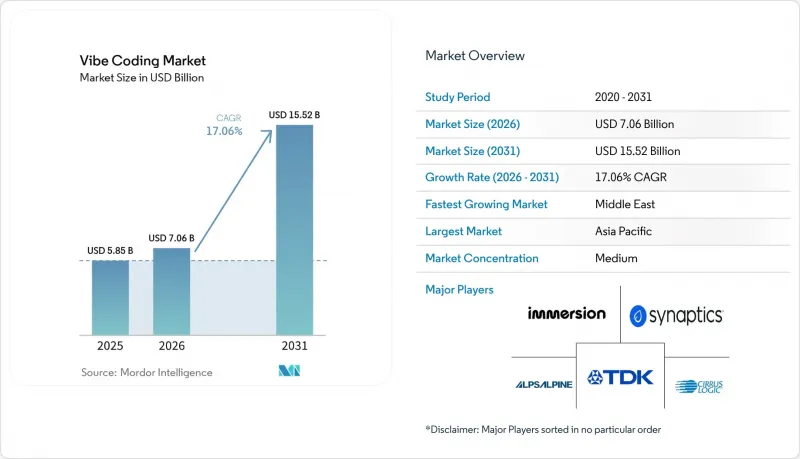
According to Mordor Intelligence, the vibe coding market size is projected to expand from USD 5.85 billion in 2025 and USD 7.06 billion in 2026 to USD 15.52 billion by 2031, registering a 17.06% CAGR between 2026 and 2031.
This report is Segmented by Product Type (Vibe Pattern Encoders, Resonance Signal Transducers, Haptic Feedback Integrated Circuits, and More), Programming Paradigm (Procedural, Object-Oriented, Functional, Reactive, and More), Deployment Model (On-Premise, Cloud-Based, and More), End User Industry (Consumer Electronics, Gaming, and More), and Geography. The Market Forecasts are Provided in Terms of Value (USD).
Global Vibe Coding Market Trends and Insights
Accelerated Adoption of Tactile Internet in 6G Testbeds
National consortia in China, South Korea, and Germany are embedding haptic channels into early 6G prototypes, aiming to achieve end-to-end latencies below 1 millisecond to enable remote surgery and industrial teleoperation. IEEE 1918.1.1-2024 codifies tactile codecs that reduce kinesthetic data by up to 90%, enabling coexistence with ultra-high-definition video over constrained wireless links. Germany's Center for Tactile Internet with Human-in-the-Loop secured long-term funding that supports passivity algorithms resilient to network jitter. South Korea's Electronics and Telecommunications Research Institute validated force-feedback transfer at 10 kHz over 28 GHz millimeter-wave channels in December 2025, confirming commercial feasibility. These proofs of concept are translating laboratory advances into pilot deployments that will inform volume rollouts after 2027.
Expanding Use of Advanced Haptics in AR and VR Headsets
Meta Quest 3 integrates dual linear resonant actuators that synchronize vibrations to virtual interactions, moving precision tactile cues into the mid-price headset tier. Sony PlayStation VR2 extends immersion with adaptive triggers that modulate resistance for firearm recoil and bow tension. Apple Vision Pro embeds a head-mounted Taptic Engine that converts spatial audio cues into localized vibration, supporting users with hearing impairments. Razer's Dynamic Haptics, launched in March 2026, converts game soundtracks into real-time vibration patterns, eliminating the need for manual authoring. Collectively, these platform moves transform haptics from a premium add-on to an expected baseline, compelling smaller vendors to license turnkey vibe coding stacks.
Fragmentation of Proprietary Haptic Protocols
Most handset and operating-system vendors still deploy incompatible APIs, including Core Haptics on iOS, Immersion TouchSense SDK on Android, and Windows Haptic Interface, requiring separate codebases that inflate engineering budgets. Automotive Tier-1 suppliers such as Bosch and Continental specify unique actuator interfaces, blocking dual sourcing and driving component premiums. The lack of a universal codec forces manual re-tuning when shifting between linear resonant and piezo actuators, consuming up to 40% of design budgets. This protocol balkanization discourages small developers and concentrates innovation within large incumbents.
Other drivers and restraints analyzed in the detailed report include:
- Automotive Shift to Software-Defined Cockpits
- Regulatory Push for Accessibility Features in Consumer Devices
- Limited Standardisation Across Hardware Layer
For complete list of drivers and restraints, kindly check the Table Of Contents.
Segment Analysis
Haptic Feedback Integrated Circuits accounted for 30.82% of 2025 revenue, establishing the core hardware layer of the vibe coding market across smartphones and automotive systems. These ICs integrate digital playback engines, boost converters, and closed-loop control into a single die, reducing board footprint and standby power consumption. The integration improves system efficiency while simplifying design complexity for OEMs operating under tight space and energy constraints. This positions ICs as the primary value-capture point, particularly in high-volume applications where performance consistency and cost optimization directly influence product competitiveness and scalability.
Integrated Vibe Development Kits are expanding at an 18.30% CAGR through 2031, driven by demand for turnkey prototyping solutions that combine actuators, drivers, and reference firmware. These kits accelerate design cycles by enabling rapid tactile prototyping, allowing industrial design teams to validate user experiences within weeks rather than months. They also reduce entry barriers by exposing I2C interfaces and force-tuning parameters via intuitive GUIs, minimizing the need for deep firmware expertise. This broadens the customer base and creates a pull-through effect, where early-stage prototyping adoption directly translates into downstream IC demand and ecosystem lock-in.
Object-Oriented Vibe Coding led 2025 revenue at 33.72%, reflecting its structural advantage in cross-platform development environments such as Android and Unity. By encapsulating haptic effects, calibration tables, and playback logic into reusable classes, teams achieve modularity, cleaner version control, and faster iteration cycles. This approach reduces integration friction across applications, particularly in ecosystems where tactile feedback consistency is critical. Its dominance is therefore rooted in maintainability and portability, aligning with enterprise-scale development workflows and multi-platform deployment requirements.
Reactive Vibe Coding, growing at 17.73% CAGR through 2031, introduces an event-driven paradigm where haptic responses are triggered by real-time sensor inputs rather than continuous polling. This reduces CPU overhead while enabling sub-100 microsecond response times, critical for latency-sensitive applications. Emerging hybrid models combine object-oriented containers with reactive bindings, allowing stored tactile assets to be dynamically deployed based on live force or proximity data. This convergence improves both system responsiveness and code maintainability, positioning reactive architectures to gradually displace procedural frameworks, particularly in wearables, gaming controllers, and other interaction-intensive devices.
Geography Analysis
Asia-Pacific generated 31.82% of 2025 revenue and is projected to grow at 17.06% CAGR through 2031, supported by integrated supply chains across China, Japan, and South Korea. Regional manufacturers shipped over 1.5 billion vibration motors by 2025, creating cost advantages and reducing lead times for handset OEMs. Local fabs commercialized miniature piezo strips delivering up to 5 g peak acceleration within thin device architectures, strengthening export competitiveness. Electric-vehicle OEMs are embedding software-defined cockpits with piezo haptic bars, reinforcing domestic driver IC ecosystems and vertically integrated innovation capacity.
North America and Europe together accounted for approximately 40% of 2025 revenue, driven by premium automotive demand and a strong console gaming ecosystem. Automotive Tier 1 suppliers integrated closed-loop haptic drivers into steering systems and infotainment stacks to comply with safety and driver-distraction regulations. Meanwhile, IP licensors based in the United States renewed global royalty agreements, sustaining predictable cash flows. Fabless semiconductor entrants gained traction in laptops and solid-state button modules, leveraging design innovation to capture incremental share in higher-margin applications across computing and interface technologies.
The Middle East is projected to expand at 17.92% CAGR through 2031, led by investments in Saudi Arabia and United Arab Emirates targeting smart-city infrastructure and service robotics. Public funding models often subsidize up to 85% of project costs, contingent on local workforce development. In contrast, South America, Africa, and smaller Asian markets remain price-sensitive, favoring sub-USD 1.00 LRAs until piezo costs decline further. However, global cost curves are trending downward, enabling broader adoption of high-definition haptics and expanding the long-term addressable market.
- Immersion Corporation
- Boreas Technologies Inc.
- Ultraleap Holdings Limited
- TDK Corporation
- Novasentis Inc.
- Aito B.V.
- Senseg Oy
- Synaptics Incorporated
- Texas Instruments Incorporated
- Microchip Technology Inc.
- Cirrus Logic Inc.
- Alps Alpine Co., Ltd.
- AAC Technologies Holdings Inc.
- Johnson Electric Holdings Limited
- Jinlong Machinery and Electronics Co., Ltd.
- Nidec Corporation
- Precision Microdrives Limited
- Awinic Technology Co., Ltd.
- Imagis Co., Ltd.
- Dongwoon Anatech Co., Ltd.
Additional Benefits:
- The market estimate (ME) sheet in Excel format
- 3 months of analyst support
TABLE OF CONTENTS
1 INTRODUCTION
- 1.1 Study Assumptions and Market Definition
- 1.2 Scope of the Study
2 RESEARCH METHODOLOGY
3 EXECUTIVE SUMMARY
4 MARKET LANDSCAPE
- 4.1 Market Overview
- 4.2 Market Drivers
- 4.2.1 Accelerated Adoption of Tactile Internet in 6G Testbeds
- 4.2.2 Expanding Use of Advanced Haptics in AR and VR Headsets
- 4.2.3 Automotive Shift to Software-Defined Cockpits
- 4.2.4 Regulatory Push for Accessibility Features in Consumer Devices
- 4.2.5 Open-Source Frameworks Lowering Entry Barriers for Developers
- 4.2.6 Edge-AI Optimisation Enabling Ultra-Low-Latency Vibe Coding
- 4.3 Market Restraints
- 4.3.1 Fragmentation of Proprietary Haptic Protocols
- 4.3.2 Limited Standardisation Across Hardware Layer
- 4.3.3 High Upfront Costs of Precision Actuators
- 4.3.4 Risk of Sensory Overload and User Fatigue
- 4.4 Impact of Macroeconomic Factors on the Market
- 4.5 Industry Value Chain Analysis
- 4.6 Regulatory Landscape
- 4.7 Technological Outlook
- 4.8 Porter's Five Forces Analysis
- 4.8.1 Threat of New Entrants
- 4.8.2 Bargaining Power of Suppliers
- 4.8.3 Bargaining Power of Buyers
- 4.8.4 Threat of Substitutes
- 4.8.5 Intensity of Competitive Rivalry
5 MARKET SIZE AND GROWTH FORECASTS (VALUE)
- 5.1 By Product Type
- 5.1.1 Vibe Pattern Encoders
- 5.1.2 Resonance Signal Transducers
- 5.1.3 Haptic Feedback Integrated Circuits
- 5.1.4 Integrated Vibe Development Kits
- 5.2 By Programming Paradigm
- 5.2.1 Procedural Vibe Coding
- 5.2.2 Object-Oriented Vibe Coding
- 5.2.3 Functional Vibe Coding
- 5.2.4 Reactive Vibe Coding
- 5.2.5 Hybrid Paradigms
- 5.3 By Deployment Model
- 5.3.1 On-Premise
- 5.3.2 Cloud-Based
- 5.3.3 Edge-Embedded
- 5.4 By End User Industry
- 5.4.1 Consumer Electronics
- 5.4.2 Automotive
- 5.4.3 Industrial Automation
- 5.4.4 Healthcare
- 5.4.5 Gaming and AR/VR
- 5.4.6 Other End User Industries
- 5.5 By Geography
- 5.5.1 North America
- 5.5.1.1 United States
- 5.5.1.2 Canada
- 5.5.1.3 Mexico
- 5.5.2 South America
- 5.5.2.1 Brazil
- 5.5.2.2 Argentina
- 5.5.2.3 Rest of South America
- 5.5.3 Europe
- 5.5.3.1 Germany
- 5.5.3.2 France
- 5.5.3.3 United Kingdom
- 5.5.3.4 Italy
- 5.5.3.5 Spain
- 5.5.3.6 Russia
- 5.5.3.7 Rest of Europe
- 5.5.4 Asia-Pacific
- 5.5.4.1 China
- 5.5.4.2 Japan
- 5.5.4.3 South Korea
- 5.5.4.4 India
- 5.5.4.5 Australia and New Zealand
- 5.5.4.6 Rest of Asia-Pacific
- 5.5.5 Middle East
- 5.5.5.1 Saudi Arabia
- 5.5.5.2 United Arab Emirates
- 5.5.5.3 Turkey
- 5.5.5.4 Rest of Middle East
- 5.5.6 Africa
- 5.5.6.1 South Africa
- 5.5.6.2 Nigeria
- 5.5.6.3 Rest of Africa
- 5.5.1 North America
6 COMPETITIVE LANDSCAPE
- 6.1 Market Concentration
- 6.2 Strategic Moves
- 6.3 Market Share Analysis
- 6.4 Company Profiles (includes Global Level Overview, Market Level Overview, Core Segments, Financials as available, Strategic Information, Market Rank/Share, Products and Services, Recent Developments)
- 6.4.1 Immersion Corporation
- 6.4.2 Boreas Technologies Inc.
- 6.4.3 Ultraleap Holdings Limited
- 6.4.4 TDK Corporation
- 6.4.5 Novasentis Inc.
- 6.4.6 Aito B.V.
- 6.4.7 Senseg Oy
- 6.4.8 Synaptics Incorporated
- 6.4.9 Texas Instruments Incorporated
- 6.4.10 Microchip Technology Inc.
- 6.4.11 Cirrus Logic Inc.
- 6.4.12 Alps Alpine Co., Ltd.
- 6.4.13 AAC Technologies Holdings Inc.
- 6.4.14 Johnson Electric Holdings Limited
- 6.4.15 Jinlong Machinery and Electronics Co., Ltd.
- 6.4.16 Nidec Corporation
- 6.4.17 Precision Microdrives Limited
- 6.4.18 Awinic Technology Co., Ltd.
- 6.4.19 Imagis Co., Ltd.
- 6.4.20 Dongwoon Anatech Co., Ltd.
7 MARKET OPPORTUNITIES AND FUTURE OUTLOOK
- 7.1 White-Space and Unmet-Need Assessment

