PUBLISHER: Mordor Intelligence | PRODUCT CODE: 2063677

PUBLISHER: Mordor Intelligence | PRODUCT CODE: 2063677
Laparotomy Sponges - Market Share Analysis, Industry Trends & Statistics, Growth Forecasts (2026 - 2031)
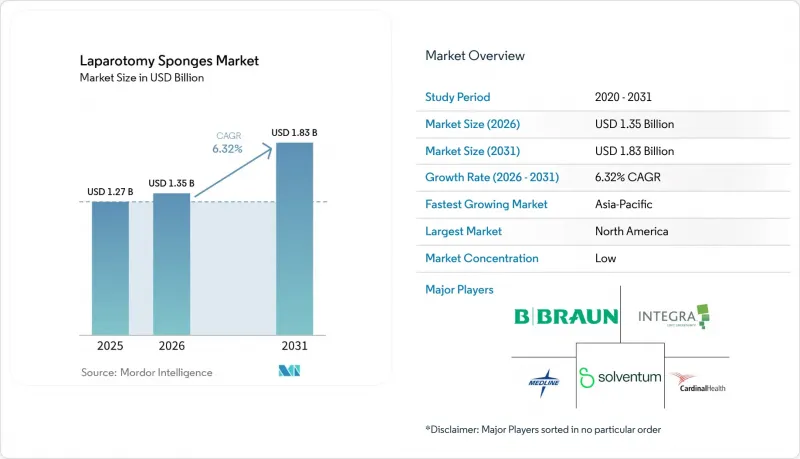
According to Mordor Intelligence, the laparotomy sponges market size is expected to increase from USD 1.27 billion in 2025 to USD 1.35 billion in 2026 and reach USD 1.83 billion by 2031, growing at a CAGR of 6.32% over 2026-2031.
This report is Segmented by Product (Radiopaque Laparotomy Sponges, Traditional Sponges, and More), Material (Cotton, Rayon / Viscose, Non-Woven & Synthetic Blends, and More), Sterility (Sterile and Non-Sterile), End-User (Hospitals & Clinics, Ambulatory Surgical Centers, and More), and Geography (North America, Europe, Asia-Pacific, and More). The Market and Forecasted in Terms of Value (USD).
Global Laparotomy Sponges Market Trends and Insights
Rising Volume of Surgical Procedures
Global case counts continue to climb, yet day-surgery protocols now dominate at major centers such as West China Hospital, where same-day procedures rose from 6.16% to 25.11% of total surgical volume and cut costs by 15%. India's 2026-27 budget channels USD 4.7 billion into the National Health Mission and USD 573 million into PM-ABHIM, creating new OR capacity but driving volume toward price-sensitive tenders. Consequently, suppliers must package sponges with logistics, consignment, or count-verification services to protect margins.
Growing Focus on Surgical Safety & RSI Prevention
AORN and the American College of Surgeons updated guidelines in 2024 to recommend radiopaque or RFID adjuncts when manual counts are unreliable. The Joint Commission recorded 119 RSI sentinel events in 2024; each costs hospitals roughly USD 525,000, so risk officers now prioritize traceability tools over unit price. Augustine Biomedical's 2024 RFID patent shows the technical path forward, allowing tags to survive 134 °C autoclaves. Liability fears are therefore shifting purchasing power from supply managers to clinical-quality teams.
Shift Toward Minimally Invasive / Hemostatic Substitutes
Robotic surgery's share of U.K. general surgery rose from 0.4% in 2015 to 7.0% in 2024 and is on track to eclipse open techniques within five years. U.S. hospitals using robotic platforms push MIS rates above 65%, cutting sponge consumption per case by up to 60%. New hemostatic agents such as chitosan-copper composites further displace traditional sponges in high-bleed fields. Suppliers must therefore redesign products for laparoscopic ports and fluoroscopic visibility or risk volume loss.
Other drivers and restraints analyzed in the detailed report include:
- Technological Advancements (Radiopaque, RFID, AI-Analytics)
- Expansion of Healthcare Infrastructure in Emerging Markets
- Regulatory & Compliance Burden
For complete list of drivers and restraints, kindly check the Table Of Contents.
Segment Analysis
Radiopaque sponges commanded 42.57% of the laparotomy sponges market share in 2025, reaffirming their role as the baseline safety standard. RFID-enabled products, however, are projected at a 7.56% CAGR through 2031 as hospitals weigh USD 525,000 average RSI liability against a 30-50% price premium. Augustine Biomedical's 2024 patent, which allows RFID tags to survive 134 °C autoclaving, removes a technical barrier to adoption.
Hospitals in litigation-prone markets are layering RFID on top of radiopaque threads, while cash-strapped public hospitals in India and Africa still opt for manual counts. The bifurcation forces suppliers to market dual portfolios: premium RFID packs for trauma and transplant centers and low-cost radiopaque lines for routine appendectomies, an approach that maximizes reach across the laparotomy sponges market.
The laparotomy sponges market saw cotton account for 34.78% of its share in 2025. Rayon and viscose are anticipated to witness significant growth, with a projected CAGR of 7.54% through 2031. Cotton dominated shipments in 2025 thanks to supply chains in India, Brazil, and the United States, though spot prices fluctuated between 60 and 78 per pound and exposed buyers to cost risk. Rayon and viscose blends are gaining share among health-system group purchasing organizations that lock in multi-year contracts for price stability.
Regulators in California and the EU are pushing biodegradable PLA and PHA options, yet unit prices remain 2-3 X higher than cotton. Antimicrobial silver-copper coatings are penetrating colorectal and trauma surgeries where infection risk is greatest, letting suppliers defend margins through outcome-based value propositions within the laparotomy sponges market size.
Geography Analysis
North America led with 38.49% revenue share in 2025 as RSI litigation costs pushed hospitals toward RFID and AI-count systems. Each sentinel event averages USD 525,000, so purchasing committees now treat sponges as risk-mitigation tools. CMS's 2026 ASC rule is fragmenting demand and favoring suppliers that preload sponges into sterile high-throughput kits, sustaining growth despite tariff-driven margin pressure flagged by Cardinal Health's FY2026 update.
Asia-Pacific will post the fastest 12.68% CAGR through 2031 thanks to India's USD 12.7 billion healthcare allocation and China's province-wide procurement alliances that standardize specifications and scale volumes. Multinationals localize production to win the lowest-bid tenders, while private hospitals in Japan and Australia adopt RFID to market premium safety credentials to medical tourists.
Europe sits in the mid-teens share bracket but faces volume drag from robotic surgery. Robotic anterior resections already represent 30% of U.K. rectal cases, a trajectory that may suppress sponge demand by 40-60% per case within five years. EUDAMED registration in 2026 will likely trim the supplier pool, advantaging firms with deep MDR experience and broad CE-marked portfolios. GCC countries and Brazil round out high-growth pockets as they fund medical-city mega projects and public-system upgrades that require CE- or FDA-listed consumables.
- A Plus International
- ACTIMED
- AdvaCare
- Allmed Medical Products
- B. Braun
- Cardinal Health
- DeRoyal Industries
- Dukal LLC
- Dynarex
- Haldor Advanced Technologies
- Integra LifeSciences
- Johnson & Johnson
- Medical Action Industries
- Medline Industries
- Medtronic
- Molnlycke Health Care
- Owens & Minor
- Premier Enterprises
- Smiths Group
- Solventum Corporation
- Stryker
Additional Benefits:
- The market estimate (ME) sheet in Excel format
- 3 months of analyst support
TABLE OF CONTENTS
1 Introduction
- 1.1 Study Assumptions & Market Definition
- 1.2 Scope of the Study
2 Research Methodology
3 Executive Summary
4 Market Landscape
- 4.1 Market Overview
- 4.2 Market Drivers
- 4.2.1 Rising Volume of Surgical Procedures
- 4.2.2 Growing Focus on Surgical Safety & RSI Prevention
- 4.2.3 Technological Advancements (radiopaque, RFID, AI)
- 4.2.4 Expansion of Healthcare Infrastructure in Emerging Markets
- 4.2.5 AI-Enabled Real-Time Sponge-Count Systems
- 4.2.6 Sustainability Mandates Boosting Biodegradable Sponges
- 4.3 Market Restraints
- 4.3.1 Shift toward Minimally Invasive / Hemostatic Substitutes
- 4.3.2 Regulatory & Compliance Burden
- 4.3.3 Cotton-Price Volatility & Supply-Chain Disruptions
- 4.3.4 Data-Privacy Concerns Slowing RFID Uptake
- 4.4 Value / Supply-Chain Analysis
- 4.5 Regulatory Landscape
- 4.6 Technological Outlook
- 4.7 Porters Five Forces Analysis
- 4.7.1 Threat of New Entrants
- 4.7.2 Bargaining Power of Buyers
- 4.7.3 Bargaining Power of Suppliers
- 4.7.4 Threat of Substitutes
- 4.7.5 Competitive Rivalry
5 Market Size & Growth Forecasts (Value, USD)
- 5.1 By Product
- 5.1.1 Radiopaque Laparotomy Sponges
- 5.1.2 Traditional (Conventional) Sponges
- 5.1.3 RFID-enabled Laparotomy Sponges
- 5.2 By Material
- 5.2.1 Cotton
- 5.2.2 Rayon / Viscose
- 5.2.3 Non-Woven & Synthetic Blends
- 5.2.4 Antimicrobial / Biodegradable Composites
- 5.3 By Sterility
- 5.3.1 Sterile
- 5.3.2 Non-sterile
- 5.4 By End-User
- 5.4.1 Hospitals & Clinics
- 5.4.2 Ambulatory Surgical Centers (ASCs)
- 5.4.3 Specialty Clinics
- 5.5 By Geography
- 5.5.1 North America
- 5.5.1.1 United States
- 5.5.1.2 Canada
- 5.5.1.3 Mexico
- 5.5.2 Europe
- 5.5.2.1 Germany
- 5.5.2.2 United Kingdom
- 5.5.2.3 France
- 5.5.2.4 Italy
- 5.5.2.5 Spain
- 5.5.2.6 Rest of Europe
- 5.5.3 Asia-Pacific
- 5.5.3.1 China
- 5.5.3.2 India
- 5.5.3.3 Japan
- 5.5.3.4 Australia
- 5.5.3.5 South Korea
- 5.5.3.6 Rest of Asia-Pacific
- 5.5.4 Middle East and Africa
- 5.5.4.1 GCC
- 5.5.4.2 South Africa
- 5.5.4.3 Rest of MEA
- 5.5.5 South America
- 5.5.5.1 Brazil
- 5.5.5.2 Argentina
- 5.5.5.3 Rest of South America
- 5.5.1 North America
6 Competitive Landscape
- 6.1 Market Concentration
- 6.2 Market Share Analysis
- 6.3 Company Profiles (includes Global Level Overview, Market Level Overview, Core Segments, Financials as Available, Strategic Information, Market Rank/Share for Key Companies, Products & Services, and Recent Developments)
- 6.3.1 A Plus International
- 6.3.2 ACTIMED
- 6.3.3 AdvaCare Pharma
- 6.3.4 Allmed Medical Products
- 6.3.5 B. Braun Melsungen AG
- 6.3.6 Cardinal Health
- 6.3.7 DeRoyal Industries
- 6.3.8 Dukal LLC
- 6.3.9 Dynarex Corporation
- 6.3.10 Haldor Advanced Technologies
- 6.3.11 Integra LifeSciences
- 6.3.12 Johnson & Johnson (Ethicon)
- 6.3.13 Medical Action Industries
- 6.3.14 Medline Industries
- 6.3.15 Medtronic plc
- 6.3.16 Molnlycke Health Care
- 6.3.17 Owens & Minor
- 6.3.18 Premier Enterprises
- 6.3.19 Smith & Nephew
- 6.3.20 Solventum Corporation
- 6.3.21 Stryker Corporation
7 Market Opportunities & Future Outlook
- 7.1 White-space & Unmet-need Assessment

