PUBLISHER: Mordor Intelligence | PRODUCT CODE: 2063729

PUBLISHER: Mordor Intelligence | PRODUCT CODE: 2063729
Gram-Positive Bacterial Infections Treatment - Market Share Analysis, Industry Trends & Statistics, Growth Forecasts (2026 - 2031)
According to Mordor Intelligence, the gram-Positive bacterial infections treatment market size is projected to expand from USD 12.66 billion in 2025 and USD 13.28 billion in 2026 to USD 16.89 billion by 2031, registering a CAGR of 4.92% between 2026 to 2031.
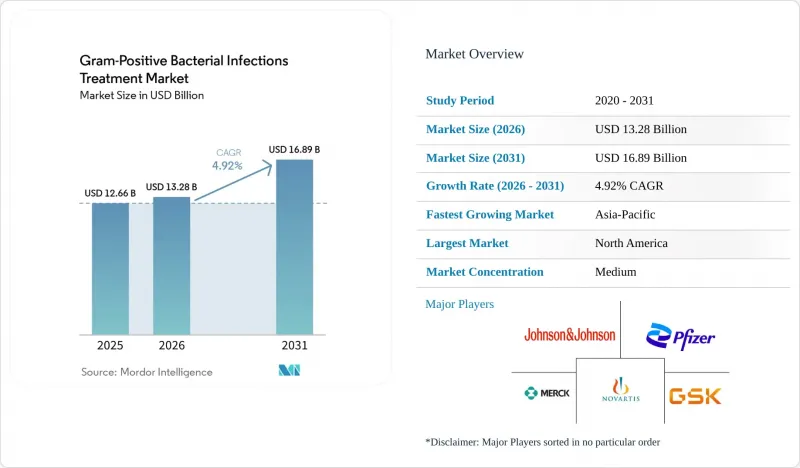
This report is Segmented by Drug Type (Beta-Lactam Antimicrobials, Cephalosporins, Fluoroquinolones, and More), Disease (Pneumonia, Sepsis, MRSA Infections, and More), Distribution Channel (Hospital Pharmacies, Retail Pharmacies, and Online Pharmacies), and Geography (North America, Europe, Asia-Pacific, and More). The Market Sizes and Forecasts are Provided in Terms of Value (USD).
Global Gram-Positive Bacterial Infections Treatment Market Trends and Insights
Rising Prevalence of Gram-Positive Infections
Healthcare-associated infections remain stubbornly high, and MRSA alone represented 121,000 AMR-related deaths annually. Hospitals now screen high-risk admissions with PCR panels that deliver 93.3% detection accuracy within 88 minutes, allowing clinicians to start targeted therapy sooner and reserve broad-spectrum agents for confirmed need. Aging populations enlarge the pool of immunocompromised patients undergoing cancer therapy or organ transplantation, further boosting demand for effective gram-positive coverage. Hypervirulent strains with novel resistance elements add urgency to stewardship, although most currently affect gram-negative pathogens. Collectively, these dynamics lift baseline utilization of oxazolidinones, lipopeptides, and new-generation cephalosporins.
Increasing Number of Drug Approvals & Pipeline Progression
Between 2024 and 2025, the U.S. FDA cleared ceftobiprole for the treatment of MRSA bacteremia and acute skin infections, achieving a 68.9% success rate in bacteremia trials. Gepotidacin secured Priority Review as the first topoisomerase-inhibiting antibiotic in decades, while contezolid earned approval in China with fewer hematologic adverse events than linezolid. WHO counts 97 antibacterial candidates in clinical development, 32 of which target priority pathogens. QIDP and Fast-Track incentives extend exclusivity, partially offsetting development risk and attracting new capital into the market for gram-positive bacterial infections. This regulatory momentum underpins a steady launch cadence through the forecast period.
Escalating Antibiotic Resistance Among Gram-Positive Pathogens
Linezolid resistance now appears in multiple regions via 23S rRNA mutation and cfr gene uptake, curbing therapy length and success. Cambodia's surveillance logged 12.5% extensively drug-resistant Neisseria gonorrhoeae isolates in 2023, underscoring how resistance traits spread quickly even in lower-use settings. Global antibiotic consumption climbed 16.3% between 2016 and 2023, with forecasts of 52.3% growth by 2030 if unchecked, accelerating selection pressure. These patterns threaten current pipelines and require simultaneous investment in prevention, diagnostics, and novel mechanisms.
Other drivers and restraints analyzed in the detailed report include:
- Growing Healthcare Expenditure In Emerging Economies
- Adoption Of Rapid Molecular Diagnostics Enabling Targeted Therapy
- Patent Expiries Driving Generic Erosion
For complete list of drivers and restraints, kindly check the Table Of Contents.
Segment Analysis
Cephalosporins held 24.20% of the gram-positive bacterial infections treatment market share in 2025, anchored by broad empirical use and inclusion in surgical prophylaxis guidelines. FDA approval of ceftobiprole for MRSA bacteremia adds premium-priced volume and supports cephalosporin revenue resilience; however, stewardship directives and growing cephalosporin resistance in some geographies moderate long-term growth. Oxazolidinones, led by linezolid, posted the fastest expansion, with a 9.26% CAGR projected through 2031. Contezolid's approval in China and promising Phase 3 data for tedizolid-analogue agents enhance safety perceptions and widen prescriber comfort. Long-acting lipopeptides such as dalbavancin hold niche utility for outpatient parenteral therapy but rely on reimbursement alignment to offset high single-dose prices. Glycopeptides face sustained pressure from vancomycin-resistant enterococci; developers respond with dosing-optimized formulations that lower nephrotoxicity risk and prolong clinical relevance. Pipeline-stage combination agents, for example, beta-lactam plus B-lactamase inhibitor pairings, mainly target gram-negative organisms, yet cross-labeling potential may expand coverage in mixed infections. Vaccinology advances, particularly against Group B Streptococcus, could gradually reshape demand by preventing infections that currently require prolonged intravenous treatment.
Geography Analysis
North America commanded 38.40% of global revenue in 2025, propelled by early regulatory approvals, high diagnostic penetration, and broad insurance coverage. The EQUIP-A-Pharma initiative adds domestic 3D-printed linezolid capacity, fortifying supply resilience while lowering transportation emissions. Canadian authorities now oblige manufacturers to file shortage-risk plans and hold safety stocks, steps that enhance predictability for hospital buyers. Mexico benefits from near-shoring trends and streamlined USMCA trade lanes that shorten lead times for critical inputs. However, fragmented stewardship enforcement still encourages empiric multi-drug regimens in some regions.
Europe preserves a sizeable share through cohesive AMR policy frameworks. The proposed Critical Medicines Act coordinates joint procurement, ensuring smaller member states can access novel agents without price inflation. Surveillance data from ECDC confirm that broad-spectrum consumption tracks resistance evolution closely, reinforcing pay-for-performance models that reward narrow-spectrum adherence. Western European markets secure advance-purchase agreements for pipeline candidates, whereas Eastern Europe faces reimbursement delays that slow uptake. Pan-regional clinical societies publish emergency-department guidelines emphasizing biomarker-guided initiation and rapid de-escalation, harmonizing practice patterns across disparate health systems.
Asia-Pacific registers the fastest growth at a 7.78% CAGR to 2031, buoyed by expanding universal health coverage schemes and domestic innovation pipelines. Singapore incubates bacteriophage and antimicrobial-peptide startups, positioning itself as a translational hub. China's National Medical Products Administration approved carrimycin and contezolid, demonstrating regulatory agility and rising innovation capacity. Japan achieved sizable consumption cuts for third-generation cephalosporins, yet the MRSA burden remains high, sustaining premium agent demand. India contends with affordability gaps that limit access to branded oxazolidinones, encouraging generic substitution and parallel importation when domestic supply falters. Australia's stockholding mandate and supplier price uplifts underpin stable supplies despite long supply chains.
- Abbvie
- AstraZeneca
- Basilea Pharmaceutica Ltd.
- Bayer
- Bristol-Myers Squibb
- Cumberland Pharmaceuticals
- Dr Reddy's Laboratories Ltd.
- Fresenius
- GlaxoSmithKline
- Hikma Pharmaceuticals
- Johnson & Johnson
- Lupin
- Melinta Therapeutics
- Merck
- Novartis
- Paratek Pharmaceuticals
- Pfizer
- Sanofi
- Shionogi & Co. Ltd.
- Sun Pharmaceuticals Industries
- Teva Pharmaceutical Industries
Additional Benefits:
- The market estimate (ME) sheet in Excel format
- 3 months of analyst support
TABLE OF CONTENTS
1 Introduction
- 1.1 Study Assumptions & Market Definition
- 1.2 Scope of the Study
2 Research Methodology
3 Executive Summary
4 Market Landscape
- 4.1 Market Overview
- 4.2 Market Drivers
- 4.2.1 Rising Incidence of Gram-Positive Infections
- 4.2.2 Surge in Drug Approvals & Advancements in Pipeline
- 4.2.3 Escalating Healthcare Spending in Developing Nations
- 4.2.4 Embrace of Rapid Molecular Diagnostics for Targeted Treatments
- 4.2.5 Revival of Older Narrow-Spectrum Antibiotics Through Stewardship Initiatives
- 4.2.6 Government Subscription Models & Pull-Incentives
- 4.3 Market Restraints
- 4.3.1 Growing Antibiotic Resistance in Gram-Positive Pathogens
- 4.3.2 Patent Expirations Leading to Generic Erosion
- 4.3.3 Strict Antimicrobial Stewardship Curtailing Broad-Spectrum Usage
- 4.3.4 Vulnerable API Supply Chains for Specialized Gram-Positive Agents
- 4.4 Supply Chain Analysis
- 4.5 Regulatory Landscape
- 4.6 Porter's Five Forces Analysis
- 4.6.1 Threat of New Entrants
- 4.6.2 Bargaining Power of Buyers
- 4.6.3 Bargaining Power of Suppliers
- 4.6.4 Threat of Substitutes
- 4.6.5 Competitive Rivalry
5 Market Size & Growth Forecasts (Value in USD)
- 5.1 By Drug Type
- 5.1.1 Beta-Lactam Antimicrobials
- 5.1.2 Cephalosporins
- 5.1.3 Penicillins
- 5.1.4 Fluoroquinolones
- 5.1.5 Lipopeptides
- 5.1.6 Oxazolidinones
- 5.1.7 Glycopeptides
- 5.1.8 Vaccines
- 5.1.9 Combination Therapies & More
- 5.2 By Disease
- 5.2.1 Pneumonia
- 5.2.2 Sepsis
- 5.2.3 Pharyngitis
- 5.2.4 MRSA Infections
- 5.2.5 Endocarditis
- 5.2.6 Meningitis
- 5.2.7 Other Diseases
- 5.3 By Distribution Channel
- 5.3.1 Hospital Pharmacies
- 5.3.2 Retail Pharmacies
- 5.3.3 Online Pharmacies
- 5.4 By Geography
- 5.4.1 North America
- 5.4.1.1 United States
- 5.4.1.2 Canada
- 5.4.1.3 Mexico
- 5.4.2 Europe
- 5.4.2.1 Germany
- 5.4.2.2 United Kingdom
- 5.4.2.3 France
- 5.4.2.4 Italy
- 5.4.2.5 Spain
- 5.4.2.6 Rest of Europe
- 5.4.3 Asia-Pacific
- 5.4.3.1 China
- 5.4.3.2 Japan
- 5.4.3.3 India
- 5.4.3.4 Australia
- 5.4.3.5 South Korea
- 5.4.3.6 Rest of Asia-Pacific
- 5.4.4 Middle East & Africa
- 5.4.4.1 GCC
- 5.4.4.2 South Africa
- 5.4.4.3 Rest of Middle East & Africa
- 5.4.5 South America
- 5.4.5.1 Brazil
- 5.4.5.2 Argentina
- 5.4.5.3 Rest of South America
- 5.4.1 North America
6 Competitive Landscape
- 6.1 Market Concentration
- 6.2 Market Share Analysis
- 6.3 Company Profiles (includes Global level Overview, Market level overview, Core Segments, Financials as available, Strategic Information, Market Rank/Share for key companies, Products & Services, and Recent Developments)
- 6.3.1 AbbVie Inc.
- 6.3.2 AstraZeneca plc
- 6.3.3 Basilea Pharmaceutica Ltd.
- 6.3.4 Bayer AG
- 6.3.5 Bristol-Myers Squibb Co.
- 6.3.6 Cumberland Pharmaceuticals
- 6.3.7 Dr Reddy's Laboratories Ltd.
- 6.3.8 Fresenius Kabi AG
- 6.3.9 GSK plc
- 6.3.10 Hikma Pharmaceuticals plc
- 6.3.11 Johnson & Johnson (Janssen)
- 6.3.12 Lupin Ltd.
- 6.3.13 Melinta Therapeutics
- 6.3.14 Merck & Co. Inc.
- 6.3.15 Novartis AG
- 6.3.16 Paratek Pharmaceuticals
- 6.3.17 Pfizer Inc.
- 6.3.18 Sanofi SA
- 6.3.19 Shionogi & Co. Ltd.
- 6.3.20 Sun Pharmaceutical Industries Ltd.
- 6.3.21 Teva Pharmaceutical Industries Ltd.
7 Market Opportunities & Future Outlook
- 7.1 White-space & Unmet-Need Assessment

