
PUBLISHER: Mordor Intelligence | PRODUCT CODE: 2063736

PUBLISHER: Mordor Intelligence | PRODUCT CODE: 2063736
Veterinary Leptospirosis Treatment - Market Share Analysis, Industry Trends & Statistics, Growth Forecasts (2026 - 2031)
According to Mordor Intelligence, the veterinary leptospirosis treatment market size is projected to expand from USD 0.85 billion in 2025 and USD 0.9 billion in 2026 to USD 1.20 billion by 2031, registering a CAGR of 5.94% between 2026 to 2031.
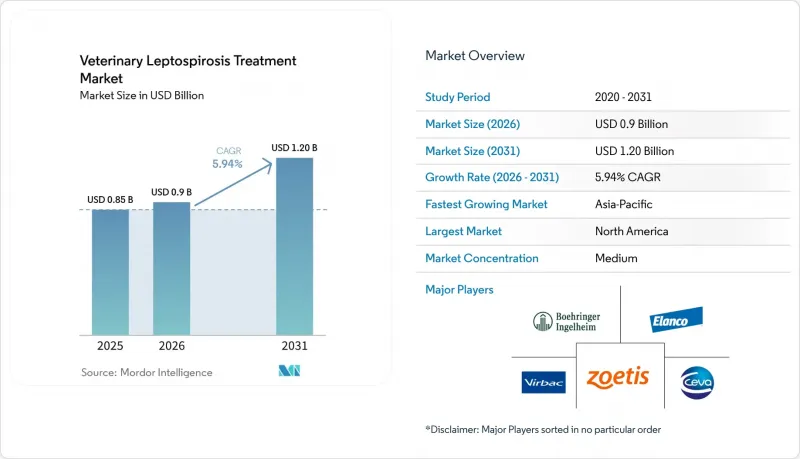
This report is Segmented by Treatment Modality (Vaccines, Antibiotics & Antimicrobials, and More), Animal Species (Companion Animals and More), Distribution Channel (Veterinary Hospitals, Veterinary Clinics, and More), and Geography (North America, Europe, Asia-Pacific, Middle East & Africa, South America). The Market Forecasts are Provided in Terms of Value (USD).
Global Veterinary Leptospirosis Treatment Market Trends and Insights
Climate Change and Flooding Drive Rising Incidence
Extreme rainfall is reducing transmission cycles, leading veterinarians to adjust booster intervals. In 2024, livestock infections significantly increased following heavy rainfall events. In Australia, the southward migration of rodent reservoirs is expanding vaccination coverage into previously unaffected regions. Flooding in Brazil's Rio Grande do Sul in 2024 caused a substantial rise in cases, prompting the implementation of a federal pre-flood vaccination mandate. These developments are driving demand for multivalent vaccines targeting locally emergent serovars, thereby supporting growth in the veterinary leptospirosis treatment market.
Surge in Pet Ownership and Veterinary Expenditure
In 2024, U.S. veterinary spending grew by 15.7% to reach USD 41.26 billion, despite a 3-4% annual decline in clinic visits between 2022 and 2025. Pet owners are consolidating care into fewer appointments, with average costs of USD 220 for dogs and USD 202 for cats, often combining leptospirosis boosters with wellness panels. Emergency visits increased by 12% in 2026, with a notable share attributed to leptospirosis-related acute kidney injuries. In Europe, insurers are waiving deductibles for core vaccines, creating financial incentives that drive recurring demand. These trends are collectively boosting revenues in the veterinary leptospirosis treatment market.
Regulatory Measures Tighten on Key Antimicrobials Amid AMR Worries
The U.S. FDA has implemented restrictions on the extra-label use of fluoroquinolones in food animals. Similarly, the European Medicines Agency has categorized fluoroquinolones as Category B, allowing their use only when no alternatives are available. Global guidelines emphasize reserving critically important antimicrobials exclusively for human medicine. While streptomycin and penicillin remain the primary drugs of choice, their requirement for daily injections increases labor costs. With national targets aiming to reduce antimicrobial sales by 50% by 2030, producers are shifting focus toward prophylactic vaccinations, reducing the reliance on antibiotics within the veterinary leptospirosis treatment market.
Other drivers and restraints analyzed in the detailed report include:
- Vaccination Initiatives by Governments and One-Health Programs
- Rapid Advancements in Veterinary Diagnostics
- Litigation Over Adverse Events Stifles Adoption of Multivalent Vaccines
For complete list of drivers and restraints, kindly check the Table Of Contents.
Segment Analysis
In 2025, vaccines dominated the veterinary leptospirosis treatment market, holding a 55.0% share. They continue to be the primary choice for both companion animals and livestock. Urban pet clinics and dairy farms consistently generate revenue through annual single-dose boosters, which target four to six serovars.
Adjunctive and supportive therapies in the veterinary leptospirosis treatment market are witnessing a robust expansion, growing at a 6.25% CAGR and projected to continue until 2031. This growth is largely driven by the increasing adoption of intravenous fluids, hepatoprotectants, renal-support drugs, and antibiotics. In Brazil, post-flood protocols showcased the efficacy of layered therapy, as CattleMaster GOLD FP 5/L5 was combined with streptomycin, leading to a swift restoration of herd productivity. Such integrated treatments are elevating emergency care into premium treatment packages.
Geography Analysis
In 2025, North America accounted for 38.34% of the veterinary leptospirosis treatment market share, driven by high pet ownership levels, strong consumer willingness to pay, and premium pricing strategies. Additionally, a well-established emergency care network further supports demand, particularly during acute outbreaks.
Asia-Pacific is projected to achieve a 6.75% CAGR from 2026 to 2031, supported by government regulations, increased dairy farming activities, and local vaccine production. Investments by regional players position the market to address rising livestock demand while reducing dependency on imports. This growth not only strengthens the region's market presence but also diversifies global revenue streams for the veterinary leptospirosis treatment market. The region's growth is primarily focused on livestock, with countries such as Indonesia, Thailand, and India allocating public funds to vaccination programs under the One-Health initiative. Local manufacturers enhance accessibility by reducing lead times and offering prices 30-40% lower than imports, facilitating adoption among small-scale farmers. Additionally, urban pet markets in China and South Korea are shifting toward premium multivalent formulations, expanding the companion-animal segment.
In Europe, demand remains strong due to strict welfare regulations and pharmacovigilance systems that mandate detailed reporting of adverse events. While efforts to combat antimicrobial resistance are reducing antibiotic usage, vaccine adoption is increasing simultaneously. Germany and France are leading the region with significant growth in pet insurance enrollments, which include coverage for preventive care.
- Bioveta
- Boehringer Ingelheim
- Ceva
- Chengdu Tecbond
- Durvet
- Elanco
- Hipra
- IDT Biologika
- Indian Immunologicals
- Jinyu Bio-Technology
- Merck
- NeoTech
- Norbrook Laboratories
- Phibro Animal Health
- Ringpu Biological
- Vetoquinol
- Virbac
- Wuhan Keqian
- Zoetis
Additional Benefits:
- The market estimate (ME) sheet in Excel format
- 3 months of analyst support
TABLE OF CONTENTS
1 Introduction
- 1.1 Study Assumptions & Market Definition
- 1.2 Scope of the Study
2 Research Methodology
3 Executive Summary
4 Market Landscape
- 4.1 Market Overview
- 4.2 Market Drivers
- 4.2.1 Rising Incidence Linked to Climate Change & Flooding
- 4.2.2 Growth in Pet Ownership & Veterinary Spend
- 4.2.3 Government/One-Health Vaccination Initiatives
- 4.2.4 Advancements In Rapid Veterinary Diagnostics
- 4.2.5 Long-Acting Fluoroquinolone Formulations Gaining Traction
- 4.2.6 Digital Vaccine-Compliance Platforms Boosting Boosters
- 4.3 Market Restraints
- 4.3.1 Regulatory Curbs on Critical Antimicrobials & AMR Concerns
- 4.3.2 Adverse-Event Litigation Dampening Uptake of Multivalent Vaccines
- 4.3.3 Low Awareness & Affordability in Smallholder Livestock Segments
- 4.3.4 Fragile BSL-2/3 Antigen Manufacturing Supply Chain
- 4.4 Value / Supply-Chain Analysis
- 4.5 Regulatory Landscape
- 4.6 Technological Outlook
- 4.7 Porter's Five Forces Analysis
- 4.7.1 Threat of New Entrants
- 4.7.2 Bargaining Power of Suppliers
- 4.7.3 Bargaining Power of Buyers
- 4.7.4 Threat of Substitutes
- 4.7.5 Competitive Rivalry
5 Market Size & Growth Forecasts (Value, USD)
- 5.1 By Treatment Modality
- 5.1.1 Vaccines
- 5.1.2 Antibiotics & Antimicrobials
- 5.1.3 Adjunctive & Supportive Therapies
- 5.2 By Animal Species
- 5.2.1 Companion Animals
- 5.2.1.1 Dogs
- 5.2.1.2 Cats
- 5.2.2 Livestock
- 5.2.2.1 Cattle
- 5.2.2.2 Small Ruminants
- 5.2.3 Others
- 5.2.1 Companion Animals
- 5.3 By Distribution Channel
- 5.3.1 Veterinary Hospitals
- 5.3.2 Veterinary Clinics
- 5.3.3 Retail & Veterinary Pharmacies
- 5.3.4 Online Pharmacies
- 5.3.5 On-Farm / Mobile Veterinarians
- 5.4 By Geography
- 5.4.1 North America
- 5.4.1.1 United States
- 5.4.1.2 Canada
- 5.4.1.3 Mexico
- 5.4.2 Europe
- 5.4.2.1 Germany
- 5.4.2.2 United Kingdom
- 5.4.2.3 France
- 5.4.2.4 Italy
- 5.4.2.5 Spain
- 5.4.2.6 Rest of Europe
- 5.4.3 Asia-Pacific
- 5.4.3.1 China
- 5.4.3.2 Japan
- 5.4.3.3 India
- 5.4.3.4 Australia
- 5.4.3.5 South Korea
- 5.4.3.6 Rest of Asia-Pacific
- 5.4.4 Middle East & Africa
- 5.4.4.1 GCC
- 5.4.4.2 South Africa
- 5.4.4.3 Rest of Middle East & Africa
- 5.4.5 South America
- 5.4.5.1 Brazil
- 5.4.5.2 Argentina
- 5.4.5.3 Rest of South America
- 5.4.1 North America
6 Competitive Landscape
- 6.1 Market Concentration
- 6.2 Market Share Analysis
- 6.3 Company Profiles (includes Global level Overview, Market level overview, Core Segments, Financials as available, Strategic Information, Market Rank/Share, Products & Services, Recent Developments)
- 6.3.1 Bioveta
- 6.3.2 Boehringer Ingelheim Animal Health
- 6.3.3 Ceva Sante Animale
- 6.3.4 Chengdu Tecbond
- 6.3.5 Durvet
- 6.3.6 Elanco Animal Health
- 6.3.7 HIPRA
- 6.3.8 IDT Biologika
- 6.3.9 Indian Immunologicals
- 6.3.10 Jinyu Bio-Technology
- 6.3.11 Merck Animal Health
- 6.3.12 NeoTech
- 6.3.13 Norbrook Laboratories
- 6.3.14 Phibro Animal Health
- 6.3.15 Ringpu Biological
- 6.3.16 Vetoquinol
- 6.3.17 Virbac
- 6.3.18 Wuhan Keqian
- 6.3.19 Zoetis
7 Market Opportunities & Future Outlook
- 7.1 White-space & Unmet-need Assessment

