PUBLISHER: Mordor Intelligence | PRODUCT CODE: 2063752

PUBLISHER: Mordor Intelligence | PRODUCT CODE: 2063752
HCM Software In Education - Market Share Analysis, Industry Trends & Statistics, Growth Forecasts (2026 - 2031)
According to Mordor Intelligence, the hCM software in education market size is expected to be USD 1.10 billion in 2025, USD 1.18 billion in 2026, and reach USD 1.72 billion by 2031, growing at a CAGR of 7.8% from 2026 to 2031.
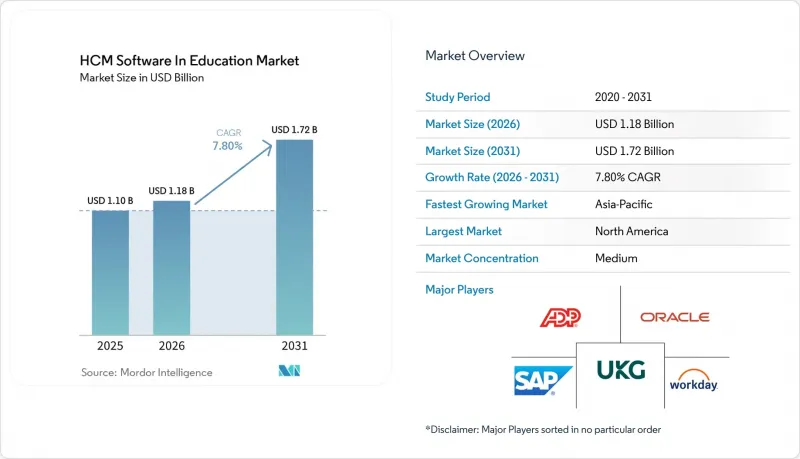
This report is Segmented by Deployment Model (Cloud, and On-Premises), Solution (Core HR, Talent Management, Workforce Management, Payroll, and Learning and Development), Institution Type (K-12 Schools, Community Colleges, Universities, and Vocational and Technical Institutes), End-User (Faculty and Staff, and More), and Geography. The Market Forecasts are Provided in Terms of Value (USD).
Global HCM Software In Education Market Trends and Insights
Growing Cloud-First Strategies Among Universities
Universities are accelerating migrations of payroll, benefits, and recruiting to cloud suites to eliminate data-center costs and support remote faculty access. The shift gained momentum after 2024 when hybrid teaching and multi-campus models exposed the limitations of fixed infrastructure. Providers now package data-conversion tools, sandboxes, and managed services that de-risk complex cutovers. Cloud editions also deliver quarterly feature releases, letting institutions adopt analytics and mobile self-service without long upgrade projects. Workday reported in its fiscal 2026 earnings that education-sector bookings grew by double digits, driven by large public universities replacing legacy ERP stacks with integrated cloud suites. As a result, the HCM software in education market records a steady transfer of workloads from on-premises to cloud subscriptions. Resistance persists where sunk costs in customized ERP stacks remain high, yet expiring maintenance contracts and the lure of elastic scaling continue to tip business cases in favor of cloud adoption.
Increasing Emphasis on Faculty Experience Management
Academic employers are elevating faculty satisfaction to strategic priority, embedding sentiment analysis, workload tracking, and professional-development dashboards into HR workflows. Experience-management tools surface data on teaching loads, research output, and service commitments, enabling deans to spot inequities early. The emphasis aligns with a competitive labor market for STEM professors, where burnout and poaching threaten program continuity. Solutions that recommend mentorship pairings, alert administrators to looming overloads, and integrate with learning-development libraries are gaining favor. Governance complexities remain, because faculty senates demand transparency on how metrics influence promotion and tenure, yet institutions now view holistic engagement analytics as essential for retention.
Budgetary Constraints in Public Institutions
Flat appropriations, enrollment dips, and inflationary pressures leave public universities extending the lives of aging HR systems rather than funding replacements. Boards often freeze hiring and defer IT capital outlays, reserving cash for instructional priorities. Consequently, vendors must propose phased deployments, deferred payment terms, or managed-service models that shift costs from capital to operating budgets. Even attractive total-cost-of-ownership analyses struggle to clear governance hurdles when fiscal forecasts remain uncertain. The funding squeeze therefore slows upgrade cycles and tempers overall expansion of the HCM software in education market.
Other drivers and restraints analyzed in the detailed report include:
- Integration of AI-Powered Skills Mapping
- Rising Compliance Burden for Academic Payroll
- Data-Privacy Concerns Around Student Employees
For complete list of drivers and restraints, kindly check the Table Of Contents.
Segment Analysis
On-premises systems held 66.78% of 2025 revenue, reflecting universities' desire to retain control of sensitive payroll and benefits records, yet cloud subscriptions are rising at a 10.72% CAGR. The HCM software in education market size for cloud deployments is expected to outpace on-premises growth through 2031 as mid-tier colleges convert fixed server costs into variable subscription fees.
Hybrid architectures now bridge legacy student systems and cloud HR modules, letting institutions meet data-residency mandates while adopting AI features delivered only in cloud releases. Vendors offer sovereign hosting options and pre-built connectors that synchronize records between environments, reducing the integration burden that once deterred migrations.
Core HR maintained 45.61% share in 2025, but talent-management suites are expanding at a 9.42% CAGR as universities compete to attract and retain specialized faculty. Learning-development catalogs, AI-driven recruiting, and micro-credential tracking give institutions tools once confined to corporate HR, broadening the HCM software in education market share for strategic talent modules.
Payroll engines remain indispensable because of ever-changing tax and benefit regulations, yet innovation concentrates on embedding conversational agents that resolve pay inquiries and surface anomaly alerts. ADP's launch of AI Agents in January 2026, which automate routine payroll inquiries and flag anomalies in pay runs, represents an effort to inject differentiation into a commoditized category. This indicates that differentiation is migrating from transactional processing to experience-centric capabilities.
Geography Analysis
North America remained the largest regional contributor with 36.18% revenue in 2025 thanks to early cloud adoption and strict FERPA governance. Private universities and flagship publics continue to fund integrated suites even amid state budget pressure, sustaining steady demand. Canada follows similar patterns as provinces sponsor digital-campus initiatives, while Mexico's institutions begin phasing out manual timekeeping, albeit at slower pace because of limited IT infrastructure.
Asia-Pacific is the fastest-growing territory, posting an 8.98% CAGR. China and India channel government grants into digital-campus programs that standardize payroll and talent analytics, lifting local vendors that integrate with national insurance and accreditation systems. Australia shows high cloud penetration and mature learning-development adoption, whereas Japan remains cautious, keeping sensitive data in on-premises clusters but exploring cloud pilots at private universities.
Europe grows modestly as GDPR compliance and budget austerity in southern states elongate procurement cycles. The United Kingdom and Germany modernize HR and finance stacks to enhance audit readiness, yet centralized civil-service pay frameworks in France, Italy, and Spain slow deal flow. The Middle East accelerates as Saudi Arabia and the United Arab Emirates embed HCM requirements in national education-transformation plans, mandating faculty-development tracking inside integrated platforms. South America and Africa are nascent, but regional startups that localize payroll and language interfaces open the HCM software in education market to smaller colleges with constrained resources.
- Workday Inc.
- Oracle Corporation
- SAP SE
- UKG Inc.
- Cornerstone OnDemand Inc.
- Instructure Holdings Inc.
- Ellucian Company L.P.
- PeopleAdmin Inc.
- Frontline Technologies Group LLC
- PowerSchool Holdings Inc.
- ADP Inc.
- Ceridian HCM Holding Inc.
- Paycom Software Inc.
- BambooHR LLC
- Paycor HCM Inc.
- Namely Inc.
- Gusto, Inc.
- Ramco Systems Limited
- Civica UK Limited
- Blackboard Inc.
Additional Benefits:
- The market estimate (ME) sheet in Excel format
- 3 months of analyst support
TABLE OF CONTENTS
1 INTRODUCTION
- 1.1 Study Assumptions and Market Definition
- 1.2 Scope of the Study
2 RESEARCH METHODOLOGY
3 EXECUTIVE SUMMARY
4 MARKET LANDSCAPE
- 4.1 Market Overview
- 4.2 Market Drivers
- 4.2.1 Growing Cloud-First Strategies Among Universities
- 4.2.2 Increasing Emphasis on Faculty Experience Management
- 4.2.3 Integration of AI-Powered Skills Mapping
- 4.2.4 Rising Compliance Burden for Academic Payroll
- 4.2.5 Expansion of Hybrid Work Models in Campuses
- 4.2.6 Demand for Analytics-Driven Student Employment Programs
- 4.3 Market Restraints
- 4.3.1 Budgetary Constraints in Public Institutions
- 4.3.2 Data-Privacy Concerns Around Student Employees
- 4.3.3 Fragmented Legacy SIS and ERP Stacks
- 4.3.4 Limited IT Talent in Small Colleges
- 4.4 Industry Value Chain Analysis
- 4.5 Regulatory Landscape
- 4.6 Technological Outlook
- 4.7 Impact of Macroeconomic Factors on the Market
- 4.8 Porter's Five Forces Analysis
- 4.8.1 Threat of New Entrants
- 4.8.2 Bargaining Power of Suppliers
- 4.8.3 Bargaining Power of Buyers
- 4.8.4 Threat of Substitutes
- 4.8.5 Competitive Rivalry
5 MARKET SIZE AND GROWTH FORECASTS (VALUE)
- 5.1 By Deployment Model
- 5.1.1 Cloud
- 5.1.2 On-Premises
- 5.2 By Solution
- 5.2.1 Core HR
- 5.2.2 Talent Management
- 5.2.3 Workforce Management
- 5.2.4 Payroll
- 5.2.5 Learning and Development
- 5.3 By Institution Type
- 5.3.1 K-12 Schools
- 5.3.2 Community Colleges
- 5.3.3 Universities
- 5.3.4 Vocational and Technical Institutes
- 5.4 By End-User
- 5.4.1 Faculty and Staff
- 5.4.2 Administrative HR
- 5.4.3 Student Employees
- 5.4.4 Contractors and Adjuncts
- 5.5 By Geography
- 5.5.1 North America
- 5.5.1.1 United States
- 5.5.1.2 Canada
- 5.5.1.3 Mexico
- 5.5.2 South America
- 5.5.2.1 Brazil
- 5.5.2.2 Argentina
- 5.5.2.3 Rest of South America
- 5.5.3 Europe
- 5.5.3.1 Germany
- 5.5.3.2 United Kingdom
- 5.5.3.3 France
- 5.5.3.4 Italy
- 5.5.3.5 Spain
- 5.5.3.6 Russia
- 5.5.3.7 Rest of Europe
- 5.5.4 Asia-Pacific
- 5.5.4.1 China
- 5.5.4.2 Japan
- 5.5.4.3 India
- 5.5.4.4 South Korea
- 5.5.4.5 Australia
- 5.5.4.6 Rest of Asia-Pacific
- 5.5.5 Middle East
- 5.5.5.1 Saudi Arabia
- 5.5.5.2 United Arab Emirates
- 5.5.5.3 Turkey
- 5.5.5.4 Rest of Middle East
- 5.5.6 Africa
- 5.5.6.1 South Africa
- 5.5.6.2 Egypt
- 5.5.6.3 Nigeria
- 5.5.6.4 Rest of Africa
- 5.5.1 North America
6 COMPETITIVE LANDSCAPE
- 6.1 Market Concentration
- 6.2 Strategic Moves
- 6.3 Market Share Analysis
- 6.4 Company Profiles (includes Global Level Overview, Market Level Overview, Core Segments, Financials as available, Strategic Information, Market Rank/Share, Products and Services, Recent Developments)
- 6.4.1 Workday Inc.
- 6.4.2 Oracle Corporation
- 6.4.3 SAP SE
- 6.4.4 UKG Inc.
- 6.4.5 Cornerstone OnDemand Inc.
- 6.4.6 Instructure Holdings Inc.
- 6.4.7 Ellucian Company L.P.
- 6.4.8 PeopleAdmin Inc.
- 6.4.9 Frontline Technologies Group LLC
- 6.4.10 PowerSchool Holdings Inc.
- 6.4.11 ADP Inc.
- 6.4.12 Ceridian HCM Holding Inc.
- 6.4.13 Paycom Software Inc.
- 6.4.14 BambooHR LLC
- 6.4.15 Paycor HCM Inc.
- 6.4.16 Namely Inc.
- 6.4.17 Gusto, Inc.
- 6.4.18 Ramco Systems Limited
- 6.4.19 Civica UK Limited
- 6.4.20 Blackboard Inc.
7 MARKET OPPORTUNITIES AND FUTURE OUTLOOK
- 7.1 White-Space and Unmet-Need Assessment

