PUBLISHER: Mordor Intelligence | PRODUCT CODE: 2063765

PUBLISHER: Mordor Intelligence | PRODUCT CODE: 2063765
Wi-Fi 6 Router - Market Share Analysis, Industry Trends & Statistics, Growth Forecasts (2026 - 2031)
According to Mordor Intelligence, the wi-Fi 6 router market size was valued at USD 6.91 billion in 2025 and is estimated to grow from USD 8.25 billion in 2026 to reach USD 11.74 billion by 2031, at a CAGR of 7.31% during the forecast period (2026-2031).
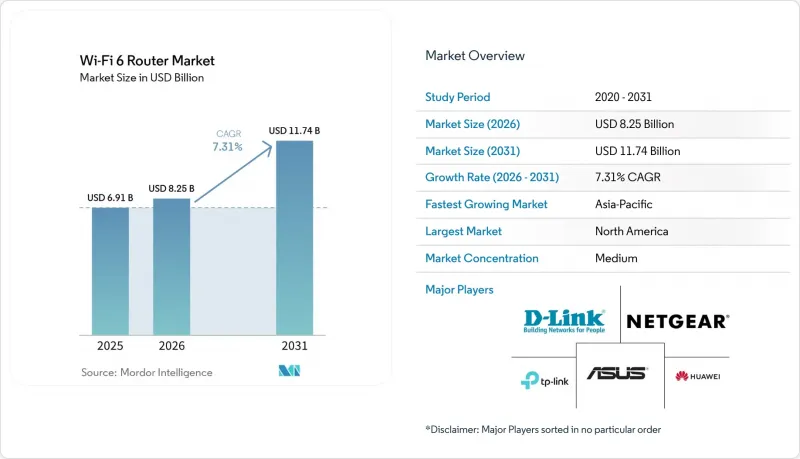
This report is Segmented by Product Type (Dual-Band Routers, Tri-Band Routers, and Quad-Band Routers), Frequency Band (2. 4 GHz, 5 GHz, and 6 GHz), End User (Residential, Commercial, and Industrial), Distribution Channel (Online Stores, Offline Retail, and Direct Enterprise Procurement), and Geography. The Market Forecasts are Provided in Terms of Value (USD).
Global Wi-Fi 6 Router Market Trends and Insights
Surging Broadband Upgrades To Gigabit-Class Service
Fiber penetration reached 89.58% of United Kingdom premises in 2025, according to Ofcom, accelerating operator-led replacement of legacy VDSL gateways that constrain throughput below gigabit levels. Charter Communications reinforced this shift by deploying multi-gigabit gateways to 1.2 million United States subscribers in late 2024, indicating cable incumbents are pre-empting fiber competition with next-generation Wi-Fi hardware. Bundled lease pricing embeds router upgrades within service fees, eliminating upfront costs and compressing replacement cycles. Concurrently, vendors delivering integrated DOCSIS and Wi-Fi platforms lock in multi-year supply contracts, improving demand visibility. As symmetrical gigabit plans expand across Europe and East Asia, the Wi-Fi 6 router market gains sustained volume momentum and pricing resilience.
Mandatory Transition Of ISPs To Wi-Fi 6 Gateways After 2025 Spectrum Re-allocation
The January 2026 decision by the Federal Communications Commission to release the full 1,200 MHz of 6 GHz spectrum forces operators to phase out Wi-Fi 5 hardware that cannot utilize these channels. In parallel, the European Telecommunications Standards Institute aligned lower-band rules, enabling vendors to standardize tri-band platforms across major EU markets. Operators are absorbing near-term write-offs on legacy inventory in 2026 financials but expect higher ARPU from premium speed tiers supported by 6 GHz backhaul. Similar regulatory actions in India and South Korea are compressing product-development cycles to 12-18 months, accelerating revenue conversion for chipset vendors.
Premium Pricing Of Wi-Fi 6E Tri-Band Models Above USD 400
NETGEAR's Orbi 870 three-pack launched at USD 1,499.99, highlighting a substantial price delta versus sub-USD 200 dual-band systems, while TP-Link positions mid-tier tri-band units around USD 333.99, a threshold typically justified only when broadband speeds exceed 500 Mbps. The elevated bill of materials reflects an additional RF chain, larger thermal assemblies, and more complex band-steering firmware spanning 2.4, 5, and 6 GHz. Although ongoing chipset integration is expected to compress entry-level tri-band pricing below USD 250 by late 2027, the current premium suppresses unit volumes in price-sensitive markets, particularly across emerging economies.
Other drivers and restraints analyzed in the detailed report include:
- Explosive Growth Of Smart-Home IoT Node Density
- Government-Backed Rural Fiber Roll-outs In South America And Africa
- Fragmented 6 GHz Rules Forcing Multi-SKU Compliance Costs
For complete list of drivers and restraints, kindly check the Table Of Contents.
Segment Analysis
Tri-band hardware is projected to expand at a 9.62% CAGR through 2031, driven by enterprise willingness to pay for dedicated 6 GHz backhaul that segregates mesh traffic from client streams and improves throughput determinism. Cisco Systems referenced campus-refresh momentum in its FY 2026 earnings, linking demand to hybrid work environments that require seamless roaming and stable video quality. Despite this, dual-band units retained 40.43% share in 2025 as residential buyers prioritized coverage and delayed 6 GHz adoption until gigabit fiber availability improved. Quad-band devices remain niche, largely confined to gaming use cases with limited ecosystem support.
Vendors are advancing early Wi-Fi 8 development, with ASUSTeK Computer Inc. introducing a prototype router aligned with draft IEEE 802.11bn specifications and peak speeds approaching 30 Gbps. Regional preferences remain differentiated: North American households favor integrated units bundled with subscription-based security, while European consumers opt for modular systems that separate routing and wireless functions to address structural interference constraints. Certification by the Wi-Fi Alliance for automatic frequency coordination strengthens buyer confidence by ensuring coexistence within the 6 GHz band, supporting sustained uptake of tri-band architectures.
The 6 GHz segment is expanding at a 9.83% CAGR through 2031, outpacing the 5 GHz band, which held a 47.32% share in 2025. The Federal Communications Commission enabled this shift by opening a contiguous 1,200 MHz block from 5.925 to 6.875 GHz, creating seven interference-free 160 MHz channels capable of sustaining multi-gigabit throughput. The Department of Telecommunications reinforced global-scale economics by delicensing 500 MHz in December 2024, allowing vendors to standardize designs across key markets. Automated frequency coordination frameworks further extend 6 GHz usability to outdoor environments, including logistics yards and enterprise campuses, without disrupting incumbent microwave systems.
The Wi-Fi 6 router market still depends on 2.4 GHz for low-power, long-range IoT applications, although its throughput ceiling of 600 Mbps limits high-bandwidth use cases. The 5 GHz band remains the practical midpoint in dense residential settings, balancing capacity and wall penetration, despite interruptions from dynamic frequency selection triggered by radar detection. In contrast, 6 GHz is increasingly reserved for latency-sensitive enterprise and industrial workloads, where jitter must remain below 3 milliseconds to support deterministic networking. This segmentation highlights a clear functional stratification, with each band optimized for distinct performance and deployment requirements.
Geography Analysis
North America generated 35.43% of global revenue in 2025, supported by cable operators that lease gateways to defend against fiber overbuild competition. This model shifts entry into the Wi-Fi 6 router market from retail to carrier provisioning, sustaining higher average selling prices and faster upgrade cycles. Charter Communications and Comcast Corporation exemplify this approach by bundling advanced gateways within service plans, including early Wi-Fi 7 deployments to retain high-value subscribers. The region also benefits from higher broadband penetration and willingness to pay for performance tiers, reinforcing premium segment growth and accelerating adoption of next-generation standards ahead of global peers.
Asia-Pacific is expected to record the fastest CAGR of 12.43% between 2026 and 2031, driven by regulatory alignment and cost-efficient manufacturing ecosystems. The Department of Telecommunications enabled 6 GHz delicensing, aligned spectrum policy with the United States and Europe, and reduced compliance complexity for vendors. Chinese manufacturers, particularly those based in Shenzhen, dominate sub-USD 50 dual-band exports, while suppliers in Taiwan and South Korea focus on higher-margin tri-band systems. Concurrently, government-backed fiber rollouts in Indonesia and Vietnam expand broadband access, increasing router volumes even as price sensitivity moderates per-unit revenue growth.
South America and Africa represent emerging growth corridors, where public funding is translating connectivity ambitions into tangible infrastructure deployment. ANATEL is channeling BRL 3.2 billion (USD 640 million) into rural connectivity, while initiatives such as Nigeria's Project BRIDGE, supported by the African Development Bank, and South Africa's broadband expansion led by the Development Bank of Southern Africa are scaling last-mile access. Although absolute revenues remain lower than mature markets, sustained double-digit shipment growth is prompting vendors to pprioritize ruggedized, temperature-resilient designs suited to diverse environmental conditions.
- TP-Link Technologies Co., Ltd.
- NETGEAR, Inc.
- ASUSTeK Computer Inc.
- D-Link Corporation
- Huawei Technologies Co., Ltd.
- Belkin International, Inc.
- Cisco Systems, Inc.
- Xiaomi Corporation
- Ubiquiti Inc.
- Zyxel Communications Corporation
- MikroTikls SIA
- Shenzhen Tenda Technology Co., Ltd.
- Shenzhen Mercury Communication Technologies Co., Ltd.
- Zioncom Holdings Limited (TOTOLINK)
- Edimax Technology Co., Ltd.
- TRENDnet, Inc.
- GL Technologies Inc.
- Buffalo Inc.
- AVM Computersysteme Vertriebs GmbH
- DrayTek Corp.
- Synology Inc.
- Cambium Networks Corporation
- Ruijie Networks Co., Ltd.
Additional Benefits:
- The market estimate (ME) sheet in Excel format
- 3 months of analyst support
TABLE OF CONTENTS
1 INTRODUCTION
- 1.1 Study Assumptions and Market Definition
- 1.2 Scope of the Study
2 RESEARCH METHODOLOGY
3 EXECUTIVE SUMMARY
4 MARKET LANDSCAPE
- 4.1 Market Overview
- 4.2 Market Drivers
- 4.2.1 Surging Broadband Upgrades to Gigabit-Class Services
- 4.2.2 Mandatory Transition of ISPs to Wi-Fi 6 Gateways After 2025 Spectrum Re-allocation
- 4.2.3 Explosive Growth of Smart-Home IoT Node Density
- 4.2.4 Government-Backed Rural Fiber Roll-outs in South America and Africa
- 4.2.5 Enterprise Network Refresh Cycles Driven by Hybrid Work Policies
- 4.2.6 Regulatory Approvals for 6 GHz Band Unleashing Wi-Fi 6E Capacity
- 4.3 Market Restraints
- 4.3.1 Premium Pricing of Wi-Fi 6E Tri-Band Models Above USD 400
- 4.3.2 Fragmented 6 GHz Rules Forcing Multi-SKU Compliance Costs
- 4.3.3 Semiconductor Lead-Times Exceeding 30 Weeks for Key Chipsets
- 4.3.4 Limited Consumer Awareness of Standard Benefits Slowing Adoption
- 4.4 Industry Supply-Chain Analysis
- 4.5 Regulatory Landscape
- 4.6 Technological Outlook
- 4.7 Impact of Macroeconomic Factors on the Market
- 4.8 Porter's Five Forces Analysis
- 4.8.1 Bargaining Power of Suppliers
- 4.8.2 Bargaining Power of Buyers
- 4.8.3 Threat of New Entrants
- 4.8.4 Threat of Substitutes
- 4.8.5 Intensity of Competitive Rivalry
5 MARKET SIZE AND GROWTH FORECASTS (VALUE)
- 5.1 By Product Type
- 5.1.1 Dual-Band Routers
- 5.1.2 Tri-Band Routers
- 5.1.3 Quad-Band Routers
- 5.2 By Frequency Band
- 5.2.1 2.4 GHz
- 5.2.2 5 GHz
- 5.2.3 6 GHz (Wi-Fi 6E)
- 5.3 By End User
- 5.3.1 Residential
- 5.3.2 Commercial
- 5.3.3 Industrial
- 5.4 By Distribution Channel
- 5.4.1 Online Stores
- 5.4.2 Offline Retail
- 5.4.3 Direct Enterprise Procurement
- 5.5 By Geography
- 5.5.1 North America
- 5.5.1.1 United States
- 5.5.1.2 Canada
- 5.5.1.3 Mexico
- 5.5.2 South America
- 5.5.2.1 Brazil
- 5.5.2.2 Argentina
- 5.5.2.3 Rest of South America
- 5.5.3 Europe
- 5.5.3.1 Germany
- 5.5.3.2 United Kingdom
- 5.5.3.3 France
- 5.5.3.4 Italy
- 5.5.3.5 Spain
- 5.5.3.6 Russia
- 5.5.3.7 Rest of Europe
- 5.5.4 Asia-Pacific
- 5.5.4.1 China
- 5.5.4.2 India
- 5.5.4.3 Japan
- 5.5.4.4 South Korea
- 5.5.4.5 Australia
- 5.5.4.6 Rest of Asia-Pacific
- 5.5.5 Middle East
- 5.5.5.1 Saudi Arabia
- 5.5.5.2 United Arab Emirates
- 5.5.5.3 Turkey
- 5.5.5.4 Rest of Middle East
- 5.5.6 Africa
- 5.5.6.1 South Africa
- 5.5.6.2 Nigeria
- 5.5.6.3 Rest of Africa
- 5.5.1 North America
6 COMPETITIVE LANDSCAPE
- 6.1 Market Concentration
- 6.2 Strategic Moves
- 6.3 Market Share Analysis
- 6.4 Company Profiles (includes Global Level Overview, Market Level Overview, Core Segments, Financials as available, Strategic Information, Market Rank/Share, Products and Services, Recent Developments)
- 6.4.1 TP-Link Technologies Co., Ltd.
- 6.4.2 NETGEAR, Inc.
- 6.4.3 ASUSTeK Computer Inc.
- 6.4.4 D-Link Corporation
- 6.4.5 Huawei Technologies Co., Ltd.
- 6.4.6 Belkin International, Inc.
- 6.4.7 Cisco Systems, Inc.
- 6.4.8 Xiaomi Corporation
- 6.4.9 Ubiquiti Inc.
- 6.4.10 Zyxel Communications Corporation
- 6.4.11 MikroTikls SIA
- 6.4.12 Shenzhen Tenda Technology Co., Ltd.
- 6.4.13 Shenzhen Mercury Communication Technologies Co., Ltd.
- 6.4.14 Zioncom Holdings Limited (TOTOLINK)
- 6.4.15 Edimax Technology Co., Ltd.
- 6.4.16 TRENDnet, Inc.
- 6.4.17 GL Technologies Inc.
- 6.4.18 Buffalo Inc.
- 6.4.19 AVM Computersysteme Vertriebs GmbH
- 6.4.20 DrayTek Corp.
- 6.4.21 Synology Inc.
- 6.4.22 Cambium Networks Corporation
- 6.4.23 Ruijie Networks Co., Ltd.
7 MARKET OPPORTUNITIES AND FUTURE OUTLOOK
- 7.1 White-Space and Unmet-Need Assessment

