
PUBLISHER: Mordor Intelligence | PRODUCT CODE: 2063852

PUBLISHER: Mordor Intelligence | PRODUCT CODE: 2063852
Employee Self-Service Portal - Market Share Analysis, Industry Trends & Statistics, Growth Forecasts (2026 - 2031)
According to Mordor Intelligence, the employee self-service portal market size is expected to be USD 6.38 billion in 2025, USD 6.94 billion in 2026, and reach USD 10.55 billion by 2031, growing at a CAGR of 8.75% from 2026 to 2031.
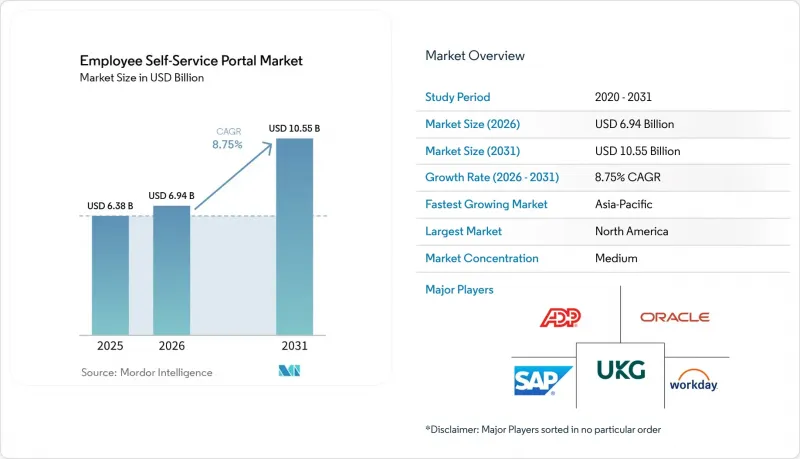
This report is Segmented by Deployment Mode (Cloud-Based, and On-Premises), Function (Payroll Management, Leave and Attendance Management, Benefits Administration, Employee Data Management, and More), Organization Size (Small and Medium-Sized Enterprises, and Large Enterprises), End-Use Industry (IT and Telecom, and More), and Geography. The Market Forecasts are Provided in Terms of Value (USD).
Global Employee Self-Service Portal Market Trends and Insights
Accelerating Digital HR Transformation Across Enterprises
Organizations are retiring mainframe HR software and moving to adaptable cloud stacks that expose APIs for payroll, benefits, and learning systems. California's Employment Development Department, which supports 90,000 users, projects USD 150 million in 10-year savings after launching its multi-language myEDD portal on Salesforce. A federal agency that rolled out ServiceNow HR Service Delivery consolidated 286 workflows in five months and uncovered more than 200 process bottlenecks. Similar makeovers are taking hold in finance, where Bajaj Finance digitized every HR activity with TCS Chroma to keep pace with rapid hiring. Because such overhauls involve multi-year procurement, the boost to the employee self-service portal market arrives steadily rather than overnight.
Rapid Adoption of Cloud-Based HR Solutions by SMEs
Small and midsize companies in Southeast Asia, Africa, and South America favor subscription portals that avoid upfront hardware expenses. Darwinbox raised USD 140 million in 2025 and released localized payroll in Singapore, Malaysia, and the Philippines to court firms that still outsource payslips. Across Kenya and Nigeria, lightweight progressive-web apps now let staff pull pay data through basic smartphones that lack high-bandwidth plans. In Bahrain, cloud portals sync with labor-ministry APIs to automate permit renewals, proving that compliance can be delivered as a service. The sub-30-day deployment cycle illustrates why SME momentum delivers a short-term lift to global demand.
Persistent Data Security and Privacy Concerns Over Employee Records
Portals store social-security numbers, direct-deposit details, and medical data that attract ransomware groups. Oracle HCM Cloud faced a 2025 handling incident that drew close GDPR scrutiny. California's Consumer Privacy Act forces granular consent controls, prompting vendors such as Sympa to market role-based access, audit trails, and ISO 27001 certification. Multinationals delay go-lives until providers guarantee local data residency, especially in healthcare and banking, keeping the restraint immediate and material.
Other drivers and restraints analyzed in the detailed report include:
- Expansion of Remote and Hybrid Work Models Requiring Anytime Self-Service Access
- Integration of Generative AI Chatbots Enhancing ESS ROI
- Integration Complexity With Legacy HR and ERP Systems
For complete list of drivers and restraints, kindly check the Table Of Contents.
Segment Analysis
On-premises deployments represented 65.44% of the employee self-service portal market in 2025, reflecting the sunk costs of data centers, perpetual licenses, and specialized IT labor. Major government bodies that once insisted on air-gapped systems now pivot to hybrid models that keep sensitive records on site while hosting the portal tier in public clouds for faster patches. Vendors that operate exclusively in the cloud, such as Darwinbox and Beisen, each posted revenue growth above 30% during 2025 as enterprises pursued elastic capacity during seasonal hiring.
Cloud implementations, expanding at an 11.67% CAGR, attract SMEs that cannot fund server refreshes every three years. Subscription pricing converts fixed capital payments into predictable monthly charges, and built-in disaster recovery limits downtime risk. The employee self-service portal market size for cloud solutions is projected to capture an increasing share of incremental spending to 2031. Yet certain defense contractors and intelligence agencies still require on-premises control, illustrating why a hybrid path will prevail rather than a sudden shift.
Payroll accounted for 45.12% of 2025 revenue, making it the anchor for every new portal. Platforms such as ADP Workforce Now let employees preview gross-to-net pay before finalizing benefit choices, which raises satisfaction scores. Real-time payroll in Dayforce further differentiates vendors that handle multiple daily pay cycles.
Leave and attendance tracking is growing at 10.56% CAGR as predictive-scheduling laws in Oregon, New York City, and Seattle levy stiff fines for last-minute shift changes. UKG Pro's fatigue algorithms alert managers when staff approach overtime caps. The employee self-service portal market share for leave and attendance modules is therefore advancing faster than any other function. Benefits administration, performance management, and core employee-data editing fill the remainder as firms push decision-support engines that cut open-enrollment questions by 60%.
Geography Analysis
North America delivered 36.40% of global revenue in 2025, buoyed by Fortune 500 clients that standardized on early SaaS HCM suites and now layer AI assistants on top. Thoma Bravo's take-private of Dayforce indicates investors view the region as a cash-rich base for cross-sell and consolidation.
Asia-Pacific is forecast to grow at a 10.05% CAGR, led by India, China, and Southeast Asia, where localized payroll engines and 25+ language interfaces meet compliance and cultural requirements. Darwinbox opened payroll modules across ASEAN, while Beisen reported RMB 945.1 million (USD 130 million) revenue in 2025 and more than 6,000 customers. The employee self-service portal market size advantage in the region will widen as governments push digital labor codes and SME digitization grants.
Europe shows steady growth, centered on GDPR-ready features such as consent dashboards and right-to-be-forgotten workflows. South America, the Middle East, and Africa trail in absolute numbers but post high double-digit portal adoption within SMEs that rely on mobile money and USSD to reach deskless staff.
- Workday Inc.
- SAP SE
- Oracle Corporation
- Automatic Data Processing Inc.
- UKG Inc.
- Ceridian HCM Holding Inc.
- BambooHR LLC
- Zoho Corporation Pvt. Ltd.
- Paycom Software Inc.
- Paylocity Holding Corporation
- Gusto Inc.
- Namely Inc.
- Rippling People Center Inc.
- Darwinbox Digital Solutions Pvt. Ltd.
- Personio GmbH
- HiBob Inc.
- Cornerstone OnDemand Inc.
- Ramco Systems Limited
- Beisen Cloud Computing Co. Ltd.
- Sage Group plc
Additional Benefits:
- The market estimate (ME) sheet in Excel format
- 3 months of analyst support
TABLE OF CONTENTS
1 INTRODUCTION
- 1.1 Study Assumptions and Market Definition
- 1.2 Scope of the Study
2 RESEARCH METHODOLOGY
3 EXECUTIVE SUMMARY
4 MARKET LANDSCAPE
- 4.1 Market Overview
- 4.2 Market Drivers
- 4.2.1 Accelerating Digital HR Transformation Across Enterprises
- 4.2.2 Rapid Adoption of Cloud-Based HR Solutions by SMEs
- 4.2.3 Expansion of Remote and Hybrid Work Models Requiring Anytime Self-Service Access
- 4.2.4 Integration of Generative AI Chatbots Enhancing ESS ROI
- 4.2.5 Growing Demand for Multilingual, Compliance-Localized ESS in Emerging Markets
- 4.2.6 Rise of Hyper-Personalized Employee Experience Platforms Driving ESS Upsell
- 4.3 Market Restraints
- 4.3.1 Persistent Data Security and Privacy Concerns over Employee Records
- 4.3.2 Integration Complexity with Legacy HR and ERP Systems
- 4.3.3 Low Digital Literacy among Frontline Workforce Limiting ESS Utilization
- 4.3.4 Vendor Lock-In Risks Due to Proprietary Workflows and Customizations
- 4.4 Industry Value Chain Analysis
- 4.5 Regulatory Landscape
- 4.6 Technological Outlook
- 4.7 Impact of Macroeconomic Factors on the Market
- 4.8 Porter's Five Forces Analysis
- 4.8.1 Threat of New Entrants
- 4.8.2 Bargaining Power of Suppliers
- 4.8.3 Bargaining Power of Buyers
- 4.8.4 Threat of Substitutes
- 4.8.5 Competitive Rivalry
5 MARKET SIZE AND GROWTH FORECASTS (VALUE)
- 5.1 By Deployment Mode
- 5.1.1 Cloud-Based
- 5.1.2 On-Premises
- 5.2 By Function
- 5.2.1 Payroll Management
- 5.2.2 Leave and Attendance Management
- 5.2.3 Benefits Administration
- 5.2.4 Employee Data Management
- 5.2.5 Performance and Appraisal Management
- 5.3 By Organization Size
- 5.3.1 Small and Medium-Sized Enterprises
- 5.3.2 Large Enterprises
- 5.4 By End-Use Industry
- 5.4.1 IT and Telecom
- 5.4.2 BFSI
- 5.4.3 Healthcare and Life Sciences
- 5.4.4 Manufacturing
- 5.4.5 Retail and E-commerce
- 5.4.6 Government and Public Sector
- 5.4.7 Other End-Use Industries
- 5.5 By Geography
- 5.5.1 North America
- 5.5.1.1 United States
- 5.5.1.2 Canada
- 5.5.1.3 Mexico
- 5.5.2 South America
- 5.5.2.1 Brazil
- 5.5.2.2 Argentina
- 5.5.2.3 Rest of South America
- 5.5.3 Europe
- 5.5.3.1 Germany
- 5.5.3.2 United Kingdom
- 5.5.3.3 France
- 5.5.3.4 Italy
- 5.5.3.5 Spain
- 5.5.3.6 Russia
- 5.5.3.7 Rest of Europe
- 5.5.4 Asia-Pacific
- 5.5.4.1 China
- 5.5.4.2 Japan
- 5.5.4.3 India
- 5.5.4.4 South Korea
- 5.5.4.5 Australia and New Zealand
- 5.5.4.6 Rest of Asia-Pacific
- 5.5.5 Middle East
- 5.5.5.1 Saudi Arabia
- 5.5.5.2 United Arab Emirates
- 5.5.5.3 Turkey
- 5.5.5.4 Rest of Middle East
- 5.5.6 Africa
- 5.5.6.1 South Africa
- 5.5.6.2 Nigeria
- 5.5.6.3 Rest of Africa
- 5.5.1 North America
6 COMPETITIVE LANDSCAPE
- 6.1 Market Concentration
- 6.2 Strategic Moves
- 6.3 Market Share Analysis
- 6.4 Company Profiles (includes Global Level Overview, Market Level Overview, Core Segments, Financials as available, Strategic Information, Market Rank/Share, Products and Services, Recent Developments)
- 6.4.1 Workday Inc.
- 6.4.2 SAP SE
- 6.4.3 Oracle Corporation
- 6.4.4 Automatic Data Processing Inc.
- 6.4.5 UKG Inc.
- 6.4.6 Ceridian HCM Holding Inc.
- 6.4.7 BambooHR LLC
- 6.4.8 Zoho Corporation Pvt. Ltd.
- 6.4.9 Paycom Software Inc.
- 6.4.10 Paylocity Holding Corporation
- 6.4.11 Gusto Inc.
- 6.4.12 Namely Inc.
- 6.4.13 Rippling People Center Inc.
- 6.4.14 Darwinbox Digital Solutions Pvt. Ltd.
- 6.4.15 Personio GmbH
- 6.4.16 HiBob Inc.
- 6.4.17 Cornerstone OnDemand Inc.
- 6.4.18 Ramco Systems Limited
- 6.4.19 Beisen Cloud Computing Co. Ltd.
- 6.4.20 Sage Group plc
7 MARKET OPPORTUNITIES AND FUTURE OUTLOOK
- 7.1 White-Space and Unmet-Need Assessment

