PUBLISHER: Mordor Intelligence | PRODUCT CODE: 2063874

PUBLISHER: Mordor Intelligence | PRODUCT CODE: 2063874
AI In Inventory Management - Market Share Analysis, Industry Trends & Statistics, Growth Forecasts (2026 - 2031)
According to Mordor Intelligence, the aI in inventory management market size is projected to be USD 4.70 billion in 2025, USD 5.85 billion in 2026, and reach USD 17.42 billion by 2031, growing at a CAGR of 24.40% from 2026 to 2031.
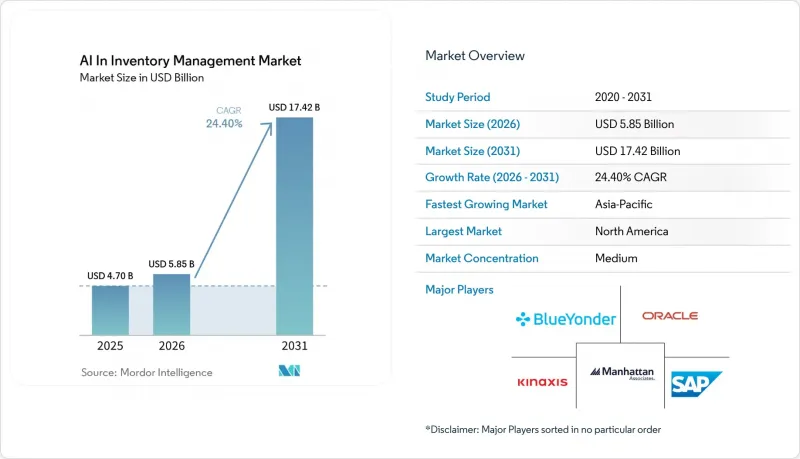
This report is Segmented by Component (Software, Services), Deployment (Cloud, On-Premise), Technology (Traditional ML, Dand More), Application (Demand Forecasting, Replenishment Planning, and More), End-User (Retail and E-Commerce, Manufacturing, and More), and Geography (North America, Europe, Asia-Pacific, and More). The Market Forecasts are Provided in Terms of Value (USD).
Global AI In Inventory Management Market Trends and Insights
AI Inventory Management Software Market Grows Amid SKU Proliferation
The rise of D2C, B2B, marketplace, and store-based selling models is driving the growth of the AI inventory management software market. These models compel companies to manage an increasing number of active SKUs across multiple fulfillment points. As product catalogs expand, reliance on manual cycle counts and spreadsheet-based forecasting becomes a significant challenge, leading to discrepancies between physical and digital stock. Consequently, there is a growing demand for tools that ensure near real-time synchronization of item, location, and order data. In January 2026, Manhattan Associates introduced its AI Agent Workforce, highlighting a trend where vendors transition from traditional planning screens to integrated agents within active inventory and fulfillment workflows. This shift signals a move away from outdated batch-refresh inventory systems to dynamic platforms that adapt to constant order fluctuations across channels. As this evolution unfolds, the focus of the AI inventory management software market is shifting from mere record-keeping to active control over stock positions across networks.
AI Inventory Management Software Market Gains Traction with Finance Teams
Finance teams are increasingly backing the AI inventory management software market, seeking tighter control over working capital and a reduction in inventory-related cash traps. Challenges like carrying costs, stock aging, and lost sales due to inaccurate forecasts elevate inventory decisions to board-level discussions in sectors like retail, manufacturing, and distribution. Users leveraging AI-driven demand forecasting have reported inventory reductions of up to 25% and a 15% boost in fill rates, underscoring the importance of forecast quality as a purchasing motivator. By 2025, companies exhibited heightened scrutiny over safety stock levels and a pressing need to justify every unit in hand.
Legacy ERP Integration Delays AI Inventory Management Software Rollouts
Delays often occur in the AI inventory management software market when integrating new planning engines with legacy systems such as ERP, warehouse, order, procurement, and finance platforms. Over time, many enterprises have developed data structures influenced by acquisitions, custom workflows, and localized system decisions, resulting in inconsistent product, supplier, and location records across business units. As a result, implementation efforts focus more on fixing foundational data issues critical for AI functionality rather than solely tuning models. In this market, integration challenges frequently extend the timeline from successful pilot projects to enterprise-scale rollouts.
Other drivers and restraints analyzed in the detailed report include:
- Cloud-Native AI Revolutionizes Cost Dynamics in Inventory Management
- AI Inventory Management Software Market Benefits from Warehouse Innovations
- Data Integrity and Planner Confidence Hinder AI's Operational Adoption
For complete list of drivers and restraints, kindly check the Table Of Contents.
Segment Analysis
In 2025, software accounted for 58.15% of the AI inventory management software market, maintaining its position as the leading revenue contributor. This dominance was driven by modular subscriptions that allowed businesses to integrate AI planning into existing ERP systems without overhauling their entire infrastructure. Additionally, software's scalability across multiple sites and user groups outpaced the capabilities of one-off project work. Major platform vendors benefited from this trend, as their established ERP and supply chain systems facilitated the cross-selling of inventory tools. The preference for software highlights enterprises' focus on reliable product capabilities before committing to large-scale transformation initiatives.
Services are projected to grow at a 24.6% CAGR from 2026 to 2031, making them the fastest-growing segment in the AI inventory management software market. This growth reflects the complexity of integrating forecasting, allocation, and tracking models across diverse nodes, data sources, and planning protocols.
In 2025, the cloud held a 65.5% share of the AI inventory management software market, establishing itself as the preferred deployment model for enterprises. This preference stems from the cloud's ability to process real-time data-such as point-of-sale, RFID, order, and demand signals-across multiple sites without local infrastructure constraints. Additionally, subscription-based cloud models reduce upfront costs and enable faster updates. Vendors can introduce new forecasting techniques, automation features, and workflow enhancements without waiting for full upgrade cycles. This makes cloud deployment particularly appealing to retailers, distributors, and multi-site operators seeking speed and scalability.
Cloud is expected to grow at a 25.15% CAGR through 2031, solidifying its position as both the largest and fastest-growing deployment model in the AI inventory management software market. This dual status reflects a strong structural preference rather than a temporary trend.
Geography Analysis
In 2025, North America commanded a dominant 40% share of the AI inventory management software market, solidifying its status as the leading regional revenue contributor. The U.S. plays a pivotal role in this dominance, leveraging a robust enterprise software ecosystem integrated with extensive retail, healthcare, and logistics networks that generate substantial inventory data. Early adoption of cloud technology and proactive ERP modernization have strengthened the region's ability to incorporate AI tools into operational workflows. Europe, led by Germany, the U.K., and France, remains the second-largest regional player, with compliance-driven sectors increasingly investing in serialized and auditable inventory processes.
Asia-Pacific is on a meteoric rise, projected to grow at a 24.75% CAGR through 2031, making it the fastest-growing region in the AI inventory management software market. While China, India, Japan, and South Korea pursue distinct digital supply chain strategies, they share a common focus on enhancing investments in software-driven inventory and warehouse management. This growth is driven by expanding manufacturing operations, increasing e-commerce complexity, and national initiatives for supply chain digitization. Additionally, as many companies transition from pilot programs to full-scale implementations, the region demonstrates significant volume potential and a long runway for growth.
While the Middle East, Africa, and South America contribute modestly in absolute revenue terms, they each present emerging growth opportunities in the AI inventory management software market. In the Gulf states, supply chain modernization initiatives are driving demand for tools focused on warehouse visibility, planning, and inventory control. In South America, Brazil stands out, where pharmaceutical traceability and broader logistics digitization are advancing the adoption of inventory software solutions.
- SAP
- Blue Yonder Group, Inc.
- Cin7
- Epicor Software Corporation
- Fishbowl
- Gather AI
- GreyOrange
- IBM
- Infor
- Kinaxis Inc.
- Manhattan Associates, Inc.
- Microsoft
- Netstock
- o9 Solutions, Inc.
- Oracle
- RELEX Solutions
- SymphonyAI
- ToolsGroup
- Zebra Technologies
- Zoho Corporation
Additional Benefits:
- The market estimate (ME) sheet in Excel format
- 3 months of analyst support
TABLE OF CONTENTS
1 Introduction
- 1.1 Study Assumptions & Market Definition
- 1.2 Scope of the Study
2 Research Methodology
3 Executive Summary
4 Market Landscape
- 4.1 Market Overview
- 4.2 Market Drivers
- 4.2.1 Omnichannel SKU Proliferation
- 4.2.2 Forecast Accuracy and Working-Capital Pressure
- 4.2.3 Cloud-Native AI Deployment Economics
- 4.2.4 Warehouse Automation and Computer Vision Adoption
- 4.2.5 Traceability and Serialization Compliance Needs
- 4.2.6 Edge and Drone-Based Perpetual Inventory
- 4.3 Market Restraints
- 4.3.1 Legacy ERP and Data Integration Complexity
- 4.3.2 Data Quality, Explainability, and Planner Trust Gaps
- 4.3.3 EU AI Act Governance and Audit-Trail Burden
- 4.3.4 Vendor Lock-In and Closed API Ecosystems
- 4.4 Value / Supply-Chain Analysis
- 4.5 Regulatory Landscape
- 4.6 Technological Outlook
- 4.7 Porter's Five Forces Analysis
- 4.7.1 Bargaining Power of Buyers
- 4.7.2 Bargaining Power of Suppliers
- 4.7.3 Threat of New Entrants
- 4.7.4 Threat of Substitutes
- 4.7.5 Intensity of Competitive Rivalry
5 Market Size & Growth Forecasts (Value, USD)
- 5.1 By Component
- 5.1.1 Software
- 5.1.2 Services
- 5.2 By Deployment
- 5.2.1 Cloud
- 5.2.2 On-Premise
- 5.3 By Technology
- 5.3.1 Traditional Machine Learning Models
- 5.3.2 Deep Learning Models
- 5.3.3 Natural Language Processing
- 5.3.4 Computer Vision
- 5.3.5 Optimization and Decision Intelligence
- 5.3.6 Generative AI and AI Agents
- 5.4 By Application
- 5.4.1 Demand Forecasting and Demand Sensing
- 5.4.2 Replenishment Planning
- 5.4.3 Inventory Control and Tracking
- 5.4.4 Order Management and Allocation
- 5.4.5 Warehouse Cycle Counting and Slotting
- 5.4.6 Shelf Monitoring and Phantom Inventory Detection
- 5.4.7 Others
- 5.5 By End-user
- 5.5.1 Retail and E-commerce
- 5.5.2 Manufacturing
- 5.5.3 Healthcare and Pharmaceuticals
- 5.5.4 Automotive
- 5.5.5 Food and Grocery
- 5.5.6 Logistics, Warehousing, and 3PL
- 5.5.7 Consumer Electronics
- 5.5.8 Others
- 5.6 By Geography
- 5.6.1 North America
- 5.6.1.1 United States
- 5.6.1.2 Canada
- 5.6.1.3 Mexico
- 5.6.2 Europe
- 5.6.2.1 Germany
- 5.6.2.2 United Kingdom
- 5.6.2.3 France
- 5.6.2.4 Italy
- 5.6.2.5 Spain
- 5.6.2.6 Rest of Europe
- 5.6.3 Asia-Pacific
- 5.6.3.1 China
- 5.6.3.2 India
- 5.6.3.3 Japan
- 5.6.3.4 South Korea
- 5.6.3.5 Australia
- 5.6.3.6 Rest of Asia-Pacific
- 5.6.4 Middle East & Africa
- 5.6.4.1 GCC
- 5.6.4.2 South Africa
- 5.6.4.3 Rest of Middle East and Africa
- 5.6.5 South America
- 5.6.5.1 Brazil
- 5.6.5.2 Argentina
- 5.6.5.3 Rest of South America
- 5.6.1 North America
6 Competitive Landscape
- 6.1 Market Concentration
- 6.2 Market Share Analysis
- 6.3 Company Profiles (includes Global level Overview, Market-level Overview, Core Segments, Financials, Strategic Information, Market Rank/Share, Products & Services, Recent Developments)
- 6.3.1 SAP SE
- 6.3.2 Blue Yonder Group, Inc.
- 6.3.3 Cin7
- 6.3.4 Epicor Software Corporation
- 6.3.5 Fishbowl
- 6.3.6 Gather AI
- 6.3.7 GreyOrange
- 6.3.8 IBM Corporation
- 6.3.9 Infor
- 6.3.10 Kinaxis Inc.
- 6.3.11 Manhattan Associates, Inc.
- 6.3.12 Microsoft Corporation
- 6.3.13 Netstock
- 6.3.14 o9 Solutions, Inc.
- 6.3.15 Oracle
- 6.3.16 RELEX Solutions
- 6.3.17 SymphonyAI
- 6.3.18 ToolsGroup
- 6.3.19 Zebra Technologies Corporation
- 6.3.20 Zoho Corporation
7 Market Opportunities & Future Outlook
- 7.1 White-space and unmet-need assessment

