PUBLISHER: Mordor Intelligence | PRODUCT CODE: 2063912

PUBLISHER: Mordor Intelligence | PRODUCT CODE: 2063912
AI In Healthcare Quality Management - Market Share Analysis, Industry Trends & Statistics, Growth Forecasts (2026 - 2031)
According to Mordor Intelligence, the aI in healthcare quality management market size is projected to be USD 0.39 billion in 2025, USD 0.45 billion in 2026, and reach USD 0.97 billion by 2031, growing at a CAGR of 16.47% from 2026 to 2031.
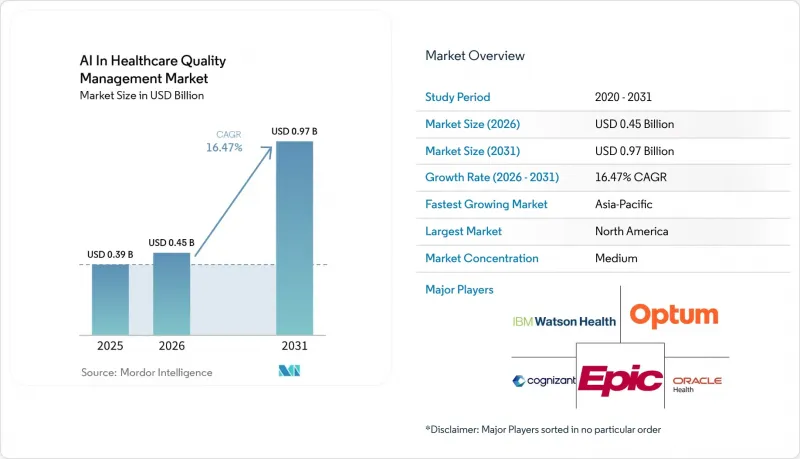
This report is Segmented by Component (Software and Services), Application (Drug Discovery & Development, and More), Technology (Machine Learning, and More), Deployment (On-Premise and Cloud), Analytics Type (Descriptive, and More), Data Source (Claims & Billing, and More), End User, and Geography. The Market and Forecasted in Terms of Value (USD).
Global AI In Healthcare Quality Management Market Trends and Insights
Government Mandates & Quality-Reporting Regulations
Federal and cross-border policy actions are now one of the clearest structural drivers for AI in the healthcare quality management market. The WISeR model is active from 2026 through 2031 and uses AI and machine learning to process prior authorizations across 6 states, which creates a direct payment-linked use case for algorithmic review workflows. CMS also finalized a new 2026 Quality Payment Program improvement activity on patient safety in the use of artificial intelligence, requiring eligible clinicians to document AI-attributable events and mitigation steps in routine care delivery. In parallel, the FDA and EMA issued joint principles in January 2026 that press drug developers toward lifecycle governance, performance monitoring, and human oversight for AI use in regulated development settings. These policy moves favor vendors and users that already have compliance infrastructure in place, and they raise entry barriers for smaller companies in the AI in healthcare quality management market.
Growing Healthcare Data Volume & Complexity
Healthcare data volume has reached a level where manual quality review is no longer workable for many regulated workflows in the AI in healthcare quality management market. One in 5 patients now has a clinical chart exceeding 206,000 words, which sharply increases the abstraction burden for quality teams and clinical reviewers. The Mayo Clinic Platform Discover dataset currently includes more than 13.6 million patient records, 3.9 billion imaging records, and 1.25 billion clinical notes, which highlights the scale of data environments now shaping validation and monitoring needs. Complexity is also expanding beyond core EHR data, as Illumina's Billion Cell Atlas program is set to generate 20 petabytes of single-cell transcriptomic data each year with founding participation from AstraZeneca, Merck, and Eli Lilly. Organizations that can score quality and trace issues across both clinical and omic datasets are likely to hold a stronger position in future drug development and quality operations.
Data-Security, Privacy & HIPAA/GDPR Compliance Hurdles
Security and privacy obligations remain a material restraint on the AI in the healthcare quality management market because they raise both implementation cost and ongoing operating burden. In Europe, GDPR Article 9 treats health information as special category data and requires additional controls, while the European Health Data Space adds new requirements for secondary use in model development. In the United States, stricter expectations around encryption, multi-factor authentication, risk assessment, and governed handling of protected health information are narrowing the room for lightly controlled deployment models. Many off-the-shelf AI tools remain unsuitable for regulated healthcare workflows because buyers need stronger contractual and technical controls than standard consumer-grade offerings provide. This pushes pharma quality teams toward enterprise-scale or tightly managed deployment models, which slows adoption among smaller organizations with fewer compliance resources.
Other drivers and restraints analyzed in the detailed report include:
- Advancement of AI-Based Predictive & Prescriptive Analytics
- Shift to Value-Based Reimbursement Incentives
- Algorithmic Bias & Clinical Explainability Limitations
For complete list of drivers and restraints, kindly check the Table Of Contents.
Segment Analysis
Software accounted for 58.23% of the AI in healthcare quality management market size in 2025, which shows how strongly buyers favor cloud-native quality systems, electronic data capture tools, and AI-enabled workflow layers across pharmaceutical and CRO settings. This lead reflects the preference for integrated platforms over narrow point solutions, because broader systems reduce data handoff issues and support more consistent validation across regulated processes. Modular deployment still matters, but buyers increasingly want modules that sit inside a governed platform rather than tools that operate outside the main quality stack. Roche's secure AWS deployment for protocol deviation classification illustrates this pattern, since the model sat within a controlled operating environment rather than a lightweight standalone application.
Services, while smaller in 2025, are the fastest-growing component with a 17.23% CAGR through 2031 in the AI in healthcare quality management market. Growth comes from implementation complexity, validation work, governance design, and ongoing model performance review, which many clients cannot staff internally. This service demand is not one-time in nature because models must be updated, revalidated, and monitored as data conditions change over time. The result is a recurring service layer around the software base, which improves vendor stickiness and keeps services tied closely to enterprise account growth in the AI in healthcare quality management market.
Patient outcome prediction held 38.54% of AI in the healthcare quality management market size in 2025, supported by long-running investment in models that flag adverse events, disease progression, and likely response patterns. These use cases are central to quality management because they influence care escalation, monitoring intensity, and documentation completeness across clinical programs. Real-time deterioration surveillance has already shown a 35.6% reduction in in-hospital mortality in randomized settings, which supports ongoing procurement of predictive quality tools. This helps explain why patient outcome prediction remains the largest application area in the AI in healthcare quality management market.
Clinical trial optimization is the fastest-growing application and is projected to grow at 16.94% through 2031, as sponsors try to reduce avoidable amendments, site underperformance, and screening inefficiency. Published evidence shows NLP-assisted prescreening can reach 76.1% chart-level accuracy versus 71.5% for human-only review and can add 10 to 20 patients screened each week in a high-volume cancer center. ConcertAI also reported that AI-driven feasibility validation can shorten overall trial timelines by 10 to 20 months and reduce protocol amendments by 50%. The broader application mix in the AI in healthcare quality management industry is therefore moving from reactive quality checks toward earlier intervention and better protocol design.
Machine learning accounted for 45.26% of the 2025 AI in healthcare quality management market because it remains the core method behind outcome prediction, risk scoring, and deviation classification. Its lead reflects established use in supervised prediction and reinforcement-style optimization tasks that already fit operational quality needs. Machine learning also benefits from a longer validation history than newer generative approaches, which matters in tightly regulated settings. That makes it the most established technology layer within the AI in healthcare quality management market.
Natural language processing is the fastest-growing technology and is projected to expand at 18.96% through 2031 because much of healthcare quality work still sits inside unstructured notes, narratives, and regulatory documents. In pathology report extraction, EHR-derived large language models achieved 99.8% accuracy on structured variables, which shows that text extraction can now support production use in research workflows. Published prescreening work in oncology also showed accuracy gains for NLP-assisted review, which reinforces its value in trial operations and quality abstraction. Computer vision and knowledge graph tools are still early in adoption. Still, they are gaining relevance where quality teams must interpret sequencing outputs and other complex data objects in the AI in healthcare quality management market.
Geography Analysis
North America held 35.43% of AI in healthcare quality management market size in 2025, which reflects the region's dense mix of regulatory activity, large healthcare datasets, and strong enterprise buyer presence. The United States remains the center of regional demand because it combines large pharma headquarters, major CRO operations, and health systems with broad digital infrastructure. CMS reimbursement programs and federal AI governance principles continue to create a strong demand signal even when broader IT budgets face pressure. Canada and Mexico remain smaller markets, but both benefit from their role in North American clinical development networks that require more standardized quality processes across sites. Europe follows as the second major regional base in the AI in healthcare quality management market, supported by the EU AI Act, the European Health Data Space, and growing alignment around lifecycle governance for regulated AI use.
Asia-Pacific is the fastest-growing region, with a 22.54% CAGR through 2031, driven by regulatory modernization, strong CRO capacity, and more active collaboration between healthcare and technology players. Japan is a key anchor, where Shionogi and Hitachi launched a generative AI solution in February 2026 that reduced clinical study report preparation time by 50% and clinical trial protocol drafting time by 20%. NTT DATA's April 2026 collaboration with Chugai Pharmaceutical also shortened draft preparation for Interview Forms by 1 to 2 months, showing that pharmacovigilance and regulatory quality workflows are moving quickly toward automation. China and India add scale through high-volume clinical trial execution, and work from Beijing University Cancer Hospital showed that an AI-enabled QC platform flagged 19.9% of 2023 study reports for quality intervention across 211 studies.
The Middle East and Africa and South America remain smaller in the AI in healthcare quality management market, but both regions show a positive direction of travel. GCC countries are investing in broader AI healthcare infrastructure, which creates early openings for quality management platforms that can scale without heavy local buildout. Brazil and Argentina remain the largest South American country markets in the current regional mix, while South Africa serves as an important base within sub-Saharan Africa. Across both regions, cloud-based SaaS models are better placed than local on-premise approaches because data infrastructure and specialized IT capability remain uneven outside major urban centers.
- Berg Health
- Change Healthcare
- Cognizant
- Epic Systems
- GE Healthcare
- Health Catalyst
- IBM
- LeanTaaS
- Medtronic Care Management
- Merative
- Optum
- Oracle Health
- Palantir Foundry for Health
- Koninklijke Philips
- Premier
- Qventus
- SAS Institute
- Tempus Labs
- Wolters Kluwer Health
- Zebra Medical Vision
Additional Benefits:
- The market estimate (ME) sheet in Excel format
- 3 months of analyst support
TABLE OF CONTENTS
1 Introduction
- 1.1 Study Assumptions & Market Definition
- 1.2 Scope of the Study
2 Research Methodology
3 Executive Summary
4 Market Landscape
- 4.1 Market Overview
- 4.2 Market Drivers
- 4.2.1 Government Mandates & Quality-Reporting Regulations
- 4.2.2 Growing Healthcare Data Volume & Complexity
- 4.2.3 Advancement of AI-Based Predictive & Prescriptive Analytics
- 4.2.4 Shift to Value-Based Reimbursement Incentives
- 4.2.5 Proliferation of Real-World Evidence from Connected Devices
- 4.2.6 Generative-AI Automation of Quality-Measure Abstraction
- 4.3 Market Restraints
- 4.3.1 High Implementation & Integration Costs
- 4.3.2 Data-Security, Privacy & HIPAA/GDPR Compliance Hurdles
- 4.3.3 Fragmented Interoperability Standards (FHIR, HL7, ICD-11)
- 4.3.4 Algorithmic Bias & Clinical Explainability Limitations
- 4.4 Value / Supply-Chain Analysis
- 4.5 Regulatory Landscape
- 4.6 Technological Outlook
- 4.7 Porter's Five Forces Analysis
- 4.7.1 Threat of New Entrants
- 4.7.2 Bargaining Power of Buyers
- 4.7.3 Bargaining Power of Suppliers
- 4.7.4 Threat of Substitutes
- 4.7.5 Competitive Rivalry
5 Market Size & Growth Forecasts (Value, USD)
- 5.1 By Component
- 5.1.1 Software
- 5.1.2 Services
- 5.2 By Application
- 5.2.1 Drug Discovery & Development
- 5.2.2 Clinical Trial Optimisation
- 5.2.3 Patient Outcome Prediction
- 5.2.4 Quality Measure Benchmarking
- 5.2.5 Adverse Event Detection & RCA
- 5.2.6 Others
- 5.3 By Technology
- 5.3.1 Machine Learning
- 5.3.2 Natural-Language Processing (NLP)
- 5.3.3 Computer Vision
- 5.3.4 Knowledge Graphs & Reasoning
- 5.3.5 Others
- 5.4 By Deployment
- 5.4.1 On-premise
- 5.4.2 Cloud
- 5.5 By Analytics Type
- 5.5.1 Descriptive
- 5.5.2 Predictive
- 5.5.3 Prescriptive
- 5.6 By Data Source
- 5.6.1 Electronic Health Records (EHR)
- 5.6.2 Genomics / Multi-omics
- 5.6.3 Clinical-Trial & RWE datasets
- 5.6.4 Claims & Billing
- 5.6.5 Others
- 5.7 By End User
- 5.7.1 Pharmaceutical Companies
- 5.7.2 Biotechnology Companies
- 5.7.3 Contract Research Organizations (CROs)
- 5.7.4 Others
- 5.8 By Geography
- 5.8.1 North America
- 5.8.1.1 United States
- 5.8.1.2 Canada
- 5.8.1.3 Mexico
- 5.8.2 Europe
- 5.8.2.1 Germany
- 5.8.2.2 United Kingdom
- 5.8.2.3 France
- 5.8.2.4 Italy
- 5.8.2.5 Spain
- 5.8.2.6 Rest of Europe
- 5.8.3 Asia-Pacific
- 5.8.3.1 China
- 5.8.3.2 India
- 5.8.3.3 Japan
- 5.8.3.4 Australia
- 5.8.3.5 South Korea
- 5.8.3.6 Rest of Asia-Pacific
- 5.8.4 Middle East & Africa
- 5.8.4.1 GCC
- 5.8.4.2 South Africa
- 5.8.4.3 Rest of MEA
- 5.8.5 South America
- 5.8.5.1 Brazil
- 5.8.5.2 Argentina
- 5.8.5.3 Rest of South America
- 5.8.1 North America
6 Competitive Landscape
- 6.1 Market Concentration
- 6.2 Market Share Analysis
- 6.3 Company Profiles (includes Global Level Overview, Market Level Overview, Core Segments, Financials as Available, Strategic Information, Market Rank/Share for Key Companies, Products & Services, and Recent Developments)
- 6.3.1 Berg Health
- 6.3.2 Change Healthcare
- 6.3.3 Cognizant
- 6.3.4 Epic Systems
- 6.3.5 GE HealthCare
- 6.3.6 Health Catalyst
- 6.3.7 IBM Watson Health
- 6.3.8 LeanTaaS
- 6.3.9 Medtronic Care Management
- 6.3.10 Merative
- 6.3.11 Optum
- 6.3.12 Oracle Health
- 6.3.13 Palantir Foundry for Health
- 6.3.14 Philips Healthcare
- 6.3.15 Premier Inc.
- 6.3.16 Qventus
- 6.3.17 SAS Institute
- 6.3.18 Tempus Labs
- 6.3.19 Wolters Kluwer Health
- 6.3.20 Zebra Medical Vision
7 Market Opportunities & Future Outlook
- 7.1 White-space & Unmet-need Assessment

