PUBLISHER: Mordor Intelligence | PRODUCT CODE: 2063925

PUBLISHER: Mordor Intelligence | PRODUCT CODE: 2063925
AI In Cold Chain Management - Market Share Analysis, Industry Trends & Statistics, Growth Forecasts (2026 - 2031)
According to Mordor Intelligence, the aI in cold chain management market size is expected to increase from USD 18.66 billion in 2025 to USD 23.53 billion in 2026 and reach USD 56.56 billion by 2031, growing at a CAGR of 23.13% over 2026-2031.
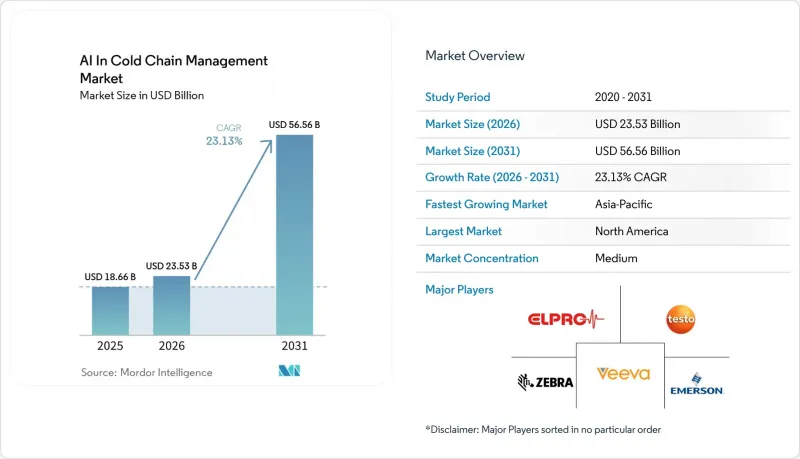
This report is Segmented by Component (Hardware, Software, Services), Temperature Range (Chilled, Frozen, Deep-Frozen, and Cryogenic), Logistics Stage (Storage, Transportation), End-Use Industry (Food and Beverages, Pharmaceuticals and Healthcare, and More), and Geography (North America, Europe, and More). The Market Forecasts are Provided in Terms of Value (USD).
Global AI In Cold Chain Management Market Trends and Insights
Compliance-Led Digital Traceability Is Rewriting Cold-Chain IT Architecture
Traceability has evolved from a back-office function to a critical part of daily operations in regulated supply chains. In the AI-driven cold chain management market, serialized identifiers and event records must transition seamlessly across handoffs while ensuring interoperability and accuracy. The FDA's package-level electronic tracing requirements under DSCSA have driven stakeholders toward EPCIS-aligned data exchanges, increasing the demand for systems capable of real-time data processing. These event streams, initially compliance-focused, now serve as inputs for predictive models assessing risks across specific routes and facilities, particularly in pharmaceuticals and other cold-chain operations.
Biologics and Specialty Pharma Cold-Chain Expansion Demands Narrow-Range Precision
The growth of biologics, mRNA platforms, and advanced therapies has tightened acceptable temperature ranges, driving the need for continuous intelligence in cold chains. This has increased demand for advanced sensors and software that monitor and interpret conditions to prevent temperature excursions. Enhanced monitoring systems have demonstrated significant operational benefits, such as reducing temperature excursions and improving audit efficiency. With substantial financial losses linked to temperature excursions, precise oversight and timely interventions are critical, aligning AI deployment with the expansion of specialty pharmaceuticals.
High Implementation Cost and Unclear ROI Realization Slow Enterprise Adoption
Adopting AI in cold chain management presents significant investment challenges, as enterprises require enterprise-grade hardware, validated software, and integration support. Deploying IoT for a fleet of 1,000 vehicles incurs high costs, making full-scale implementation unaffordable for smaller operators. These smaller companies, which dominate cold-chain operations, often lack the financial capacity to manage extended payback periods. The issue is more pronounced in regulated environments, where compliance with validation, documentation, and audit standards further increases costs. As a result, adoption is often delayed until compliance demands, product risks, or customer requirements make the returns more evident.
Other drivers and restraints analyzed in the detailed report include:
- Food-Waste Reduction and Perishable E-Grocery Growth Create Parallel AI Demand Curve
- Shift from Passive Logging to Real-Time Predictive Monitoring Restructures Operating Models
- ERP-WMS-TMS-IoT Interoperability Gaps Create Systemic Data Blind Spots
For complete list of drivers and restraints, kindly check the Table Of Contents.
Segment Analysis
Hardware held 71.34% of AI in the cold chain management market share in 2025, which shows that physical sensing and connectivity remain the first investment layer in most deployments. The hardware base includes temperature sensors, gateways, edge processors, and connectivity modules that make condition data available at shipment, pallet, vehicle, and facility levels. This pattern is consistent with how the AI in the cold chain management market has developed, because no analytics stack can scale if reliable field data is weak or intermittent.
The revenue weight of hardware does not reduce the importance of software, because the fastest compounding value often appears after the sensor estate is already in place. Software is projected to record a 28.55% CAGR during 2026-2031, reflecting rising demand for analytics, automated compliance reporting, route risk scoring, and digital twin tools that extract more value from installed infrastructure.
Chilled accounted for 61.45% of AI in cold chain management market size in 2025, making it the largest temperature segment by a clear margin. This range covers a broad mix of products, including insulin, GLP-1 injectables, dairy, fresh produce, and many standard vaccines, so shipment volumes are naturally deeper than they are in more specialized ranges. Frozen is projected to grow at a 27.79% CAGR through 2031, which reflects the stronger need for precise control as advanced pharmaceutical products move through colder environments.
Geography Analysis
In 2025, North America accounted for 42.45% of the AI-driven cold chain management market share, securing its position as the leading revenue contributor. This dominance is driven by the region's advanced pharmaceutical distribution systems, strong cold logistics infrastructure, and early regulatory initiatives that have expedited advancements in digital traceability and monitoring. The implementation of DSCSA has played a pivotal role in this market by prioritizing data interoperability and package-level traceability in daily operations. Phased compliance deadlines for DSCSA, extending through November 2026 for smaller dispensers, continue to drive procurement activities and system upgrades across pharmaceutical distribution networks. Additionally, North America's significant volume of temperature-sensitive pharmaceutical flows has facilitated the early adoption of predictive monitoring, validated data capture, and enhanced service standards in last-mile delivery operations.
Asia-Pacific is projected to achieve the highest growth rate in the AI-driven cold chain management market, with a CAGR of 29.67% through 2031. China leads in scale, while India represents a key growth opportunity, as both markets combine substantial perishable flows with significant potential for digital transformation. The region's growth is supported by increasing food distribution demands, the expansion of refrigerated logistics networks, and the need to reduce losses in temperature-sensitive supply chains. Asia-Pacific also presents a substantial opportunity for vendors offering low-integration solutions, as many operators are transitioning from basic visibility to proactive prediction and intervention. This creates a dual growth scenario, with immediate demand for hardware and long-term potential for software enhancements, particularly in areas where cold-chain modernization efforts are already underway.
- Controlant
- DeltaTrak
- ELPRO-BUCHS AG
- Emerson
- Geotab
- ORBCOMM
- Monnit
- Roambee
- Samsara
- SAP
- Sensitech
- SmartSense by Digi
- SpotSee
- Testo
- Tive
- Vaisala
- Veeva Systems
- Wiliot
- Zebra Technologies
Additional Benefits:
- The market estimate (ME) sheet in Excel format
- 3 months of analyst support
TABLE OF CONTENTS
1 Introduction
- 1.1 Study Assumptions & Market Definition
- 1.2 Scope of the Study
2 Research Methodology
3 Executive Summary
4 Market Landscape
- 4.1 Market Overview
- 4.2 Market Drivers
- 4.2.1 Compliance-Led Digital Traceability Adoption
- 4.2.2 Biologics and Specialty Pharma Cold-Chain Expansion
- 4.2.3 Food-Waste Reduction and Perishable E-Grocery Growth
- 4.2.4 Shift From Passive Logging to Real-Time Predictive Monitoring
- 4.2.5 GLP-1 Direct-To-Patient Cold-Chain Complexity
- 4.2.6 Automated Product-Release Decisioning in Pharma
- 4.3 Market Restraints
- 4.3.1 High Implementation Cost and Unclear ROI Realization
- 4.3.2 ERP-WMS-TMS-IoT Interoperability Gaps
- 4.3.3 Tariff-Driven Inflation in Sensing and Edge Hardware
- 4.3.4 Refrigeration and Reefer Technician Shortages
- 4.4 Value / Supply-Chain Analysis
- 4.5 Regulatory Landscape
- 4.6 Technological Outlook
- 4.7 Porter's Five Forces
5 Market Size & Growth Forecasts (Value, USD)
- 5.1 By Component
- 5.1.1 Hardware
- 5.1.2 Software
- 5.1.3 Services
- 5.2 By Temperature Range
- 5.2.1 Chilled
- 5.2.2 Frozen
- 5.2.3 Deep-frozen and cryogenic
- 5.3 By Logistics Stage
- 5.3.1 Storage
- 5.3.2 Transportation
- 5.4 By End-use Industry
- 5.4.1 Food and Beverages
- 5.4.2 Pharmaceuticals and Healthcare
- 5.4.3 Chemicals
- 5.4.4 Agriculture and Horticulture
- 5.4.5 Others
- 5.5 By Geography
- 5.5.1 North America
- 5.5.1.1 United States
- 5.5.1.2 Canada
- 5.5.1.3 Mexico
- 5.5.2 Europe
- 5.5.2.1 Germany
- 5.5.2.2 United Kingdom
- 5.5.2.3 France
- 5.5.2.4 Italy
- 5.5.2.5 Spain
- 5.5.2.6 Rest of Europe
- 5.5.3 Asia-Pacific
- 5.5.3.1 China
- 5.5.3.2 Japan
- 5.5.3.3 India
- 5.5.3.4 Australia
- 5.5.3.5 South Korea
- 5.5.3.6 Rest of Asia-Pacific
- 5.5.4 Middle East & Africa
- 5.5.4.1 GCC
- 5.5.4.2 South Africa
- 5.5.4.3 Rest of Middle East & Africa
- 5.5.5 South America
- 5.5.5.1 Brazil
- 5.5.5.2 Argentina
- 5.5.5.3 Rest of South America
- 5.5.1 North America
6 Competitive Landscape
- 6.1 Market Concentration
- 6.2 Market Share Analysis
- 6.3 Company Profiles (includes Global level Overview, Market level overview, Core Segments, Financials as available, Strategic Information, Market Rank/Share for key companies, Products & Services, and Recent Developments)
- 6.3.1 Controlant
- 6.3.2 DeltaTrak
- 6.3.3 ELPRO-BUCHS AG
- 6.3.4 Emerson
- 6.3.5 Geotab
- 6.3.6 ORBCOMM
- 6.3.7 Monnit
- 6.3.8 Roambee
- 6.3.9 Samsara
- 6.3.10 SAP
- 6.3.11 Sensitech
- 6.3.12 SmartSense by Digi
- 6.3.13 SpotSee
- 6.3.14 Testo SE & Co. KGaA
- 6.3.15 Tive
- 6.3.16 Vaisala
- 6.3.17 Veeva Systems
- 6.3.18 Wiliot
- 6.3.19 Zebra Technologies
7 Market Opportunities & Future Outlook
- 7.1 White-space & unmet-need assessment

