PUBLISHER: Mordor Intelligence | PRODUCT CODE: 2063984

PUBLISHER: Mordor Intelligence | PRODUCT CODE: 2063984
AI In Hospital Inventory - Market Share Analysis, Industry Trends & Statistics, Growth Forecasts (2026 - 2031)
According to Mordor Intelligence, the aI in hospital inventory market size is projected to be USD 502.54 million in 2025, USD 563.35 million in 2026, and reach USD 997.25 million by 2031, growing at a CAGR of 12.10% from 2026 to 2031.
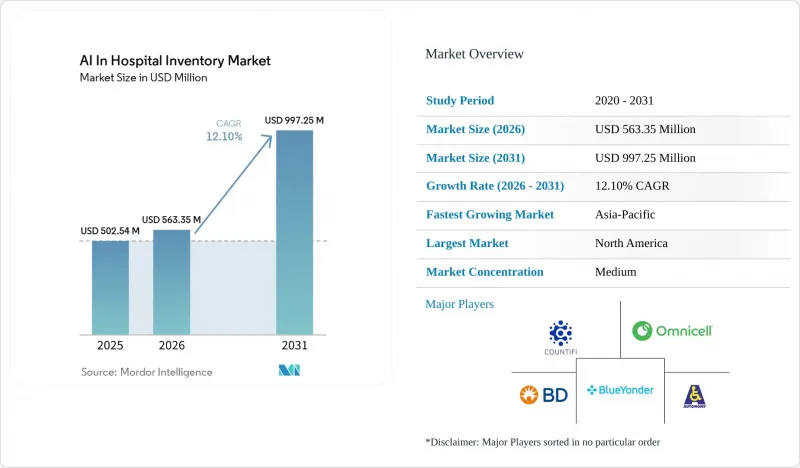
This report is Segmented by Component (Software, Hardware, Services), Deployment Model (Cloud-Based, On-Premises, Hybrid), Inventory Type (Pharmaceuticals, Medical Supplies, Iand More), Technology (RFID, Barcode, AI/ML, Computer Vision, Iot Cabinets), Hospital Area (Pharmacy, OR, Nursing, and More), and Geography (North America, Europe, Asia-Pacific, MEA, South America). Forecasts in Value (USD).
Global AI In Hospital Inventory Market Trends and Insights
Traceability and Recall Compliance Automation
Traceability has transitioned from being a compliance-focused initiative to a critical operational requirement in the AI-driven hospital inventory management market. Regulatory frameworks, such as the FDA's UDI guidelines, have driven hospitals to enhance item-level visibility for devices across clinical settings. Additionally, broader UDI integration into interoperable data standards has strengthened the need to link scanned product data with clinical and inventory records. As a result, the AI in the hospital inventory management market is experiencing increased demand for systems that go beyond compliance tracking. Hospitals now seek AI solutions that integrate UDI capture with replenishment, recall management, billing accuracy, and real-time stock visibility.
Waste and Stockout Reduction Mandates
Efforts to reduce waste and prevent stockouts have become significant growth drivers for the AI in hospital inventory management market, as hospitals face mounting pressure to protect margins and maintain service continuity. Studies have demonstrated that AI-driven pharmaceutical demand forecasting can significantly reduce stockout incidents and lower holding costs within a short period. Public procurement trends also reflect this shift, with hospitals adopting AI inventory solutions that deliver high service rates and substantial logistics cost reductions.
ERP / EHR / MMIS Integration Burden
Integration remains a key challenge in the AI-driven hospital inventory management market. Many hospitals still use outdated ERP, EHR, and materials management systems that lack compatibility with cloud-native data exchanges and real-time AI workflows. Infor highlights difficulties in unifying data across pharmacy, operating room, and nursing supply points due to inconsistent master data structures. Additionally, supporting UDI integration is often costly and time-intensive, even for well-resourced organizations. These factors lead to slower deployments, higher costs, and limited initial use cases.
Other drivers and restraints analyzed in the detailed report include:
- Clinician Time Recovery from Manual Inventory Work
- Growing Adoption of Smart Hospitals and Digital Healthcare
- Cybersecurity and Interoperability Concerns
For complete list of drivers and restraints, kindly check the Table Of Contents.
Segment Analysis
In 2025, software led the AI in hospital inventory management market with a 42.50% share, driven by its ability to integrate with existing EHR, ERP, and pharmacy systems. Hospitals prioritize software-first deployments for enterprise visibility and forecasting before investing in hardware. Omnicell's OmniSphere exemplifies this trend by integrating robotics, smart devices, and workflows through a cloud-native platform. Services are gaining importance as hospitals rely on vendors for optimization and updates. Hardware, growing at 12.88% CAGR from 2026 to 2031, is critical for generating live data essential for predictive layers, complementing software's foundational role.
On-premises deployment held a 55.55% share in 2025, reflecting hospitals' preference for direct control over data and system access. This model remains strong in academic and government systems due to data sensitivity and legacy infrastructure. Cloud-based solutions, growing at 12.90% CAGR from 2026 to 2031, are gaining traction as multi-hospital systems seek enterprise-wide visibility without duplicating infrastructure. Cloud architecture enables centralized updates and analytics, driving adoption. However, the pace of cloud adoption depends on resolving data governance and integration challenges.
Geography Analysis
In 2025, North America held a 39.67% share of the AI-driven hospital inventory management market, driven by stringent regulations, mature distributor networks, and significant hospital technology investments. Policies such as DSCSA enforcement, FDA's UDI mandates, and 340B audit requirements have pushed hospitals to adopt traceable and auditable inventory systems. This has positioned North America as a leader in deploying enterprise solutions across pharmacies, operating rooms, and supply chain workflows.
Europe remains a key player in the AI-driven hospital inventory management market, with regulations driving adoption while increasing implementation demands. The EU MDR 2017/745 enhances device traceability, while the EU AI Act and GDPR impose stricter governance and data requirements. Germany leads the region, with hospitals integrating AI-driven demand planning with operating room scheduling and logistics, creating consistent demand and higher expectations for vendor solutions.
Asia-Pacific is the fastest-growing region, with a 14.15% CAGR projected for 2026-2031, supported by rapid hospital digitalization in countries like China, Japan, South Korea, and India. China's National Health Commission is advancing the integration of HIS, SPD supply chain platforms, and operational data systems, while Japan promotes adoption through digitalization and AI subsidy programs. The market is transitioning from a North America-led base to a more balanced global structure, with Asia-Pacific driving growth.
- Autonomi
- Beckton Dickinson
- Blue Yonder Group, Inc.
- Cardinal Health
- Clarium
- Countifi
- DARVIS
- GHX
- IDENTI Medical
- Infor
- Jump Technologies
- Mckesson
- Mobile Aspects
- Omnicell
- Oracle
- SAP
- SmartPAR
- Tecsys
- Terso Solutions
- Zebra Technologies
Additional Benefits:
- The market estimate (ME) sheet in Excel format
- 3 months of analyst support
TABLE OF CONTENTS
1 Introduction
- 1.1 Study Assumptions & Market Definition
- 1.2 Scope of the Study
2 Research Methodology
3 Executive Summary
4 Market Landscape
- 4.1 Market Overview
- 4.2 Market Drivers
- 4.2.1 Traceability and Recall Compliance Automation
- 4.2.2 Waste and Stockout Reduction Mandates
- 4.2.3 Clinician Time Recovery from Manual Inventory Work
- 4.2.4 OR Consignment and Bill-Only Capture Blind Spots
- 4.2.5 Growing Adoption of Smart Hospitals and Digital Healthcare Infrastructure
- 4.2.6 Drug-Shortage Substitute Orchestration
- 4.3 Market Restraints
- 4.3.1 ERP / EHR / MMIS Integration Burden
- 4.3.2 Cybersecurity and Interoperability Concerns
- 4.3.3 Resistance to Technology Adoption Among the Hospital Staff
- 4.3.4 Poor Item-Master and UDI Data Quality
- 4.4 Value / Supply-Chain Analysis
- 4.5 Regulatory Landscape
- 4.6 Technological Outlook
- 4.7 Porter's Five Forces Analysis
- 4.7.1 Threat of New Entrants
- 4.7.2 Bargaining Power of Suppliers
- 4.7.3 Bargaining Power of Buyers
- 4.7.4 Threat of Substitutes
- 4.7.5 Industry Rivalry
5 Market Size & Growth Forecasts (Value, USD)
- 5.1 By Component
- 5.1.1 Software
- 5.1.2 Hardware
- 5.1.3 Services
- 5.2 By Deployment Model
- 5.2.1 Cloud-Based
- 5.2.2 On-Premises
- 5.2.3 Hybrid
- 5.3 By Inventory Type Managed
- 5.3.1 Pharmaceuticals
- 5.3.2 Medical Supplies & Consumables
- 5.3.3 Implants & High-Value Devices
- 5.3.4 Tissues & Biologics
- 5.3.5 Laboratory Supplies
- 5.4 By Technology
- 5.4.1 RFID-Enabled Inventory Systems
- 5.4.2 Barcode & Mobile Scanning
- 5.4.3 AI/ML Predictive Inventory Systems
- 5.4.4 Computer Vision / Image Recognition
- 5.4.5 IoT Smart Cabinets / Smart Shelves
- 5.5 By Hospital Area of Use
- 5.5.1 Central Pharmacy
- 5.5.2 Operating Rooms & Procedural Areas
- 5.5.3 Nursing Units / Floor Stock
- 5.5.4 Cath Lab / Interventional Radiology / Electrophysiology Labs
- 5.5.5 Central Supply / Warehouse
- 5.5.6 Laboratories
- 5.5.7 Emergency Department
- 5.6 By Geography
- 5.6.1 North America
- 5.6.1.1 United States
- 5.6.1.2 Canada
- 5.6.1.3 Mexico
- 5.6.2 Europe
- 5.6.2.1 Germany
- 5.6.2.2 United Kingdom
- 5.6.2.3 France
- 5.6.2.4 Italy
- 5.6.2.5 Spain
- 5.6.2.6 Rest of Europe
- 5.6.3 Asia-Pacific
- 5.6.3.1 China
- 5.6.3.2 India
- 5.6.3.3 Japan
- 5.6.3.4 South Korea
- 5.6.3.5 Australia
- 5.6.3.6 Rest of Asia-Pacific
- 5.6.4 Middle East and Africa
- 5.6.4.1 GCC
- 5.6.4.2 South Africa
- 5.6.4.3 Rest of Middle East and Africa
- 5.6.5 South America
- 5.6.5.1 Brazil
- 5.6.5.2 Argentina
- 5.6.5.3 Rest of South America
- 5.6.1 North America
6 Competitive Landscape
- 6.1 Market Concentration
- 6.2 Market Share Analysis
- 6.3 Company Profiles (includes Global level Overview, Market level overview, Core Segments, Financials as available, Strategic Information, Market Rank/Share for key companies, Products & Services, and Recent Developments)
- 6.3.1 Autonomi
- 6.3.2 Becton, Dickinson and Company
- 6.3.3 Blue Yonder Group, Inc.
- 6.3.4 Cardinal Health Inc.
- 6.3.5 Clarium
- 6.3.6 Countifi
- 6.3.7 DARVIS
- 6.3.8 GHX
- 6.3.9 IDENTI Medical
- 6.3.10 Infor
- 6.3.11 Jump Technologies
- 6.3.12 McKesson Corporation
- 6.3.13 Mobile Aspects
- 6.3.14 Omnicell
- 6.3.15 Oracle
- 6.3.16 SAP
- 6.3.17 SmartPAR
- 6.3.18 Tecsys
- 6.3.19 Terso Solutions
- 6.3.20 Zebra Technologies
7 Market Opportunities & Future Outlook
- 7.1 White-space & unmet-need assessment

