
PUBLISHER: Mordor Intelligence | PRODUCT CODE: 2063986

PUBLISHER: Mordor Intelligence | PRODUCT CODE: 2063986
AI In Nutraceutical Formulation - Market Share Analysis, Industry Trends & Statistics, Growth Forecasts (2026 - 2031)
According to Mordor Intelligence, the aI in nutraceutical formulation market size is projected to expand from USD 1.32 billion in 2025 and USD 1.49 billion in 2026 to USD 2.78 billion by 2031, registering a CAGR of 13.25% between 2026 to 2031.
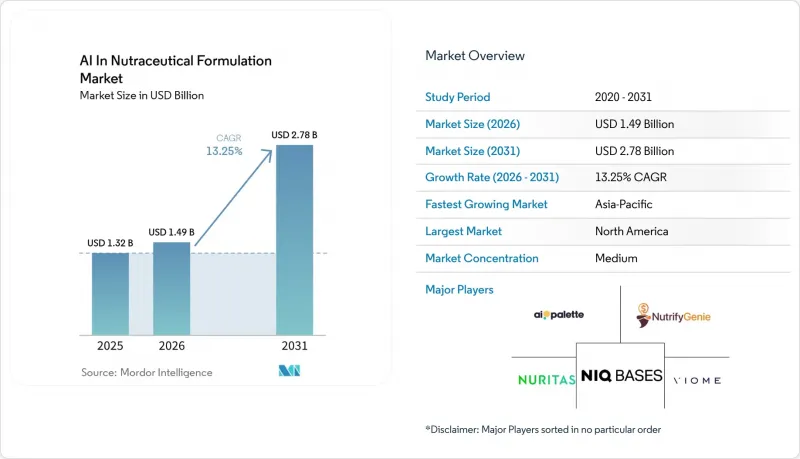
This report is Segmented by Product Type (Dietary Supplements, Functional Foods), Application (Ingredient Selection, Product Formulation, and More), Technology (Machine Learning, and More), Deployment Mode (Cloud-Based, On-Premise, Hybrid), End User (Nutraceutical Manufacturers, and More), and Geography (North America, and More). The Market Forecasts are Provided in Terms of Value (USD).
Global AI In Nutraceutical Formulation Market Trends and Insights
Personalized Nutrition and Biomarker-Led Targeting Accelerates Product Science
AI is transforming the nutraceutical formulation market by shifting from generic dietary advice to supplements tailored to individual biological profiles. Multi-omics systems integrating genomics, transcriptomics, metabolomics, and microbiome data enable formulation teams to design products based on metabolic variations rather than population averages. Platforms building long-term biomarker histories enhance recommendation accuracy and create a competitive data advantage. Diagnostics and formulation are increasingly linked, with biological testing directly influencing product design and supplement recommendations. Privacy-by-design architecture is becoming critical as companies managing sensitive biological data with clear governance scale personalization effectively.
Faster Formulation Cycles Through AI Screening Compress Time-to-Market
AI platforms are accelerating nutraceutical development by simultaneously screening ingredients, scientific literature, pathway interactions, and regulatory compliance. This approach reduces traditional timelines from 18-24 months to 6-9 months, enabling brands to explore more variants at lower costs. AI also diminishes the advantage of exclusive novel ingredients by repurposing known ones for new health applications with better documentation. Formal support structures are growing, with AI tools mining extensive research archives for formulation insights. Speed is now a critical capability across product design, regulatory compliance, and commercialization.
Data Privacy and Health-Data Governance Constraints Limit Biomarker Platform Scale
The biomarker depth that strengthens the AI in the nutraceutical formulation market also creates significant scaling challenges, as personalization depends on managing sensitive health data. The EU AI Act classifies certain health-related AI systems as high-risk, while GDPR enforces strict regulations on processing genetic and biometric data, increasing compliance burdens for multi-omics platforms.These challenges affect data transfer, model training, auditability, and how recommendations are communicated to users and regulators.
Other drivers and restraints analyzed in the detailed report include:
- Aging and Metabolic Health Demand Creates a Durable Structural Tailwind
- Digital Twin and PBPK Simulation Reduce Costly Physical Prototyping
- High Implementation and Workflow-Integration Costs Constrain Mid-Market Adoption
For complete list of drivers and restraints, kindly check the Table Of Contents.
Segment Analysis
In 2025, Dietary Supplements accounted for 57.78% of the AI-driven nutraceutical formulation market, making it the largest product category by revenue. This segment remains dominant due to high reformulation activity, claim support, and ingredient optimization across vitamins, minerals, botanicals, and specialty supplements.
Functional Foods are projected to grow at a 14.24% CAGR from 2026 to 2031, outpacing dietary supplements in growth despite a smaller base. AI enables supplement-grade design to be applied to consumer food formats like fortified beverages and plant-based dairy alternatives while addressing sensory, stability, and compliance challenges. This shift expands AI applications into complex food formulations, fostering collaboration between food science and nutraceutical R&D teams. Functional foods are increasingly used for rapid innovation in areas like metabolic health and cognitive function.
In 2025, Product Formulation held the largest application share at 31.55%, reflecting AI's primary role in ingredient selection, compatibility checks, and bioavailability improvement. This application offers measurable operational value and aligns with regulatory requirements for AI-generated evidence. The FDA's 2025 draft guidance emphasizes credibility and traceability, reinforcing Product Formulation's leadership in the market.
Personalized Nutrition is expected to grow at a 14.76% CAGR from 2026 to 2031, making it the fastest-growing application. Platforms now integrate biomarker data, wearable signals, and dietary inputs to provide dynamic recommendations. Research shows that AI-driven personalization improves adherence and physiological outcomes, shifting consumer data from post-production insights to upstream formulation decisions. This feedback loop is blurring the lines between formulation and personalized recommendations.
Geography Analysis
In 2025, North America accounted for 38.77% of the AI in nutraceutical formulation market, maintaining its leadership by revenue. This dominance is driven by significant R&D investments, a mature digital health ecosystem, and a consumer base favoring personalized nutrition. The FDA's draft guidance on AI for regulatory decision-making emphasizes credibility, traceability, and oversight, further shaping the region's market dynamics. These factors position North America as a hub for platform innovation, premium product launches, and biomarker-driven formulations.
Asia-Pacific is projected to grow at a CAGR of 14.45% from 2026 to 2031, making it the fastest-growing regional market. The region's growth is fueled by a shift toward precision nutrition, cloud-based product development, and rapid digital adoption across industries. Its large, diverse consumer base and preference for modular AI tools over heavy in-house systems create opportunities for personalization and quick concept testing.
Europe, the second-largest market, faces unique growth challenges due to strict regulations like EFSA's health claim framework, GDPR, and the EU AI Act. These regulations drive investments in auditability and governance, creating short-term hurdles but enhancing long-term credibility for compliant companies. South America, though in an early stage, shows potential as local players explore AI-driven nutraceutical designs leveraging regional biodiversity and faster workflows. Globally, the market's performance depends on regulatory readiness, digital infrastructure, and the ability to implement personalized nutrition effectively.
- Ai Palette
- Bioniq Health-Tech Solutions
- Brightseed Bioactives
- Enbiosis
- FoodWake
- Formulaite Inc.
- FormulationLab.AI
- Invision Pharma AI
- Journey Foods
- NEXTbite360
- NIQ BASES AI Product Developer
- Nuritas
- Nutra Comp
- Nutralytics Ltd.
- Nutraworks
- NutrifyGenie
- Path Forward Formulator
- SKUsafe
- Specright
- Viome Life Sciences Inc.
Additional Benefits:
- The market estimate (ME) sheet in Excel format
- 3 months of analyst support
TABLE OF CONTENTS
1 Introduction
- 1.1 Study Assumptions & Market Definition
- 1.2 Scope of the Study
2 Research Methodology
3 Executive Summary
4 Market Landscape
- 4.1 Market Overview
- 4.2 Market Drivers
- 4.2.1 Personalized Nutrition and Biomarker-Led Targeting
- 4.2.2 Faster Formulation Cycles Through AI Screening
- 4.2.3 Cloud Deployment Lowering Adoption Friction
- 4.2.4 Aging and Metabolic Health Demand Expansion
- 4.2.5 Digital Twin and PBPK Simulation for Dose Design
- 4.2.6 Claims-Substantiation Automation for Faster Launches
- 4.3 Market Restraints
- 4.3.1 Data Privacy and Health-Data Governance Complexity
- 4.3.2 High Implementation and Workflow-Integration Cost
- 4.3.3 Ingredient Master-Data Fragmentation Across Suppliers
- 4.3.4 Cross-Country Rules for AI-Led Claims and Personalization
- 4.4 Value Chain Analysis
- 4.5 Regulatory Landscape
- 4.6 Technological Outlook
- 4.7 Porter's Five Forces Analysis
- 4.7.1 Threat of New Entrants
- 4.7.2 Bargaining Power of Suppliers
- 4.7.3 Bargaining Power of Buyers
- 4.7.4 Threat of Substitutes
- 4.7.5 Competitive Rivalry
5 Market Size & Growth Forecasts (Value, USD)
- 5.1 By Product Type
- 5.1.1 Dietary Supplements
- 5.1.1.1 Vitamins and Minerals
- 5.1.1.2 Botanicals and Herbals
- 5.1.1.3 Probiotics, Prebiotics, and Synbiotics
- 5.1.1.4 Sports Nutrition
- 5.1.1.5 Specialty Condition-Specific Formulas
- 5.1.2 Functional Foods
- 5.1.2.1 Fortified Beverages
- 5.1.2.2 Nutrition Bars and Snacks
- 5.1.2.3 Functional Dairy and Dairy Alternatives
- 5.1.2.4 Powdered Nutrition Mixes
- 5.1.1 Dietary Supplements
- 5.2 By Application
- 5.2.1 Ingredient Selection and Optimization
- 5.2.2 Product Formulation
- 5.2.3 Personalized Nutrition
- 5.2.4 Quality Control and Safety Assurance
- 5.2.5 Supply Chain Optimization
- 5.3 By Technology
- 5.3.1 Machine Learning
- 5.3.2 Predictive Analytics
- 5.3.3 Natural Language Processing
- 5.3.4 Computer Vision
- 5.3.5 Knowledge Graphs
- 5.3.6 Generative AI and Large Language Models
- 5.3.7 Digital Twins and Mechanistic Simulation
- 5.4 By Deployment Mode
- 5.4.1 Cloud-Based
- 5.4.2 On-Premise
- 5.4.3 Hybrid
- 5.5 By End User
- 5.5.1 Nutraceutical Product Manufacturers
- 5.5.2 Functional Food Innovators
- 5.5.3 Personalized Nutrition Platforms
- 5.5.4 R&D Labs and Contract Formulators
- 5.5.5 Ingredient Suppliers
- 5.5.6 Healthcare and Wellness Platforms
- 5.6 By Geography
- 5.6.1 North America
- 5.6.1.1 United States
- 5.6.1.2 Canada
- 5.6.1.3 Mexico
- 5.6.2 Europe
- 5.6.2.1 Germany
- 5.6.2.2 United Kingdom
- 5.6.2.3 France
- 5.6.2.4 Italy
- 5.6.2.5 Spain
- 5.6.2.6 Rest of Europe
- 5.6.3 Asia-Pacific
- 5.6.3.1 China
- 5.6.3.2 India
- 5.6.3.3 Japan
- 5.6.3.4 South Korea
- 5.6.3.5 Australia
- 5.6.3.6 Rest of Asia-Pacific
- 5.6.4 Middle East and Africa
- 5.6.4.1 GCC
- 5.6.4.2 South Africa
- 5.6.4.3 Rest of Middle East and Africa
- 5.6.5 South America
- 5.6.5.1 Brazil
- 5.6.5.2 Argentina
- 5.6.5.3 Rest of South America
- 5.6.1 North America
6 Competitive Landscape
- 6.1 Market Concentration
- 6.2 Market Share Analysis
- 6.3 Company Profiles (includes Global level Overview, Market level overview, Core Segments, Financials as available, Strategic Information, Market Rank/Share for key companies, Products & Services, and Recent Developments)
- 6.3.1 Ai Palette
- 6.3.2 Bioniq Health-Tech Solutions
- 6.3.3 Brightseed Bioactives
- 6.3.4 Enbiosis
- 6.3.5 FoodWake
- 6.3.6 Formulaite Inc.
- 6.3.7 FormulationLab.AI
- 6.3.8 Invision Pharma AI
- 6.3.9 Journey Foods
- 6.3.10 NEXTbite360
- 6.3.11 NIQ BASES AI Product Developer
- 6.3.12 Nuritas
- 6.3.13 Nutra Comp
- 6.3.14 Nutralytics Ltd.
- 6.3.15 Nutraworks
- 6.3.16 NutrifyGenie
- 6.3.17 Path Forward Formulator
- 6.3.18 SKUsafe
- 6.3.19 Specright
- 6.3.20 Viome Life Sciences Inc.
7 Market Opportunities & Future Outlook
- 7.1 White-space & unmet-need assessment

