PUBLISHER: Mordor Intelligence | PRODUCT CODE: 2063989

PUBLISHER: Mordor Intelligence | PRODUCT CODE: 2063989
Eggshell Membrane - Market Share Analysis, Industry Trends & Statistics, Growth Forecasts (2026 - 2031)
According to Mordor Intelligence, the eggshell membrane market size is projected to be USD 204.65 million in 2025, USD 224.09 million in 2026, and reach USD 352.77 million by 2031, growing at a CAGR of 9.65% from 2026 to 2031.
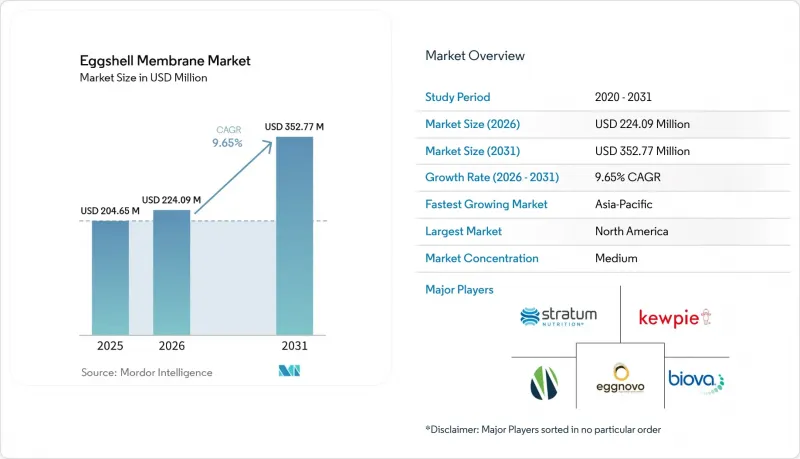
This report is Segmented by Type (Hydrolyzed, Unhydrolyzed), Product Form (Powder, Capsules, Tablets, Liquid Formats), Application (Nutraceuticals, Cosmetics and Personal Care, Food and Beverages, Pharmaceuticals, Animal Nutrition and Pet Supplements), and Geography (North America, Europe, Asia-Pacific, Middle East and Africa, South America). The Market Forecasts are Provided in Terms of Value (USD).
Global Eggshell Membrane Market Trends and Insights
Osteoarthritis Burden Fuels Structural Demand for Joint Supplements
The global osteoarthritis burden, driven by aging populations and obesity-related joint stress, is significantly boosting the eggshell membrane market. In 2024, 607 million people globally were affected by osteoarthritis, with prevalence rates projected to rise by 2050. East Asia, where knee osteoarthritis accounts for 73% of cases, represents a key growth region. Middle-income economies expanding access to non-pharmacological joint support present strong near-term opportunities. The NEM brand eggshell membrane differentiates itself by reducing the cartilage degradation biomarker CTX-II by 19.2% within a week, outperforming slower-acting alternatives like glucosamine and chondroitin.
Clean-Label and Upcycled Ingredient Demand Reframes Competitive Positioning
The eggshell membrane market benefits from its alignment with clean-label trends and the appeal of upcycled ingredients. Eggshell membrane, sourced from industrial egg-breaking streams, supports sustainability by diverting billions of eggshells from landfills annually. Over 800 products have achieved Upcycled Certified status, reflecting mainstream acceptance of this model. Suppliers emphasizing environmental performance gain an edge with multinational brands focused on ESG compliance. Eggnovo SL's negative carbon footprint further strengthens the eggshell membrane's premium positioning over lower-cost substitutes like bovine collagen and glucosamine.
Egg-Processing Dependence and Avian Disease Volatility
The eggshell membrane market faces supply challenges as raw membrane availability depends on industrial egg-breaking operations. In Q1 2025, nearly 40 million poultry were lost to avian influenza in the U.S., with recovery expected to take 9 months to a year if outbreaks remain contained. Since eggshell membrane is a byproduct, reduced egg-processing throughput lowers availability and increases fixed costs per unit. Cost pressures intensify when egg prices fluctuate, as seen with a spike to USD 8/dozen in February 2025 before dropping to USD 3/dozen in March. European suppliers, like Eggnovo SL, are investing in process improvements, but the market is likely to face sustained cost challenges in the near term.
Other drivers and restraints analyzed in the detailed report include:
- Nutricosmetics and Beauty-from-Within Uptake Extends the Addressable Market
- Regulatory Approvals for Food-Supplement Use Unlock New Geographies
- Extraction Cost and Bioactive Standardization Burden
For complete list of drivers and restraints, kindly check the Table Of Contents.
Segment Analysis
In 2025, hydrolyzed eggshell membrane held 67.40% of the market, driven by its established role in joint health nutraceuticals. Its market leadership is supported by extensive clinical validation, such as ESM Technologies' NEM, which has been studied in over 10 human clinical trials for joint comfort and flexibility. While hydrolyzed formats remain central to revenue, unhydrolyzed eggshell membrane is forecast to grow at a 10.24% CAGR from 2026 to 2031, fueled by its increasing use in skin and beauty applications. Stratum Nutrition's Ovolux, launched in 2025, demonstrated significant improvements in skin elasticity and firmness, highlighting the growing segmentation between hydrolyzed forms for joint support and unhydrolyzed forms for beauty products. Denk Ingredients' expanded ESM(R) range reflects how suppliers are diversifying portfolios to capture both market segments.
Geography Analysis
In 2025, North America led the eggshell membrane market with a 37.65% share. The region's mature supplement retail system, strong acceptance of clinically-claimed products, and the presence of key domestic suppliers like ESM Technologies, Biova LLC, and Stratum Nutrition drive its dominance. These factors enable faster commercialization, supported by established connections between ingredient developers, product brands, and retail channels.
Europe is the second-largest market for eggshell membranes, with growth previously constrained by regulatory delays rather than demand. Biova's EU Novel Foods approval in July 2024 allowed European brands to use U.S.-sourced eggshell membranes with fewer regulatory barriers. Additionally, investments like Eggnovo SL's factory upgrades for processing enhance local supply resilience, positioning Europe for balanced growth in demand and supply.
Asia-Pacific is projected to grow at a CAGR of 11.45% from 2026 to 2031, making it the fastest-growing region in the eggshell membrane market. Japan leads with a mature market supported by product recognition and research collaborations. South Korea's high osteoarthritis incidence and China's rising burden create significant opportunities, while India's FSSAI approval for NEM facilitates premium joint supplement launches. The Middle East, Africa, and South America remain smaller markets but show potential due to improving retail systems and growth in Brazil's nutraceutical sector.
- Barentz
- Biova LLC
- Bolise Co., Ltd.
- Certified Nutraceuticals Inc.
- DEPP B.V.
- Ecovatec Solutions Inc.
- Eggnovo SL
- ESM Technologies, LLC
- Healthy Origins
- Kewpie Corporation
- Microcore Research Labs India Pvt. Ltd.
- Mitushi Biopharma
- Natural Factors USA
- NOW Foods
- Oxford Natural Products
- Parchem Fine & Specialty Chemicals
- Redd Remedies
- Silver Fern Brand
- Stratum Nutrition
- Swanson Health Products
Additional Benefits:
- The market estimate (ME) sheet in Excel format
- 3 months of analyst support
TABLE OF CONTENTS
1 Introduction
- 1.1 Study Assumptions & Market Definition
- 1.2 Scope of the Study
2 Research Methodology
3 Executive Summary
4 Market Landscape
- 4.1 Market Overview
- 4.2 Market Drivers
- 4.2.1 Joint-Health Supplement Adoption
- 4.2.2 Clean-Label and Upcycled Ingredient Demand
- 4.2.3 Nutricosmetics and Beauty-From-Within Uptake
- 4.2.4 Regulatory Approvals for Food-Supplement Use
- 4.2.5 Pet Mobility Supplementation Crossover
- 4.2.6 Vegetarian Collagen Alternative Positioning
- 4.3 Market Restraints
- 4.3.1 Egg-Processing Dependence and Avian Disease Volatility
- 4.3.2 Extraction Cost and Bioactive Standardization Burden
- 4.3.3 Egg-Allergen Labeling Limits Mass-Market Use
- 4.3.4 Native Insolubility Constrains Beverage-Scale Formulation
- 4.4 Value Chain Analysis
- 4.5 Regulatory Landscape
- 4.6 Technological Outlook
- 4.7 Porter's Five Forces Analysis
- 4.7.1 Supplier Power
- 4.7.2 Buyer Power
- 4.7.3 Threat of New Entrants
- 4.7.4 Threat of Substitutes
- 4.7.5 Competitive Rivalry
5 Market Size & Growth Forecasts (Value, USD)
- 5.1 By Type
- 5.1.1 Hydrolyzed
- 5.1.2 Unhydrolyzed
- 5.2 By Product Form
- 5.2.1 Powder
- 5.2.2 Capsules
- 5.2.3 Tablets
- 5.2.4 Liquid and Highly Dispersible Formats
- 5.3 By Application
- 5.3.1 Nutraceuticals and Dietary Supplements
- 5.3.2 Cosmetics and Personal Care
- 5.3.3 Food and Beverages
- 5.3.4 Pharmaceuticals
- 5.3.5 Animal Nutrition and Pet Supplements
- 5.4 By Geography
- 5.4.1 North America
- 5.4.1.1 United States
- 5.4.1.2 Canada
- 5.4.1.3 Mexico
- 5.4.2 Europe
- 5.4.2.1 Germany
- 5.4.2.2 United Kingdom
- 5.4.2.3 France
- 5.4.2.4 Italy
- 5.4.2.5 Spain
- 5.4.2.6 Rest of Europe
- 5.4.3 Asia-Pacific
- 5.4.3.1 China
- 5.4.3.2 India
- 5.4.3.3 Japan
- 5.4.3.4 South Korea
- 5.4.3.5 Australia
- 5.4.3.6 Rest of Asia-Pacific
- 5.4.4 Middle East and Africa
- 5.4.4.1 GCC
- 5.4.4.2 South Africa
- 5.4.4.3 Rest of Middle East and Africa
- 5.4.5 South America
- 5.4.5.1 Brazil
- 5.4.5.2 Argentina
- 5.4.5.3 Rest of South America
- 5.4.1 North America
6 Competitive Landscape
- 6.1 Market Concentration
- 6.2 Market Share Analysis
- 6.3 Company Profiles (includes Global level Overview, Market level overview, Core Segments, Financials as available, Strategic Information, Market Rank/Share for key companies, Products & Services, and Recent Developments)
- 6.3.1 Barentz
- 6.3.2 Biova LLC
- 6.3.3 Bolise Co., Ltd.
- 6.3.4 Certified Nutraceuticals Inc.
- 6.3.5 DEPP B.V.
- 6.3.6 Ecovatec Solutions Inc.
- 6.3.7 Eggnovo SL
- 6.3.8 ESM Technologies, LLC
- 6.3.9 Healthy Origins
- 6.3.10 Kewpie Corporation
- 6.3.11 Microcore Research Labs India Pvt. Ltd.
- 6.3.12 Mitushi Biopharma
- 6.3.13 Natural Factors USA
- 6.3.14 NOW Foods
- 6.3.15 Oxford Natural Products
- 6.3.16 Parchem Fine & Specialty Chemicals
- 6.3.17 Redd Remedies
- 6.3.18 Silver Fern Brand
- 6.3.19 Stratum Nutrition
- 6.3.20 Swanson Health Products
7 Market Opportunities & Future Outlook
- 7.1 White-space and unmet-need assessment

