PUBLISHER: Mordor Intelligence | PRODUCT CODE: 2064007

PUBLISHER: Mordor Intelligence | PRODUCT CODE: 2064007
Corticosteroids - Market Share Analysis, Industry Trends & Statistics, Growth Forecasts (2026 - 2031)
According to Mordor Intelligence, the corticosteroids market size is projected to be USD 5.89 billion in 2025, USD 6.20 billion in 2026, and reach USD 8.02 billion by 2031, growing at a CAGR of 5.27% from 2026 to 2031.
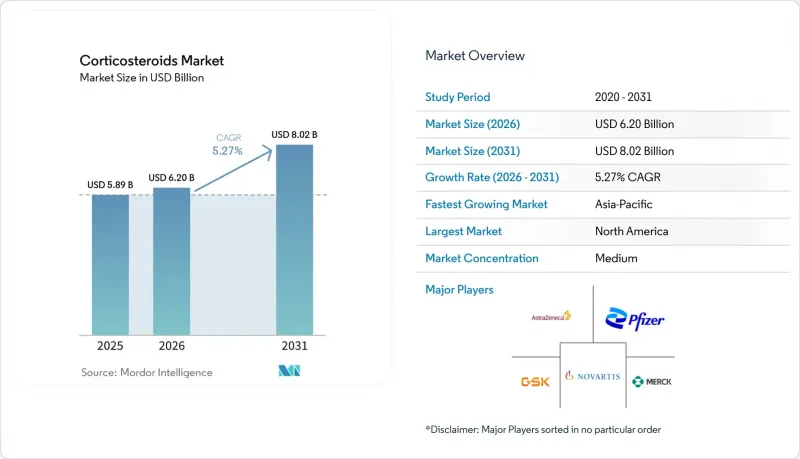
This report is Segmented by Product (Glucocorticoids and Mineralocorticoids), Route of Administration (Topical Steroids, Inhaled Steroids, and More), Application (Rheumatology Indications, and More), Distribution Channel (Hospital Pharmacies, Retail Pharmacies, and More) and Geography (North America, Europe, Asia-Pacific, and More). The Market and Forecasts are Provided in Terms of Value (USD).
Global Corticosteroids Market Trends and Insights
Growing Geriatric Population & Chronic Diseases
Population aging is lifting chronic inflammatory case-loads, prompting earlier steroid intervention and longer treatment windows. Critical-care updates list corticosteroids for septic shock and ARDS, widening systemic use. Healthcare systems are also backing steroid-sparing research partnerships that target toxicity reduction. The combined trend sustains baseline demand while opening niches for low-dose and extended-release versions that maintain efficacy yet curb adverse events.
Rising Prevalence of Autoimmune & Inflammatory Disorders
Autoimmune disease incidence is climbing, compelling personalized, multidisciplinary care pathways. Consensus statements now advocate tailored glucocorticoid regimens and combo biologics for eosinophil-driven disease, supporting corticosteroid-sparing yet still relying on baseline steroids.Data from combination reliever therapies show markedly fewer exacerbations, reinforcing inhaled steroid positioning. Expanded recognition of inflammatory pathways in new diseases is stretching addressable populations.
Government Pricing Pressure & Generic Erosion
Negotiated drug pricing schemes in the United States and aggressive reimbursement talks in China are compressing branded margins. Key inhalers and topical brands face 2025 exclusivity loss, inviting low-cost generics that quickly cannibalize share. Companies front-load price increases and shift rebate structures but these levers offer only short-term relief.
Other drivers and restraints analyzed in the detailed report include:
- Expanding Use of Inhaled Corticosteroids in Updated Asthma/COPD Guidelines
- Broader OTC Availability of Low-Potency Topical Steroids in Emerging Markets
- Adverse Events from Prolonged Corticosteroid Use
For complete list of drivers and restraints, kindly check the Table Of Contents.
Segment Analysis
Glucocorticoids held 75.86% of 2025 revenue, underpinned by continual advances in delivery technologies and receptor-selective chemistry. The corticosteroids market size attributed to glucocorticoids stood at USD 4.47 billion in 2025, and the segment is projected to grow at 5.19% CAGR. High clinical familiarity and broad label coverage shield revenue even as biologics encroach on some indications. Mineralocorticoids, although small in value, will outpace at 6.02% CAGR as products such as finerenone show cardio-renal benefit.
Pipeline data point to next-wave selective modulators and nanoparticle carriers that aim to keep anti-inflammatory potency yet diminish adverse profiles. Approvals like crinecerfont for congenital adrenal hyperplasia illustrate combination strategies that trim glucocorticoid dose without losing disease control. Capacity expansions in South Korea and Ireland signal readiness to meet expected volume growth.
Inhaled therapies captured 38.47% share in 2025 and remain essential owing to updated respiratory guidelines. Yet systemic and parenteral products will chart a faster 6.05% CAGR as critical-care protocols broaden and extended-release injectables prolong dosing intervals.
Engineering improvements are driving this trend. Extended-release IA injections deliver months-long osteoarthritis pain relief, while nano-aerosol generators lower particle size for deeper lung deposition. Nasal, ophthalmic, and topical platforms are also adopting in-situ gel matrices to extend mucosal residence time and curb dosing frequency.
Geography Analysis
North America retained the largest revenue share at 39.98% in 2025 on the back of high diagnosis and treatment penetration, comprehensive insurance cover, and rapid uptake of new formulations. The corticosteroids market size in the region reached USD 2.36 billion in 2025. Pricing reforms under the Inflation Reduction Act are squeezing margins, yet large installed user bases and clinical guideline alignment sustain volume.
Asia-Pacific is the fastest-growing territory, clocking a 6.34% CAGR as regulators streamline drug registration and broaden OTC access. Domestic producers are winning national tenders following aggressive price cuts, but multinationals bolster competitiveness by localizing manufacturing and launching connected inhalers that address adherence. Regional clinical panels now endorse nebulized budesonide in both stable and acute respiratory settings, reinforcing demand.
Europe follows steady mid-single-digit growth. EMA harmonization allows cross-border launches that reduce time-to-market for niche formulations. Evidence-based medicine culture accelerates adoption of receptor-selective modulators and steroid-sparing combos. Eastern Europe, with rising healthcare spend, offers incremental upside. Latin America and the Middle East & Africa record moderate gains as infrastructure and reimbursement expand, though affordability hurdles still limit inhaled steroid access in low-income settings.
- Pfizer
- GlaxoSmithKline
- AstraZeneca
- Novartis
- Sanofi
- Merck
- Johnson & Johnson
- Cipla
- Leo Pharma
- Bayer
- Teva Pharmaceutical Industries
- Viatris
- Sun Pharmaceuticals Industries
- Lupin
- Hikma Pharmaceuticals
- Bausch Health
- Glenmark Pharmaceuticals
- Kyowa Kirin
- Orion
- Mallinckrodt plc
Additional Benefits:
- The market estimate (ME) sheet in Excel format
- 3 months of analyst support
TABLE OF CONTENTS
1 Introduction
- 1.1 Study Assumptions & Market Definition
- 1.2 Scope of the Study
2 Research Methodology
3 Executive Summary
4 Market Landscape
- 4.1 Market Overview
- 4.2 Market Drivers
- 4.2.1 Growing geriatric population & chronic diseases
- 4.2.2 Rising prevalence of autoimmune & inflammatory disorders
- 4.2.3 Expanding use of inhaled corticosteroids in updated asthma / COPD guidelines
- 4.2.4 Broader OTC availability of low-potency topical steroids in emerging markets
- 4.2.5 Development of selective glucocorticoid receptor modulators (SEGRMs)
- 4.2.6 Digital / connected drug-delivery devices improving adherence
- 4.3 Market Restraints
- 4.3.1 Government pricing pressure & generic erosion
- 4.3.2 Adverse events from prolonged corticosteroid use
- 4.3.3 Stringent regulatory scrutiny for new formulations
- 4.3.4 Biologics & JAK-inhibitors as steroid-sparing alternatives
- 4.4 Porters Five Forces Analysis
- 4.4.1 Bargaining Power of Buyers/Consumers
- 4.4.2 Bargaining Power of Suppliers
- 4.4.3 Threat of Substitute Products
- 4.4.4 Intensity of Competitive Rivalry
5 Market Size & Growth Forecasts (Value, USD)
- 5.1 By Product
- 5.1.1 Glucocorticoids
- 5.1.2 Mineralocorticoids
- 5.2 By Route of Administration
- 5.2.1 Topical Steroids
- 5.2.2 Inhaled Steroids
- 5.2.3 Oral Forms
- 5.2.4 Systemic / Parenteral Forms
- 5.2.5 Others
- 5.3 By Application
- 5.3.1 Rheumatology Indications
- 5.3.2 Dermatology / Skin Allergies
- 5.3.3 Endocrinology
- 5.3.4 Gastroenterology
- 5.3.5 Respiratory Diseases
- 5.3.6 Others
- 5.4 By Distribution Channel
- 5.4.1 Hospital Pharmacies
- 5.4.2 Retail Pharmacies
- 5.4.3 Online Pharmacies
- 5.5 By Geography
- 5.5.1 North America
- 5.5.1.1 United States
- 5.5.1.2 Canada
- 5.5.1.3 Mexico
- 5.5.2 Europe
- 5.5.2.1 Germany
- 5.5.2.2 United Kingdom
- 5.5.2.3 France
- 5.5.2.4 Italy
- 5.5.2.5 Spain
- 5.5.2.6 Rest of Europe
- 5.5.3 Asia-Pacific
- 5.5.3.1 China
- 5.5.3.2 Japan
- 5.5.3.3 India
- 5.5.3.4 Australia
- 5.5.3.5 South Korea
- 5.5.3.6 Rest of Asia-Pacific
- 5.5.4 Middle East and Africa
- 5.5.4.1 GCC
- 5.5.4.2 South Africa
- 5.5.4.3 Rest of Middle East and Africa
- 5.5.5 South America
- 5.5.5.1 Brazil
- 5.5.5.2 Argentina
- 5.5.5.3 Rest of South America
- 5.5.1 North America
6 Competitive Landscape
- 6.1 Market Concentration
- 6.2 Market Share Analysis
- 6.3 Company Profiles (includes Global level Overview, Market level overview, Core Segments, Financials as available, Strategic Information, Market Rank/Share for key companies, Products & Services, and Recent Developments)
- 6.3.1 Pfizer Inc.
- 6.3.2 GlaxoSmithKline plc
- 6.3.3 AstraZeneca plc
- 6.3.4 Novartis AG
- 6.3.5 Sanofi S.A.
- 6.3.6 Merck & Co., Inc.
- 6.3.7 Johnson & Johnson
- 6.3.8 Cipla Ltd.
- 6.3.9 LEO Pharma A/S
- 6.3.10 Bayer AG
- 6.3.11 Teva Pharmaceutical Industries Ltd.
- 6.3.12 Viatris Inc.
- 6.3.13 Sun Pharmaceutical Industries Ltd.
- 6.3.14 Lupin Ltd.
- 6.3.15 Hikma Pharmaceuticals plc
- 6.3.16 Bausch Health Companies Inc.
- 6.3.17 Glenmark Pharmaceuticals Ltd.
- 6.3.18 Kyowa Kirin Co., Ltd.
- 6.3.19 Orion Corporation
- 6.3.20 Mallinckrodt plc
7 Market Opportunities & Future Outlook
- 7.1 White-Space & Unmet-Need Assessment

