PUBLISHER: Mordor Intelligence | PRODUCT CODE: 2064342

PUBLISHER: Mordor Intelligence | PRODUCT CODE: 2064342
CI/CD Tools And Pipeline Automation - Market Share Analysis, Industry Trends & Statistics, Growth Forecasts (2026 - 2031)
According to Mordor Intelligence, the CI/CD tools and pipeline automation market size is expected to increase from USD 10.38 billion in 2025 to USD 11.85 billion in 2026 and reach USD 22.92 billion by 2031, growing at a CAGR of 14.12% over 2026-2031.
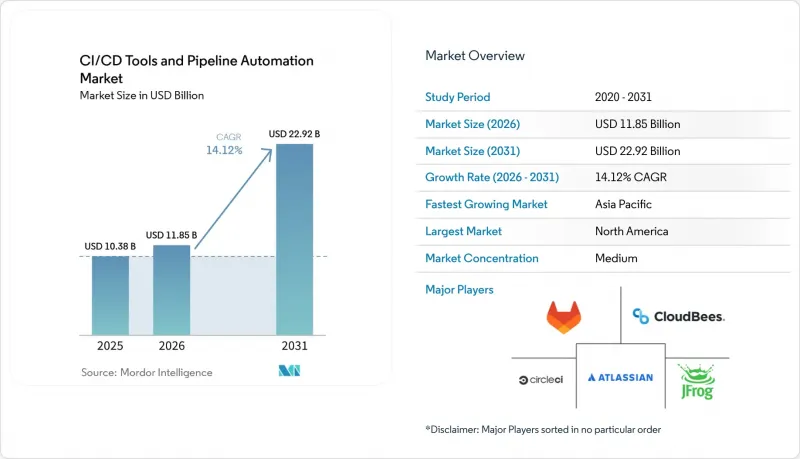
This report is Segmented by Component Type (Tools/Software Platforms, and Services), Deployment Model (Cloud-Based, On-Premises, and Hybrid), End-User Enterprise Size (Large Enterprises, and Small and Medium Enterprises), End-User Industry (BFSI, Healthcare and Life Sciences, Retail and ECommerce, and More), and Geography. The Market Forecasts are Provided in Terms of Value (USD).
Global CI/CD Tools And Pipeline Automation Market Trends and Insights
Rapid Adoption of DevOps Across Enterprises
Enterprises now view deployment frequency as a proxy for revenue velocity rather than an internal metric. In 2025, 78% of surveyed organizations reported active GitOps deployments, and 93% planned to expand their use. Financial services firms synchronize Kubernetes manifests across dozens of clusters, enabling code approved for compliance to reach production within minutes. The resulting agility forces laggards to accelerate adoption or cede ground, cementing DevOps maturity as a competitive differentiator inside the Continuous Integration and Continuous Delivery (CI/CD) tools and pipeline automation market.
Growing Preference for Cloud-Native and Containerized Pipelines
Containerization has shifted from experiment to foundation, with 82% of enterprises running Kubernetes in production during 2025 and 60% adopting pipelines optimized for cloud-native workloads. Economic drivers dominate, bin-packing can trim compute expense by 30%-40% while preventing environment drift that once consumed significant developer time. Kubernetes penetration hit 96% in 2026, compelling vendors to fine-tune for Helm charts, Kustomize overlays, and ephemeral test pods. Outside air-gapped defense workloads, on-premise Continuous Integration and Continuous Delivery (CI/CD) tools are rapidly losing relevance.
Legacy System Integration Complexity
The primary obstacle is organizational inertia rather than pure technical mismatch. Older platforms often lack modern APIs, forcing teams to craft custom adapters that immediately balloon technical debt. Financial institutions frequently report proof-of-concept failures because transaction-processing cores cannot expose real-time data. Vendors offering pre-built connectors for SAP, Oracle, or IBM middleware shorten integration cycles from quarters to weeks, yet the cumulative effort still throttles the trajectory of the Continuous Integration and Continuous Delivery (CI/CD) tools and pipeline automation market.
Other drivers and restraints analyzed in the detailed report include:
- Integration of AI for Predictive Testing and Orchestration
- Expansion of GitOps and Infrastructure-as-Code Practices
- Shortage of Skilled DevOps Professionals
For complete list of drivers and restraints, kindly check the Table Of Contents.
Segment Analysis
Tools commanded 75.82% revenue in 2025, yet the services arm of the CI/CD tools and pipeline automation market is poised to expand at 16.45% through 2031. Professional assessments, implementation projects, and managed pipelines are becoming prerequisites for platform adoption as buyers seek proof-of-concept validation. Tata Consultancy Services formalized alliances to deliver AI-powered orchestration, demonstrating how implementation expertise now drives value.
Meanwhile, consolidation is reshaping the tools landscape. GitLab recorded USD 955 million in fiscal-year 2026 revenue, validating demand for unified platforms that merge source control, CI/CD, security, and project management. Atlassian's USD 1 billion purchase of DX in 2025 underscores a pivot toward embedded engineering intelligence, while niche vendors like Buildkite carve performance-specific lanes. The shift indicates that strategic advantage now accrues to platforms bundling analytics, security, and deployment into a single control plane.
Cloud solutions held 62.11% share in 2025 because elastic pricing aligns with fluctuating build volumes. Yet hybrid adoption is growing by 15.76% through 2031 as financial, healthcare, and public-sector organizations split sensitive workloads between on-premises clusters and cloud burst capacity. ArgoCD's declarative synchronization lets teams apply identical policies across both realms, satisfying PCI-DSS or HIPAA audits. By leveraging a GitOps model, it ensures that the desired system state is version-controlled, auditable, and automatically enforced across environments, reducing configuration drift between development, staging, and production.
On-premises systems exist only within air-gapped defense environments, and their relevance continues to wane. Vendors now offer dedicated instances inside customer VPCs, blending SaaS convenience with data control. The trend signals that seamless movement between on-premise, public cloud, and edge locations will become the baseline expectation inside the CI/CD tools and pipeline automation market.
Geography Analysis
North America led with 38.20% revenue in 2025, buoyed by a dense ecosystem of platform providers and Fortune 500 adopters. Venture funding for DevOps startups topped USD 13 billion in 2026, sustaining high competitive churn. Canada and Mexico also scale adoption as cross-border data flows require hybrid models that respect both GDPR and national privacy statutes. Organizations operating across North America increasingly adopt hybrid and multi-cloud CI/CD architectures to ensure data residency, sovereignty, and compliance requirements are met without disrupting development velocity.
Asia-Pacific is on pace for a 17.48% CAGR to 2031, the fastest worldwide. India's Unified Payments Interface processes more than 10 billion monthly transactions and relies on continuous delivery to update fraud-detection algorithms without downtime. China emphasizes domestic hosting with Alibaba Cloud or Tencent Cloud integrations, while Japan and South Korea embed DevSecOps to meet stringent cyber rules. Singapore, Malaysia, and Indonesia adopt artifact-management services in response to data-localization mandates, illustrating how regulatory nuance fuels demand inside the CI/CD tools and pipeline automation market.
Europe is accelerating under the Cyber Resilience Act, which enforces automated security testing and SBOM generation beginning August 2026. Germany, the United Kingdom, and France lead uptake, helped by deep manufacturing and automotive footprints. Open-source tooling retains popularity, with GitHub Actions, Jenkins, and GitLab capturing much of the share. The Middle East experiences early-stage adoption driven by sovereign cloud mandates, whereas Africa and South America advance more gradually as connectivity and skills improve.
- GitLab Inc.
- CloudBees Inc.
- Circle Internet Services Inc.
- Atlassian Corporation
- Harness Inc.
- JetBrains s.r.o.
- Semaphore CI Inc.
- Buddy Sp. z o.o.
- Codefresh Inc.
- Spacelift Inc.
- JFrog Ltd.
- Argo Workflows
- Tekton
- Buildkite Pty Ltd.
- ThoughtWorks Inc.
- Bitrise Ltd.
- AppVeyor Systems Inc.
- DeployHub Inc.
- GitHub (Microsoft Corporation)
- ReleaseHub Inc.
Additional Benefits:
- The market estimate (ME) sheet in Excel format
- 3 months of analyst support
TABLE OF CONTENTS
1 INTRODUCTION
- 1.1 Study Assumptions and Market Definition
- 1.2 Scope of the Study
2 RESEARCH METHODOLOGY
3 EXECUTIVE SUMMARY
4 MARKET LANDSCAPE
- 4.1 Market Overview
- 4.2 Market Drivers
- 4.2.1 Rapid Adoption of DevOps Across Enterprises
- 4.2.2 Growing Preference for Cloud-Native and Containerised Pipelines
- 4.2.3 Integration of AI for Predictive Testing and Orchestration
- 4.2.4 Expansion of GitOps and Infrastructure-as-Code Practices
- 4.2.5 Rising Compliance Demands Driving DevSecOps Automation
- 4.2.6 Surge in Low-Code/No-Code Pipeline Builders for SMEs
- 4.3 Market Restraints
- 4.3.1 Legacy System Integration Complexity
- 4.3.2 Shortage of Skilled DevOps Professionals
- 4.3.3 Escalating Tool Sprawl and Governance Challenges
- 4.3.4 Security Risks from Misconfigured Pipelines
- 4.4 Industry Value Chain Analysis
- 4.5 Regulatory Landscape
- 4.6 Technological Outlook
- 4.7 Industry Attractiveness - Porter's Five Forces Analysis
- 4.7.1 Threat of New Entrants
- 4.7.2 Bargaining Power of Suppliers
- 4.7.3 Bargaining Power of Buyers
- 4.7.4 Threat of Substitutes
- 4.7.5 Intensity of Competitive Rivalry
- 4.8 Impact of Macroeconomic Factors on the Market
- 4.9 Investment Analysis
5 MARKET SIZE AND GROWTH FORECASTS (VALUE)
- 5.1 By Component Type
- 5.1.1 Tools/Software Platforms
- 5.1.2 Services
- 5.2 By Deployment Model
- 5.2.1 Cloud-Based
- 5.2.2 On-Premises
- 5.2.3 Hybrid
- 5.3 By End-user Enterprise Size
- 5.3.1 Large Enterprises
- 5.3.2 Small and Medium Enterprises
- 5.4 By End-user Industry
- 5.4.1 Banking, Financial Services and Insurance (BFSI)
- 5.4.2 Healthcare and Life Sciences
- 5.4.3 Retail and eCommerce
- 5.4.4 Automotive and Transportation
- 5.4.5 IT and Telecommunications
- 5.4.6 Government and Defense
- 5.4.7 Manufacturing
- 5.4.8 Other End-User Industries
- 5.5 By Geography
- 5.5.1 North America
- 5.5.1.1 United States
- 5.5.1.2 Canada
- 5.5.1.3 Mexico
- 5.5.2 South America
- 5.5.2.1 Brazil
- 5.5.2.2 Argentina
- 5.5.2.3 Rest of South America
- 5.5.3 Europe
- 5.5.3.1 Germany
- 5.5.3.2 United Kingdom
- 5.5.3.3 France
- 5.5.3.4 Italy
- 5.5.3.5 Spain
- 5.5.3.6 Russia
- 5.5.3.7 Rest of Europe
- 5.5.4 Asia-Pacific
- 5.5.4.1 China
- 5.5.4.2 Japan
- 5.5.4.3 India
- 5.5.4.4 South Korea
- 5.5.4.5 Australia and New Zealand
- 5.5.4.6 Rest of Asia-Pacific
- 5.5.5 Middle East
- 5.5.5.1 Saudi Arabia
- 5.5.5.2 United Arab Emirates
- 5.5.5.3 Turkey
- 5.5.5.4 Rest of Middle East
- 5.5.6 Africa
- 5.5.6.1 South Africa
- 5.5.6.2 Nigeria
- 5.5.6.3 Egypt
- 5.5.6.4 Rest of Africa
- 5.5.1 North America
6 COMPETITIVE LANDSCAPE
- 6.1 Market Concentration
- 6.2 Strategic Moves
- 6.3 Market Share Analysis
- 6.4 Company Profiles (includes Global Level Overview, Market Level Overview, Core Segments, Financials as available, Strategic Information, Market Rank/Share, Products and Services, Recent Developments)
- 6.4.1 GitLab Inc.
- 6.4.2 CloudBees Inc.
- 6.4.3 Circle Internet Services Inc.
- 6.4.4 Atlassian Corporation
- 6.4.5 Harness Inc.
- 6.4.6 JetBrains s.r.o.
- 6.4.7 Semaphore CI Inc.
- 6.4.8 Buddy Sp. z o.o.
- 6.4.9 Codefresh Inc.
- 6.4.10 Spacelift Inc.
- 6.4.11 JFrog Ltd.
- 6.4.12 Argo Workflows
- 6.4.13 Tekton
- 6.4.14 Buildkite Pty Ltd.
- 6.4.15 ThoughtWorks Inc.
- 6.4.16 Bitrise Ltd.
- 6.4.17 AppVeyor Systems Inc.
- 6.4.18 DeployHub Inc.
- 6.4.19 GitHub (Microsoft Corporation)
- 6.4.20 ReleaseHub Inc.
7 MARKET OPPORTUNITIES AND FUTURE OUTLOOK
- 7.1 White-Space and Unmet-Need Assessment

