PUBLISHER: Mordor Intelligence | PRODUCT CODE: 2064366

PUBLISHER: Mordor Intelligence | PRODUCT CODE: 2064366
Natural Household Cleaners - Market Share Analysis, Industry Trends & Statistics, Growth Forecasts (2026 - 2031)
According to Mordor Intelligence, the natural household cleaners market size is expected to grow from USD 37.23 billion in 2025 to USD 39.16 billion in 2026 and is forecast to reach USD 49.19 billion by 2031 at a 4.67% CAGR over 2026-2031.
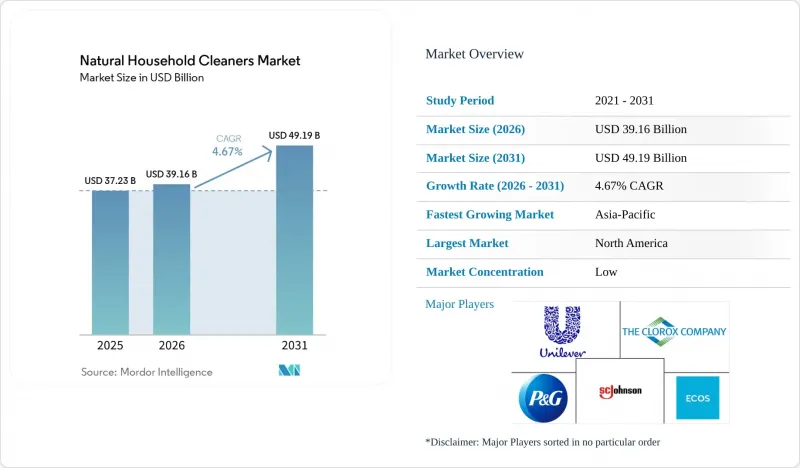
This report is Segmented by Product Type (Surface Cleaners, Laundry Care Products, Dishwashing Products, and More), Form (Liquid, Powder, Bar, Others), Distribution Channel (Specialty Stores, Supermarkets/Hypermarkets, Online Retail Stores, Other Channels), and Geography (North America, Europe, Asia-Pacific, South America, Middle East and Africa). The Market Forecasts are Provided in Terms of Value (USD).
Global Natural Household Cleaners Market Trends and Insights
Growing consumer awareness regarding harmful chemicals in conventional cleaners
Consumer awareness of indoor chemical exposure has shifted from a secondary wellness concern to a key factor in purchasing natural cleaning products. According to the 2026 Household & Cleaning Trend Report by O&3, 73% of surveyed consumers are willing to pay a premium for sustainably produced cleaning products, even amidst cost-of-living pressures. Additionally, 80% of respondents expect brands to provide detailed disclosures about their manufacturing processes, an expectation that conventional cleaning product manufacturers often fail to meet. This growing awareness is no longer limited to driving one-time trial purchases; it is fostering long-term customer retention. Households that transition to verified-natural cleaning products rarely revert to conventional options, as the idea of reintroducing family members to products containing chlorinated or ammoniated chemicals becomes emotionally unacceptable. This consumer loyalty is reflected in higher repeat-purchase rates and subscription conversions, providing natural cleaning brands with a competitive advantage over conventional alternatives on digital commerce platforms.
Rising preference for eco-friendly and biodegradable products
The increasing demand for eco-friendly and biodegradable products is driving the growth of the global natural household cleaners market. Consumers are prioritizing sustainability and environmental safety in their purchasing decisions. Awareness of the negative impact of chemical-based cleaning agents on water systems, indoor air quality, and ecological balance is prompting households to adopt plant-based, non-toxic, and biodegradable cleaning solutions. Buyers are seeking products made with naturally derived ingredients, recyclable packaging, and minimal chemical residues to align with environmentally responsible lifestyles. Additionally, stricter environmental regulations and corporate sustainability initiatives are encouraging manufacturers to create greener cleaning alternatives with reduced environmental impact. This shift toward sustainable consumption patterns is boosting the demand for natural household cleaners in both residential and commercial applications globally.
Raw material supply chain volatility
Volatility in the raw material supply chain is a significant restraint for the global natural household cleaners market. Manufacturers depend heavily on plant-based oils, bio-surfactants, essential oils, and other naturally sourced ingredients, which are susceptible to supply disruptions, fluctuating availability, and rising procurement costs. Factors such as climate-related agricultural uncertainties, transportation disruptions, geopolitical trade tensions, and evolving import regulations can adversely affect the consistent sourcing of sustainable raw materials. Additionally, the U.S. tariff environment through 2025 has added complexity to ingredient procurement, leading manufacturers to reevaluate supply networks and expedite the qualification of North American bio-surfactant suppliers to mitigate duty exposure and transportation variability. Sustainability certifications such as the Roundtable on Sustainable Palm Oil (RSPO) and the EU Ecolabel add compliance overhead to sourcing decisions, which tightens margin further even as they address legitimate deforestation concerns. These challenges increase operational complexity, extend production lead times, and exert pressure on pricing strategies, thereby constraining the scalability and profitability of natural household cleaner manufacturers in the global market.
Other drivers and restraints analyzed in the detailed report include:
- Growing popularity of plant-based ingredients
- Expansion of e-commerce and direct-to-consumer green brands
- Strong competition from conventional cleaning brands
For complete list of drivers and restraints, kindly check the Table Of Contents.
Segment Analysis
Surface cleaners accounted for a 43.35% share of the natural household cleaners market in 2025, driven by increasing consumer awareness of indoor hygiene, chemical exposure, and environmentally safe cleaning practices. Consumers are progressively replacing traditional chemical-based sprays and disinfectants with plant-based and biodegradable surface cleaners, which are perceived as safer for children, pets, and individuals with allergies or respiratory sensitivities. The heightened focus on maintaining hygienic living spaces, particularly in kitchens, bathrooms, and frequently touched surfaces, has fueled demand for non-toxic multi-surface cleaning products. Furthermore, the rise of eco-conscious lifestyles and clean-label product preferences has prompted manufacturers to develop natural surface cleaners using ingredients such as vinegar, citrus extracts, essential oils, and bio-based surfactants. Innovations such as refillable packaging, concentrated formulations, and fragrance-free variants are also appealing to environmentally conscious consumers, contributing to the global growth of natural surface cleaners.
Laundry care products are projected to grow at a 4.94% CAGR from 2026 to 2031, driven by increasing consumer demand for skin-safe, fragrance-free, and chemical-free fabric cleaning solutions. Concerns about synthetic dyes, phosphates, chlorine bleach, and harsh detergents in conventional laundry products, due to their potential effects on skin health and water pollution, have led to a rise in demand for plant-based laundry detergents, fabric softeners, and stain removers formulated with biodegradable ingredients and low-toxicity compounds. Growing awareness of sustainable living and the environmental impact of wastewater discharge is further encouraging households to adopt eco-friendly laundry care alternatives that minimize chemical contamination. Additionally, the increasing adoption of high-efficiency washing machines, concentrated detergent formats, refill systems, and plastic-reducing packaging solutions is driving innovation and the global adoption of natural laundry care products.
Geography Analysis
North America accounted for the largest share of the natural household cleaners market, holding 36.04% in 2025. This dominance is attributed to strong consumer awareness regarding environmental sustainability, indoor air quality, and the health risks associated with chemical-based cleaning products. Consumers in the United States and Canada are increasingly opting for plant-based, non-toxic, and biodegradable cleaning solutions that align with eco-conscious lifestyles and clean-label preferences. The region's advanced retail and e-commerce infrastructure has enhanced product accessibility, while stringent environmental regulations and growing corporate sustainability initiatives are driving the adoption of greener cleaning alternatives. Additionally, the rising popularity of refillable packaging, cruelty-free certifications, and zero-waste household practices is further propelling market growth. Established natural brands are leveraging strong marketing strategies, and the increasing demand for premium, wellness-oriented household products continues to support the expansion of natural household cleaner sales in North America.
Asia-Pacific is the fastest-growing region in the natural household cleaners market, with a projected CAGR of 5.05% from 2026 to 2031. This growth is driven by rapid urbanization, increasing awareness of hygiene and sanitation, and rising consumer interest in safer and environmentally friendly cleaning products. Concerns about pollution, chemical exposure, and health-related sensitivities are prompting households in countries such as China, Japan, India, South Korea, and Australia to adopt plant-based and low-toxicity cleaning solutions. The expanding middle-class population, evolving lifestyle patterns, and growing penetration of modern retail and e-commerce platforms are improving the availability and visibility of natural household cleaning products across the region. Furthermore, government initiatives focused on sustainability, waste reduction, and environmentally responsible consumption are encouraging the adoption of biodegradable cleaners and recyclable packaging. Product innovations tailored to local preferences, such as herbal ingredients and naturally derived fragrances, are also driving demand for natural household cleaners in the Asia-Pacific.
In Europe, South America, and the Middle East and Africa, the demand for natural household cleaners is fueled by sustainability awareness, evolving consumer lifestyles, and a growing focus on environmentally responsible household products. In Europe, stringent environmental regulations, strong consumer preference for eco-certified products, and high awareness of chemical-free living are significantly boosting the demand for biodegradable and plant-based cleaners. In South America, urban population growth, expanding retail access, and increasing awareness of natural and affordable cleaning alternatives are driving the adoption of eco-friendly household products, particularly in major metropolitan areas. Meanwhile, in the Middle East and Africa, rising hygiene awareness, improving retail infrastructure, and exposure to global sustainability trends are contributing to market growth. Consumers in these regions are increasingly seeking safer cleaning solutions with natural ingredients, recyclable packaging, and reduced environmental impact, prompting manufacturers to expand their natural household cleaner portfolios and regional distribution networks.
- SC Johnson
- Ecover
- Unilever
- Seventh Generation
- The Clorox Company
- Procter & Gamble
- Earth Friendly Products
- Blueland
- Grove Collaborative
- Cleancult
- ATTITUDE
- Better Life
- Bio-D
- Werner & Mertz
- Sonett
- AspenClean
- Puracy
- Aunt Fannie's
- Meliora
- Babyganics
- AlmaWin
- Dropps
Additional Benefits:
- The market estimate (ME) sheet in Excel format
- 3 months of analyst support
TABLE OF CONTENTS
1 INTRODUCTION
- 1.1 Study Assumptions and Market Definition
- 1.2 Scope of the Study
2 RESEARCH METHODOLOGY
3 EXECUTIVE SUMMARY
4 MARKET LANDSCAPE
- 4.1 Market Overview
- 4.2 Market Drivers
- 4.2.1 Growing consumer awareness regarding harmful chemicals in conventional cleaners
- 4.2.2 Rising preference for eco-friendly and biodegradable products
- 4.2.3 Growing popularity of plant-based ingredients
- 4.2.4 Expansion of e-commerce and direct-to-consumer green brands
- 4.2.5 Rising demand for multi-functional natural cleaning products
- 4.2.6 Growth of allergy-sensitive and fragrance-free cleaning solutions
- 4.3 Market Restraints
- 4.3.1 Raw material supply chain volatility
- 4.3.2 Strong competition from conventional cleaning brands
- 4.3.3 Challenges in achieving strong disinfection claims
- 4.3.4 Consumer perception of lower cleaning effectiveness
- 4.4 Consumer Behavior Analysis
- 4.5 Regulatory Landscape
- 4.6 Technological Outlook
- 4.7 Porter's Five Forces
- 4.7.1 Threat of New Entrants
- 4.7.2 Bargaining Power of Suppliers
- 4.7.3 Bargaining Power of Buyers
- 4.7.4 Threat of Substitutes
- 4.7.5 Competitive Rivalry
5 MARKET SIZE AND GROWTH FORECASTS (VALUE)
- 5.1 By Product Type
- 5.1.1 Surface Cleaners
- 5.1.1.1 Bathroom cleaners
- 5.1.1.2 Kitchen cleaners
- 5.1.1.3 Glass & window cleaners
- 5.1.1.4 Floor cleaners
- 5.1.1.5 Others
- 5.1.2 Laundry Care Products
- 5.1.2.1 Liquid detergents
- 5.1.2.2 Powders
- 5.1.2.3 Pods/tablets/sheets
- 5.1.2.4 Others
- 5.1.3 Dishwashing Products
- 5.1.3.1 Hand dishwashing liquids
- 5.1.3.2 Dishwasher tablets/pods/powders
- 5.1.4 Air Care and Freshening Products
- 5.1.5 Others
- 5.1.1 Surface Cleaners
- 5.2 By Form
- 5.2.1 Liquid
- 5.2.2 Powder
- 5.2.3 Bar
- 5.2.4 Others
- 5.3 By Distribution Channel
- 5.3.1 Specialty Stores
- 5.3.2 Supermarkets/Hypermarkets
- 5.3.3 Online Retail Stores
- 5.3.4 Other Channels
- 5.4 By Geography
- 5.4.1 North America
- 5.4.1.1 United States
- 5.4.1.2 Canada
- 5.4.1.3 Mexico
- 5.4.1.4 Rest of North America
- 5.4.2 Europe
- 5.4.2.1 United Kingdom
- 5.4.2.2 Germany
- 5.4.2.3 France
- 5.4.2.4 Italy
- 5.4.2.5 Spain
- 5.4.2.6 Rest of Europe
- 5.4.3 Asia-Pacific
- 5.4.3.1 China
- 5.4.3.2 Japan
- 5.4.3.3 India
- 5.4.3.4 South Korea
- 5.4.3.5 Australia
- 5.4.3.6 Rest of Asia-Pacific
- 5.4.4 South America
- 5.4.4.1 Brazil
- 5.4.4.2 Argentina
- 5.4.4.3 Colombia
- 5.4.4.4 Rest of South America
- 5.4.5 Middle East and Africa
- 5.4.5.1 Saudi Arabia
- 5.4.5.2 South Africa
- 5.4.5.3 United Arab Emirates
- 5.4.5.4 Rest of Middle East and Africa
- 5.4.1 North America
6 COMPETITIVE LANDSCAPE
- 6.1 Market Concentration
- 6.2 Strategic Moves
- 6.3 Market Share Analysis
- 6.4 Company Profiles (includes Global level Overview, Market level overview, Core Segments, Financials (if available), Strategic Information, Market Share for key companies, Products, and Recent Developments)
- 6.4.1 SC Johnson
- 6.4.2 Ecover
- 6.4.3 Unilever
- 6.4.4 Seventh Generation
- 6.4.5 The Clorox Company
- 6.4.6 Procter & Gamble
- 6.4.7 Earth Friendly Products
- 6.4.8 Blueland
- 6.4.9 Grove Collaborative
- 6.4.10 Cleancult
- 6.4.11 ATTITUDE
- 6.4.12 Better Life
- 6.4.13 Bio-D
- 6.4.14 Werner & Mertz
- 6.4.15 Sonett
- 6.4.16 AspenClean
- 6.4.17 Puracy
- 6.4.18 Aunt Fannie's
- 6.4.19 Meliora
- 6.4.20 Babyganics
- 6.4.21 AlmaWin
- 6.4.22 Dropps
7 MARKET OPPORTUNITIES AND FUTURE OUTLOOK

