
PUBLISHER: Mordor Intelligence | PRODUCT CODE: 2064369

PUBLISHER: Mordor Intelligence | PRODUCT CODE: 2064369
Diagnostic Imaging Services - Market Share Analysis, Industry Trends & Statistics, Growth Forecasts (2026 - 2031)
According to Mordor Intelligence, the diagnostic imaging services market size is projected to be USD 591.41 billion in 2025, USD 624.82 billion in 2026, and reach USD 822.44 billion by 2031, growing at a CAGR of 5.65% from 2026 to 2031.
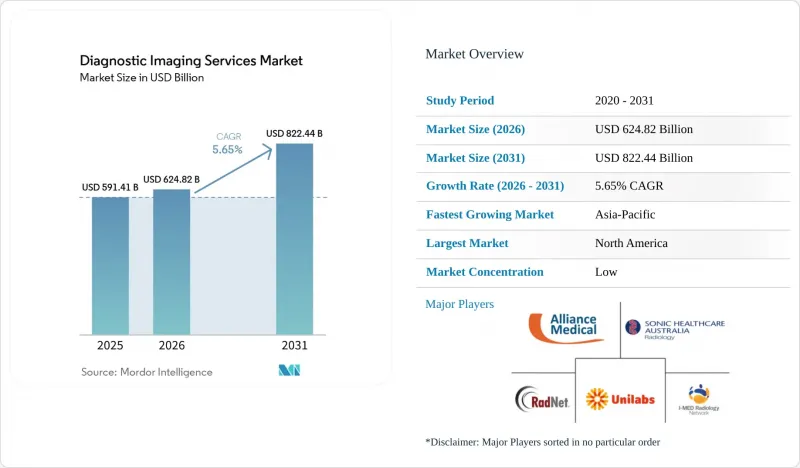
This report is Segmented by Modality (X-Ray, CT, MRI, Ultrasound, and More), Application (Oncology, Cardiology, Neurology & Spine, Orthopedics, and More), Service Setting (Hospital-Based, Freestanding, Community, Mobile), Delivery Model (Owned Networks, Hospital Joint Ventures, and More), and Geography (North America, Europe, and More). The Market Forecasts are Provided in Terms of Value (USD).
Global Diagnostic Imaging Services Market Trends and Insights
Aging Chronic-Disease Imaging Volumes
The demographic case for sustained imaging demand remains unusually strong. A February 2025 projection published in the Journal of the American College of Radiology showed that the 85 to 94 age cohort in the United States is expected to grow by 149.6% by 2055, while the population aged 95 and above is projected to grow by 282.1%. Older adults also consume imaging at structurally higher rates than younger populations, which means demand growth is linked to age mix rather than only headline population growth. Multimorbidity strengthens that effect because diabetes, cardiovascular disease, cancer, and musculoskeletal degeneration often appear in the same patient and generate multiple imaging episodes over time. This makes aging one of the most durable demand supports in the diagnostic imaging services market, especially for providers with broad CT, MRI, and general imaging coverage.
Screening-Led Early Diagnosis Demand
Early diagnosis pathways continue to increase the need for repeated imaging across several service lines. In oncology, imaging no longer sits only at the first diagnosis, because modern care pathways also require staging, treatment selection, therapy monitoring, and recurrence follow-up. That pattern is becoming more pronounced in radiotheranostics, where paired diagnostic scans are tied directly to treatment decisions and post-therapy assessment. The result is a larger recurring scan base rather than a one-time study profile, which lifts utilization even when scanner growth is gradual. This repeated-use pattern is adding steadier volume to the diagnostic imaging services market because it connects imaging demand to ongoing clinical protocols rather than isolated acute events.
Radiologist and Technologist Shortages
The imaging labor gap now looks structural rather than temporary. A February 2025 study projected that imaging utilization could rise by 17% to 27% over the next 30 years while radiologist supply growth remains constrained, creating a persistent mismatch between demand and reading capacity. The same research noted that post-COVID attrition among radiologists rose to 3%, and if that pattern persists the workforce could be 3,116 radiologists smaller by 2055 than under historical attrition assumptions. The training pipeline is not closing that gap quickly, and the American Journal of Neuroradiology warned in 2025 that job growth is running ahead of radiology training capacity. This keeps a hard ceiling on service expansion in the diagnostic imaging services market, even when scanner access and software tools improve.
Other drivers and restraints analyzed in the detailed report include:
- AI-Enabled Workflow and Scan Productivity
- Outpatient Imaging Migration
- Reimbursement and Margin Pressure
For complete list of drivers and restraints, kindly check the Table Of Contents.
Segment Analysis
X-ray held 28.5% of the diagnostic imaging services market share in 2025, while computed tomography is projected to record the fastest 6.4% CAGR through 2031. X-ray remained the largest modality because it stays essential in emergency medicine, primary care, orthopedics, and high-throughput routine diagnostics where quick access matters. CT is expanding faster because oncology staging, trauma assessment, and cardiac evaluation rely on detailed cross-sectional imaging that standard radiography cannot replace. AI-supported workflow is also making advanced scanners more productive, which strengthens the role of CT inside the diagnostic imaging services market.
MRI and ultrasound continue to anchor broad chronic and routine diagnostic demand across the diagnostic imaging services industry. Nuclear imaging remains smaller in base, but its strategic importance is rising because radiotheranostic care ties diagnostic PET activity more directly to treatment selection and follow-up. Mammography also remains a core part of women's imaging service lines because screening and follow-up studies still generate large recurring volumes even when growth is steadier than CT. The modality mix therefore favors operators that can balance high-volume conventional imaging with selected investment in premium scanners across the diagnostic imaging services market.
Oncology accounted for 32.2% of the diagnostic imaging services market size in 2025, giving it the largest application base, while neurology and spine is projected to grow at 7.5% CAGR through 2031. Oncology leads because imaging is involved across screening, diagnosis, staging, treatment planning, and response assessment. The use of radiotheranostic pathways strengthens this position because many patients need imaging before therapy and again during follow-up, which creates repeat demand instead of a single diagnostic event. This makes oncology one of the most dependable recurring revenue pools in the diagnostic imaging services market.
Neurology and spine is expanding faster because tracer-based brain imaging and advanced neurodiagnostic workups are widening the need for repeated studies in complex disease management. Cardiac imaging is also supporting growth as CT-based assessment becomes more embedded in advanced cardiovascular evaluation. Orthopedics, women's health, and general imaging provide stable baseline volume that keeps service portfolios diversified across the diagnostic imaging services industry. The application mix therefore combines a large oncology base with rising specialty demand that helps premium imaging systems achieve stronger utilization in the diagnostic imaging services market.
Geography Analysis
North America accounted for 39.2% of the diagnostic imaging services market share in 2025. The United States drives most of that base because advanced modalities are widely used and outpatient imaging networks are well developed. RadNet reported USD 2.04 billion in revenue in 2025, up 11.5% from the prior year, which shows continued scale expansion by large imaging operators. HCA Healthcare also reported USD 75.6 billion in revenue for 2025 and operated diagnostic and imaging centers within a network of approximately 2,500 ambulatory facilities. The 2026 Physician Fee Schedule adds pressure through a 2.5% efficiency adjustment on image interpretation services, which keeps productivity and scale central in this part of the diagnostic imaging services market.
Europe remains the second-largest regional cluster in the diagnostic imaging services market. NHS England processed 4.03 million imaging procedures in January 2025, and MRI recorded a median wait of 23 days between request and examination. This backlog is pushing providers toward remote and extended-hours operating models that can add capacity without full hospital expansion. Affidea widened its European footprint through the October 2024 acquisition of Nu-Med Group in Poland and the February 2025 acquisition of histopathology laboratories in Switzerland, which tightened its position along the oncology diagnostics pathway.
Asia-Pacific is projected to grow at 6.8% CAGR through 2031, giving the diagnostic imaging services market size a faster expansion profile there than in more mature Western regions. China remains the largest revenue base in the region, and United Imaging stated in early 2025 that its products were deployed across 14,000 hospitals in more than 75 countries. The Middle East is also becoming more strategic, with Burjeel Holdings acquiring an 80% stake in Advanced Care Oncology Center for AED 92 million, or USD 25 million, in February 2025 to expand radiation oncology capacity in the GCC. South America remains smaller in absolute terms, but urban private providers and public access programs continue to support steady diagnostic demand. Across these regions, infrastructure build-out, equipment rollout, and access to specialist reading capacity will shape the next phase of the diagnostic imaging services market.
- Affidea
- Akumin
- Alliance Medical Group
- Apollo Hospitals
- Capitol Health / Capital Radiology
- CommonSpirit Health
- HCA Healthcare
- I-MED Radiology Network
- InHealth Group
- Lumus Imaging
- MedQuest Imaging
- Novant Health
- RadNet
- Ramsay Health Care
- RAYUS Radiology
- SimonMed Imaging
- Sonic Healthcare Australia - Radiology
- Spire Healthcare
- Unilabs
Additional Benefits:
- The market estimate (ME) sheet in Excel format
- 3 months of analyst support
TABLE OF CONTENTS
1 Introduction
- 1.1 Study Assumptions & Market Definition
- 1.2 Scope of the Study
2 Research Methodology
3 Executive Summary
4 Market Landscape
- 4.1 Market Overview
- 4.2 Market Drivers
- 4.2.1 Aging Chronic-Disease Imaging Volumes
- 4.2.2 Screening-Led Early Diagnosis Demand
- 4.2.3 AI-Enabled Workflow and Scan Productivity
- 4.2.4 Outpatient Imaging Migration
- 4.2.5 Remote Contrast Supervision Expansion
- 4.2.6 Theranostics-Led PET-CT Mix Upgrade
- 4.3 Market Restraints
- 4.3.1 Radiologist and Technologist Shortages
- 4.3.2 Reimbursement and Margin Pressure
- 4.3.3 Prior-Authorization Friction in Advanced Imaging
- 4.3.4 Isotope and Imported-Equipment Input Volatility
- 4.4 Value Chain Analysis
- 4.5 Regulatory Landscape
- 4.6 Technological Outlook
- 4.7 Porter's Five Forces
- 4.7.1 Threat of New Entrants
- 4.7.2 Bargaining Power of Suppliers
- 4.7.3 Bargaining Power of Buyers
- 4.7.4 Threat of Substitutes
- 4.7.5 Intensity of Competitive Rivalry
5 Market Size & Growth Forecasts (Value, USD)
- 5.1 By Modality
- 5.1.1 X-ray
- 5.1.2 Computed Tomography
- 5.1.3 Magnetic Resonance Imaging
- 5.1.4 Ultrasound
- 5.1.5 Nuclear Imaging
- 5.1.6 Mammography
- 5.2 By Application
- 5.2.1 Oncology
- 5.2.2 Cardiology
- 5.2.3 Neurology and Spine
- 5.2.4 Orthopedics and Musculoskeletal
- 5.2.5 Women's Health and Obstetrics
- 5.2.6 General Imaging
- 5.3 By Service Setting
- 5.3.1 Hospital-based Imaging Departments
- 5.3.2 Freestanding Imaging Centers
- 5.3.3 Community Diagnostic Centres and Polyclinic Hubs
- 5.3.4 Mobile Imaging Units
- 5.4 By Delivery Model
- 5.4.1 Owned and Operated Networks
- 5.4.2 Hospital Joint Ventures
- 5.4.3 Managed Services and Outsourcing Contracts
- 5.4.4 Teleradiology-enabled Networks
- 5.5 By Geography
- 5.5.1 North America
- 5.5.1.1 United States
- 5.5.1.2 Canada
- 5.5.1.3 Mexico
- 5.5.2 Europe
- 5.5.2.1 Germany
- 5.5.2.2 United Kingdom
- 5.5.2.3 France
- 5.5.2.4 Italy
- 5.5.2.5 Spain
- 5.5.2.6 Rest of Europe
- 5.5.3 Asia-Pacific
- 5.5.3.1 China
- 5.5.3.2 India
- 5.5.3.3 Japan
- 5.5.3.4 South Korea
- 5.5.3.5 Australia
- 5.5.3.6 Rest of Asia-Pacific
- 5.5.4 Middle East and Africa
- 5.5.4.1 GCC
- 5.5.4.2 South Africa
- 5.5.4.3 Rest of Middle East and Africa
- 5.5.5 South America
- 5.5.5.1 Brazil
- 5.5.5.2 Argentina
- 5.5.5.3 Rest of South America
- 5.5.1 North America
6 Competitive Landscape
- 6.1 Market Concentration
- 6.2 Market Share Analysis
- 6.3 Company Profiles {(includes Global level Overview, Market level overview, Core Segments, Financials as available, Strategic Information, Market Rank/Share for key companies, Products & Services, and Recent Developments)}
- 6.3.1 Affidea
- 6.3.2 Akumin
- 6.3.3 Alliance Medical Group
- 6.3.4 Apollo Hospitals
- 6.3.5 Capitol Health / Capital Radiology
- 6.3.6 CommonSpirit Health
- 6.3.7 HCA Healthcare
- 6.3.8 I-MED Radiology Network
- 6.3.9 InHealth Group
- 6.3.10 Lumus Imaging
- 6.3.11 MedQuest Imaging
- 6.3.12 Novant Health
- 6.3.13 RadNet
- 6.3.14 Ramsay Health Care
- 6.3.15 RAYUS Radiology
- 6.3.16 SimonMed Imaging
- 6.3.17 Sonic Healthcare Australia - Radiology
- 6.3.18 Spire Healthcare
- 6.3.19 Unilabs
7 Market Opportunities & Future Outlook
- 7.1 White-space & unmet-need assessment

