PUBLISHER: Mordor Intelligence | PRODUCT CODE: 2064421

PUBLISHER: Mordor Intelligence | PRODUCT CODE: 2064421
Cafe - Market Share Analysis, Industry Trends & Statistics, Growth Forecasts (2026 - 2031)
According to Mordor Intelligence, the cafe market size is expected to grow from USD 309.77 billion in 2025 to USD 326.34 billion in 2026 and is forecast to reach USD 423.49 billion by 2031 at 5.35% CAGR over 2026-2031.
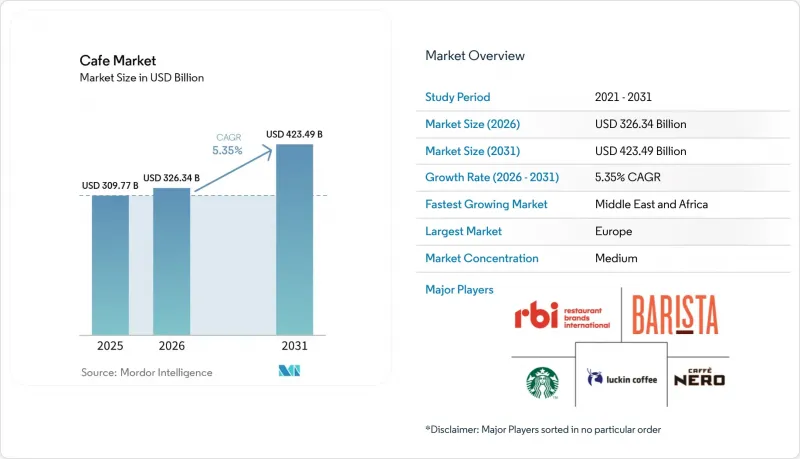
This report is Segmented by Service Type (Dine-In, Takeaway, Delivery), Outlet (Chained and Independent), Location (Leisure, Lodging, Retail, Standalone, Travel), and Geography (North America, Europe, Asia-Pacific, South America, Middle East & Africa). The Market Forecasts are Provided in Terms of Value (USD).
Global Cafe Market Trends and Insights
Rising global coffee consumption and cafe culture adoption
The growth of global coffee consumption and the rapid adoption of cafe culture are major factors driving the expansion of the cafe market worldwide. Consumers are increasingly viewing cafes as social, professional, and lifestyle-oriented destinations rather than solely beverage outlets. The rising popularity of specialty coffee, premium beverages, and personalized cafe experiences has significantly increased cafe visitation across both developed and emerging economies. Younger consumers, particularly millennials and Generation Z, are strongly contributing to the demand for experiential coffee consumption and cafe-based social interactions. According to the National Coffee Association 2025 report, nearly two-thirds of American adults consume coffee daily, with 66% of the adult population drinking coffee every day, highlighting the strong and consistent consumer demand for coffee beverages. In addition, the expansion of international cafe chains, digital ordering platforms, and takeaway formats has further strengthened coffee accessibility across urban markets.
Expansion of specialty coffee and premium beverage demand
The rising demand for specialty coffee and premium beverages is becoming a major growth driver for the global cafe market. Consumers are increasingly shifting toward high-quality coffee experiences that include artisanal brewing methods, single-origin beans, cold brews, flavored beverages, and customized drink options. Premium cafe offerings are particularly gaining popularity among millennials and younger consumers who value product quality, authenticity, and experiential consumption. According to the National Coffee Association, specialty coffee consumption in the United States reached a 14-year high in 2025, with 46% of American adults consuming specialty coffee daily. The association also reported that specialty coffee consumption has increased by 84% since 2011 and, for the first time, surpassed traditional coffee consumption, which stood at 42%. This trend reflects the growing consumer preference for premiumized coffee products and elevated cafe experiences across mature and emerging markets alike.
High operational and rental costs in prime urban locations
High operational and rental costs represent a significant challenge restraining the growth of the global cafe market. Cafe operators, particularly those located in prime urban areas, shopping malls, airports, and commercial districts, face substantial expenses related to rent, utilities, labor, and daily operations. Rising real estate prices in metropolitan cities are increasing the financial burden on both independent cafes and large cafe chains, affecting overall profitability margins. In addition, cafes require continuous investments in interior design, seating arrangements, premium equipment, and customer experience enhancements to remain competitive in the market. Labor-intensive operations, including skilled baristas, customer service staff, and food preparation personnel, further contribute to escalating operational expenditures. Small and independent cafe operators are especially vulnerable to fluctuating costs, making long-term business sustainability more challenging.
Other drivers and restraints analyzed in the detailed report include:
- Growing consumer preference for social dining and experiential spaces
- Rising penetration of international and regional cafe chains
- Volatility in coffee bean and dairy ingredient prices
For complete list of drivers and restraints, kindly check the Table Of Contents.
Segment Analysis
The dine-in segment accounted for 62.64% of the global cafe market share in 2025, making it the dominant service type within the industry. The segment's leadership is primarily driven by consumer preference for social interaction, premium cafe ambiance, and experiential dining environments. Cafes are increasingly being used as meeting spaces for professionals, students, and social gatherings, particularly in urban areas. The expansion of specialty coffee shops, bakery cafes, and premium cafe chains has further strengthened dine-in consumption across both developed and emerging markets. In addition, consumers often associate dine-in cafe experiences with product freshness, customization, and a relaxed atmosphere, encouraging longer visit durations and higher spending per customer.
The delivery segment is projected to register the fastest growth in the cafe market, expanding at a CAGR of 7.45% through 2031. The rapid adoption of online food delivery platforms and mobile ordering applications has significantly transformed cafe consumption patterns worldwide. Consumers increasingly prefer convenient access to coffee beverages, snacks, and bakery products through home delivery and office delivery services. Cafe operators are actively partnering with third-party delivery platforms and investing in digital ordering ecosystems to improve customer accessibility and operational efficiency. The growth of remote working culture and rising demand for convenience-based foodservice solutions are further accelerating delivery segment expansion.
Geography Analysis
Europe accounted for 38.45% of the global cafe market share in 2025, making it the largest regional market worldwide. The region's dominance is primarily supported by its deeply established coffee culture, high cafe density, and strong consumer preference for premium coffee experiences. Countries such as Italy, France, Germany, and the United Kingdom continue to witness strong footfall across specialty cafes, bakery cafes, and branded coffee chains. The presence of major international operators alongside a large network of independent cafes has further strengthened market penetration across urban and suburban areas. In addition, consumers in Europe increasingly prefer artisanal beverages, organic coffee products, and cafe environments that offer social and work-friendly experiences. The growing popularity of specialty coffee, premium bakery products, and sustainable cafe concepts continues to reinforce Europe's leadership position in the global cafe market.
The Middle East & Africa region is projected to register the fastest growth in the global cafe market, expanding at a CAGR of 7.11% through 2031. Rapid urbanization, rising disposable incomes, and changing consumer lifestyles are significantly increasing cafe visitation rates across countries such as the United Arab Emirates, Saudi Arabia, and South Africa. International cafe chains are aggressively expanding their regional presence through franchising and premium outlet development in shopping malls, commercial districts, and travel hubs. The increasing young population and growing demand for premium coffee beverages are also supporting higher cafe consumption across metropolitan cities. Furthermore, the region is witnessing strong growth in specialty coffee culture, particularly among millennials and working professionals seeking premium social dining experiences.
North America remains one of the most mature cafe markets globally, supported by high per capita coffee consumption and the strong presence of established cafe chains and specialty coffee brands. The United States and Canada continue to drive regional demand through premium coffee offerings, loyalty programs, and expanding drive-through and takeaway formats. Asia-Pacific is emerging as a highly attractive growth market due to rapid urbanization, increasing westernization of food habits, and expanding middle-class populations in countries such as China, India, Japan, and South Korea. The region is witnessing strong outlet expansion from both international and domestic cafe brands, particularly in metropolitan areas. Meanwhile, South America maintains stable market growth supported by its strong coffee production base and evolving cafe culture across countries such as Brazil, Colombia, and Argentina.
- Starbucks Corporation
- Restaurant Brands International (Tim Hortons)
- Barista Coffee Company Limited
- Luckin Coffee Inc.
- Caffe Nero Group Ltd
- The Coffee Bean & Tea Leaf
- Peet's Coffee, Inc.
- Costa Coffee Limited
- Caribou Coffee Operating Company, Inc.
- Blue Bottle Coffee, Inc.
- Cafe Coffee Day Global Limited
- Pret A Manger Limited
- Panera Bread Company
- Dunkin' Brands
- Keurig Dr Pepper Inc.
- Tata Starbucks Private Limited
- Coffee Day Enterprises Limited
- Coffee Republic Trading Limited
- Greggs plc
- PJ's Coffee of New Orleans
- Biggby Coffee
Additional Benefits:
- The market estimate (ME) sheet in Excel format
- 3 months of analyst support
TABLE OF CONTENTS
1 INTRODUCTION
- 1.1 Study Assumptions and Market Definition
- 1.2 Scope of the Study
2 RESEARCH METHODOLOGY
3 EXECUTIVE SUMMARY
4 KEY INDUSTRY TRENDS
- 4.1 Number of Outlets
- 4.2 Average Order Value
- 4.3 Regulatory Framework
5 MARKET LANDSCAPE
- 5.1 Market Overview
- 5.2 Market Drivers
- 5.2.1 Rising global coffee consumption and cafe culture adoption
- 5.2.2 Expansion of specialty coffee and premium beverage demand
- 5.2.3 Growing consumer preference for social dining and experiential spaces
- 5.2.4 Rising penetration of international and regional cafe chains
- 5.2.5 Increasing adoption of digital ordering and food delivery platforms
- 5.2.6 Expansion of remote working and cafe -based work culture
- 5.3 Market Restraints
- 5.3.1 High operational and rental costs in prime urban locations
- 5.3.2 Volatility in coffee bean and dairy ingredient prices
- 5.3.3 Labor shortages and increasing employee wage pressures
- 5.3.4 Rising consumer shift toward home brewing and ready-to-drink beverages
- 5.4 Regulatory Outlook
- 5.5 Consumer Behavior Analysis
- 5.6 Porter's Five Forces
- 5.6.1 Threat of New Entrants
- 5.6.2 Bargaining Power of Buyers/Consumers
- 5.6.3 Bargaining Power of Suppliers
- 5.6.4 Threat of Substitute Products
- 5.6.5 Intensity of Competitive Rivalry
6 MARKET SIZE AND GROWTH FORECASTS (VALUE)
- 6.1 By Service Type
- 6.1.1 Dine-in
- 6.1.2 Takeaway
- 6.1.3 Delivery
- 6.2 By Outlet
- 6.2.1 Chained Outlets
- 6.2.2 Independent Outlets
- 6.3 By Location
- 6.3.1 Leisure
- 6.3.2 Lodging
- 6.3.3 Retail
- 6.3.4 Standalone
- 6.3.5 Travel
- 6.4 By Geography
- 6.4.1 North America
- 6.4.1.1 United States
- 6.4.1.2 Canada
- 6.4.1.3 Mexico
- 6.4.1.4 Rest of North America
- 6.4.2 Europe
- 6.4.2.1 Germany
- 6.4.2.2 United Kingdom
- 6.4.2.3 Italy
- 6.4.2.4 France
- 6.4.2.5 Spain
- 6.4.2.6 Netherlands
- 6.4.2.7 Poland
- 6.4.2.8 Belgium
- 6.4.2.9 Sweden
- 6.4.2.10 Rest of Europe
- 6.4.3 Asia-Pacific
- 6.4.3.1 China
- 6.4.3.2 India
- 6.4.3.3 Japan
- 6.4.3.4 Australia
- 6.4.3.5 Indonesia
- 6.4.3.6 South Korea
- 6.4.3.7 Thailand
- 6.4.3.8 Singapore
- 6.4.3.9 Rest of Asia-Pacific
- 6.4.4 South America
- 6.4.4.1 Brazil
- 6.4.4.2 Argentina
- 6.4.4.3 Colombia
- 6.4.4.4 Chile
- 6.4.4.5 Peru
- 6.4.4.6 Rest of South America
- 6.4.5 Middle East & Africa
- 6.4.5.1 South Africa
- 6.4.5.2 Saudi Arabia
- 6.4.5.3 United Arab Emirates
- 6.4.5.4 Nigeria
- 6.4.5.5 Egypt
- 6.4.5.6 Morocco
- 6.4.5.7 Turkey
- 6.4.5.8 Rest of Middle East and Africa
- 6.4.1 North America
7 COMPETITIVE LANDSCAPE
- 7.1 Market Concentration
- 7.2 Strategic Moves
- 7.3 Market Ranking Analysis
- 7.4 Company Profiles (includes Global-level Overview, Market-level Overview, Core Segments, Financials (if available), Strategic Information, Market Rank/Share, Products and Services, Recent Developments)
- 7.4.1 Starbucks Corporation
- 7.4.2 Restaurant Brands International (Tim Hortons)
- 7.4.3 Barista Coffee Company Limited
- 7.4.4 Luckin Coffee Inc.
- 7.4.5 Caffe Nero Group Ltd
- 7.4.6 The Coffee Bean & Tea Leaf
- 7.4.7 Peet's Coffee, Inc.
- 7.4.8 Costa Coffee Limited
- 7.4.9 Caribou Coffee Operating Company, Inc.
- 7.4.10 Blue Bottle Coffee, Inc.
- 7.4.11 Cafe Coffee Day Global Limited
- 7.4.12 Pret A Manger Limited
- 7.4.13 Panera Bread Company
- 7.4.14 Dunkin' Brands
- 7.4.15 Keurig Dr Pepper Inc.
- 7.4.16 Tata Starbucks Private Limited
- 7.4.17 Coffee Day Enterprises Limited
- 7.4.18 Coffee Republic Trading Limited
- 7.4.19 Greggs plc
- 7.4.20 PJ's Coffee of New Orleans
- 7.4.21 Biggby Coffee
8 MARKET OPPORTUNITIES AND FUTURE OUTLOOK

