PUBLISHER: Mordor Intelligence | PRODUCT CODE: 2064438

PUBLISHER: Mordor Intelligence | PRODUCT CODE: 2064438
Multi-Experience Development Platform (MXDP) - Market Share Analysis, Industry Trends & Statistics, Growth Forecasts (2026 - 2031)
According to Mordor Intelligence, the multi-experience development platform (MXDP) market size is projected to expand from USD 4.93 billion in 2025 and USD 5.94 billion in 2026 to USD 15.03 billion by 2031, registering a CAGR of 20.41% between 2026 to 2031.
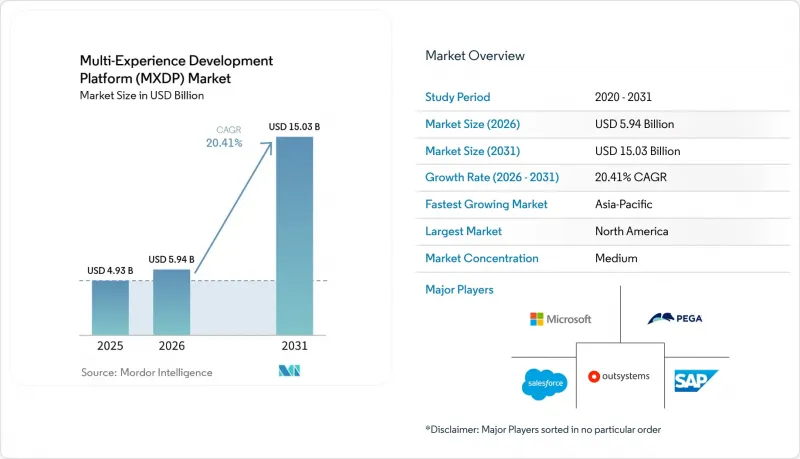
This report is Segmented by Component (Platforms, and Services), Deployment Model (Cloud, and On-Premises), Organization Size (Large Enterprises, and SMEs), Industry Vertical (BFSI, IT and Telecom, Government, Manufacturing, Retail, Healthcare, Energy, Media, and Transportation), and Geography (North America, and More). The Market Forecasts are Provided in Terms of Value (USD).
Global Multi-Experience Development Platform (MXDP) Market Trends and Insights
Digital Transformation And Omnichannel Experience Modernization
The multi-experience development platform (MXDP) market is benefiting from enterprise efforts to replace fragmented channel investments with unified application delivery models. Organizations in BFSI, retail, and healthcare increasingly need the same service logic to work across mobile apps, websites, kiosks, voice interfaces, and chatbot-led workflows. That requirement is pushing the MXDP market beyond customer experience use cases and into employee experience, field operations, and service delivery redesign. Enterprises are treating these platforms less as incremental developer tools and more as foundational infrastructure for fixing disconnected journeys that were built over several technology cycles. This shift matters because every additional channel raises the cost of maintaining separate front ends, separate rules, and separate governance models. It also expands the opportunity set for the multi experience development platform (MXDP) market because platform decisions now affect both revenue-facing and operational workflows.
Low-Code And No-Code Adoption To Offset Developer Shortages
The multi experience development platform market is also advancing because low-code and no-code adoption now addresses a labor constraint rather than a temporary productivity preference. Large organizations are under pressure to deliver more applications with fewer skilled developers, which is making visual development environments and reusable components more important in project planning. In Japan, the low-code platform market reached JPY 317.8 billion, or USD 2.1 billion, in FY2024, showing that enterprise demand is already broad enough to support sustained double-digit expansion in a talent-constrained environment. The same pattern supports the multi-experience development platform (MXDP) market because AI-assisted development lets business users and departmental teams contribute more directly to app creation while experienced developers move toward architecture, governance, and integration oversight. Mendix Maia and Microsoft Copilot style workflows reinforce this model by shortening the time between requirement definition and working application output. As this operating model spreads, the MXDP market gains from both faster adoption among large enterprises and better accessibility for smaller organizations.
Legacy Integration Complexity And Data Silos
Legacy integration remains a major restraint on the multi experience development platform market because unified front ends still depend on fragmented data and process estates underneath. Many enterprises are trying to deliver consistent omnichannel journeys while core business logic remains tied to older systems that were never designed for reusable APIs or real-time orchestration. That raises implementation cost, extends delivery timelines, and increases reliance on custom middleware and specialist services. The multi experience development platform (MXDP) market therefore faces a practical limit in organizations where presentation-layer modernization runs ahead of data unification. In those cases, the user experience may look consistent across channels while the data used by workflows and AI models remains incomplete or inconsistent. This issue is especially hard to resolve in manufacturing, BFSI, and government environments where process history, data sensitivity, and system age all slow down structural modernization.
Other drivers and restraints analyzed in the detailed report include:
- AI-Assisted Development And Embedded Conversational Experiences
- Cloud-Native Deployment And API-First Composability
- Security, Privacy, And Compliance Burdens
For complete list of drivers and restraints, kindly check the Table Of Contents.
Segment Analysis
Platforms held 58.81% of the Multi-Experience Development Platform (MXDP) market share in 2025, showing that buyers still place the most value on integrated environments that combine design, deployment, monitoring, and governance in one licensed stack. The appeal of the platform layer comes from consolidation, since one environment can replace separate tools for UI design, workflow configuration, integration handling, testing, and access management. That makes the multi-experience development platform market more resilient than narrower developer tool categories because the buying decision is tied to operating model simplification rather than a single feature set. The multi-experience development platform (MXDP) industry also benefits when vendors embed AI co-development and agent orchestration into the core integrated development environment, because that raises switching costs after customers standardize on one platform. OutSystems Developer Cloud and ServiceNow Studio reflect this direction by linking development work more directly to AI-assisted delivery and governed orchestration.
Services are forecast to grow at 23.42% through 2031, which means the gap with platforms should narrow as deployments become more complex and governance-heavy. The multi-experience development platform market size for Services is projected to expand at a 23.42% CAGR through 2031 as enterprises require help with implementation, agent lifecycle management, training, and ongoing optimization. Vendors are also broadening their own service models to capture modernization work that sits between legacy application cleanup and new AI-enabled experience design. Appian's April 2026 announcement of AI-assisted spec-driven development points to a service model where modernization becomes faster, more template-driven, and less dependent on fully manual migration programs.
Cloud accounted for 62.36% of the Multi-Experience Development Platform (MXDP) market size in 2025 and is also expected to grow at a 24.14% CAGR through 2031, which gives it both scale and growth leadership. That position reflects more than pricing flexibility, because real-time agentic systems depend on shared context, continuous model updating, and coordinated workflows that are easier to manage in cloud-native environments. The multi-experience development platform market is therefore seeing cloud become the default architecture for enterprises that want rapid deployment across multiple channels with built-in AI layers. Salesforce's hosted MCP Servers became generally available in April 2026, enabling AI agents to securely access Salesforce data across enterprise environments and showing how infrastructure trust is becoming part of application orchestration. This architecture also supports broader ecosystem participation because external tools and agents can interact with governed enterprise assets through standardized interfaces instead of one-off integrations.
On-premises deployment still retains a strategic role inside the MXDP market, especially in regulated sectors and sovereign environments where public cloud hosting is not always acceptable. Buyers in these settings treat hosting jurisdiction, network isolation, and access control as part of the application design decision rather than a later infrastructure choice. That means vendors need genuine portability across cloud, private cloud, and self-managed deployments if they want to compete for sensitive workloads. Mendix on Azure general availability in December 2025 and Appian's expanded AI support in self-managed environments both show how deployment flexibility remains central to enterprise buying criteria.
Geography Analysis
North America accounted for 40.98% of the Multi-Experience Development Platform (MXDP) market share in 2025, which kept it in the lead on the back of mature cloud infrastructure, high enterprise technology spending, and the strong presence of major vendors. The region continues to set the tone for the multi-experience development platform market because large enterprises and public sector bodies are willing to fund broader modernization programs that connect application delivery with AI governance. Appian's 10-year enterprise agreement with the U.S. Army, worth up to USD 500 million and awarded in January 2026, showed how public sector demand can support platform revenue over long timeframes. North America also benefits from dense integration ecosystems, which makes it easier for enterprises to combine low-code delivery, process automation, data access, and AI-assisted design in one roadmap. This combination helps the multi-experience development platforms market retain strong commercial and government momentum in the region.
Asia-Pacific is the fastest-growing geography, and the multi-experience development platform market size in the region is set to advance at a 25.34% CAGR through 2031. Growth in the region is being supported by aggressive digitalization, large mobile-first user bases, and greater urgency around application delivery efficiency. Japan remains a key example because its low-code platform segment reached JPY 317.8 billion, or USD 2.1 billion, in FY2024, reflecting strong enterprise demand in a market facing long-term IT talent constraints. China, India, Japan, and Southeast Asia are not following one identical path, but all are reinforcing the multi-experience development platform market through combinations of public digitalization programs, domestic cloud ecosystems, and rising enterprise demand for faster software delivery. The region also gives smaller and mid-sized firms more room to adopt platform-led development as pricing and AI assistance improve access.
Europe occupies a distinct position in the multi-experience development platforms (MXDP) market because demand for modernization remains strong while data governance expectations are among the strictest in the world. Buyers in the region place greater weight on deployment choice, auditability, and policy alignment, which narrows the field toward vendors with stronger compliance and sovereignty options. This pattern keeps on-premises and private-cloud deployment relevant, especially for sensitive public sector and regulated commercial workloads. South America and the Middle East and Africa remain smaller in absolute size, yet the multi-experience development platforms market is still gaining support there through digital financial services expansion, national transformation programs, and growing partner ecosystems tied to local cloud investment.
- OutSystems, Inc.
- Mendix Technology B.V.
- Microsoft Corporation
- Salesforce, Inc.
- SAP SE
- Oracle Corporation
- Pegasystems Inc.
- Progress Software Corporation
- ServiceNow, Inc.
- Appian Corporation
- International Business Machines Corporation
- Temenos AG
- GeneXus S.A.
- Neptune Software AS
- HCL Technologies Limited
- i-exceed technology solutions private limited
- Convertigo SA
- Neutrinos Solutions Pvt. Ltd.
- Betty Blocks B.V.
- Creatio Ltd.
Additional Benefits:
- The market estimate (ME) sheet in Excel format
- 3 months of analyst support
TABLE OF CONTENTS
1 INTRODUCTION
- 1.1 Study Assumptions and Market Definition
- 1.2 Scope of the Study
2 RESEARCH METHODOLOGY
3 EXECUTIVE SUMMARY
4 MARKET LANDSCAPE
- 4.1 Market Overview
- 4.2 Market Drivers
- 4.2.1 Digital Transformation and Omnichannel Experience Modernization
- 4.2.2 Low-Code and No-Code Adoption to Offset Developer Shortages
- 4.2.3 AI-Assisted Development and Embedded Conversational Experiences
- 4.2.4 Cloud-Native Deployment and API-First Composability
- 4.2.5 Offline-First Field Workflow Redesign
- 4.2.6 Agentic Interface Orchestration and Micro-Frontend Governance
- 4.3 Market Restraints
- 4.3.1 Legacy Integration Complexity and Data Silos
- 4.3.2 Security, Privacy, and Compliance Burdens
- 4.3.3 LLM Governance and Hallucination Risk in AI-Assisted Experience Flows
- 4.3.4 Device-Fragmentation Testing Burden and Design-System Drift
- 4.4 Industry Value Chain Analysis
- 4.5 Impact of Macroeconomic Factors on the Market
- 4.6 Regulatory Landscape
- 4.7 Technological Outlook
- 4.8 Porter's Five Forces Analysis
- 4.8.1 Threat of New Entrants
- 4.8.2 Bargaining Power of Suppliers
- 4.8.3 Bargaining Power of Buyers
- 4.8.4 Threat of Substitutes
- 4.8.5 Intensity of Competitive Rivalry
5 MARKET SIZE AND GROWTH FORECASTS (VALUE)
- 5.1 By component
- 5.1.1 Platforms
- 5.1.2 Services
- 5.2 By deployment model
- 5.2.1 Cloud
- 5.2.2 On-premises
- 5.3 By organization size
- 5.3.1 Large enterprises
- 5.3.2 Small and medium-sized enterprises
- 5.4 By industry vertical
- 5.4.1 BFSI
- 5.4.2 IT and telecommunications
- 5.4.3 Government and public sector
- 5.4.4 Manufacturing
- 5.4.5 Retail and consumer goods
- 5.4.6 Healthcare and life sciences
- 5.4.7 Energy and utilities
- 5.4.8 Media and entertainment
- 5.4.9 Transportation and logistics
- 5.5 By geography
- 5.5.1 North America
- 5.5.1.1 United States
- 5.5.1.2 Canada
- 5.5.1.3 Mexico
- 5.5.2 South America
- 5.5.2.1 Brazil
- 5.5.2.2 Argentina
- 5.5.2.3 Rest of South America
- 5.5.3 Europe
- 5.5.3.1 Germany
- 5.5.3.2 United Kingdom
- 5.5.3.3 France
- 5.5.3.4 Italy
- 5.5.3.5 Spain
- 5.5.3.6 Russia
- 5.5.3.7 Rest of Europe
- 5.5.4 Asia-Pacific
- 5.5.4.1 China
- 5.5.4.2 Japan
- 5.5.4.3 India
- 5.5.4.4 South Korea
- 5.5.4.5 Australia
- 5.5.4.6 Rest of Asia-Pacific
- 5.5.5 Middle East and Africa
- 5.5.5.1 Saudi Arabia
- 5.5.5.2 United Arab Emirates
- 5.5.5.3 South Africa
- 5.5.5.4 Nigeria
- 5.5.5.5 Rest of Middle East and Africa
- 5.5.1 North America
6 COMPETITIVE LANDSCAPE
- 6.1 Market Concentration
- 6.2 Strategic Moves
- 6.3 Market Share Analysis
- 6.4 Company Profiles (includes Global Level Overview, Market Level Overview, Core Segments, Financials as available, Strategic Information, Market Rank/Share, Products and Services, Recent Developments)
- 6.4.1 OutSystems, Inc.
- 6.4.2 Mendix Technology B.V.
- 6.4.3 Microsoft Corporation
- 6.4.4 Salesforce, Inc.
- 6.4.5 SAP SE
- 6.4.6 Oracle Corporation
- 6.4.7 Pegasystems Inc.
- 6.4.8 Progress Software Corporation
- 6.4.9 ServiceNow, Inc.
- 6.4.10 Appian Corporation
- 6.4.11 International Business Machines Corporation
- 6.4.12 Temenos AG
- 6.4.13 GeneXus S.A.
- 6.4.14 Neptune Software AS
- 6.4.15 HCL Technologies Limited
- 6.4.16 i-exceed technology solutions private limited
- 6.4.17 Convertigo SA
- 6.4.18 Neutrinos Solutions Pvt. Ltd.
- 6.4.19 Betty Blocks B.V.
- 6.4.20 Creatio Ltd.
7 MARKET OPPORTUNITIES AND FUTURE OUTLOOK
- 7.1 White-Space and Unmet-Need Assessment

