PUBLISHER: Mordor Intelligence | PRODUCT CODE: 2064446

PUBLISHER: Mordor Intelligence | PRODUCT CODE: 2064446
Perennial Allergic Rhinitis - Market Share Analysis, Industry Trends & Statistics, Growth Forecasts (2026 - 2031)
According to Mordor Intelligence, the perennial allergic rhinitis market size is projected to be USD 8.18 billion in 2025, USD 8.91 billion in 2026, and reach USD 13.64 billion by 2031, growing at a CAGR of 8.88% from 2026 to 2031.
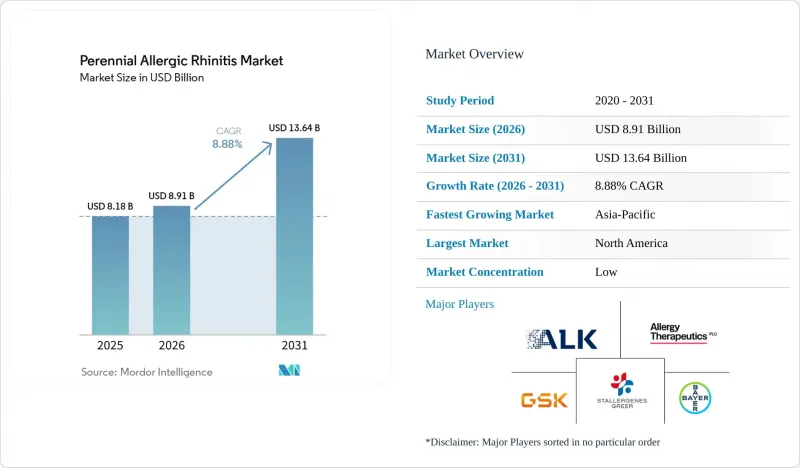
This report is Segmented by Trigger Allergen (HDM, Pet Dander, Mold, Cockroach/Rodent), Treatment Class (Symptomatic, Disease-Modifying, Biologics), Route (Oral, Intranasal, Sublingual, Subcutaneous), Patient Group (Pediatric, Adult, Geriatric), Distribution Channel (Hospital, Retail, Online), and Geography (North America, Europe, Asia-Pacific, MEA, South America). Forecasts Provided in Value (USD).
Global Perennial Allergic Rhinitis Market Trends and Insights
Rising Indoor Allergen Sensitization Creates Permanent, Year-Round Demand
The perennial allergic rhinitis market benefits from the persistent presence of indoor allergens, which are harder to avoid compared to seasonal pollen. House dust mites thrive in specific temperature and humidity conditions, affecting 4-6% of the global population, with sensitization rates as high as 60-80% in humid regions. In Europe, 49% of allergic rhinitis patients are sensitized to house dust mites, making it the leading perennial trigger. Urban housing trends and pet dander further exacerbate allergen exposure, creating a consistent demand for effective treatments.
Expansion of House Dust Mite Immunotherapy Redefines PAR's Disease-Modifying Standard of Care
The perennial allergic rhinitis market is evolving as house dust mite immunotherapy becomes a mainstream treatment. In February 2025, the US FDA approved ODACTRA for children aged 5 to 11, following a trial showing a 22% improvement over placebo. Similarly, ACARIZAX gained approval across 21 European countries, expanding its reach. Real-world evidence shows immunotherapy reduces medication use by 37.7% and transitions patients from persistent to intermittent rhinitis. Updated asthma guidelines also endorse house dust mite SLIT as an add-on for uncontrolled asthma, reinforcing its role in comprehensive airway management.
Long Immunotherapy Duration and Adherence Drop-Off Are Amplified in Perennial Disease
The perennial allergic rhinitis market faces adherence challenges as house dust mite immunotherapy requires year-round treatment for 3-5 years, leading to patient fatigue compared to shorter seasonal regimens. A Dutch study reported that only 66.7% of patients continued treatment beyond one year, with 18.3% discontinuing due to motivational or logistical issues. Additionally, patients stopping before two years failed to achieve sustained immunological benefits. Development programs, such as the PROACAROS Phase III trial involving 250 patients in Spain, aim to address these gaps, with recruitment expected to conclude by December 2025.
Other drivers and restraints analyzed in the detailed report include:
- Higher Diagnosis of Rhinitis-Asthma Overlap Compounds PAR's Per-Patient Treatment Burden
- Pediatric Expansion of SLIT Tablet Eligibility Is Structurally Consequential for Perennial Disease
- Reimbursement and Supervision Frictions for Advanced Therapies Constrain Disease-Modifying PAR Market Potential
For complete list of drivers and restraints, kindly check the Table Of Contents.
Segment Analysis
In 2025, House Dust Mite accounted for 57.12% of the revenue and is projected to grow at an 8.90% CAGR through 2031, making it the largest and fastest-growing segment in the perennial allergic rhinitis market. Its dominance stems from being the most common indoor allergen and the focus of leading immunotherapy products, now expanding into pediatric care. Clinical evidence links house dust mite sensitization to chronic nasal obstruction and persistent symptoms, reinforcing its central role in both symptomatic and disease-modifying therapies.
Symptomatic Pharmacotherapy held 71.7% of the revenue in 2025, driven by year-round reliance on intranasal corticosteroids and antihistamines. Fixed-combination intranasal products are increasingly preferred for moderate-to-severe cases, reinforcing their role in routine management. Disease-modifying therapies, while smaller in scale, offer long-term benefits by addressing immune responses and are gaining traction in severe cases with chronic inflammation.
Geography Analysis
In 2025, North America accounted for 38.47% of global revenue, maintaining its position as the largest regional contributor in the perennial allergic rhinitis market. The United States drives this dominance with extensive treatment access, high diagnosis rates, and established use of intranasal corticosteroids, antihistamines, and house dust mite immunotherapy in care protocols. Canada complements this with approvals for Acarizax and support for intranasal corticosteroids and allergen immunotherapy in managing persistent diseases. Europe remains a key revenue contributor, supported by updated guidelines, active immunotherapy adoption across countries, and reimbursement progress in the UK for moderate-to-severe house dust mite conditions.
Asia-Pacific is projected to grow at a 9.66% CAGR through 2031, making it the fastest-growing region in the perennial allergic rhinitis market. The region's humid climates promote year-round mite proliferation, creating a strong base for market expansion. Japan exemplifies this with a 24.5% prevalence of perennial allergic rhinitis and insurance-backed use of house dust mite SLIT tablets. Southeast Asia and China also show high sensitization rates, with underdiagnosed cases presenting significant growth opportunities. The region combines heavy exposure, rising awareness, and expanding treatment pathways, driving sustained growth.
The Middle East, Africa, and South America are smaller markets but show potential for gradual growth. In the Gulf region, house dust mites are the most common indoor allergen, with a 77.8% prevalence in Saudi homes, while air-conditioned spaces sustain exposure. South America shares similar conditions, with warm, humid environments supporting high allergen burdens. As screening and physician awareness improve, these regions are expected to see an expanding treated patient base, highlighting emerging demand for addressing indoor allergen diseases.
- ALK-Abello
- Allergy Therapeutics plc
- Bayer
- Dr. Reddy's Laboratories
- Eli Lilly and Company
- FAES Farma S.A.
- Glenmark Pharmaceuticals
- GlaxoSmithKline
- Haleon
- Hikma Pharmaceuticals
- Hisamitsu Pharmaceutical
- Inmunotek S.L.
- Kenvue Inc.
- Opella / Sanofi Consumer Healthcare
- Perrigo Company
- Regeneron Pharmaceuticals
- Stallergenes Greer
- Teva Pharmaceutical Industries
- Torii Pharmaceutical
- Viatris
Additional Benefits:
- The market estimate (ME) sheet in Excel format
- 3 months of analyst support
TABLE OF CONTENTS
1 Introduction
- 1.1 Study Assumptions & Market Definition
- 1.2 Scope of the Study
2 Research Methodology
3 Executive Summary
4 Market Landscape
- 4.1 Market Overview
- 4.2 Market Drivers
- 4.2.1 Rising Indoor Allergen Sensitization
- 4.2.2 Preference for Intranasal Corticosteroids and Combination Sprays
- 4.2.3 Expansion of House Dust Mite Immunotherapy
- 4.2.4 Higher Diagnosis of Rhinitis-Asthma Overlap
- 4.2.5 Pediatric Expansion of SLIT Tablet Eligibility
- 4.2.6 Biomarker-Led Identification of Local Allergic Rhinitis
- 4.3 Market Restraints
- 4.3.1 Long Immunotherapy Duration and Adherence Drop-Off
- 4.3.2 OTC and Generic Price Pressure
- 4.3.3 Mixed-Rhinitis Misclassification
- 4.3.4 Reimbursement and Supervision Frictions for Advanced Therapies
- 4.4 supply / Value Chain Analysis
- 4.5 Regulatory Landscape
- 4.6 Technological Outlook
- 4.7 Reimbursement Landscape
- 4.8 Porter's Five Forces Analysis
- 4.8.1 Threat of New Entrants
- 4.8.2 Bargaining Power of Suppliers
- 4.8.3 Bargaining Power of Buyers
- 4.8.4 Threat of Substitutes
- 4.8.5 Competitive Rivalry
5 Market Size & Growth Forecasts (Value, USD)
- 5.1 By Trigger Allergen
- 5.1.1 House Dust Mite
- 5.1.2 Pet Dander
- 5.1.3 Mold
- 5.1.4 Cockroach and Rodent Allergens
- 5.2 By Treatment Class
- 5.2.1 Symptomatic Pharmacotherapy
- 5.2.1.1 Oral Antihistamines
- 5.2.1.2 Intranasal Corticosteroids
- 5.2.1.3 Combination Nasal Sprays
- 5.2.1.4 Decongestants
- 5.2.1.5 Leukotriene Receptor Antagonists
- 5.2.2 Disease-Modifying Therapy
- 5.2.3 Advanced Biologics
- 5.2.1 Symptomatic Pharmacotherapy
- 5.3 By Route of Administration
- 5.3.1 Oral
- 5.3.2 Intranasal
- 5.3.3 Sublingual
- 5.3.4 Subcutaneous
- 5.4 By Patient Group
- 5.4.1 Pediatric
- 5.4.2 Adult
- 5.4.3 Geriatric
- 5.5 By Distribution Channel
- 5.5.1 Hospital Pharmacies
- 5.5.2 Retail Pharmacies
- 5.5.3 Online Pharmacies
- 5.6 By Geography
- 5.6.1 North America
- 5.6.1.1 United States
- 5.6.1.2 Canada
- 5.6.1.3 Mexico
- 5.6.2 Europe
- 5.6.2.1 Germany
- 5.6.2.2 United Kingdom
- 5.6.2.3 France
- 5.6.2.4 Italy
- 5.6.2.5 Spain
- 5.6.2.6 Rest of Europe
- 5.6.3 Asia-Pacific
- 5.6.3.1 China
- 5.6.3.2 India
- 5.6.3.3 Japan
- 5.6.3.4 South Korea
- 5.6.3.5 Australia
- 5.6.3.6 Rest of Asia-Pacific
- 5.6.4 Middle East and Africa
- 5.6.4.1 GCC
- 5.6.4.2 South Africa
- 5.6.4.3 Rest of Middle East and Africa
- 5.6.5 South America
- 5.6.5.1 Brazil
- 5.6.5.2 Argentina
- 5.6.5.3 Rest of South America
- 5.6.1 North America
6 Competitive Landscape
- 6.1 Market Concentration
- 6.2 Market Share Analysis
- 6.3 Company Profiles (includes Global level Overview, Market level overview, Core Segments, Financials as available, Strategic Information, Market Rank/Share for key companies, Products & Services, and Recent Developments)
- 6.3.1 ALK-Abello A/S
- 6.3.2 Allergy Therapeutics plc
- 6.3.3 Bayer AG
- 6.3.4 Dr. Reddys Laboratories Ltd.
- 6.3.5 Eli Lilly and Company
- 6.3.6 FAES Farma S.A.
- 6.3.7 Glenmark Pharmaceuticals Ltd.
- 6.3.8 GSK plc
- 6.3.9 Haleon
- 6.3.10 Hikma Pharmaceuticals PLC
- 6.3.11 Hisamitsu Pharmaceutical Co., Inc.
- 6.3.12 Inmunotek S.L.
- 6.3.13 Kenvue Inc.
- 6.3.14 Opella / Sanofi Consumer Healthcare
- 6.3.15 Perrigo Company plc
- 6.3.16 Regeneron Pharmaceuticals, Inc.
- 6.3.17 Stallergenes Greer
- 6.3.18 Teva Pharmaceutical Industries Ltd.
- 6.3.19 Torii Pharmaceutical Co., Ltd.
- 6.3.20 Viatris Inc.
7 Market Opportunities & Future Outlook
- 7.1 White-space & Unmet-need Assessment

