PUBLISHER: Mordor Intelligence | PRODUCT CODE: 2064448

PUBLISHER: Mordor Intelligence | PRODUCT CODE: 2064448
U.S. Specialty Medical Chairs - Market Share Analysis, Industry Trends & Statistics, Growth Forecasts (2026 - 2031)
According to Mordor Intelligence, the u.S. specialty medical chairs market size is projected to be USD 1.74 billion in 2025, USD 1.86 billion in 2026, and reach USD 2.64 billion by 2031, growing at a CAGR of 7.20% from 2026 to 2031.
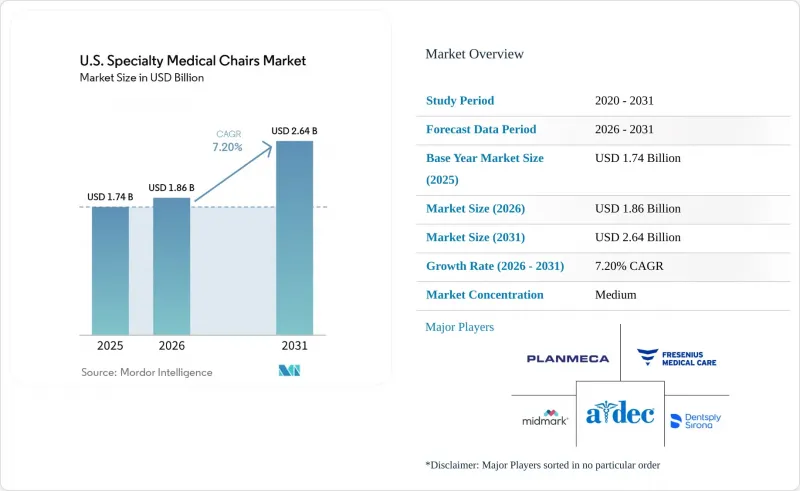
This report is Segmented by Product Type (Examination, Treatment, Rehabilitation), Technology (Manual, Hydraulic, Fully Electric, Connected Electric), End User (Hospitals, Dental Practices and DSOs, Ascs, Dialysis Centers, and More), and Clinical Application (Dental, Ophthalmic, ENT, Dialysis, Infusion, OB/GYN, and More). Forecasts are in Value (USD).
U.S. Specialty Medical Chairs Market Trends and Insights
Outpatient Procedure Migration Restructuring Chair Demand in Real Time
CMS has removed 285 musculoskeletal procedures from its Inpatient-Only list for CY 2026 and added 560 procedures to the ASC Covered Procedures List, accelerating the shift of treatment volumes to ambulatory settings. Medicare facility payments to ASCs are projected to reach USD 9.2 billion in 2026, with ASC surgical procedures per fee-for-service Medicare beneficiary increasing by 3.4% in 2024. This shift is driving demand in the United States specialty medical chairs market for versatile, programmable electric platforms that support multi-procedure workflows and optimize outpatient room layouts.
Aging Demographics Driving Multi-Comorbidity Seating Requirements
The aging population in the United States, projected to reach 88.8 million by 2060, is increasing the need for medical chairs designed for mobility challenges, transfer difficulties, and fall prevention. With 53% of Medicare beneficiaries aged 65-74 managing three or more chronic conditions, facilities are replacing older fixed-height chairs with models offering safer transfers and longer treatment support, broadening demand geographically and extending replacement cycles.
High Upfront Chair Costs Creating Capital Access Disparities
Fully electric specialty exam chairs in ophthalmic applications are priced between USD 5,850 and USD 11,650, while dental chairs range from USD 6,300 to USD 11,650. Fixed phlebotomy seating is more affordable, priced between USD 400 and USD 1,300. Redesigning products to meet the 17-inch low transfer height standard could increase manufacturer costs by 20% to 30%, creating a financial gap between large health systems and smaller clinics with limited budgets. Compliance pressures remain high, as federally funded providers must meet accessibility standards by July 8, 2026. Demand in the United States specialty medical chairs market is steady at the compliance threshold, but broader upgrades are constrained by budget limitations.
Other drivers and restraints analyzed in the detailed report include:
- DSO Standardization Creating Fleet-Level Chair Procurement
- CKD and Infusion-Treatment Demand Sustained by Evolving Treatment Modalities
- Budget Pressure in Small and Independent Practices Dampening Replacement Cycles
For complete list of drivers and restraints, kindly check the Table Of Contents.
Segment Analysis
Treatment chairs are projected to grow at an 8.20% CAGR through 2031, driven by the shift of chemotherapy, infusion, and hemodialysis activities to outpatient centers. These chairs are valued for comfort during long sessions, stable positioning, safe transfers, and durability for high utilization, making them a key growth driver in the United States specialty medical chairs market. Models balancing recline range, transfer access, and durability are gaining preference.
Rehabilitation chairs held a 75.69% market share in 2025, reflecting their demand in skilled nursing, post-acute recovery, and long-term care settings. Extended daily use emphasizes pressure redistribution, bariatric capacity, and caregiver safety.
Fully electric chairs accounted for 65.55% of the United States specialty medical chairs market in 2025, driven by programmable positioning, enhanced ergonomics, and accessibility compliance. These systems reduce caregiver strain and support multiple workflows, maintaining their strong position across hospitals, DSOs, and outpatient sites.
Hydraulic and semi-electric chairs, with a projected 7.99% CAGR through 2031, cater to cost-sensitive settings requiring height adjustability without premium connectivity. Manual chairs remain relevant in home care and home dialysis but are expected to see reduced facility-based applications. Maintenance visibility and service simplicity are becoming critical purchase factors.
List of Companies Covered in this Report:
- ActiveAid, Inc.
- A-dec
- ATMOS MedizinTechnik
- Champion Manufacturing, Inc.
- DACOR Manufacturing, Inc.
- DENTALEZ, Inc.
- Dentsply Sirona
- Fresenius Medical Care AG
- Haag-Streit USA
- Hill Laboratories Company
- J. Morita Corp.
- Marco Ophthalmic, Inc.
- Medical Technology Industries, Inc.
- Midmark
- MP Seating
- OSSTEM IMPLANT Co., Ltd.
- Planmeca
- S4OPTIK LLC
- Takara Belmont
- The Brewer Company, LLC
- Topcon Healthcare, Inc.
- UMF Medical
- Winco Manufacturing, LLC
Additional Benefits:
- The market estimate (ME) sheet in Excel format
- 3 months of analyst support
TABLE OF CONTENTS
1 Introduction
- 1.1 Study Assumptions & Market Definition
- 1.2 Scope of the Study
2 Research Methodology
3 Executive Summary
4 Market Landscape
- 4.1 Market Overview
- 4.2 Market Drivers
- 4.2.1 Outpatient Procedure Migration
- 4.2.2 Aging and Mobility-Limited Patient Base
- 4.2.3 Dental Chair Replacement and DSO Standardization
- 4.2.4 Chronic Kidney Disease and Infusion-Treatment Demand
- 4.2.5 Accessible Exam-Chair Compliance After MDE Rule
- 4.2.6 Pressure-Injury Prevention Seating Protocols
- 4.3 Market Restraints
- 4.3.1 High Upfront Cost of Powered Chairs
- 4.3.2 Budget Pressure in Small Clinics and Private Practices
- 4.3.3 Actuator and Upholstery Service Bottlenecks
- 4.3.4 Room Retrofit and Electrical-Load Constraints
- 4.4 Value / Supply-Chain Analysis
- 4.5 Regulatory Landscape
- 4.6 Technological Outlook
- 4.7 Porter's Five Forces Analysis
- 4.7.1 Bargaining Power of Suppliers
- 4.7.2 Bargaining Power of Buyers
- 4.7.3 Threat of New Entrants
- 4.7.4 Threat of Substitutes
- 4.7.5 Competitive Rivalry
5 Market Size & Growth Forecasts (Value, USD)
- 5.1 By Product Type
- 5.1.1 Examination Chairs
- 5.1.2 Treatment Chairs
- 5.1.3 Rehabilitation Chairs
- 5.2 By Technology / Actuation
- 5.2.1 Manual
- 5.2.2 Hydraulic / Semi-electric
- 5.2.3 Fully Electric
- 5.2.4 Connected / Programmable Electric
- 5.3 By End User
- 5.3.1 Hospitals
- 5.3.2 Physician Offices and Specialty Clinics
- 5.3.3 Dental Practices and DSOs
- 5.3.4 Ambulatory Surgery Centers
- 5.3.5 Dialysis Centers
- 5.3.6 Blood Collection Centers
- 5.3.7 Rehabilitation Centers, Skilled Nursing Facilities, and Long-term Care Settings
- 5.3.8 Home Care and Home Dialysis Settings
- 5.3.9 Others
- 5.4 By Clinical Application
- 5.4.1 Dental
- 5.4.2 Ophthalmic
- 5.4.3 ENT
- 5.4.4 Dialysis
- 5.4.5 Infusion and Oncology
- 5.4.6 OB/GYN
- 5.4.7 Dermatology and Aesthetics
- 5.4.8 Podiatry
- 5.4.9 Rehabilitation and Physiotherapy
- 5.4.10 Others
6 Competitive Landscape
- 6.1 Market Concentration
- 6.2 Market Share Analysis
- 6.3 Company Profiles (includes Global level Overview, Market level overview, Core Segments, Financials as available, Strategic Information, Market Rank/Share for key companies, Products & Services, and Recent Developments)
- 6.3.1 ActiveAid, Inc.
- 6.3.2 A-dec, Inc.
- 6.3.3 ATMOS MedizinTechnik GmbH & Co. KG
- 6.3.4 Champion Manufacturing, Inc.
- 6.3.5 DACOR Manufacturing, Inc.
- 6.3.6 DENTALEZ, Inc.
- 6.3.7 Dentsply Sirona Inc.
- 6.3.8 Fresenius Medical Care AG
- 6.3.9 Haag-Streit USA
- 6.3.10 Hill Laboratories Company
- 6.3.11 J. Morita Corp.
- 6.3.12 Marco Ophthalmic, Inc.
- 6.3.13 Medical Technology Industries, Inc.
- 6.3.14 Midmark Corporation
- 6.3.15 MP Seating
- 6.3.16 OSSTEM IMPLANT Co., Ltd.
- 6.3.17 Planmeca Oy
- 6.3.18 S4OPTIK LLC
- 6.3.19 Takara Belmont Corporation
- 6.3.20 The Brewer Company, LLC
- 6.3.21 Topcon Healthcare, Inc.
- 6.3.22 UMF Medical
- 6.3.23 Winco Manufacturing, LLC
7 Market Opportunities & Future Outlook
- 7.1 White-space and Unmet-need Assessment

