PUBLISHER: Mordor Intelligence | PRODUCT CODE: 2064449

PUBLISHER: Mordor Intelligence | PRODUCT CODE: 2064449
U.S. Reprocessed Medical Devices - Market Share Analysis, Industry Trends & Statistics, Growth Forecasts (2026 - 2031)
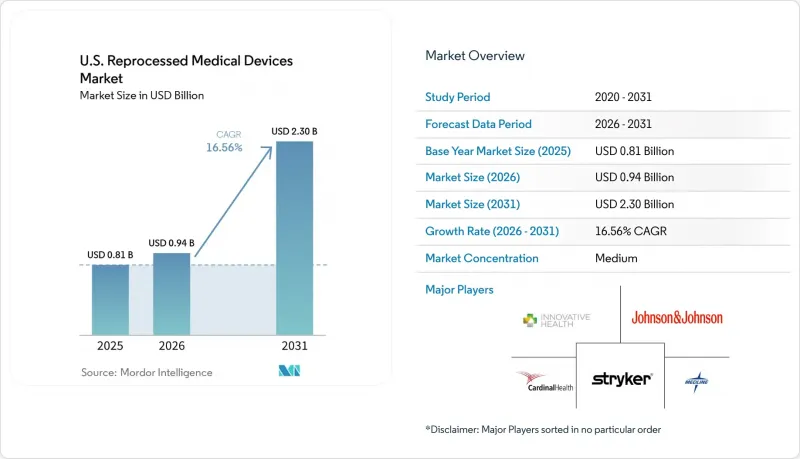
According to Mordor Intelligence, the u.S. reprocessed medical devices market size was valued at USD 0.81 billion in 2025 and is estimated to grow from USD 0.94 billion in 2026 to reach USD 2.30 billion by 2031, at a CAGR of 16.56% during the forecast period (2026-2031).
This report is Segmented by Product Type (Cardiovascular, Laparoscopic, and Others), Reprocessing Model (Third-Party/Commercial and Others), Device Risk Class (Critical, Semi-Critical, Non-Critical), Clinical Application (Cardiology and EP, Gastroenterology, and Others), and End User (Acute Care Hospitals, Ascs, and Others). The Market Forecasts are Provided in Terms of Value (USD).
U.S. Reprocessed Medical Devices Market Trends and Insights
Hospital Supply Cost Containment and Recurring Per-Procedure Savings
Hospital cost pressures remain a key driver in the United States reprocessed medical devices market, as purchasing teams can assess budget impacts on a case-by-case basis rather than during annual reviews. In 2025, AMDR reported that member reprocessors saved hospitals USD 495.5 million, making reprocessing a critical strategy for finance teams under margin pressure. These savings are recurring, as cleared reuse cycles allow repeated cost reductions within the same fiscal period. In 2024, Innovative Health noted a 50% increase in electrophysiology labs saving over USD 1 million annually through reprocessing, with average partner lab savings rising 17% due to new FDA clearances. This shift is prompting hospitals to treat reprocessing as a core procurement strategy rather than an optional initiative.
Rising Cardiovascular and Electrophysiology Procedure Volumes
Increasing cardiovascular and electrophysiology procedure volumes are driving the United States reprocessed medical devices market, as these specialties rely heavily on expensive single-use products. Atrial fibrillation procedures have been growing at nearly 17% annually, with device costs reaching USD 2.5 billion annually. High case volumes amplify savings, as reprocessing a single intracardiac echo catheter can reduce unit costs from USD 3,500 to USD 1,400-1,750 in high-volume programs. A 49-hospital health system achieved USD 4.9 million in savings over four years while diverting over 19,000 pounds of waste, reinforcing the financial and operational benefits of reprocessing in high-throughput labs.
OEM Anti-Reprocessing Design and Contracting Tactics
In the United States reprocessed medical devices market, original equipment manufacturers (OEMs) leverage their scale and contractual power to hinder the adoption of reprocessed devices, despite the demand for cost-effective solutions. Tactics such as bundling practices, software controls, and selective support create barriers for hospitals seeking reprocessed options. Although legal verdicts against Medtronic and Biosense Webster in 2026 marked a shift in addressing anti-competitive practices, commercial challenges and evolving OEM strategies continue to slow market penetration in high-value device categories.
Other drivers and restraints analyzed in the detailed report include:
- Waste Reduction and Health-System Decarbonization Goals
- FDA-Cleared Category Expansion Lifting Buyer Confidence
- FDA Validation and Quality-System Burden
For complete list of drivers and restraints, kindly check the Table Of Contents.
Segment Analysis
In 2025, cardiovascular devices accounted for 56.50% of the United States reprocessed medical devices market share, driven by the high unit value of electrophysiology catheters and a long history of reprocessing in cardiac labs. Administrators benefit from significant savings in electrophysiology, with reprocessing reducing procedure costs by nearly 30%, making cardiovascular devices a key revenue driver as hospitals expand reuse programs.
Orthopedic and arthroscopy devices, along with general surgery products, held mid-tier positions due to repeatable designs and efficient collection workflows. Laparoscopic devices are projected to grow at a 16.20% CAGR from 2026 to 2031, supported by the shift to outpatient settings where cost efficiency is critical, aligning with the need for affordable solutions without disrupting surgical workflows.
Third-party and commercial reprocessing dominated the United States reprocessed medical devices market in 2025, with an 84.12% share, reflecting the preference for scale, logistics, and regulatory expertise. Large operators manage collection, validation, and compliance efficiently, offering cost advantages and operational insights that smaller programs cannot match.
This model benefits from processing large volumes, enabling data-driven improvements in quality and cycle management. With a projected 16.99% CAGR from 2026 to 2031, outsourcing remains the preferred approach as hospitals prioritize risk reduction and administrative simplicity alongside reprocessed devices.
List of Companies Covered in this Report:
- Abbott Laboratories
- Alliance Medical Corporation
- Arjo, Inc.
- Avante Health Solutions
- Cardinal Health
- Case Medical, Inc.
- Centurion Medical Products Corp.
- EP Sustain
- GE HealthCare Technologies Inc.
- Innovative Health LLC
- Johnson & Johnson MedTech
- Medline Industries
- Midwest Reprocessing Center LLC
- NEScientific
- Sterilmed, Inc.
- STERIS
- Stryker
- SureTek Medical
- Vanguard
- Vein360 LLC
Additional Benefits:
- The market estimate (ME) sheet in Excel format
- 3 months of analyst support
TABLE OF CONTENTS
1 Introduction
- 1.1 Study Assumptions & Market Definition
- 1.2 Scope of the Study
2 Research Methodology
3 Executive Summary
4 Market Landscape
- 4.1 Market Overview
- 4.2 Market Drivers
- 4.2.1 Hospital Supply Cost Containment and Recurring Per-Procedure Savings
- 4.2.2 Waste Reduction and Health-System Decarbonization Goals
- 4.2.3 Rising Cardiovascular and Electrophysiology Procedure Volumes
- 4.2.4 FDA-Cleared Category Expansion Lifting Buyer Confidence
- 4.2.5 ASC Migration Increasing Demand for Lower-Cost Invasive Devices
- 4.2.6 Digital Traceability Strengthening Reprocessor Selection
- 4.3 Market Restraints
- 4.3.1 FDA Validation and Quality-System Burden
- 4.3.2 Clinician Perception and Value-Analysis Committee Friction
- 4.3.3 OEM Anti-Reprocessing Design and Contracting Tactics
- 4.3.4 Low Return Yield and Turnaround Complexity for Advanced Catheters
- 4.4 Value / Supply-Chain Analysis
- 4.5 Regulatory Landscape
- 4.6 Technological Outlook
- 4.7 Porter's Five Forces Analysis
- 4.7.1 Bargaining Power of Suppliers
- 4.7.2 Bargaining Power of Buyers
- 4.7.3 Threat of New Entrants
- 4.7.4 Threat of Substitutes
- 4.7.5 Intensity of Competitive Rivalry
5 Market Size & Growth Forecasts (Value, USD)
- 5.1 By Product Type
- 5.1.1 Cardiovascular Devices
- 5.1.2 Laparoscopic Devices
- 5.1.3 General Surgery Devices
- 5.1.4 Gastroenterology Devices
- 5.1.5 Orthopedic and Arthroscopy Devices
- 5.1.6 ENT Devices
- 5.1.7 Non-invasive Patient Care Devices
- 5.2 By Reprocessing Model
- 5.2.1 Third-Party / Commercial Reprocessing
- 5.2.2 In-House Hospital Reprocessing
- 5.2.3 Blended OEM-Reprocessor Programs
- 5.3 By Device Risk Class
- 5.3.1 Critical Devices
- 5.3.2 Semi-Critical Devices
- 5.3.3 Non-Critical Devices
- 5.4 By Clinical Application
- 5.4.1 Cardiology and Electrophysiology
- 5.4.2 Gastroenterology
- 5.4.3 General Surgery
- 5.4.4 Orthopedic and Arthroscopy
- 5.4.5 ENT
- 5.4.6 Vascular Surgery
- 5.4.7 Urology and Gynecology
- 5.5 By End User
- 5.5.1 Acute Care Hospitals
- 5.5.2 Ambulatory Surgery Centers
- 5.5.3 Specialty Clinics and Cath Labs
- 5.5.4 Government and Federal Facilities
- 5.5.5 Academic and Research Hospitals
6 Competitive Landscape
- 6.1 Market Concentration
- 6.2 Market Share Analysis
- 6.3 Company Profiles (includes Global level Overview, Market level overview, Core Segments, Financials as available, Strategic Information, Market Rank/Share for key companies, Products & Services, and Recent Developments)
- 6.3.1 Abbott
- 6.3.2 Alliance Medical Corporation
- 6.3.3 Arjo, Inc.
- 6.3.4 Avante Health Solutions
- 6.3.5 Cardinal Health, Inc.
- 6.3.6 Case Medical, Inc.
- 6.3.7 Centurion Medical Products Corp.
- 6.3.8 EP Sustain
- 6.3.9 GE HealthCare Technologies Inc.
- 6.3.10 Innovative Health LLC
- 6.3.11 Johnson & Johnson MedTech
- 6.3.12 Medline Industries, LP
- 6.3.13 Midwest Reprocessing Center LLC
- 6.3.14 NEScientific, Inc.
- 6.3.15 Sterilmed, Inc.
- 6.3.16 STERIS plc
- 6.3.17 Stryker Corporation
- 6.3.18 SureTek Medical
- 6.3.19 Vanguard AG
- 6.3.20 Vein360 LLC
7 Market Opportunities & Future Outlook
- 7.1 White-space & Unmet-need Assessment

