PUBLISHER: Mordor Intelligence | PRODUCT CODE: 2064472

PUBLISHER: Mordor Intelligence | PRODUCT CODE: 2064472
U.S. Child Care - Market Share Analysis, Industry Trends & Statistics, Growth Forecasts (2026 - 2031)
According to Mordor Intelligence, the u.S. child care market size is expected to increase from USD 69.07 billion in 2025 to USD 82.38 billion in 2026 and reach USD 110.34 billion by 2031, growing at a CAGR of 6.02% over 2026-2031.
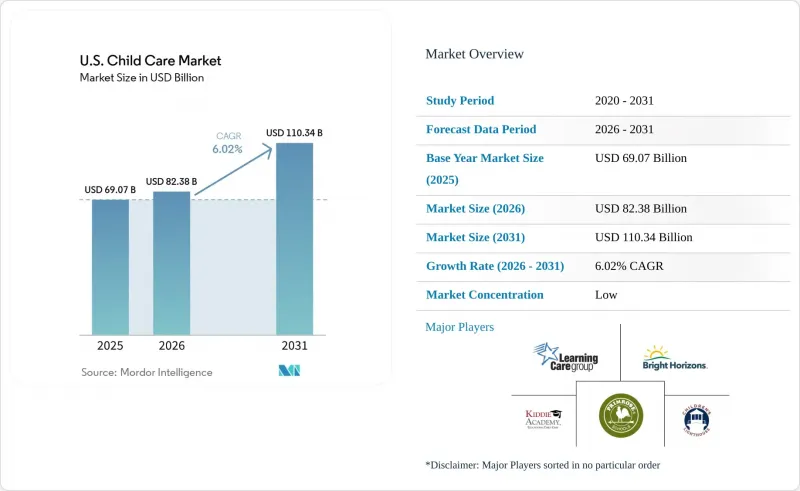
This report is Segmented by Care Setting (Center-Based, Home-Based, Relative Care), Age Group (Infants, Toddlers, Preschoolers, School-Age Children), Program Format (Full-Day Full-Year, Part-Day/Preschool, Before-School, After-School, Others), Ownership Model (For-Profit, Nonprofit, Public and School-Linked Providers), and Geography (United States). The Market Forecasts are Provided in Terms of Value (USD).
U.S. Child Care Market Trends and Insights
Rising Maternal Labor-Force And Dual-Income Dependency
In 2025, 65% of mothers with children under age 3 participated in the labor force, maintaining strong demand for the United States child care market. Dual-employed households, 2.8 times more likely to pay for child care than single-earner households, spent an average of USD 12,760 on child care in 2024. A USD 100 quarterly increase in per-child costs reduced maternal labor-force participation by 1.1 percentage points, emphasizing the market's influence on employment decisions. Providers are incentivized to collaborate with subsidy programs and employers to reduce families' financial burden.
Employer-Sponsored Child Care And Backup-Care Adoption
The expanded IRC 45F credit, effective January 2026, is driving employer-sponsored child care from a perk to a strategic financial decision. In 2025, 67% of employers prioritized family-care benefits, and 82.03% of large organizations adopted backup care. Bright Horizons reported 38% of 2025 enrollment from 14 new Fortune 500 contracts, while KinderCare's employer-sponsored tuition programs contributed USD 535 million, nearly 20% of 2024 revenue. Larger operators benefit from managing national contracts and backup-care networks, unlike smaller providers.
Teacher Shortages And Wage Compression
Teacher availability remains the primary challenge in the United States child care market. In 2024, early childhood educators earned a median wage of USD 16.01 per hour, USD 8.59 less than comparable professions. They were 7.7 times more likely to live in poverty than K-12 teachers, leading to retention issues. Annual turnover rates ranged from 15% to 46%, with each turnover costing programs nearly USD 7,000. Labor costs, accounting for 70% to 80% of operating budgets, and profit margins below 1% make wage increases difficult, perpetuating staffing shortages despite parental demand.
Other drivers and restraints analyzed in the detailed report include:
- Public Subsidy Expansion And Mixed-Delivery Support
- Manufacturing And Healthcare Campus Child Care Build-Out
- Parent Affordability Gap And Subsidy Cliffs
For complete list of drivers and restraints, kindly check the Table Of Contents.
Segment Analysis
In 2025, Center-Based Care accounted for 65.34% of the United States child care market share, maintaining its position as the leading revenue-generating care setting. This reflects parental preference for licensed, curriculum-based environments, particularly in urban and suburban areas. Licensed child care centers increased by 1.3% from 2022 to 2023 across 41 states, with larger facilities expanding capacity by 18% between 2005 and 2017, influencing current supply dynamics.
Home-Based Care is the fastest-growing segment of the United States child care market, with a projected 6.55% CAGR through 2031. Its growth addresses scheduling gaps, as 40% of children in care require coverage outside standard hours, including early mornings, evenings, and weekends.
Infants are the fastest-growing age group in the United States child care market, with a projected 7.95% CAGR from 2026 to 2031. A significant supply gap persists, with three infants for every licensed care slot in 80% of counties across 19 states and the District of Columbia. Licensed infant slots in Cook County dropped 8% since 2019, and quality centers in metro areas report waitlists of 12 to 18 months.
Preschoolers accounted for 38.55% of revenue in 2025, making them the largest revenue-generating age group in the United States child care market. This is driven by school-readiness demand and state-funded pre-K programs. However, public pre-K expansion shifts 4-year-olds from family child care homes, impacting revenue mixes for operators managing higher-cost infant and toddler care.
List of Companies Covered in this Report:
- Big Blue Marble Academy
- Bright Horizons Family Solutions
- Cadence Education
- Celebree School
- Children's Lighthouse
- Discovery Point Franchising
- Endeavor Schools
- Goddard Systems, LLC
- Guidepost Montessori
- Kiddie Academy Domestic Franchising LLC
- Kids 'R' Kids International
- KinderCare Learning Companies
- Learning Care Group
- Lightbridge Academy
- New Horizon Academy
- Primrose Schools Franchising Company
- Spring Education Group
- Sunshine House Early Learning Academy
- The Learning Experience
- YMCA of the USA
Additional Benefits:
- The market estimate (ME) sheet in Excel format
- 3 months of analyst support
TABLE OF CONTENTS
1 Introduction
- 1.1 Study Assumptions & Market Definition
- 1.2 Scope of the Study
2 Research Methodology
3 Executive Summary
4 Market Landscape
- 4.1 Market Overview
- 4.2 Market Drivers
- 4.2.1 Rising Maternal Labor-Force and Dual-Income Dependence
- 4.2.2 Public Subsidy Expansion and Mixed-Delivery Support
- 4.2.3 Employer-Sponsored Child Care and Backup-Care Adoption
- 4.2.4 Manufacturing and Healthcare Campus Child Care Build-Outs
- 4.2.5 Rebound of Family Child Care for Nontraditional-Hour Demand
- 4.3 Market Restraints
- 4.3.1 Teacher Shortages and Wage Compression
- 4.3.2 Parent Affordability Gap and Subsidy Cliffs
- 4.3.3 Occupancy, Insurance, and Compliance Cost Inflation
- 4.3.4 CCDF Payment-Rule Rollback Volatility
- 4.4 Value Chain Analysis
- 4.5 Regulatory Landscape
- 4.6 Technological Outlook
- 4.7 Porter's Five Forces Analysis
- 4.7.1 Bargaining Power of Buyers
- 4.7.2 Bargaining Power of Suppliers
- 4.7.3 Threat of New Entrants
- 4.7.4 Threat of Substitutes
- 4.7.5 Intensity of Rivalry
5 Market Size & Growth Forecasts (Value, USD)
- 5.1 By Care Setting
- 5.1.1 Center-Based Care
- 5.1.2 Home-Based Care
- 5.1.3 Relative Care
- 5.2 By Age Group
- 5.2.1 Infants
- 5.2.2 Toddlers
- 5.2.3 Preschoolers
- 5.2.4 School-Age Children
- 5.3 By Program Format
- 5.3.1 Full-Day Full-Year Care
- 5.3.2 Part-Day / Preschool Programs
- 5.3.3 Before-School Care
- 5.3.4 After-School Care
- 5.3.5 Others
- 5.4 By Ownership and Funding Model
- 5.4.1 For-Profit Private Providers
- 5.4.2 Nonprofit Providers
- 5.4.3 Public and School-Linked Providers
6 Competitive Landscape
- 6.1 Market Concentration
- 6.2 Market Share Analysis
- 6.3 Company Profiles (includes Global level Overview, Market level overview, Core Segments, Financials as available, Strategic Information, Market Rank/Share for key companies, Products & Services, and Recent Developments)
- 6.3.1 Big Blue Marble Academy
- 6.3.2 Bright Horizons Family Solutions
- 6.3.3 Cadence Education
- 6.3.4 Celebree School
- 6.3.5 Children's Lighthouse
- 6.3.6 Discovery Point Franchising
- 6.3.7 Endeavor Schools
- 6.3.8 Goddard Systems, LLC
- 6.3.9 Guidepost Montessori
- 6.3.10 Kiddie Academy Domestic Franchising LLC
- 6.3.11 Kids 'R' Kids International
- 6.3.12 KinderCare Learning Companies
- 6.3.13 Learning Care Group
- 6.3.14 Lightbridge Academy
- 6.3.15 New Horizon Academy
- 6.3.16 Primrose Schools Franchising Company
- 6.3.17 Spring Education Group
- 6.3.18 Sunshine House Early Learning Academy
- 6.3.19 The Learning Experience
- 6.3.20 YMCA of the USA
7 Market Opportunities & Future Outlook
- 7.1 White-space & Unmet-need Assessment

