PUBLISHER: Mordor Intelligence | PRODUCT CODE: 2064473

PUBLISHER: Mordor Intelligence | PRODUCT CODE: 2064473
U.S. Medical Device Manufacturers - Market Share Analysis, Industry Trends & Statistics, Growth Forecasts (2026 - 2031)
According to Mordor Intelligence, the u.S. medical device manufacturers market size is expected to increase from USD 355.67 billion in 2025 to USD 377.72 billion in 2026 and reach USD 510.26 billion by 2031, growing at a CAGR of 6.20% over 2026-2031.
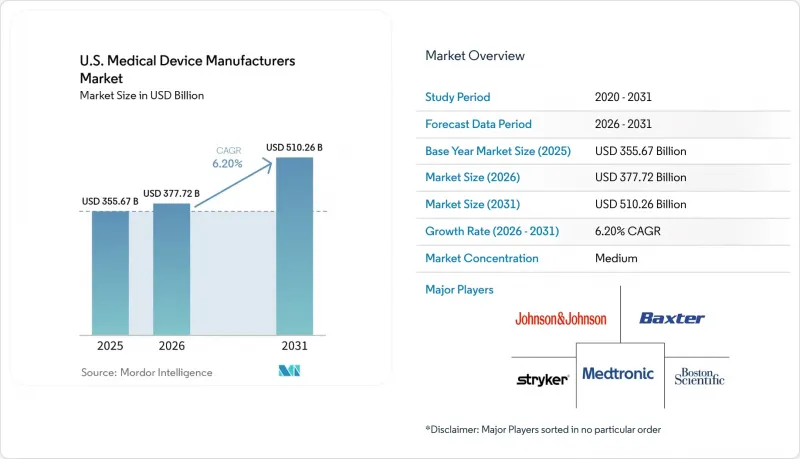
This report is Segmented by Device Type (Diagnostic, Therapeutic, Surgical, Monitoring Devices), Technology Platform (Conventional, Wearable, Telehealth, Robotic Surgery, 3-D Printing, AR/VR, Nanotechnology, Samd), Therapeutic Application (Cardiology, Orthopedics, Neurology, Ophthalmology, Surgery, Oncology), and End User (Hospitals, Ascs, Phys. Offices, Labs, Home Care). Forecasts in Value (USD).
U.S. Medical Device Manufacturers Market Trends and Insights
Aging Population and Chronic Disease: Structural Foundation for Demand
The United States medical device manufacturers market benefits from a strong demand base driven by chronic conditions requiring ongoing diagnostics, therapeutic interventions, and monitoring. This demand is particularly significant among older populations managing multiple conditions, increasing the use of imaging, cardiac support devices, orthopedic implants, and monitoring systems. Multimorbid patients necessitate broader procurement, supporting both capital equipment and consumables, while chronic disease care remains less impacted by economic fluctuations compared to elective spending.
Shift Toward Minimally Invasive and Image-Guided Procedures
The shift to robotic-assisted and image-guided procedures is transforming demand across device categories. Hospitals adopting robotic systems have increased minimally invasive surgery rates from 60.5% to 65.8%, expanding procedure mixes. This trend drives demand for energy devices, visualization tools, navigation systems, and intraoperative imaging, while integrated operating room ecosystems enhance throughput and recovery times. Companies offering comprehensive portfolios are better positioned than those with standalone products.
Stringent FDA Evidence, Quality, and Post-Market Burden
Regulatory scrutiny is tightening for medical device manufacturers, with deeper focus on quality systems and supplier controls. In FY2025, 38 out of 44 device warning letters cited Part 820, and over 100 QMSR inspections were conducted within 75 days of the February 2026 effective date. This increases fixed costs for smaller manufacturers, requiring investments in risk files, CAPA systems, and ongoing surveillance. Larger firms in the United States medical device manufacturers market are better positioned to use compliance as a competitive advantage, while smaller players face challenges balancing growth and regulatory readiness.
Other drivers and restraints analyzed in the detailed report include:
- Hospital Capital Refresh for Imaging, Monitoring, and Robotics
- Expansion of Outpatient and Home-Monitoring Pathways
- Recall, Cybersecurity, and Remediation Costs
For complete list of drivers and restraints, kindly check the Table Of Contents.
Segment Analysis
In 2025, Diagnostic Devices accounted for 38.45% of the United States medical device manufacturers market, driven by consistent imaging demand, in-vitro diagnostics, and image-guided workflows in hospitals and outpatient centers. These systems are integral to care pathways in cardiology, oncology, neurology, and routine monitoring, with procurement influenced by throughput, workflow efficiency, and software integration.
Monitoring Devices are projected to grow at a 7.23% CAGR from 2026 to 2031, making them the fastest-growing segment in the United States medical device market. Growth is fueled by remote patient monitoring adoption, expanded use in ambulatory settings, and the shift toward wireless, compact systems like Sibel Health's ANNE Maternal platform.
In 2025, Conventional Electro-mechanical and Disposable platforms represented 55.9% of the technology mix in the United States medical device market, reflecting reliance on high-volume consumables and standard equipment. This segment thrives on volume, reliability, and uninterrupted supply, as seen in BD's investment in U.S. manufacturing and expansion of its Nebraska syringe plant.
Nanotechnology and Smart Materials are expected to grow at an 8.11% CAGR from 2026 to 2031, driven by a shift from passive devices to systems enhancing precision and reducing tissue burden. Innovations in responsive systems and material-enabled performance are advancing beyond concept stages, supported by commercial precedents.
List of Companies Covered in this Report:
- Abbott Laboratories
- Baxter
- Beckton Dickinson
- Boston Scientific
- Conmed
- Dexcom
- Edwards Lifesciences Inc.
- GE Healthcare
- Hologic
- ICU Medical
- Insulet
- Intuitive Surgical
- Johnson & Johnson
- Medtronic
- Penumbra
- Resmed
- Siemens Healthineers
- Stryker
- Teleflex
- Zimmer Biomet
Additional Benefits:
- The market estimate (ME) sheet in Excel format
- 3 months of analyst support
TABLE OF CONTENTS
1 Introduction
- 1.1 Study Assumptions & Market Definition
- 1.2 Scope of the Study
2 Research Methodology
3 Executive Summary
4 Market Landscape
- 4.1 Market Overview
- 4.2 Market Drivers
- 4.2.1 Aging Population and Chronic Disease Burden
- 4.2.2 Shift Toward Minimally Invasive and Image-Guided Procedures
- 4.2.3 Hospital Capital Refresh for Imaging, Monitoring, and Robotics
- 4.2.4 Expansion of Outpatient and Home-Monitoring Pathways
- 4.2.5 CMS Pass-Through Pathway Lift for Breakthrough Devices
- 4.2.6 Stabilizing EtO Sterilization Capacity for Single-Use Devices
- 4.3 Market Restraints
- 4.3.1 Stringent FDA Evidence, Quality, and Post-Market Burden
- 4.3.2 Recall, Cybersecurity, and Remediation Costs
- 4.3.3 Medicare Coverage Lag After FDA Authorization
- 4.3.4 QMSR Transition Compliance Burden
- 4.4 Value / Supply-Chain Analysis
- 4.5 Regulatory Landscape
- 4.6 Technological Outlook
- 4.7 Porter's Five Forces Analysis
- 4.7.1 Threat of new entrants
- 4.7.2 Bargaining power of suppliers
- 4.7.3 Bargaining power of buyers
- 4.7.4 Threat of substitutes
- 4.7.5 Industry rivalry
5 Market Size & Growth Forecasts (Value, USD)
- 5.1 By Device Type
- 5.1.1 Diagnostic Devices
- 5.1.1.1 Diagnostic Imaging Devices
- 5.1.1.1.1 MRI Systems
- 5.1.1.1.2 CT Scanners
- 5.1.1.1.3 Ultrasound
- 5.1.1.2 In-Vitro Diagnostics
- 5.1.1.1 Diagnostic Imaging Devices
- 5.1.2 Therapeutic Devices
- 5.1.2.1 Implants
- 5.1.2.2 Drug-Delivery Pumps
- 5.1.3 Surgical Devices
- 5.1.3.1 Robotics & Navigation
- 5.1.3.2 Energy-based Devices
- 5.1.4 Monitoring Devices
- 5.1.4.1 Multiparameter Monitors
- 5.1.4.2 Remote Patient Monitors
- 5.1.5 Others
- 5.1.1 Diagnostic Devices
- 5.2 By Technology Platform
- 5.2.1 Conventional Electro-mechanical & Disposable
- 5.2.2 Wearable & Remote Monitoring
- 5.2.3 Telehealth & mHealth
- 5.2.4 Robotic Surgery
- 5.2.5 3-D Printing
- 5.2.6 Augmented / Virtual Reality
- 5.2.7 Nanotechnology & Smart Materials
- 5.2.8 AI-as-a-Medical-Device (SaMD)
- 5.3 By Therapeutic Application
- 5.3.1 Cardiology
- 5.3.2 Orthopedics & Sports Medicine
- 5.3.3 Neurology
- 5.3.4 Ophthalmology
- 5.3.5 General & Laparoscopic Surgery
- 5.3.6 Oncology
- 5.3.7 Others
- 5.4 By End User
- 5.4.1 Hospitals
- 5.4.2 Ambulatory Surgery Centers
- 5.4.3 Physician Offices and Specialty Clinics
- 5.4.4 Diagnostic Laboratories and Imaging Centers
- 5.4.5 Home Care and Remote Monitoring Settings
- 5.4.6 Others
6 Competitive Landscape
- 6.1 Market Concentration
- 6.2 Market Share Analysis
- 6.3 Company Profiles (includes Global level Overview, Market level overview, Core Segments, Financials as available, Strategic Information, Market Rank/Share for key companies, Products & Services, and Recent Developments)
- 6.3.1 Abbott
- 6.3.2 Baxter
- 6.3.3 Becton, Dickinson and Company
- 6.3.4 Boston Scientific Inc.
- 6.3.5 CONMED Corporation
- 6.3.6 Dexcom
- 6.3.7 Edwards Lifesciences Inc.
- 6.3.8 GE HealthCare
- 6.3.9 Hologic Inc.
- 6.3.10 ICU Medical
- 6.3.11 Insulet
- 6.3.12 Intuitive Surgical
- 6.3.13 Johnson & Johnson
- 6.3.14 Medtronic plc
- 6.3.15 Penumbra
- 6.3.16 ResMed Inc.
- 6.3.17 Siemens Healthineers AG
- 6.3.18 Stryker Corporation
- 6.3.19 Teleflex
- 6.3.20 Zimmer Biomet
7 Market Opportunities & Future Outlook
- 7.1 White-space & unmet-need assessment

