PUBLISHER: Mordor Intelligence | PRODUCT CODE: 2064491

PUBLISHER: Mordor Intelligence | PRODUCT CODE: 2064491
Passive Temperature Controlled Packaging - Market Share Analysis, Industry Trends & Statistics, Growth Forecasts (2026 - 2031)
According to Mordor Intelligence, the passive temperature controlled packaging market size is projected to expand from USD 9.62 billion in 2025 and USD 10.52 billion in 2026 to USD 15.75 billion by 2031, registering a CAGR of 8.41% between 2026 and 2031.
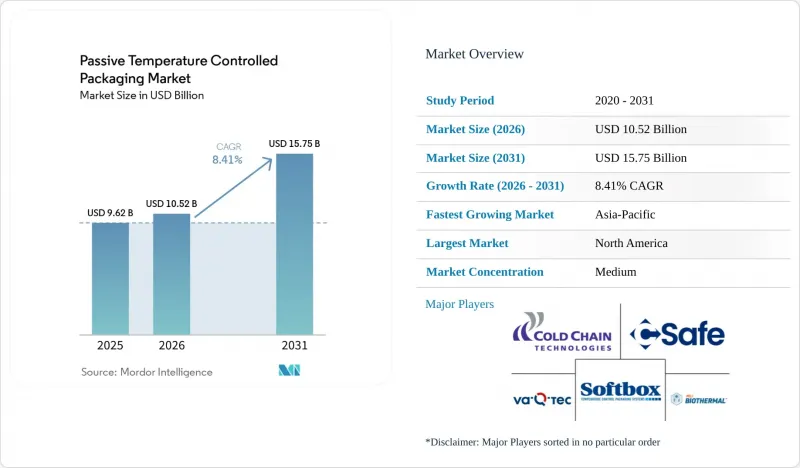
This report is Segmented by Product Type (Insulated Shippers, Insulated Containers, and More), Material Type (Plastic, Paper and Paperboard, and More), Usability (Single-Use, and Reusable), Temperature Range (Ambient, Frozen, and More), End-User Industry (Pharmaceuticals and Biotechnology, Chemical, and More), and Geography. The Market Forecasts are Provided in Terms of Value (USD).
Global Passive Temperature Controlled Packaging Market Trends and Insights
Rising Biologics and Specialty Pharma Shipments
Rising biologics volumes are changing the shipment mix that supports the passive temperature controlled packaging market. Many newer therapies are sensitive to both heat exposure and unintended freezing, which keeps the 2°C to 8°C range central to packaging design and lane qualification. The same trend is increasing the value of route-specific validation, as biologics require tighter control than traditional small-molecule drugs during transit. Cencora stated in November 2025 that nearly 50% of drugs expected to launch globally through 2027 would require cold chain storage, up from 37% a decade earlier, which shows how quickly cold chain dependence is widening across drug pipelines. As more of these products move through specialty distribution and direct dispensing channels, the passive temperature controlled packaging market benefits from larger recurring shipment volumes and more repeatable pack-out requirements. This favors suppliers that can offer validated payload protection, multiple duration options, and documentation that supports qualification across changing seasonal conditions.
Growth In GLP-1 and Direct-To-Patient Refrigerated Parcel Flows
GLP-1 therapies are creating a large parcel-based demand stream for the passive temperature controlled packaging market. These products fit a delivery model that relies on specialty pharmacies, telehealth channels, and home delivery, underscoring the need for compact, insulated formats rather than pallet systems. Nordic Cold Chain Solutions launched a GLP-1 and small-format packaging innovation lab in March 2026, indicating that suppliers now see this as a distinct packaging problem that requires its own validated configurations. TemperPack reported in 2025 that 12 EPS foam coolers used for GLP-1 shipments were being discarded in US landfills every minute, underscoring why this therapy category is also drawing sustainability concerns into the last-mile cold chain discussion. That combination of high shipment frequency and rising waste visibility is prompting buyers to review both pack size and insulation choice simultaneously. It also makes the passive temperature controlled packaging market more dependent on standardized, easy-to-pack shipper formats that can scale with prescription volume growth.
Limited Hold Time Versus Active Systems on Long and Variable Lanes
Hold-time limits remain a practical constraint on the passive temperature controlled packaging market. Passive formats work well on many regional and single-leg international lanes, but they become harder to rely on when a shipment faces customs delays, missed connections, or long dwell time at transfer points. Peli BioThermal stated in 2025 that high-performance passive configurations can provide 96 to 168 hours of protection, which is strong for many use cases but still finite compared with active-powered systems. The constraint becomes sharper when the route spans different climates, as the same payload may require separate validation for hot and cold seasonal profiles. This reduces flexibility for shippers that operate across global multi-stop networks and lack reliable reconditioning points along the route. As a result, the passive temperature controlled packaging market is likely to remain strongest in short-to-medium-haul lanes, while the hardest intercontinental movements continue to play a larger role for active or hybrid approaches.
Other drivers and restraints analyzed in the detailed report include:
- Expansion of Food E-Commerce and Meal-Kit Cold Chains
- Tightening GDP, USP, and Food-Safety Compliance Standards
- High Cost of VIP and Advanced PCM Configurations
For complete list of drivers and restraints, kindly check the Table Of Contents.
Segment Analysis
Insulated shippers held 46.65% share in 2025, making them the largest product category in the passive temperature controlled packaging market. Their lead position comes from a strong fit with parcel-sized healthcare shipments and food e-commerce orders, where ease of packing and broad temperature coverage matter more than very large payload capacity. The product is especially well aligned with direct-to-patient programs because it supports small payloads, standardized pack-outs, and fast handling at distribution sites. Cencora announced a USD 1 billion investment through 2030 to expand and modernize its US distribution network, including major refrigerated and frozen storage additions at its Alabama specialty facility, which supports the underlying logistics infrastructure that keeps parcel and specialty cold chain traffic growing. As distribution networks add more cold storage and specialized handling capacity, insulated shippers remain the practical choice for many repeat-shipment programs because they are easy to scale across large delivery volumes.
Insulated containers remain important for bulk pharmaceutical flows and larger cold chain moves, especially where shipment value justifies a stronger packaging system and a more controlled reuse cycle. Thermal liners and covers still represent the smallest product slice, but the passive temperature controlled packaging industry is treating them less as low-value accessories and more as managed assets that can add lane flexibility. CSafe launched Silverskin RE in October 2025 as a reusable thermal pallet cover with lifecycle management, integrated tracking, and support for 2°C to 8°C and 15°C to 25°C ranges, which shows how this sub-segment is becoming more service oriented. Refrigerants and coolants are projected to grow at 9.26% CAGR through 2031, and that pace reflects the wider shift from basic gel packs toward PCM formats that offer better thermal stability and more repeatable documentation for regulated shipment lanes. The passive temperature controlled packaging market share tied to refrigerants also benefits from higher bill-of-materials content per shipment because more complex biologic and GLP-1 pack-outs often require carefully matched coolant configurations rather than a generic cold source.
Plastic accounted for 41.58% of the passive temperature controlled packaging market in 2025, reflecting the long-established use of EPS and polyurethane across pharmaceutical and food shipment formats. These materials have kept their position because they are familiar to packers, widely available, and already embedded in many validated pack-outs. EPS has remained common in parcel shipping because it balances thermal performance and cost in a way that still works for many standard cold lanes. Polyurethane also plays a role in higher-specification systems where structure and insulation value need to support more demanding transport conditions. This leaves plastic-based materials with a large installed base even as customer preferences begin to shift.
Bio-based insulation materials are projected to expand at a 9.18% CAGR through 2031, driven by a mix of sustainability pressures and improving proof of performance. TemperPack said its GreenCell Foam platform supports more than 60 pre-qualified shippers across 2°C to 8°C, 15°C to 25°C, and -20°C temperature profiles, indicating that buyers no longer see compostable insulation as a niche option only for light-duty applications. Landpack also promotes pre-qualified life science cooling solutions based on natural fiber materials, indicating that bio-based alternatives are moving into regulated use cases in Europe rather than remaining limited to food delivery. The passive temperature controlled packaging market is therefore seeing a gradual replacement path at the low-to-mid performance tier, where buyers want to reduce reliance on EPS without losing qualification confidence. This transition remains selective because the material must meet the same transit expectations as incumbent insulation before the buyer will approve a switch.
Geography Analysis
North America held a 41.38% share in 2025, making it the leading region in the passive temperature controlled packaging market. The United States drives most of that scale by combining a dense pharmaceutical distribution system with strong direct-to-patient shipments and a large cold-chain e-commerce base. Cencora's November 2025 plan to invest USD 1 billion through 2030 in its US distribution network, including major refrigerated and frozen expansion in Alabama, points to continued infrastructure build-out behind pharmaceutical cold chain flows. That investment supports the practical conditions that help passive solutions scale, including access to cold storage, handling capacity, and standardized specialty distribution lanes. The region also benefits from strong adoption of parcel-format healthcare shipping, which keeps demand high for insulated shippers, qualified refrigerants, and small-format solutions.
Asia-Pacific is projected to grow at a 9.25% CAGR through 2031, making it the fastest-growing regional segment in the passive temperature controlled packaging market. The region's growth is tied to expanding pharmaceutical manufacturing, improving cold chain logistics, and stronger food e-commerce penetration across several large consumer markets. Australia and New Zealand are important early adopters in parcel cold chain formats, while China and India support the broad manufacturing and export base that is raising regional packaging needs. Nordic Cold Chain Solutions' focus on GLP-1 and small-format innovation also has relevance beyond North America because the same parcel-based therapy model is spreading into other developed healthcare systems. This leaves Asia-Pacific with both healthcare and food demand drivers, which gives the regional growth story more balance than a single-sector expansion cycle.
Europe remained a major revenue base for the passive temperature controlled packaging market in 2025, supported by pharmaceutical manufacturing density and regulated logistics standards across Germany, the United Kingdom, France, Italy, and Spain. Landpack's pre-qualified life science solutions and the broader move toward natural fiber insulation in Europe show how sustainability rules are starting to affect commercial packaging choice in addition to temperature performance. South America is still developing, but Peli BioThermal's March 2026 distribution partnership with Polar Group in Brazil indicates growing supplier commitment to pharmaceutical cold chain expansion in the region. The Middle East and Africa remains earlier stage, with Gulf transit hubs, Turkey, South Africa, and Nigeria forming the main points of adoption as healthcare logistics networks become more structured and more compliance driven.
- Cold Chain Technologies, LLC
- Pelican BioThermal LLC
- CSafe Global Cooperatief U.A.
- Softbox Systems Limited
- va-Q-tec Thermal Solutions GmbH
- Envirotainer AB
- DGP Intelsius Ltd
- Cryopak Industries Inc.
- Inmark, LLC
- Tempack Packaging Solutions, S.L.
- Temperpack Technologies, Inc.
- Temperatsure, LLC
- Sofrigam SAS
- Sealed Air Corporation
- Polar Tech Industries Inc.
Additional Benefits:
- The market estimate (ME) sheet in Excel format
- 3 months of analyst support
TABLE OF CONTENTS
1 INTRODUCTION
- 1.1 Study Assumptions and Market Definition
- 1.2 Scope of the Study
2 RESEARCH METHODOLOGY
3 EXECUTIVE SUMMARY
4 MARKET LANDSCAPE
- 4.1 Market Overview
- 4.2 Market Drivers
- 4.2.1 Rising Biologics and Specialty Pharma Shipments
- 4.2.2 Expansion of Food E-Commerce and Meal-Kit Cold Chains
- 4.2.3 Tightening GDP, USP, and Food-Safety Compliance Standards
- 4.2.4 Shift Toward Reusable and Recyclable Passive Solutions
- 4.2.5 Growth in GLP-1 and Direct-to-Patient Refrigerated Parcel Flows
- 4.2.6 Adoption of Lane-Specific Pack-Out Optimization and Connected Passive Packaging
- 4.3 Market Restraints
- 4.3.1 Limited Hold Time Versus Active Systems on Long and Variable Lanes
- 4.3.2 High Cost of VIP and Advanced PCM Configurations
- 4.3.3 Reverse-Logistics Gaps Reducing Reuse Economics Outside Core Pharma Corridors
- 4.3.4 Supply Risk in Qualified VIP, PCM, and Fiber-Based Input Chains
- 4.4 Industry Value Chain Analysis
- 4.5 Regulatory Landscape
- 4.6 Technological Outlook
- 4.7 Porter's Five Forces Analysis
- 4.7.1 Threat of New Entrants
- 4.7.2 Bargaining Power of Suppliers
- 4.7.3 Bargaining Power of Buyers
- 4.7.4 Threat of Substitutes
- 4.7.5 Competitive Rivalry
5 MARKET SIZE AND GROWTH FORECASTS (VALUE)
- 5.1 By Product Type
- 5.1.1 Insulated Shippers
- 5.1.2 Insulated Containers
- 5.1.3 Refrigerants and Coolants
- 5.1.4 Thermal Liners and Covers
- 5.2 By Material Type
- 5.2.1 Plastic
- 5.2.1.1 Polystyrene
- 5.2.1.2 Polyurethane
- 5.2.1.3 Polypropylene
- 5.2.2 Paper and Paperboard
- 5.2.3 Bio-Based Insulation Materials
- 5.2.1 Plastic
- 5.3 By Usability
- 5.3.1 Single-Use
- 5.3.2 Reusable
- 5.4 By Temperature Range
- 5.4.1 Ambient
- 5.4.2 Chilled/Refrigerated
- 5.4.3 Frozen
- 5.5 By End-User Industry
- 5.5.1 Pharmaceuticals and Biotechnology
- 5.5.2 Food and Beverage
- 5.5.3 Chemical
- 5.5.4 Other End-Use Industries
- 5.6 By Geography
- 5.6.1 North America
- 5.6.1.1 United States
- 5.6.1.2 Canada
- 5.6.1.3 Mexico
- 5.6.2 South America
- 5.6.2.1 Brazil
- 5.6.2.2 Argentina
- 5.6.2.3 Rest of South America
- 5.6.3 Europe
- 5.6.3.1 Germany
- 5.6.3.2 United Kingdom
- 5.6.3.3 France
- 5.6.3.4 Italy
- 5.6.3.5 Spain
- 5.6.3.6 Russia
- 5.6.3.7 Rest of Europe
- 5.6.4 Asia-Pacific
- 5.6.4.1 China
- 5.6.4.2 Japan
- 5.6.4.3 South Korea
- 5.6.4.4 India
- 5.6.4.5 Australia and New Zealand
- 5.6.4.6 Rest of Asia-Pacific
- 5.6.5 Middle East and Africa
- 5.6.5.1 Middle East
- 5.6.5.1.1 Saudi Arabia
- 5.6.5.1.2 United Arab Emirates
- 5.6.5.1.3 Turkey
- 5.6.5.1.4 Rest of Middle East
- 5.6.5.2 Africa
- 5.6.5.2.1 South Africa
- 5.6.5.2.2 Nigeria
- 5.6.5.2.3 Rest of Africa
- 5.6.5.1 Middle East
- 5.6.1 North America
6 COMPETITIVE LANDSCAPE
- 6.1 Market Concentration
- 6.2 Strategic Moves
- 6.3 Market Share Analysis
- 6.4 Company Profiles (includes Global level Overview, Market level overview, Core Segments, Financials as available, Strategic Information, Market Rank/Share for key companies, Products and Services, and Recent Developments)
- 6.4.1 Cold Chain Technologies, LLC
- 6.4.2 Pelican BioThermal LLC
- 6.4.3 CSafe Global Cooperatief U.A.
- 6.4.4 Softbox Systems Limited
- 6.4.5 va-Q-tec Thermal Solutions GmbH
- 6.4.6 Envirotainer AB
- 6.4.7 DGP Intelsius Ltd
- 6.4.8 Cryopak Industries Inc.
- 6.4.9 Inmark, LLC
- 6.4.10 Tempack Packaging Solutions, S.L.
- 6.4.11 Temperpack Technologies, Inc.
- 6.4.12 Temperatsure, LLC
- 6.4.13 Sofrigam SAS
- 6.4.14 Sealed Air Corporation
- 6.4.15 Polar Tech Industries Inc.
7 MARKET OPPORTUNITIES AND FUTURE OUTLOOK
- 7.1 White-Space and Unmet-Need Assessment

