PUBLISHER: Mordor Intelligence | PRODUCT CODE: 2064525

PUBLISHER: Mordor Intelligence | PRODUCT CODE: 2064525
Refrigerated Display Cases - Market Share Analysis, Industry Trends & Statistics, Growth Forecasts (2026 - 2031)
According to Mordor Intelligence, the refrigerated display cases market size is projected to expand from USD 18.86 billion in 2025 and USD 20.48 billion in 2026 to USD 29.76 billion by 2031, registering a CAGR of 7.76% between 2026 and 2031.
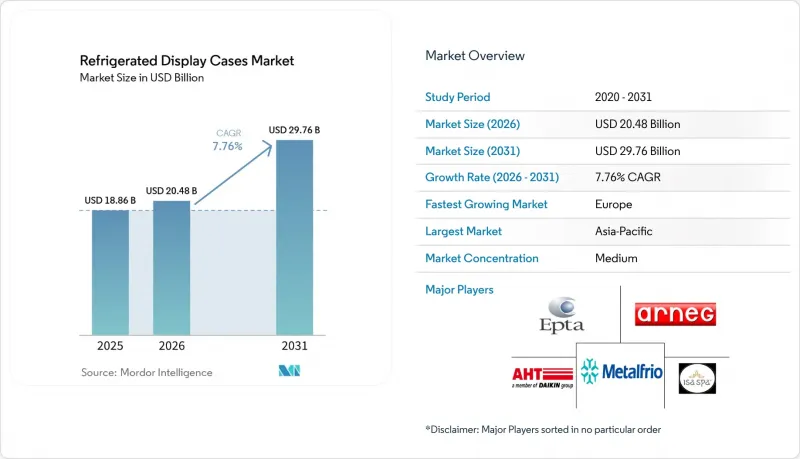
This report is Segmented by Refrigeration Architecture (Plug-In, Semi Plug-In, and Remote), Product Design (Vertical, Horizontal, Hybrid, and Semi-Vertical), Application (Retail Stores, Restaurants and Hotels, and More), End User (Supermarkets and Hypermarkets, Convenience Stores, Specialty Stores, Discount Stores, and More), and Geography. The Market Forecasts are Provided in Terms of Value (USD).
Global Refrigerated Display Cases Market Trends and Insights
Retail Chain Refurbishment and Convenience Store Expansion
Retail modernization programs are extending demand for refrigerated display cases beyond a typical replacement cycle. Convenience stores are allocating more floor space to prepared meals, packaged beverages, and chilled foodservice, which raises the number of cases needed in each remodeled outlet. C-store foodservice accounted for 28.5% of total in-store sales in 2025, up from 11.9% in 2005, and contributed 38.9% of in-store gross profit, underscoring why operators are redesigning stores around chilled food visibility. Love's Travel Stops committed USD 700 million in 2026 to open 20 locations and remodel 35 existing sites under its Road Ahead Plan, with a stronger food-and-beverage offer at the center of the program. In the refrigerated display cases market, that pattern matters because a food-led convenience format typically needs more linear chilled frontage than a legacy fuel-centered layout. This is keeping demand active in both new openings and store refresh work.
Natural Refrigerant and Energy-Efficiency Retrofit Cycle
The refrigerated display case market is undergoing a replacement wave driven by refrigerant rules rather than discretionary spending. Regulation (EU) 2024/573 took effect in March 2024 and tightened the phasedown path for fluorinated greenhouse gases across the European Union. In the United States, newer federal rules have pushed the sector toward lower-global-warming-potential refrigerants in new commercial refrigeration equipment, thereby shortening the replacement window for older HFC-based systems. The EPA also raised the R290 charge limit for self-contained display cases in 2024, which widened the use case for propane-based plug-in systems in larger footprints than before. Between 2025 and 2029, U.S. food retailers planned to install 1,470 new transcritical CO2 stores and replace 13,400 existing systems, which shows how large the transition pipeline has become. In the refrigerated display cases market, these compliance deadlines are serving as a floor for demand, as operators cannot indefinitely defer equipment decisions.
High Upfront Retrofit and Installation Costs
Capital costs remain a direct brake on adoption in the refrigerated display case market, especially for smaller operators. Transcritical CO2 systems can cost 10-20% more than conventional HFC systems in new builds, and retrofit projects often require additional infrastructure work, widening the gap further. That burden becomes harder to absorb when operators are also funding store remodels, energy upgrades, and refrigerant compliance in the same planning cycle. New York State awarded USD 350,000 to support 2 Bronx Key Food stores in shifting to R290 cases, demonstrating that public support is already helping smaller retailers cover the economic costs. In the refrigerated display cases market, this favors large chains that can spread transition costs across bigger store networks and longer capital programs. It also slows conversion in fragmented retail environments where stores lack scale purchasing power.
Other drivers and restraints analyzed in the detailed report include:
- Fresh, Frozen, and Grab-and-Go Food Merchandising Growth
- Smart Monitoring and Predictive Maintenance Adoption
- Energy and Lifecycle Service Cost Burden
For complete list of drivers and restraints, kindly check the Table Of Contents.
Segment Analysis
Plug-in refrigerated display cases held 58.37% of the market share in 2025, maintaining their position as the largest architecture segment in the refrigerated display cases market. Their lead reflects the deep installed base of self-contained units across convenience stores, bakeries, specialty retailers, and smaller grocery formats. Plug-in systems remain the default choice in many retrofit projects because they are easier to install and do not require a centralized refrigeration plant. The 2024 increase in EPA charge limits for R290 self-contained cases widened the range of store formats that propane-based plug-in units can serve, which strengthened the case for replacement in smaller and medium-sized outlets.
Remote systems are projected to grow at a 8.34% CAGR from 2026 to 2031, making them the fastest-growing architecture in the refrigerated display cases market. Growth is being driven by new supermarket builds and large remodel programs that favor centralized CO2 racks for broader temperature control and system integration. Food Lion's late-2025 remodel program in the Charlotte region included CO2-based cooling systems in select stores, which shows how large chains are pairing store renewal with refrigerant transition. Semi plug-in systems continue to occupy the middle ground, especially in European retail, where heat recovery and waterloop layouts support medium-format stores that need more flexibility than a full remote setup. The refrigerated display cases industry is therefore splitting more clearly between retrofit-friendly plug-in units and chain-led remote builds.
Vertical cases accounted for 55.12% share in 2025 and remained the core design format across the refrigerated display cases market. Their position comes from strong use in dairy, fresh food, beverage, and perimeter merchandising, where shelf visibility and broad SKU display are critical. Epta's Zenith line, launched in 2026, delivered up to 36% energy savings compared to prior models while expanding the display area by up to 13%, demonstrating how vertical cabinets improve both efficiency and sales performance. That combination helps vertical formats defend their lead as retailers look for higher productivity from existing floor space.
Hybrid configurations are projected to expand at a 8.56% CAGR through 2031, making them the fastest-growing design segment in the refrigerated display cases market. Retailers are showing more interest in mixed-display formats that can combine open and closed presentation within a single run while improving energy control. Horizontal cases continue to serve freezer chest and ice cream applications, and AHT's KIGALI XL launch in late 2024 demonstrated continued product development focused on visibility and R290-based performance in that market segment. Hybrid growth is important because it reflects retailer demand for fewer separate case lines across the store and better flexibility in category placement. In the refrigerated display case industry, design competitions are now centered less on simple form factors and more on how each cabinet layout supports both energy savings and merchandising quality.
Geography Analysis
Europe held 39.41% of the refrigerated display cases market share in 2025, making it the largest regional contributor. The region's lead reflects a dense supermarket base and an earlier move into CO2 refrigeration, supported by tighter environmental rules than in most other markets. Regulation (EU) 2024/573 strengthened the phase-out path for fluorinated greenhouse gases and is forcing operators across the European Union to bring forward system replacement plans. That policy backdrop is being reinforced by store refresh activity, including projects such as Waitrose Coulsdon's 2025 refrigeration replacement and store update, which linked system renewal with broader modernization work.
Asia-Pacific is projected to grow at a 8.73% CAGR through 2031, making it the fastest-growing region in the refrigerated display cases market. Urbanization, the expansion of convenience retail, and continued investment in cold chain infrastructure are driving broader demand across China, India, South Korea, and Southeast Asia. South Korea's convenience store base has entered a quality-upgrade phase, with operators replacing older units with inverter-based, high-efficiency display cases at conversion rates above 70%. India is also emerging as a stronger demand center, with domestic commercial refrigeration growth supported by organized retail expansion and supplier investments such as Elanpro's 2025 experience center initiative.
North America remained the second-largest regional market and a key battleground for natural refrigerant adoption in the refrigerated display cases market. The United States entered a more binding compliance phase when new federal restrictions on higher-GWP refrigerants in self-contained installations took effect in January 2025 and were further extended to remote condensing applications in January 2026. Large retailers, including Kroger, ALDI, Whole Foods, and Walmart, have already aligned their new-store refrigeration strategy with CO2 transcritical adoption, which is tightening the direction of travel for the region. South America is supported more by organized retail expansion and imported plug-in units, while the Middle East remains constrained by high ambient conditions that are less favorable to standard CO2 transcritical designs. Africa is still at an earlier stage of cold chain development, but Frigoglass's Egypt expansion, with a target of 100,000 units of annual production through its partnership with Fresh S.A.E, points to a longer-term growth position for the refrigerated display cases market in the region
- Epta S.p.A.
- Arneg S.p.A.
- ISA S.p.A.
- AHT Cooling Systems GmbH
- Metalfrio Solutions S.A.
- Frigoglass Services Single Member S.A.
- True Manufacturing Co., Inc.
- Zero Zone, Inc.
- Turbo Air Inc.
- Beverage-Air Corporation
- Structural Concepts Corporation
- Hill PHOENIX, Inc.
- TEFCOLD A/S
- Ugur Cooling Inc. Co.
- Migali Industries Inc.
- Qingdao Hiron Commercial Cold Chain Co., Ltd.
- Gram Professional ApS
- Fagor Professional, S.Coop.
- Liebherr-Hausgerate GmbH
- Hoshizaki America, Inc.
Additional Benefits:
- The market estimate (ME) sheet in Excel format
- 3 months of analyst support
TABLE OF CONTENTS
1 INTRODUCTION
- 1.1 Study Assumptions and Market Definition
- 1.2 Scope of the Study
2 RESEARCH METHODOLOGY
3 EXECUTIVE SUMMARY
4 MARKET LANDSCAPE
- 4.1 Market Overview
- 4.2 Market Drivers
- 4.2.1 Retail Chain Refurbishment and Convenience Store Expansion
- 4.2.2 Natural Refrigerant and Energy-Efficiency Retrofit Cycle
- 4.2.3 Fresh, Frozen, and Grab-and-Go Food Merchandising Growth
- 4.2.4 Smart Monitoring and Predictive Maintenance Adoption
- 4.2.5 Omnichannel Grocery Pickup and Micro-Fulfillment Chilled Staging
- 4.2.6 Premium Fresh Food Perimeter Remodeling
- 4.3 Market Restraints
- 4.3.1 High Upfront Retrofit and Installation Costs
- 4.3.2 Energy and Lifecycle Service Cost Burden
- 4.3.3 Technician Shortage for CO2, R290, and A2L Systems
- 4.3.4 High-Ambient and Grid-Volatility Performance Risk
- 4.4 Impact of Macroeconomic Factors on the Market
- 4.5 Industry Value Chain Analysis
- 4.6 Regulatory Landscape
- 4.7 Technological Outlook
- 4.8 Porter's Five Forces Analysis
- 4.8.1 Threat of New Entrants
- 4.8.2 Bargaining Power of Suppliers
- 4.8.3 Bargaining Power of Buyers
- 4.8.4 Threat of Substitutes
- 4.8.5 Intensity of Competitive Rivalry
5 MARKET SIZE AND GROWTH FORECASTS (VALUE)
- 5.1 By Refrigeration Architecture
- 5.1.1 Plug-In
- 5.1.2 Semi Plug-In
- 5.1.3 Remote
- 5.2 By Product Design
- 5.2.1 Vertical
- 5.2.2 Horizontal
- 5.2.3 Hybrid
- 5.2.4 Semi-Vertical
- 5.3 By Application
- 5.3.1 Retail Stores
- 5.3.2 Restaurants and Hotels
- 5.3.3 Other Applications
- 5.4 By End User
- 5.4.1 Supermarkets and Hypermarkets
- 5.4.2 Convenience Stores
- 5.4.3 Specialty Stores
- 5.4.4 Discount Stores
- 5.4.5 Fuel Station Stores
- 5.4.6 Restaurants and Cafes
- 5.4.7 Bakeries
- 5.4.8 Hotels
- 5.4.9 Other End User Outlets
- 5.5 By Geography
- 5.5.1 North America
- 5.5.1.1 United States
- 5.5.1.2 Canada
- 5.5.1.3 Mexico
- 5.5.2 South America
- 5.5.2.1 Brazil
- 5.5.2.2 Argentina
- 5.5.2.3 Rest of South America
- 5.5.3 Europe
- 5.5.3.1 Germany
- 5.5.3.2 United Kingdom
- 5.5.3.3 France
- 5.5.3.4 Italy
- 5.5.3.5 Spain
- 5.5.3.6 Rest of Europe
- 5.5.4 Asia-Pacific
- 5.5.4.1 China
- 5.5.4.2 Japan
- 5.5.4.3 India
- 5.5.4.4 South Korea
- 5.5.4.5 Rest of Asia-Pacific
- 5.5.5 Middle East
- 5.5.5.1 Saudi Arabia
- 5.5.5.2 United Arab Emirates
- 5.5.5.3 Rest of Middle East
- 5.5.6 Africa
- 5.5.6.1 South Africa
- 5.5.6.2 Nigeria
- 5.5.6.3 Rest of Africa
- 5.5.1 North America
6 COMPETITIVE LANDSCAPE
- 6.1 Market Concentration
- 6.2 Strategic Moves
- 6.3 Market Share Analysis
- 6.4 Company Profiles (includes Global Level Overview, Market Level Overview, Core Segments, Financials as available, Strategic Information, Market Rank/Share, Products and Services, Recent Developments)
- 6.4.1 Epta S.p.A.
- 6.4.2 Arneg S.p.A.
- 6.4.3 ISA S.p.A.
- 6.4.4 AHT Cooling Systems GmbH
- 6.4.5 Metalfrio Solutions S.A.
- 6.4.6 Frigoglass Services Single Member S.A.
- 6.4.7 True Manufacturing Co., Inc.
- 6.4.8 Zero Zone, Inc.
- 6.4.9 Turbo Air Inc.
- 6.4.10 Beverage-Air Corporation
- 6.4.11 Structural Concepts Corporation
- 6.4.12 Hill PHOENIX, Inc.
- 6.4.13 TEFCOLD A/S
- 6.4.14 Ugur Cooling Inc. Co.
- 6.4.15 Migali Industries Inc.
- 6.4.16 Qingdao Hiron Commercial Cold Chain Co., Ltd.
- 6.4.17 Gram Professional ApS
- 6.4.18 Fagor Professional, S.Coop.
- 6.4.19 Liebherr-Hausgerate GmbH
- 6.4.20 Hoshizaki America, Inc.
7 MARKET OPPORTUNITIES AND FUTURE OUTLOOK
- 7.1 White-Space and Unmet-Need Assessment

