
PUBLISHER: Mordor Intelligence | PRODUCT CODE: 2064533

PUBLISHER: Mordor Intelligence | PRODUCT CODE: 2064533
United States Home Healthcare - Market Share Analysis, Industry Trends & Statistics, Growth Forecasts (2026 - 2031)
According to Mordor Intelligence, the united states home healthcare market size is expected to increase from USD 120.68 billion in 2025 to USD 131.36 billion in 2026 and reach USD 200.73 billion by 2031, growing at a CAGR of 8.85% over 2026-2031.
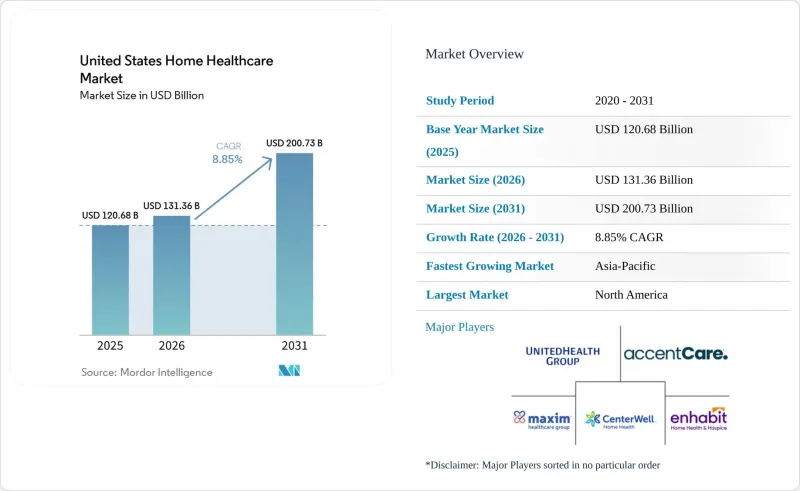
This report is Segmented by Offering (Equipment, Services, Software Platforms), Indication (Cardiovascular Disorders & Hypertension, Diabetes, Respiratory Diseases, Renal Disorders, Cancer, Wound Care, Other Indications), and Payer (Medicaid, Commercial/Private Insurance, Self-pay/Out-of-pocket, Others). The Market Forecasts are Provided in Terms of Value (USD).
United States Home Healthcare Market Trends and Insights
Aging Population and Multi-Morbidity Burden
Older adults remain the core demand base for the United States home healthcare market, which gives the sector a steady flow of recurring need across skilled nursing, monitoring, therapy, infusion, and personal care. This demand profile is stronger than in many consumer-led healthcare categories because utilization is tied less to discretionary spending and more to age, frailty, and coexisting chronic conditions. Multi-morbidity also raises revenue intensity per patient because cardiovascular disease, diabetes, renal disease, and mobility limits often need several services and devices at the same time. That combination makes volume more predictable and makes home-based care more attractive to payers looking for clinically manageable alternatives to facility use. As the older patient pool deepens, providers with broader service breadth are better positioned to capture a larger share of the United States home healthcare market.
Chronic-Care Migration to Lower-Cost Home Settings
The cost gap between institutional and home-based chronic care remains a powerful reason for payers to move more treatment into the home. The Federal Reserve Bank of Richmond reported that a private nursing-home room costs 3.8 times the annual cost of a home health aide at median rates, which keeps the economic case for home-based care clear when patients are clinically stable. The National Home Infusion Association reported that immune globulins were the fastest-growing category in home infusion claims during 2025, which shows that migration is strongest in higher-value specialty therapy rather than in every service line equally. March 2025 bipartisan legislation to preserve patient access to home infusion signaled that reimbursement support for serious home-treated conditions continues to draw policy attention. CareCentrix's expansion of Oncology at Home to include 30 immunotherapy drugs also showed that managed care organizations are actively designing benefit pathways around treatment at home rather than simply responding to it.
Skilled Clinician and Aide Shortages
Workforce availability remains the hardest operating constraint in the United States home healthcare market because service demand can rise faster than agencies can staff visits safely and on time. Homecare Homebase reported that more than 4.2 million patients in 2024 did not receive physician-recommended home health services because of workforce and operational capacity constraints. The same source also highlighted that demand for home health and personal care aides is expected to keep increasing for years, which means access pressure is not likely to ease quickly. Administrative workload further reduces effective staffing capacity, and KFF has shown that prior authorization remains a heavy operational burden across post-acute services in Medicare Advantage. These conditions are especially damaging in rural and high-density urban markets where travel time, wage competition, and paperwork all make it harder to convert referrals into timely starts of care.
Other drivers and restraints analyzed in the detailed report include:
- Telehealth and Remote Monitoring Reimbursement Support
- Hospital-at-Home and Post-Acute-at-Home Adoption
- PDGM-Related Reimbursement Pressure and Rate Uncertainty
For complete list of drivers and restraints, kindly check the Table Of Contents.
Segment Analysis
Services held 52.31% of the United States home healthcare market share in 2025, which kept them clearly ahead of equipment and software in total revenue. That lead reflects the recurring and labor-intensive nature of skilled nursing, therapy, hospice, personal care, and home infusion delivered in the residence. Skilled nursing remains the central service because it supports post-acute transitions, medication oversight, chronic disease management, and repeated patient contact over time. Therapy is also benefiting from the expansion of hospital-at-home and post-acute-at-home programs, which create more patients who leave acute episodes but still need rehabilitation and home follow-up.
Equipment is projected to record the fastest growth in the United States home healthcare market size at a 9.38% CAGR from 2026 to 2031, supported by rising demand for CPAP and BiPAP devices, home dialysis systems, remote multi-parameter monitors, and continuous glucose monitors. Demand is strengthening because payers and providers both have stronger incentives to intervene earlier at home and to generate more real-time patient data outside the hospital. CMS's January 2025 expansion of Medicare coverage for home dialysis in acute kidney injury added a direct reimbursement pathway that supports equipment uptake in renal care. Software remains the smallest offering type, yet it is becoming more strategic as agencies seek better documentation, referral automation, hospitalization-risk prediction, and revenue cycle control within the United States home healthcare industry. WellSky's 2025 and 2026 product releases in AI-enabled intake, medication reconciliation, ambient documentation, and personal care summarization show that digital tools are moving from support functions to operating infrastructure in the United States home healthcare market.
List of Companies Covered in this Report:
- Abbott Laboratories
- AdaptHealth Corp.
- Amedisys (UnitedHealth Group)
- Baxter
- BAYADA Home Health Care
- CareCentrix Inc.
- CenterWell Home Health
- Coloplast
- Drive DeVilbiss Healthcare
- Enhabit Inc.
- Fresenius
- GE HealthCare Technologies Inc.
- Home Instead Inc.
- Homecare Homebase
- Honor Technology
- Koninklijke Philips
- Medtronic
- OMRON Healthcare, Inc.
- Resmed
- Sunrise Medical
- WellSky Corporation
Additional Benefits:
- The market estimate (ME) sheet in Excel format
- 3 months of analyst support
TABLE OF CONTENTS
1 Introduction
- 1.1 Study Assumptions & Market Definition
- 1.2 Scope of the Study
2 Research Methodology
3 Executive Summary
4 Market Landscape
- 4.1 Market Overview
- 4.2 Market Drivers
- 4.2.1 Aging Population and Multi-Morbidity Burden
- 4.2.2 Chronic-Care Migration to Lower-Cost Home Settings
- 4.2.3 Telehealth And Remote Monitoring Reimbursement Support
- 4.2.4 Hospital-At-Home and Post-Acute-At-Home Adoption
- 4.2.5 Home Dialysis Coverage Expansion for AKI Patients
- 4.2.6 Home-Administered Immunotherapy and Specialty Infusion Migration
- 4.3 Market Restraints
- 4.3.1 Skilled Clinician and Aide Shortages
- 4.3.2 PDGM-Related Reimbursement Pressure and Rate Uncertainty
- 4.3.3 Smart-Home IoT Cybersecurity and HIPAA Compliance Burden
- 4.3.4 Fragmented Referral-To-Start-Of-Care Workflows
- 4.4 Value Chain Analysis
- 4.5 Regulatory Landscape
- 4.6 Technological Outlook
- 4.7 Porter's Five Forces
- 4.7.1 Bargaining Power of Buyers
- 4.7.2 Bargaining Power of Suppliers
- 4.7.3 Threat of New Entrants
- 4.7.4 Threat of Substitutes
- 4.7.5 Competitive Rivalry
5 Market Size & Growth Forecasts (Value, USD)
- 5.1 By Offering
- 5.1.1 Equipment
- 5.1.1.1 Therapeutic Equipment
- 5.1.1.1.1 Insulin Delivery Devices
- 5.1.1.1.2 Home IV Pumps & Infusion Equipment
- 5.1.1.1.3 Home Dialysis Equipment
- 5.1.1.1.4 Ventilators & Nebulizers
- 5.1.1.1.5 CPAP & BiPAP Devices
- 5.1.1.1.6 Compression & Wound Therapy Equipment
- 5.1.1.2 Diagnostic & Monitoring Equipment
- 5.1.1.2.1 Blood-Glucose Monitors & CGM
- 5.1.1.2.2 Blood Pressure Monitors
- 5.1.1.2.3 Pulse Oximeters
- 5.1.1.2.4 ECG & Holter Monitors
- 5.1.1.2.5 Digital Thermometers
- 5.1.1.2.6 Multi-parameter Remote Monitoring Devices
- 5.1.1.3 Mobility & Daily Living Assist Equipment
- 5.1.1.3.1 Wheelchairs
- 5.1.1.3.2 Walkers & Rollators
- 5.1.1.3.3 Mobility Scooters
- 5.1.1.3.4 Patient Lifts & Transfer Aids
- 5.1.1.3.5 Home Medical Furniture & Safety Aids
- 5.1.1.1 Therapeutic Equipment
- 5.1.2 Services
- 5.1.2.1 Skilled Nursing
- 5.1.2.2 Physical Therapy
- 5.1.2.3 Occupational Therapy
- 5.1.2.4 Speech Therapy
- 5.1.2.5 Hospice & Palliative Care
- 5.1.2.6 Personal Care / Home Health Aide Services
- 5.1.2.7 Respiratory Therapy
- 5.1.2.8 Home Infusion Services
- 5.1.2.9 Tele-homecare / Virtual Care Coordination
- 5.1.3 Software Platforms
- 5.1.3.1 Agency Management & Scheduling
- 5.1.3.2 Clinical / EHR Platforms
- 5.1.3.3 Remote Patient Monitoring Platforms
- 5.1.3.4 Revenue Cycle & Referral Management
- 5.1.1 Equipment
- 5.2 By Indication
- 5.2.1 Cardiovascular Disorders & Hypertension
- 5.2.2 Diabetes
- 5.2.3 Respiratory Diseases
- 5.2.4 Renal Disorders
- 5.2.5 Cancer
- 5.2.6 Wound Care
- 5.2.7 Other Indications
- 5.3 By Payer
- 5.3.1 Medicare
- 5.3.2 Medicaid
- 5.3.3 Commercial / Private Insurance
- 5.3.4 Self-pay / Out-of-pocket
- 5.3.5 Others
6 Competitive Landscape
- 6.1 Market Concentration
- 6.2 Market Share Analysis
- 6.3 Company Profiles (includes Global level Overview, Market level overview, Core Segments, Financials as available, Strategic Information, Market Rank/Share for key companies, Products & Services, and Recent Developments)
- 6.3.1 Abbott Laboratories
- 6.3.2 AdaptHealth Corp.
- 6.3.3 Amedisys (UnitedHealth Group)
- 6.3.4 Baxter International Inc.
- 6.3.5 BAYADA Home Health Care
- 6.3.6 CareCentrix Inc.
- 6.3.7 CenterWell Home Health
- 6.3.8 Coloplast A/S
- 6.3.9 Drive DeVilbiss Healthcare
- 6.3.10 Enhabit Inc.
- 6.3.11 Fresenius Medical Care AG & Co. KGaA
- 6.3.12 GE HealthCare Technologies Inc.
- 6.3.13 Home Instead Inc.
- 6.3.14 Homecare Homebase
- 6.3.15 Honor Technology Inc.
- 6.3.16 Koninklijke Philips N.V.
- 6.3.17 Medtronic plc
- 6.3.18 OMRON Healthcare, Inc.
- 6.3.19 ResMed Inc.
- 6.3.20 Sunrise Medical LLC
- 6.3.21 WellSky Corporation
7 Market Opportunities & Future Outlook
- 7.1 White-space & Unmet-need Assessment

